By The Straits Times | Created at 2026-09-26 21:01:45 | Updated at 2026-09-26 22:10:03
1 hour ago
By The Straits Times | Created at 2026-09-26 21:01:45 | Updated at 2026-09-26 22:10:03
1 hour ago
TANJUNG MALIM, KUALA SELANGOR, KUALA TERENGGANU – At the foothills of the Titiwangsa range’s western face sits an unassuming patch of farmland. But behind one set of gates in Tanjung Malim, close to Perak’s border with Selangor, lies a series of ponds, pools and small buildings that appear more like a science lab than a farm.
Since 2016, that farm has been producing one of the world’s most expensive foods: caviar. If you’re thinking that sturgeons are not suited for Malaysia’s tropical climate, you would be right.
Neither are wagyu cattle or Japanese musk melons. Importing and storing such luxury foods in Malaysia’s warm, humid climate can be costly.
But enterprising Malaysians are finding ways to produce premium versions at home, as demand grows among the country’s expanding affluent class. This appetite for luxury is reflected in the local culinary scene, where Malaysia now boasts nine Michelin-starred restaurants – more than double the four that greeted the prestigious guide’s arrival three years ago.
Statistics from Trade Data Monitor, a global commerce tracker, show that beef and buffalo meat imports into Malaysia, where chicken and eggs are the staple protein, rose to 200,000 tonnes in 2024 from 140,000 tonnes a decade earlier.
Darren Teoh, founder and chef-patron of two Michelin-starred Dewakan, believes there is a market for locally produced premium foods, drawing a parallel with Malaysia’s decision to develop a local car industry.
“These luxury foods are still niche markets, but one of the plus sides is that for things like beef especially, there will be more trust in local halal certification, which could tap into more potential demand.”
How do these homegrown products compare with their imported counterparts? The Straits Times’ correspondents go coast to coast to find out.
T’lur: tropical caviar
In a serene 1.3-hectare plot in Tanjung Malim, half a million sturgeon have perished since 2008 in a farm’s bid to rear the cold-water fish in Malaysia’s tropical climate.
A decade on, the experiment finally bore fruit. The farm had fine-tuned an adaptation process in which the fish are gradually introduced to warmer water as they mature, until they can tolerate spring water that can reach 30 deg C in hot weather. Sturgeons are ancient fish whose lineage dates back hundreds of millions of years, but most species are associated with cooler waters.
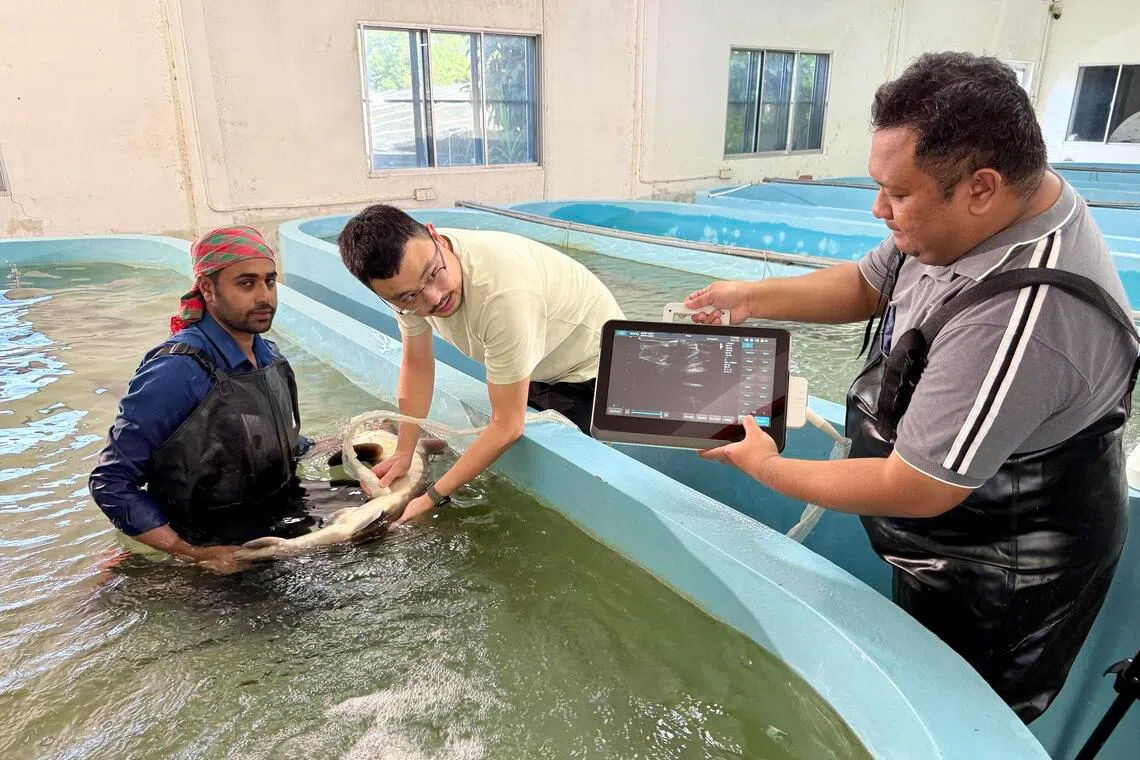
T’lur Caviar staff scanning a sturgeon on July 8, to see if it has begun producing roe.
ST PHOTO: SHANNON TEOH
Then came another surprise. In 2016, the founders of T’lur Caviar – a play on the Malay word for “egg” – found roe in one of their fish.
The caviar is still harvested by hand in a sterilised environment, with everyone from the owners and marketing team to scientists and farm managers involved in protecting the fragile harvest. The company now fulfils orders of 40kg to 80kg a month, triple the volume it sold in 2019.
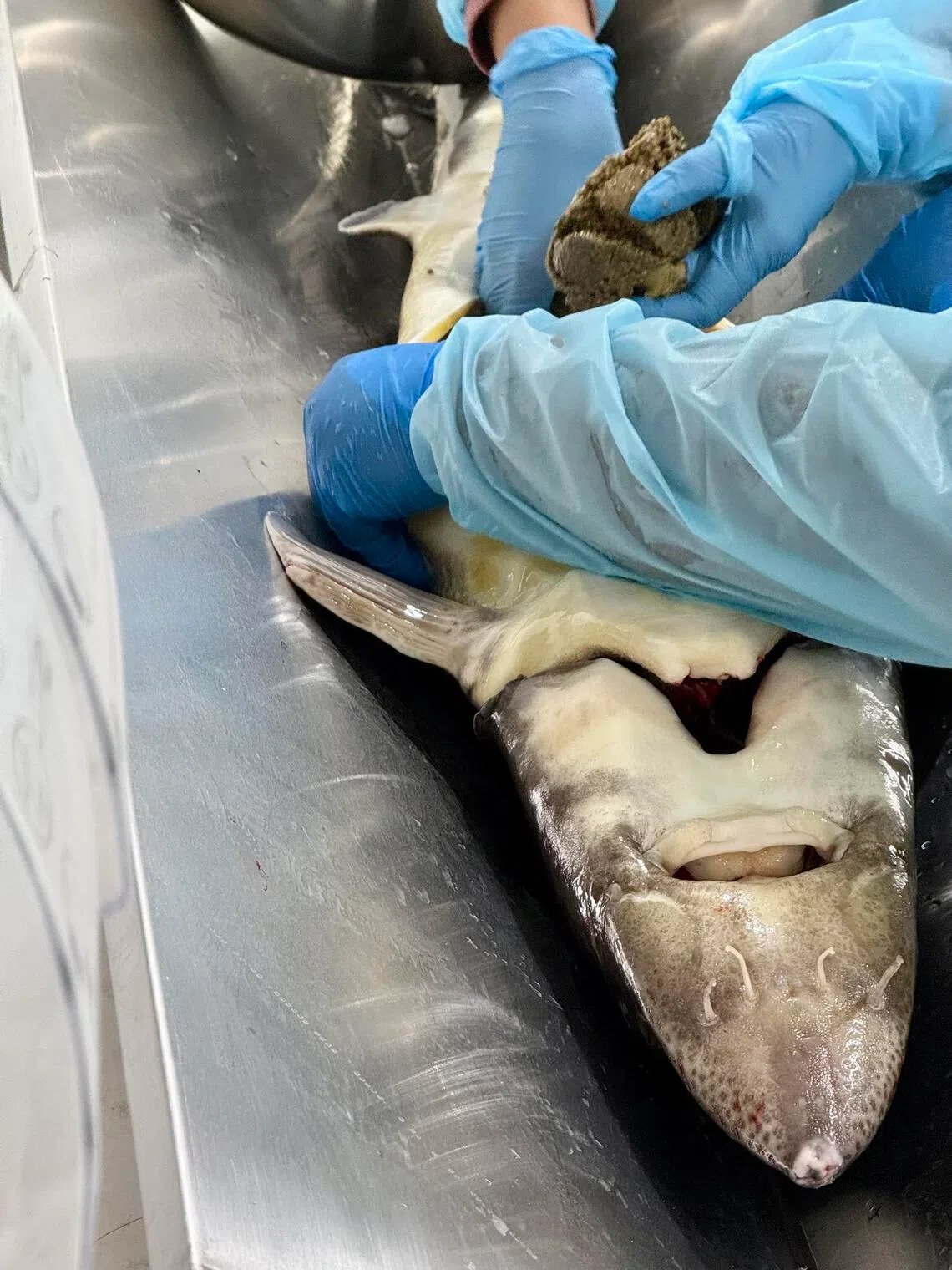
Sturgeon roe being extracted at T’lur Caviar’s farm.
ST PHOTO: SHANNON TEOH
Its caviar varieties retail around RM1,000 (S$313) per 100g, with discounts for customers on monthly subscriptions.
At that price, T’lur sits within the price spectrum of imported caviar, which typically runs from RM980 to over RM3,000 per 100g for connoisseur grades. However, for caviar aficionados, price is not necessarily the main draw.
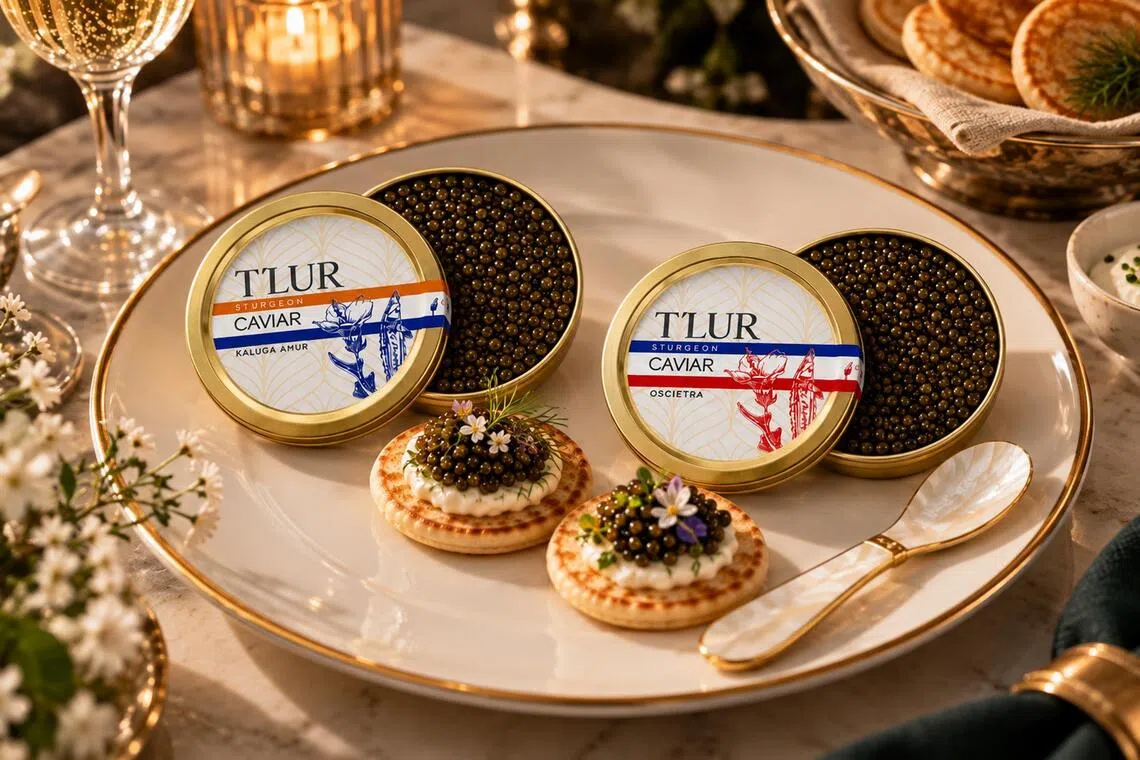
T'lur Caviar produces roe from different species of sturgeon that have adapted to Malaysia's tropical climate.
PHOTO: T’LUR CAVIAR
“Most businesses here are not equipped to store caviar. When they receive stock from foreign suppliers, the seller’s responsibility ends there, and if something is wrong, there is no refund. We use clinical chillers, and you just tell us when you want it and we send it on-demand fresh from Kuala Lumpur,” marketing chief Shaun Simon told ST.
“For us, restaurateurs are our partners and we develop the product together – different flavour profiles, ageing, the kind of salt we use. With imported caviar, it’s take it or leave it.”
MyGyu: Malaysian-bred wagyu
At Colla Cattle Farm in rural Kuala Selangor, former accountant-turned-farmer Jamal Abdul Karim has spent five years trying to develop a premium Malaysian beef using wagyu genetics.
Known for the heavy fat marbling in its meat, wagyu has a distinctive melt-in-the-mouth texture that sets it apart from other types of beef. Raising wagyu cattle in Malaysia is not as simple as importing them from Japan. Japan halted exports of wagyu genetic material and live cattle in the 1990s.
“I like challenges, and doing things that are impossible,” Jamal told ST during a visit to the farm in Selangor.
Jamal instead turned to artificial insemination, breeding Angus cows with semen from wagyu bulls in Australia descended from bloodlines exported from Japan before exports were halted.
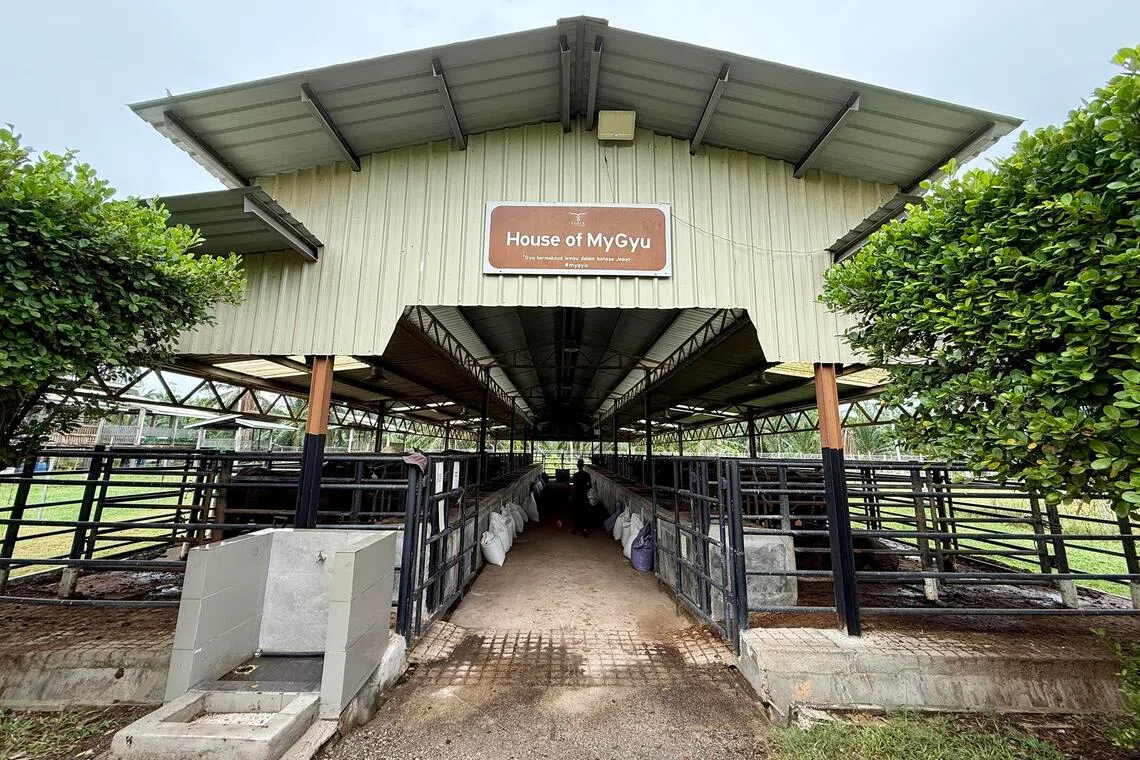
The House of MyGyu at Colla Cattle Farm, where the farm’s Malaysian wagyu cattle are kept.
ST PHOTO: HADI AZMI
From 2019 to 2024, after three generations of crossbreeding, Colla Cattle Farm produced what it calls F3 MyGyu cattle, with 87.5 per cent wagyu genetics.
“Wagyu means Japanese cow, so we called ours MyGyu for Malaysia,” Jamal said.
The resulting meat, he said, scores between M7 and M9 on the Australian marbling scale – a prime grade reserved for highly marbled, buttery beef.
This high fat density produces the rich flavour and melt-in-the-mouth texture expected of wagyu. While MyGyu is below that of top-grade Japanese wagyu, Jamal said its flavour profile is better suited to the Malaysian palate, which tends to favour a meatier taste and firmer bite.
The local adaptation also makes financial sense for consumers. While imported wagyu can fetch around RM210 per 100g at local retail outlets depending on the grade, Jamal’s MyGyu retails for about half that price – putting the luxury experience within reach of a broader market.
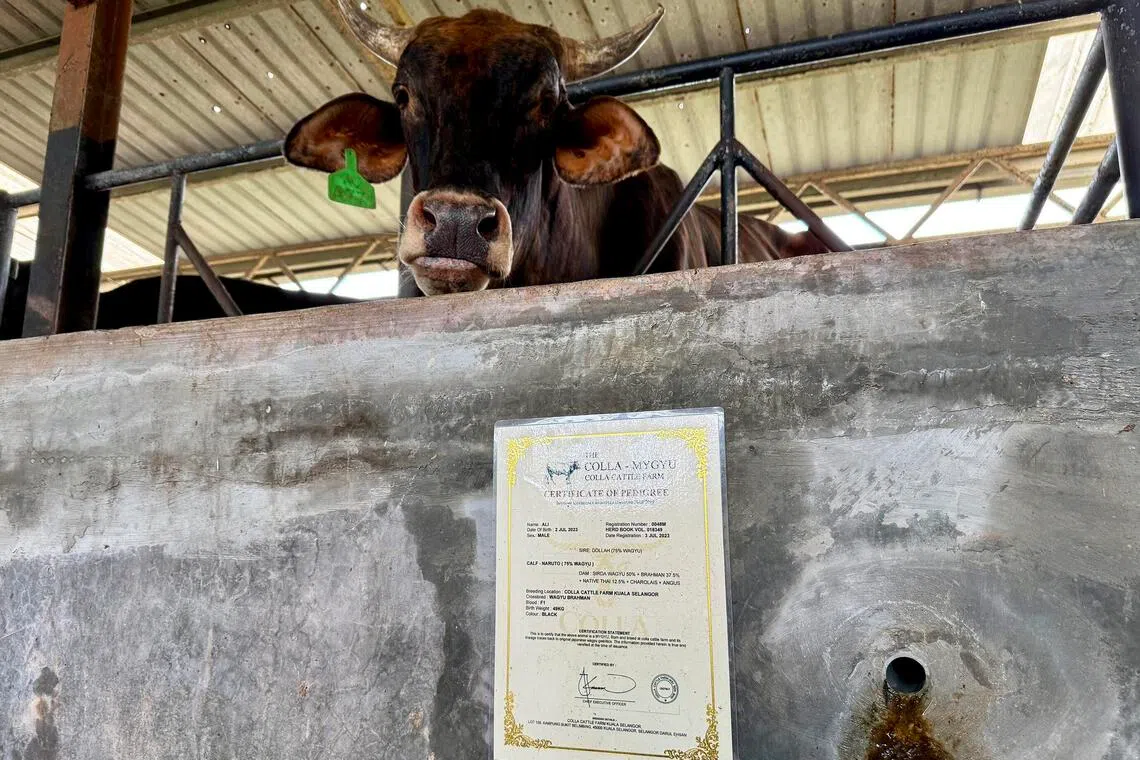
Ali, a MyGyu cow with 75 per cent wagyu genetics, with its pedigree certificate at Colla Cattle Farm.
ST PHOTO: HADI AZMI
The farm now has eight bulls and 40 MyGyu cattle in its herd. An 800kg animal yields about 400kg of meat, of which only around 150kg can be considered prime cuts.
“The rest we sell as meat skewers at RM50 per stick, at around 80g per stick. It is very popular with the public,” he said.
The prime cuts, meanwhile, are finding a growing market among high-end restaurants in Kuala Lumpur and Penang, as well as hotels.
Chef Syamil Azizi of Good Eats Kitchen in Penang favours locally produced wagyu, saying it not only lowers operating costs but also allows restaurants to meet customers’ demand for higher-quality meat.
“Locally produced wagyu would not be as well marbled as the high-end Japanese varieties, but the ball is in our court in terms of how well we cook and present it to customers,” Syamil told ST.
Jamal said his farm will focus on expanding its breeding programme this year. “Demand is higher than what we can supply – we restock as often as we can.”
Murai: Terengganu’s premium melon
Meanwhile, in Marang, Terengganu, a husband-and-wife team’s Covid-era farming venture in the east coast state is turning the state’s sweet melon from a locally consumed fruit into a premium product sold in some of Kuala Lumpur’s supermarkets.
“We had zero farming knowledge,” said Raja Nordiana Zainal Shah, who spent 15 years at Malaysia Airlines, where she led the airline’s loyalty programme.
Murai Estates was started in 2022 by Raja Nordiana and her husband, James Alexander, a former Walt Disney executive, after both left corporate careers to go into farming. The couple’s 12ha farm employs 12 people.
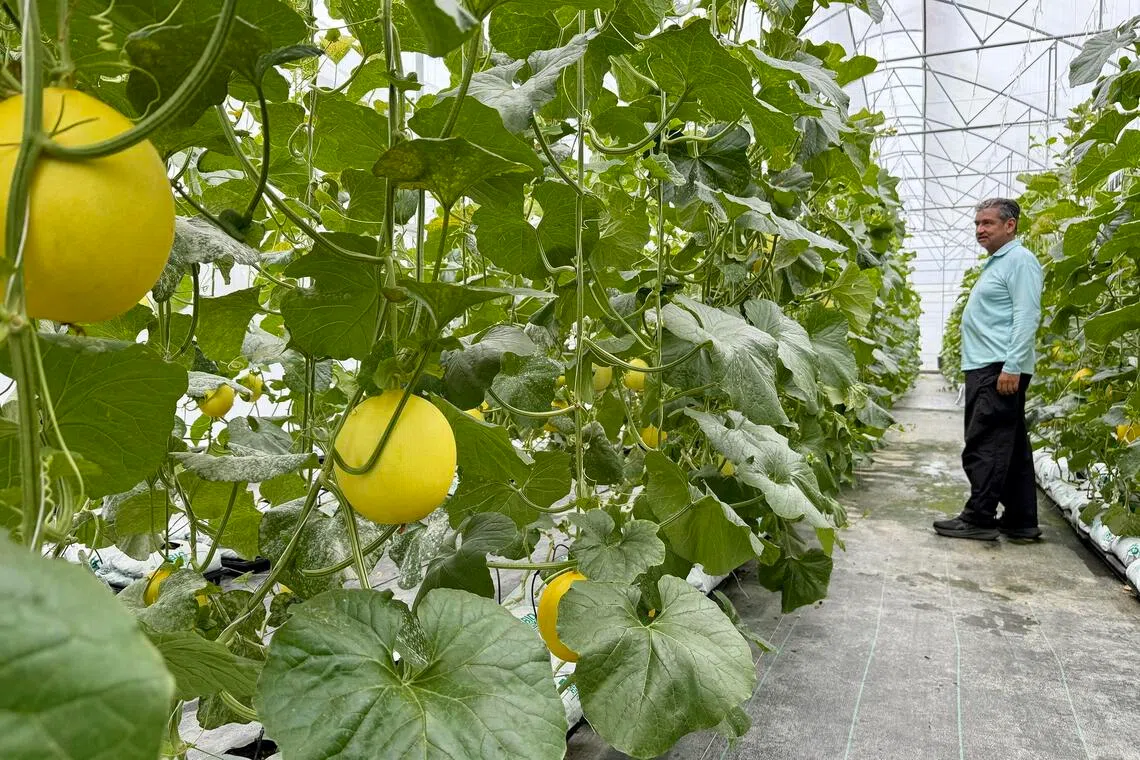
Murai Estates' James Alexander examining Terengganu melons growing inside a greenhouse in March.
ST PHOTO: HADI AZMI
Unlike the more familiar Japanese musk melon, known for its soft, silky and almost melting texture, Terengganu’s salmon-orange sweet melon is crisp and crunchy, almost like a pear, and can even be sweeter.
This is not an attempt to replicate Japanese musk melon. The fruit is distinctive to Terengganu.
“It can only be grown in Terengganu,” said Raja Nordiana. Her statement reflects the strict legal protections surrounding the fruit, which holds an official geographical indication registration with the Intellectual Property Corporation of Malaysia (MyIPO). Under state regulations, seed distribution is tightly controlled to ensure cultivation remains exclusive to local growers.
The farm produces more than 30 tonnes of melons every 65 days from around 8,000 plants grown across four greenhouses. A Murai melon goes for RM21 per kg at local grocers and supermarkets, compared with the Japanese import that sells for RM300 or more per kg.
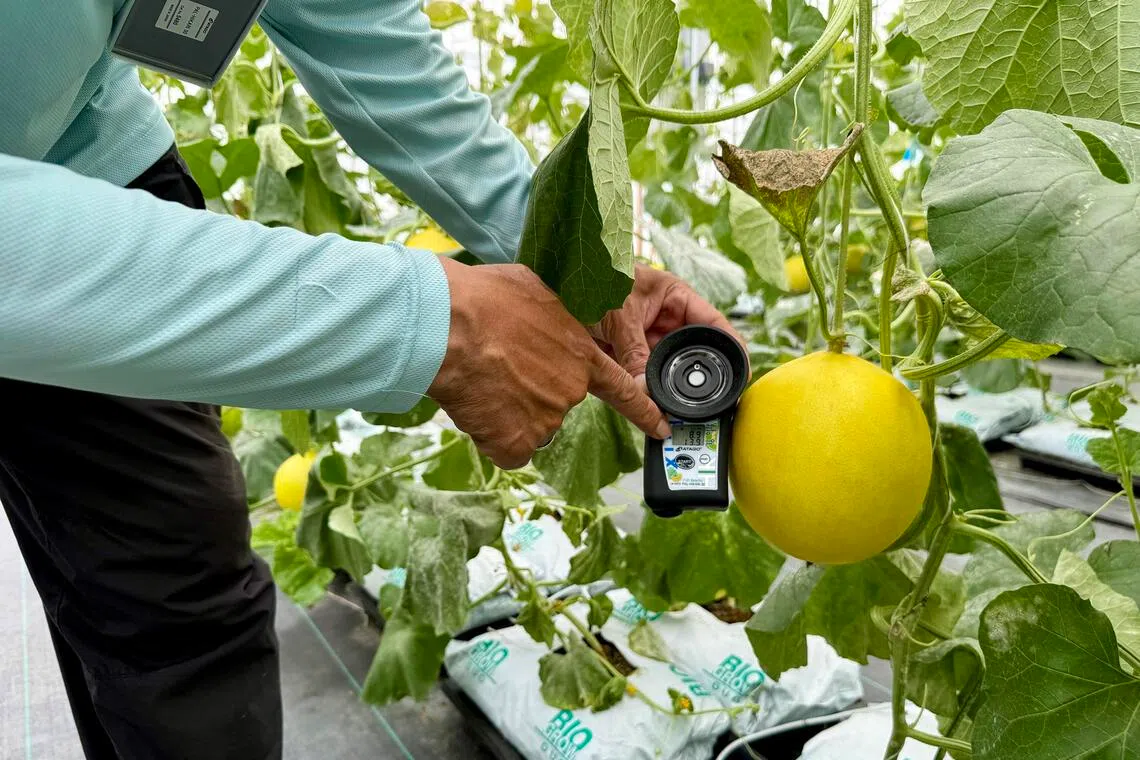
Murai Estates' James Alexander demonstrating a device used to measure the sweetness of Terengganu melons.
ST PHOTO: HADI AZMI
Malaysia’s luxury-food experiment has largely been defined by premium taste, from sturgeon ponds to cattle sheds. Now, technology is entering the mix.
Alexander, a self-described technophile, said he compensated for his lack of farming experience by using AI to learn the intricacies of cultivation.
“Everyone else is doing traditional farming, but we cultivated it using an international approach,” said Alexander, who has incorporated agricultural technology from his native Netherlands into the farm.
“The Internet of Things, IoT, that is how our melons are grown.”
Sign up for our weekly Asian Insider Malaysia Edition newsletter to make sense of the big stories in Malaysia