By The Straits Times | Created at 2026-06-24 07:46:50 | Updated at 2026-06-24 08:35:50
50 minutes ago
By The Straits Times | Created at 2026-06-24 07:46:50 | Updated at 2026-06-24 08:35:50
50 minutes ago
TOKYO – During their two-week tour of the Netherlands and Belgium that will end on June 26, Japan’s Emperor Naruhito and Empress Masako have met the heirs-apparent to the two European thrones.
Both are women. Dutch Crown Princess Catharina-Amalia, 22, and Belgian Crown Princess Elisabeth, 24, are both poised to succeed their fathers, the result of decades-old reforms allowing the eldest child to inherit the throne regardless of gender.
Back home, however, a starkly different reality awaits their 24-year-old only daughter, Princess Aiko. The highly popular princess, who regularly draws big crowds and loud cheers during her public engagements and who is reportedly scheduled to visit Singapore later in 2026, is legally barred from ever ascending the Chrysanthemum Throne.
Nor will an upcoming revision to the 1947 Imperial House Law open a path for her.
The plan, set to be approved by Prime Minister Sanae Takaichi’s Cabinet on June 26 and passed before Parliament adjourns on July 17, completely bypasses the issue in seeking a fragile political consensus to ensure the monarchy’s numbers do not shrink further, such is the family’s vital role in fostering international goodwill and domestic unity.
“The historical fact that the imperial line has been passed down through the male line for 126 generations is unparalleled in the world and is the source of the Emperor’s authority and legitimacy,” Takaichi said at the ruling Liberal Democratic Party convention on April 12.
Yet the debate has become so politically-charged that Naruhito, 66, broke from the apolitical nature of his role to implicitly weigh in: “The fundamental nature and activities of the Imperial Family lie in constantly wishing for people’s happiness and sharing in their joys and sorrows.
“I hope that discussions on how to secure the number of imperial family members will gain the understanding of the people.”
Japan boasts the world’s oldest continuous hereditary monarchy, tracing mythical origins back to 660 BC. Historically, the patrilineal line was sustained through concubinage and polygamy, practices that were once socially acceptable but legally abolished during the Meiji Period (1868-1912).
The imperial family shrank further after World War II when 51 distant relatives from 11 collateral branches were stripped of their royal status, primarily as a cost-cutting measure.
Today, the family has dwindled to just 16 members, with five unmarried princesses and only three eligible male heirs: the Emperor’s younger brother Crown Prince Akishino, 60; his nephew Prince Hisahito, who turns 20 in September; and his uncle Prince Hitachi, 90.
The current proposal has two key prongs. First, royals will be able to retain their status after marriage. Currently, female royals are stripped of their status upon marrying commoners. Under the new law, they will have the choice to retain their royal titles and continue their official duties after marriage.
Second, unmarried male descendants from the 11 ejected branches, aged 15 and above, can choose to be adopted into the imperial family.
Yet this political compromise leaves glaring questions unanswered.
It creates a messy legal paradox for families as it leaves undetermined whether the princesses’ spouses and children are to be regarded as royals. Conservatives fear that doing so will pave the way for a matrilineal line, while critics argue that forcing a single household to split into royal and non-royal statuses is socially untenable.
It also remains highly questionable whether the 10 or so prospective male adoptees, who were born and raised as ordinary citizens and reportedly work in industries like advertising and manufacturing, would even want to trade their freedoms for a cloistered, regimented palace life.
Under the proposed law, they would be barred from ever leaving the imperial family after adoption. While they themselves cannot ascend the throne, the law leaves a murky question mark over whether their future children could.
Hideya Kawanishi, an imperial historian at Nagoya University, told The Straits Times that the move is unprecedented and exposes the deep-rooted patriarchal thinking that is pervasive even under Japan’s first female prime minister.
“For potential adoptees, given the intense public scrutiny, the prospect of joining the imperial family is daunting. It seems unlikely that anyone will easily step forward,” he said. “My concern is that someone might end up being forced into the role against their will.”
The government defends its male-only stance by arguing that while eight women have occupied the Chrysanthemum Throne – six during the Asuka and Nara Periods (592-794) and two during the Edo Period (1603-1868) – they served as brief interim placeholders. All belonged to the patrilineal line, and none passed the throne to their own children.
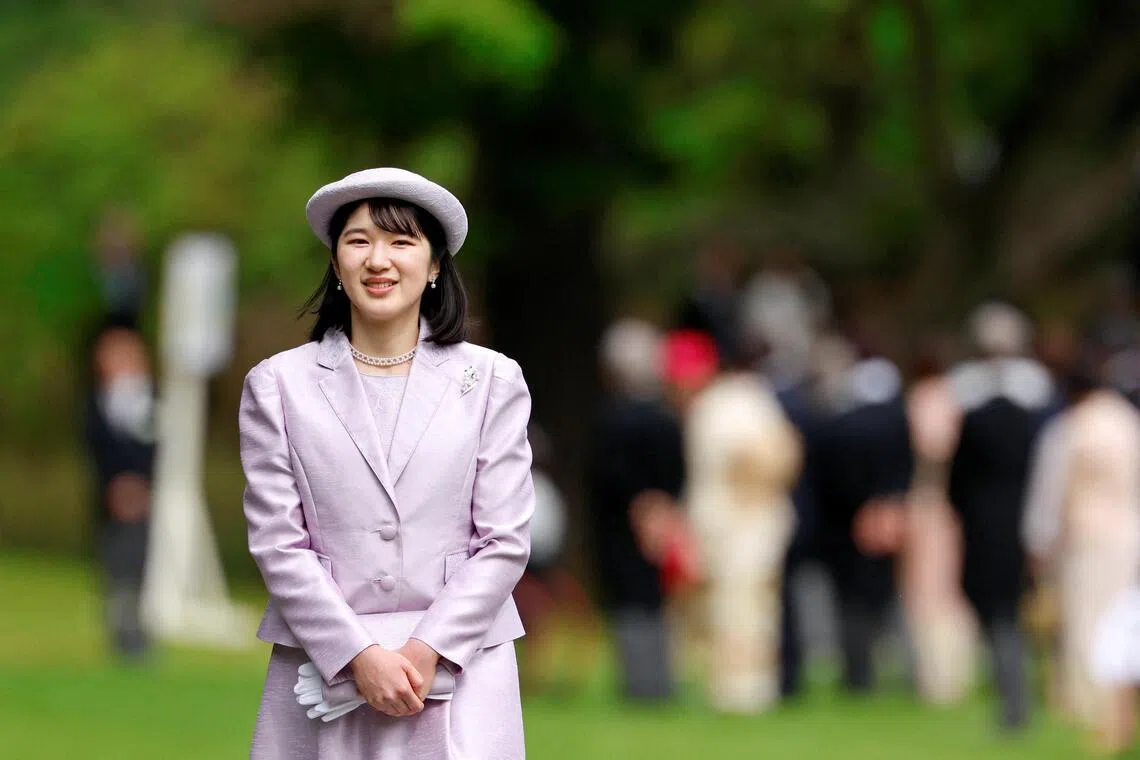
Princess Aiko attending the Spring Imperial Garden Party at the Akasaka Imperial Gardens in Tokyo on April 17.
PHOTO: REUTERS
The new proposal not only shelves the prospect of a matrilineal emperor, but also bars Aiko from ever taking the throne.
This is a sharp pivot from 2005, when a four-decade drought of male births in the imperial family brought the LDP to the brink of legalising female or matrilineal succession. But the momentum evaporated overnight when Hisahito was born a year later.
Public sentiment is starkly divided particularly on the adoption plan, polls on June 20-21 found.
While a sweeping majority backs letting princesses keep their status after marriage, the Mainichi newspaper found 28 per cent in favour and 32 per cent against the adoption plan, while the Asahi newspaper found 45 per cent in favour and 36 per cent against.
Kawanishi sees Takaichi’s government as again kicking the can down the road, fearing that the rigid insistence on an exclusively male line could ironically drive the ancient institution to extinction.
“The Imperial Family has always evolved alongside society, and this evolution is, in itself, its tradition. It has evolved to embrace monogamy and romantic marriages,” he said.
“Therefore, I believe Japan should also adapt to the realities of modern society regarding the possibility of a female Emperor. This will preserve the Emperor’s status as a figure who inspires the people’s admiration and, only then, can the institution’s sanctity be upheld.”