By The Straits Times | Created at 2026-09-22 09:36:45 | Updated at 2026-09-22 10:20:00
50 minutes ago
By The Straits Times | Created at 2026-09-22 09:36:45 | Updated at 2026-09-22 10:20:00
50 minutes ago
SINGAPORE - From frying dumplings to fuelling aircraft, China’s ambition to feed the soaring demand for greener aviation fuel starts at the restaurant backdoor.
Each year, millions of tonnes of discarded cooking oil and grease are gathered from eateries and food manufacturers across the country, trucked to collection depots, and sold to treatment plants and refineries as an increasingly prized commodity.
While this waste once fed the infamous trade in illegal “gutter oil” – where waste oil from sewer drains and grease traps are filtered and sold for reuse – it is now being turned into high-flying fuel powering flights that are said to be better for the environment.
However, as China ramps up production of sustainable aviation fuel (SAF), scrutiny over its climate credentials has shone a spotlight on a fragmented supply chain vulnerable to fraud.
To tackle this, Chinese aviation regulators are proposing new national standards to track used cooking oil from kitchen to refinery using digital tools like satellite tracking and tamper-proof logs.
China’s move is expected to benefit major aviation hubs like Singapore that are ramping up the use of SAF, experts told The Straits Times, though it could also position Beijing as a direct competitor to Singapore’s own refining hub.
SAF, which is largely made from waste oil today, is seen by the aviation sector as the most viable way to meet an industry commitment to reach net-zero emissions by 2050. This is because SAF replaces the use of fossil fuels and can be used without modifying existing aircraft or infrastructure.
As China seeks to reduce the carbon emissions generated by the transport sector and meet its climate goals, some experts say the proposed standards could even pave the way for China to introduce its own green jet fuel mandates.
“Without credible, standardised data at the source, it would be very difficult to enforce carbon accounting or traceability down the line,” said a China-based energy policy researcher, who asked not to be named.
“It suggests the authorities are serious about building the infrastructure, both technical and administrative, that will support future SAF scale-up,” he added.
Ramping up
China is, today, the world’s biggest source of used cooking oil (UCO), which can be used to make SAF and other renewable fuels like biodiesel.
In 2025, the country exported 2.8 million tonnes of the waste material, with the United States, Netherlands, Italy, Canada, Singapore and Malaysia among the biggest buyers. These are also where some of the world’s major SAF refineries are housed.
But lately, China has begun to retain a bigger portion of its UCO supply for its own needs, as it scales up domestic production and use of renewable fuels.
SAF, which purportedly has up to 80 per cent less planet-heating emissions, is of especially high value due to its limited supply, making it three to five times more expensive than regular jet fuel.
Since 2022, China has aggressively expanded domestic SAF production, with six refineries operating today that have a combined annual production capacity of about two million tonnes – twice that of the largest SAF facility here in Singapore.
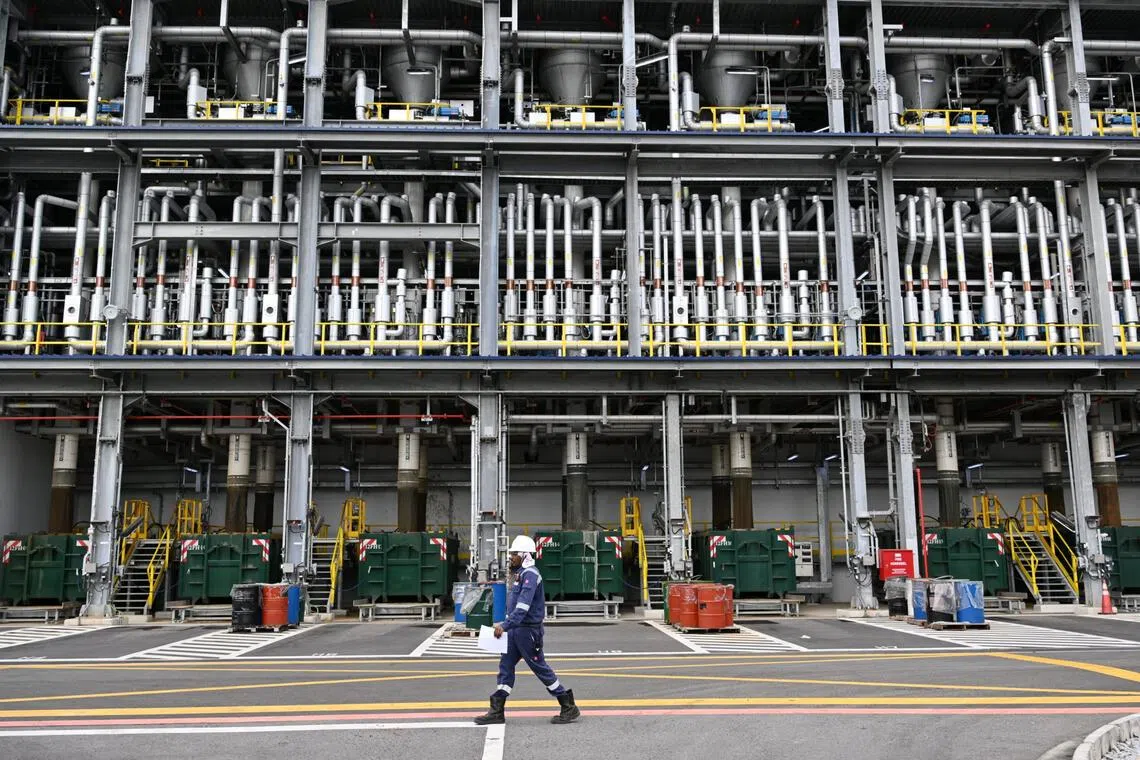
The largest SAF facility in Singapore, Finnish energy giant Neste, can produce up to 1 million tonnes of sustainable aviation fuel annually.
ST PHOTO: CHONG JUN LIANG
China’s capacity is expected to grow further, reaching four million tonnes per year by 2030.
On the demand side, China is also scaling up SAF use, launching a national pilot programme in 2024 that was later expanded to include all domestic flights out of four airports.
This rapid growth prompted the Civil Aviation Administration of China (CAAC) to draft new UCO measurement standards, which were published on Sept 7 for public review.
In an accompanying note, the CAAC pointed to the lack of unified rules as an issue, citing a visit it conducted to Hangzhou in 2025, which uncovered irregularities such as improper sorting and the illicit resale of waste oil through unauthorised channels.
“This lack of standards leaves room for raw material adulteration and unclear origins, threatening the industry’s credibility and hindering the large-scale growth of China’s SAF sector,” the regulator said.
Under the new framework envisioned by the CAAC, every batch of UCO collected will be tracked. Kitchens will be required to provide identification details and maintain a daily log of the waste oil generated. Collection crews must submit time-stamped photographs to prevent falsification.
Meanwhile, tanker trucks transporting UCO will be monitored in real time using satellite tracking and cameras to prevent illegal dumping or tampering on the road. At the refinery, deliveries must be cross-checked against collection records, which are uploaded to a central system where logs are kept for at least three years for auditing purposes.
Building confidence
Lauren Moffitt, Asia biofuels editor at commodity tracking agency Argus Media, said these proposed standards appear aimed at building confidence across the UCO supply chain.
“A single SAF producer may ultimately rely on feedstock collected from thousands of restaurants, catering facilities and food manufacturers through multiple layers of collectors, aggregators and traders.
“Ensuring traceability across such a dispersed network is challenging, particularly once material from many different sources has been combined in storage tanks and logistics networks,” she told ST.
The CAAC may also be addressing risks tied to the rising value of UCO, which has nearly doubled to US$1,165 (S$1,487) per tonne compared with 2018, Moffitt added.
“As feedstocks become more valuable, regulators and certification systems typically place greater emphasis on traceability and verification to reduce the risk of misreporting,” she said.
While there is no evidence of widespread UCO supply chain fraud in China, groups such as Brussels-based Transport & Environment (T&E) have raised concerns about falsified data and mislabelled virgin oils, including palm oil, within Asian supply chains, as this drives deforestation and undermines accurate carbon accounting.
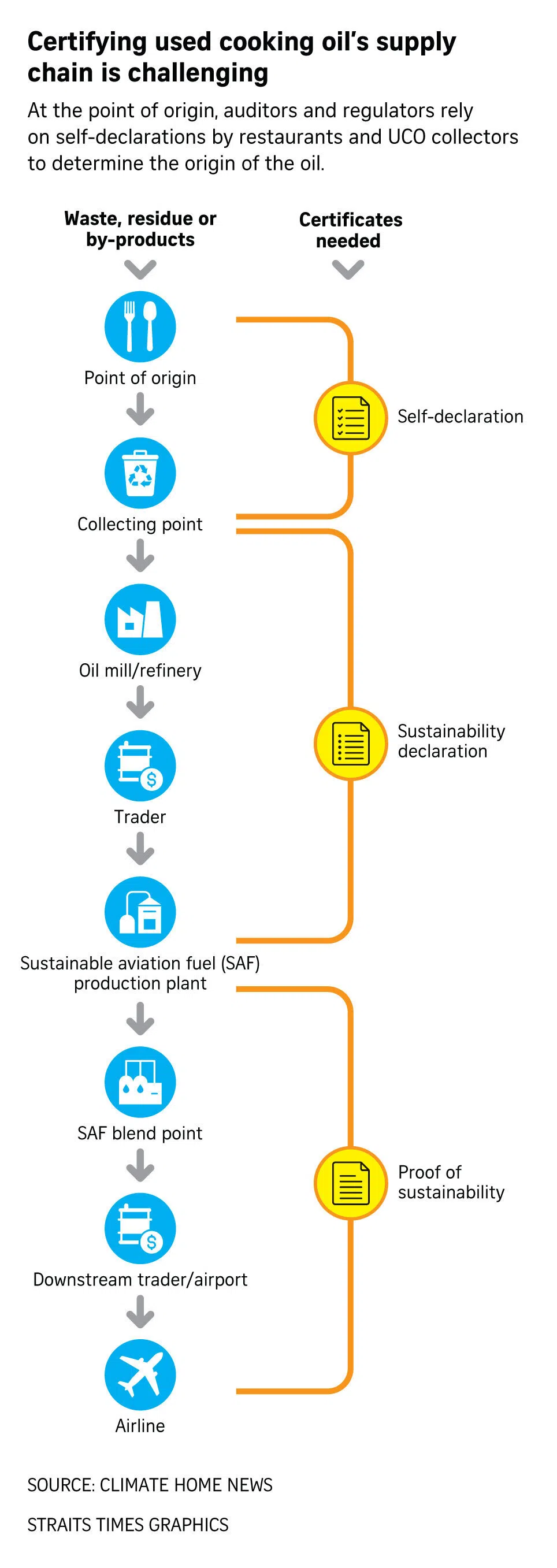
That is because the current certification framework for UCO relies primarily on paperwork and self-declarations rather than physical testing and tracking, said T&E biofuels policy manager Cian Delaney.
A 2024 T&E analysis, for instance, showed that the sampling of points of origin for waste oil occurred in less than 10 per cent of approved audits in China, compared with about 30 per cent in the European Union.
“It is within this paper trail that there is a significant opportunity to commit fraud,” Delaney added.
The heightened scrutiny over opaque UCO supply chains has led to more exacting standards in the SAF industry, especially among those racing to meet looming emission reduction targets and shed accusations of greenwashing.
For Hong Kong-based SAF producer EcoCeres, the proposed CAAC specifications are a constructive and potentially important step in the development of China’s SAF ecosystem, said the refiner’s chief executive Matti Lievonen.
“International SAF markets increasingly require robust evidence of feedstock origin, chain-of-custody, sustainability characteristics and lifecycle greenhouse gas performance,” Lievonen told ST.
“Greater consistency in China’s upstream data and measurement practices can therefore support confidence in SAF produced from eligible Chinese waste-based feedstocks,” he said.
The proposed CAAC standards could have other knock-on effects, too, experts said.
For one, smaller and informal “gutter oil” collectors in China may face greater difficulties with compliance as they may need to invest in new equipment, digital systems and trained staff, said Shane Zhang, professor of aviation at Adelaide University in Australia.
“Some may join larger collection networks or withdraw from SAF-oriented supply chains. The standards are therefore likely to encourage professionalisation and some industry consolidation,” Zhang told ST.
Neither he nor Moffitt foresee this impacting the competitiveness of China’s SAF exports, with economies of scale cited as one factor offsetting potentially higher compliance costs.
Zhang, however, noted that the standards CAAC proposes will still need to align with international rules.
He said: “Recognition under international frameworks, including ICAO’s CORSIA (International Civil Aviation’s Carbon Offsetting and Reduction Scheme for International Aviation) and relevant European Union schemes, would make Chinese SAF more attractive to buyers in Singapore and other international markets.”