By Literary Hub | Created at 2026-09-25 11:44:08 | Updated at 2026-09-25 14:32:08
5 hours ago
By Literary Hub | Created at 2026-09-25 11:44:08 | Updated at 2026-09-25 14:32:08
5 hours ago
Amy Fusselman Recommends Her Favorite Unconventional Writing Practice
This first appeared in Lit Hub’s Craft of Writing newsletter—sign up here.
Article continues after advertisement
I love art that seems like it came from outer space, that seems unrelated to anything else in the Zeitgeist, that makes me wonder how the artist ever came up with it and put it together.
When I am confronted by a work like this—and I love it if it feels like a confrontation—I sometimes think of the French otolaryngologist Dr. Alfred Tomaitis and his theory that the voice can’t produce what the ear can’t hear.
Tomatis’s idea illustrates how difficult it is for any artist to create something new. As a human maker, I sometimes feel as if I am locked in a closed system, only capable of making work that exists within the range of what I’ve already been exposed to.
As a writer, I am always trying to find what I think of as dead zones—places where I unknowingly hold unexamined ideas. Locating these isn’t easy, but one thing I have found helpful is studying another medium. For me, this has been theater.
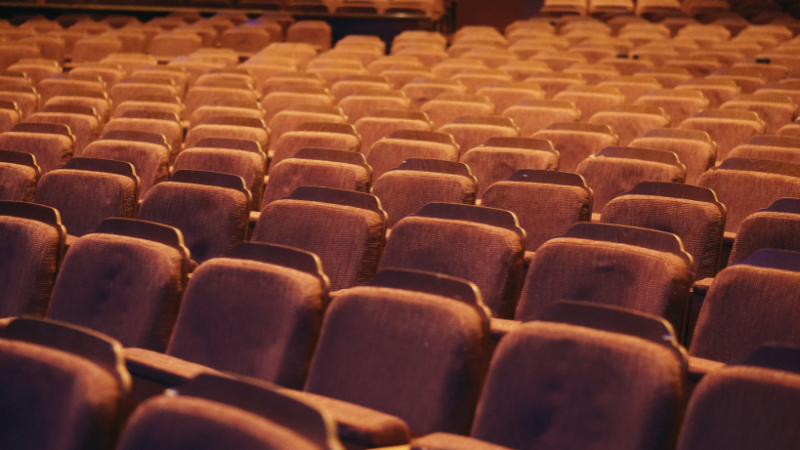
At first I went to the theater simply because I’m a fan. But now I consider regular theatergoing an important part of my writing practice. For one thing, it’s convenient. While it may take me days or weeks to finish a book, I can sit down in my theater seat and witness someone else’s fully realized ideas about plot, character, dialogue, setting, etc., in under three hours.
It helps that I like the structure of theatergoing—I like sitting in the dark, in a room full of humans watching other humans. If I’m not engaged with what is happening onstage, I even like watching the audience. As the adage goes, an audience does not lie. It can be useful, as a maker of narrative, to observe real-time reactions to a story as it unfolds.
What helps my theater study most, though, is just staying open and curious. I’m not trying to become a theater expert; I want to remain a student. Merely recognizing that this is my goal helps me bring this same attitude back to my reading, where I am more apt to be cranky and impatient.
I believe that my theatergoing also helps me ask myself more interesting questions. Is a novel a performance? (I think so). What kind? (I haven’t figured that out yet). But merely contemplating these issues aided me, I believe, in being more fearless when doing the world building for my new novel, Cloud Six.
Theatergoing helps me think laterally. When I am inspired by something I see onstage, I find myself stretching to think how that thing can be remade with language. And when something in a production moves me, it helps expand my understanding of what my own work can do. In those moments, I feel genuinely rewarded, like I can almost detect a sound out of my hearing range.
I may have strong preferences about what I read, but when it comes to seeing a performance, I will go to pretty much anything. My theatergoing this year has run the gamut from avant garde shows that left me gob smacked (Victory Over the Sun by Nature Theater of Oklahoma and Tanz by Florentina Holzinger) to a comedy about race I adored (Race: The Movie: The Play by Bret Raybould & Cristian Duran) to a one-person clown show that charmed me (The Passion of Mr. Cardboard by Miles Calderon).
Of course, my theatergoing commitment probably wouldn’t work so well if I weren’t so fortunately situated. I live in New York City on a block that is home, remarkably, to three off-off Broadway theaters (as well a Parisian Tea Room and a falafel car parking lot that doubles as a mosque, but that’s another story).
If you live somewhere without a robust theater scene, no problem. The point is simply to study something you love that isn’t writing.
Besides, on some level, everything is theater. Everything except writing, that is.
____________________________________

Cloud Six by Amy Fusselman is available via Catapult.