By The Straits Times | Created at 2026-09-08 18:06:22 | Updated at 2026-09-08 19:10:18
1 hour ago
By The Straits Times | Created at 2026-09-08 18:06:22 | Updated at 2026-09-08 19:10:18
1 hour ago
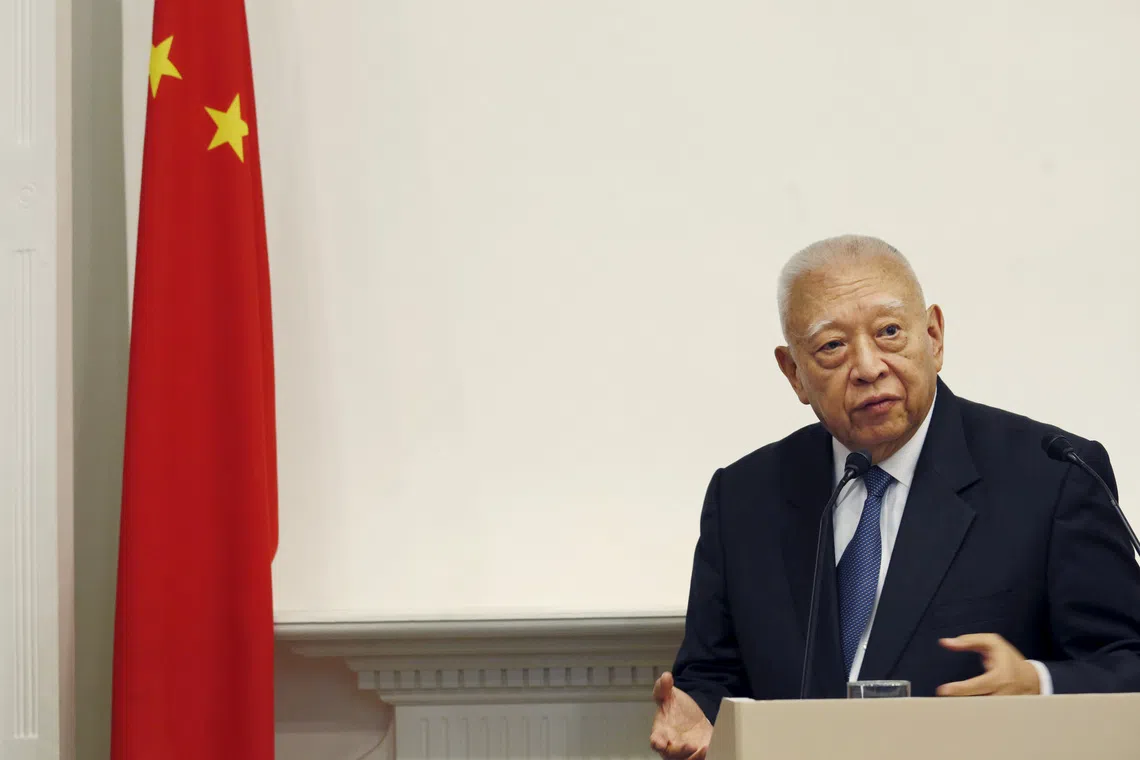
HONG KONG – Hong Kong’s first chief executive, Tung Chee Hwa, who was China’s choice for the city’s leader but whose administration faced a number of challenges, including the Asian financial crisis, widespread protests, and the Sars outbreak, died on Sept 8, aged 89.
Tung died peacefully, surrounded by his loved ones, official Hong Kong broadcaster RTHK reported early on Sept 9.
Tung was Hong Kong’s first local leader after the city’s handover from British colonial rule to Beijing in 1997, and he governed the city until he resigned in 2005, citing health problems.
RTHK cited a statement from his office, which said: “Tung Chee Hwa was an upright and incorruptible man, devoted to his country and its people, and dedicated himself to his work. His noble character and integrity will live on forever in our hearts.”
The former politician’s health had deteriorated in recent years after he underwent surgery in 2021, and he had rarely appeared in public since, local media reported.
His administration was instrumental in the development of several major infrastructure projects including the Disneyland theme park and the Cyberport technology park.
But his tenure was also marked by a series of crises including the 1997 Asian financial crisis, the bird flu outbreak from 1997 to 2002, and the 2003 severe acute respiratory syndrome (Sars) outbreak.
Perhaps the most politically significant event during Tung’s term was a mass protest on July 1, 2003, when more than half a million Hong Kong people took to the streets to oppose a plan to legislate a constitutionally-required national security Bill, also known as Article 23.
The plan stoked public concern that the freedoms Hong Kong had been promised by Beijing under the “one country, two systems” framework would be compromised.
The unexpectedly strong opposition to the Bill from across sectors of society forced Mr Tung to withdraw the plan, and the law was not passed until more than two decades later in March 2024.
The Hong Kong people’s sentiment turned against Tung’s administration following the incident and, combined with their unhappiness over the government’s handling of the deadly Sars epidemic that year, catalysed his political downfall, especially when Beijing withdrew its support for him.
Tung resigned in March 2005, citing health problems midway through his second term, some months after he was publicly criticised by then Chinese president Hu Jintao for poor governance.
But even after Tung left the top job, he remained an influential Hong Kong politician and an important adviser to Beijing for many years.
Following his resignation as chief executive, he was appointed vice-chairman of China’s top political advisory body, the Chinese People’s Political Consultative Conference, a position he held for 18 years until he stepped down in early 2023.
In 2008, he set up the Hong Kong-based non-profit China-United States Exchange Foundation to promote better understanding between the two powers; and in 2014, founded local think tank Our Hong Kong Foundation, serving as its chairman for nine years until late 2023 amid growing concerns over his health.
The foundation aims to contribute to Hong Kong’s prosperity and stability as well as its sustainable development under the “one country, two systems” principle, its website states. The principle refers to the framework under which Beijing promised Hong Kong a high degree of autonomy that lets it retain its own systems unique from that of mainland China.
‘Thankless job’
Tung was a long-time friend of Singapore’s founding father Lee Kuan Yew.
At a leadership luncheon in Hong Kong in 2005, shortly after Tung’s resignation as chief executive, Singapore’s first prime minister, Lee Kuan Yew, described the former Hong Kong leader as being “too nice a man, not sufficiently young and nimble”.
“He wasn’t a street fighter,” Mr Lee said at the time, referring to Tung’s chief executive role as “a thankless job”.
“You have a master in China. You have subsidiary masters in Hong Kong,” he said.
“Anything you do here in Hong Kong which does not disturb or can become an example of what China should do, that will be allowed… If you try to influence the course of events in China by examples and say this is a better system, I would think that is not likely to win enthusiastic support.”
After Lee’s death in 2015, Tung hailed his old friend as “a giant of our times”.
“Though we did not see each other very often, we talked at length on a wide range of topics whenever we met,” Tung said at the time. “I have learned much from his wisdom and unique insights.”
Born in Shanghai on May 29, 1937, Tung was the eldest child of shipping magnate Tung Chao Yung, founder of Orient Overseas, one of Hong Kong’s biggest shipping firms.
He had one brother and three sisters.
His family moved to Hong Kong when he was 11, and in his late teens he was sent to study in Britain, where he obtained a bachelor of science degree in marine engineering from the University of Liverpool.
He subsequently worked for nine years in the US before returning to Hong Kong in 1969 to help run the family business.
After his father’s death in 1982, Tung took over the reins of Orient Overseas.
He headed the company for 14 years before stepping down in 1996 to run in Hong Kong’s first chief executive election, where he beat two other contenders – former Supreme Court chief justice Yang Ti Ling and tycoon Peter Woo – with 320 votes from a 400-member selection committee.
“I decided to run (for chief executive) because of my sense of mission. My father always taught me to do meaningful things and to be proud of being Chinese,” Tung said at the time.
He was re-elected uncontested in 2002.
Tung also “truly believed that the relationship between China and the United States is the most consequential relationship in the world today,” his son Andy said of his father at a May 2026 event honouring the elder Tung’s efforts to foster understanding between the two world powers.
Tung’s last public appearance was in July 2021 at a film premiere marking the 100th anniversary of the founding of the Communist Party of China, according to local media reports.
Earlier that year in March, he had collapsed in public while at the opening ceremony of the Chinese parliament, the National People’s Congress, in Beijing, sparking speculation over his heart problems.
He underwent successful heart surgery at Hong Kong’s Queen Mary Hospital in September 2021.
Tung is survived by his wife, Betty Chiu, two sons Alan and Andy, and a daughter, Audrey.
He had a net worth of US$3.2 billion and ranked 1,325th on Forbes' List of Billionaires as of Sept 2026.