By The Straits Times | Created at 2026-09-19 21:16:35 | Updated at 2026-09-20 00:14:41
3 hours ago
By The Straits Times | Created at 2026-09-19 21:16:35 | Updated at 2026-09-20 00:14:41
3 hours ago
JIANGSU – Raise a knife in front of this robodog, and it will fire a net to restrain you.
Trained to respond on its own to more than 200 different scenarios, including identifying suspicious or hostile behaviour, the AI Patrol Net-launch Robot Dog Pro was part of a showcase of hi-tech police tools at the third Public Security Tech Expo held at Lianyungang in China’s eastern province of Jiangsu.
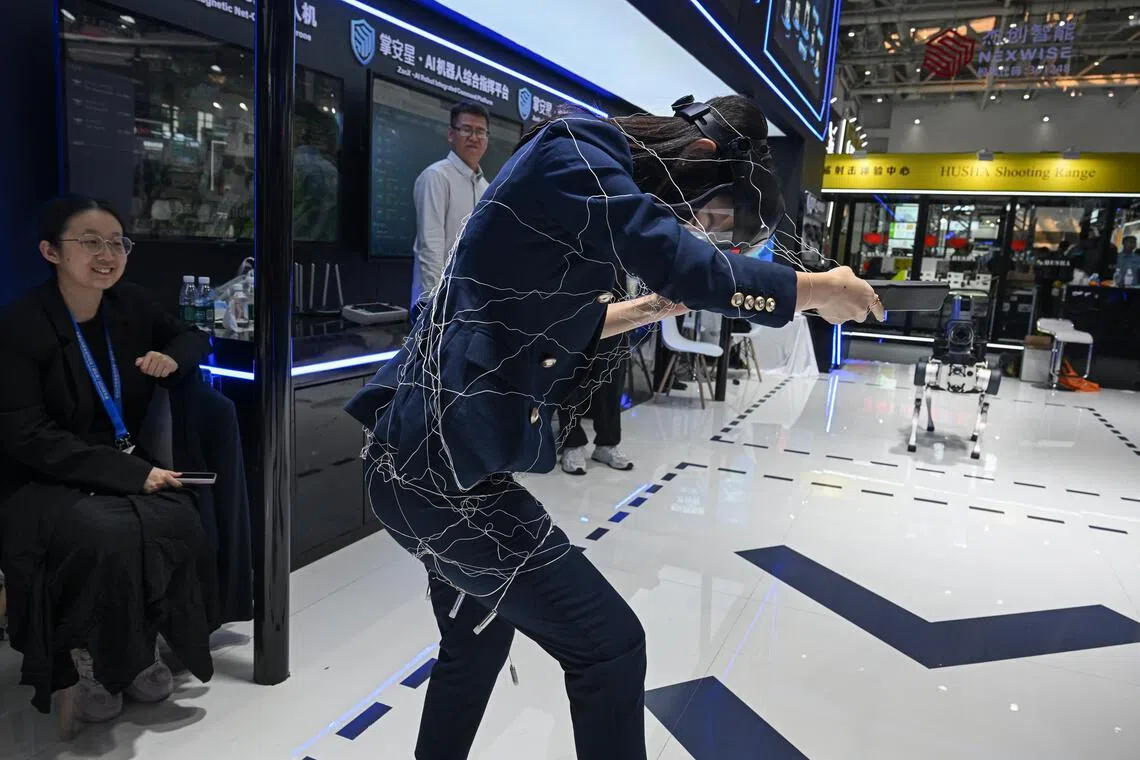
The AI Patrol Net-launch Robot Dog Pro releasing a non-lethal net on a hostile subject.
ST PHOTO: SHINTARO TAY
The expo, which ran from Sept 7 to 11, showcased what China has in public security technology, including autonomous robots such as the robodog, facial analysis, aerial vehicles and non-lethal restraint devices.
It was held on the sidelines of the annual Global Public Security Cooperation Forum, which attracted more than 2,100 delegates from 139 countries, regions and international organisations.
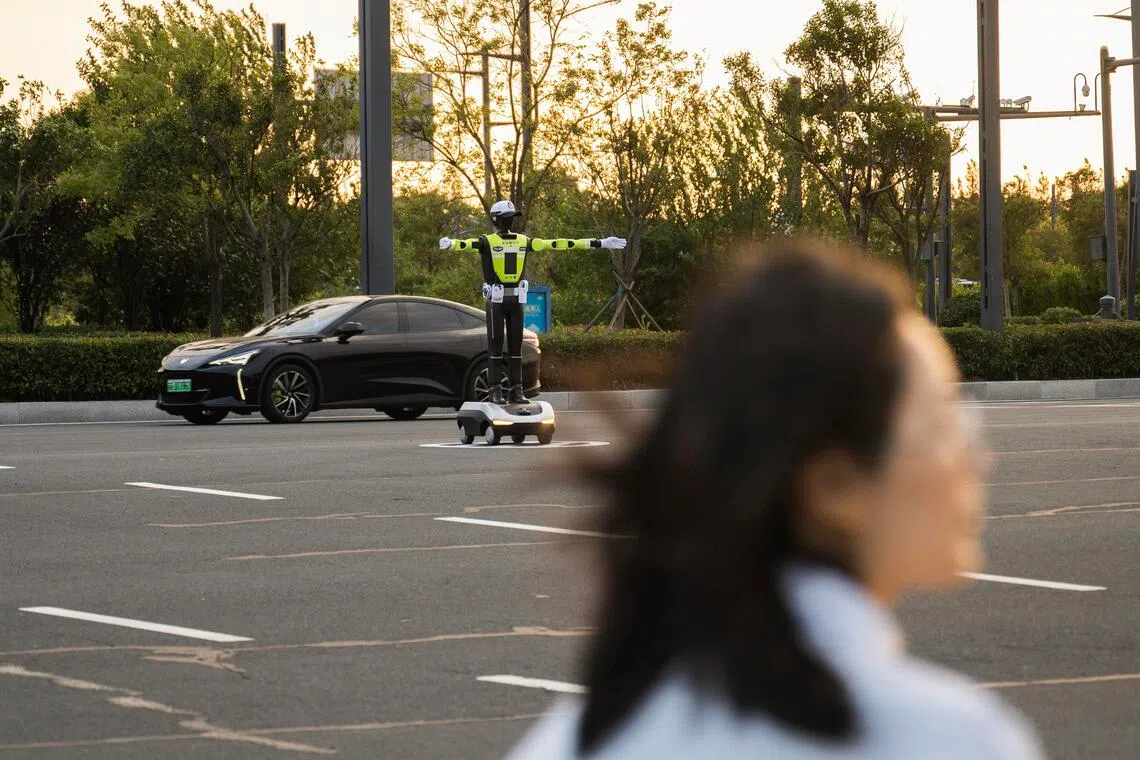
The Shenzhi T2 police robot directing traffic on the road near the Haizhou Bayview Conference Centre on Sept 9.
ST PHOTO: SHINTARO TAY
This photojournalist is in China for a 3.5-month familiarisation programme organised by the China Public Diplomacy Association.
The forum comes as China’s spending on public security IT has more than doubled in a decade from 10.8 billion yuan in 2015 to 25.5 billion yuan (S$4.9 billion) in 2025, with a compound annual growth rate of 8.96 per cent, according to a recent report in China Daily, the national English-language newspaper.
In particular, robotics and embodied AI – in which artificial intelligence is integrated into machinery to create “smart” physical systems – are strategic priorities in the government’s 15th Five-Year Plan, which charts the nation’s socio-economic development until 2030.
Embodied AI devices such as the robodog, designed by Chinese company Nexwise, have already been sold to 30 prefecture-level cities across nine provinces.
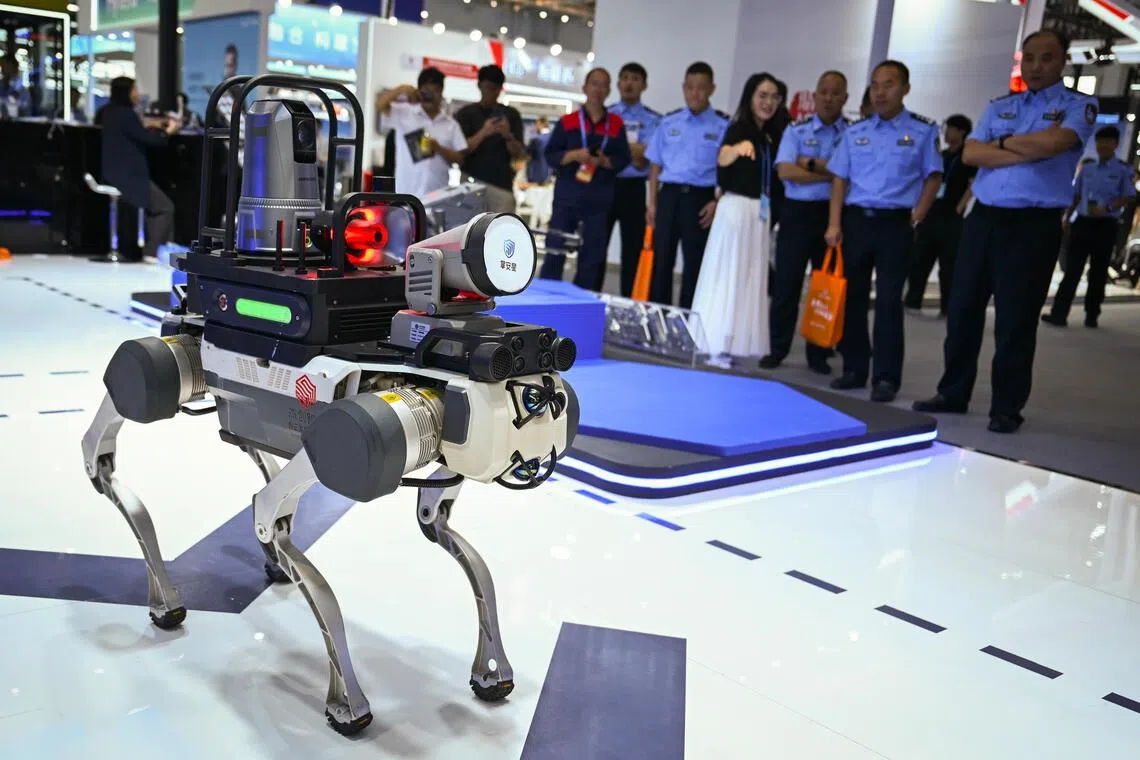
The AI Patrol Net-Launch Robot Dog Pro has been trained to respond on its own to more than 200 scenarios.
ST PHOTO: SHINTARO TAY
Zeng Yuanyuan, managing director of overseas business at Nexwise, told The Straits Times at the Expo: “Right now, a lot of embodied intelligence robots are only used for entertainment. But we wanted to design a robot dog that can be put into real industrial usage.”
Autonomous regions such as Ningxia and Guangxi as well as the coastal city of Zhuhai in Guangdong province are using the robodog to keep the streets safe. It was deployed during the 15th National Games in 2025, as well as at major public events.
China’s police tech is also attracting overseas buyers.
The robodog and other tech solutions from Nexwise are being exported to more than 20 countries across Europe, the Americas, South-east Asia and the Middle East. The company is also in business discussions with private security providers in Malaysia.
At another booth at the Expo, a grenade-shaped device that is already being used by police in China offers a non-lethal approach to dealing with threats.
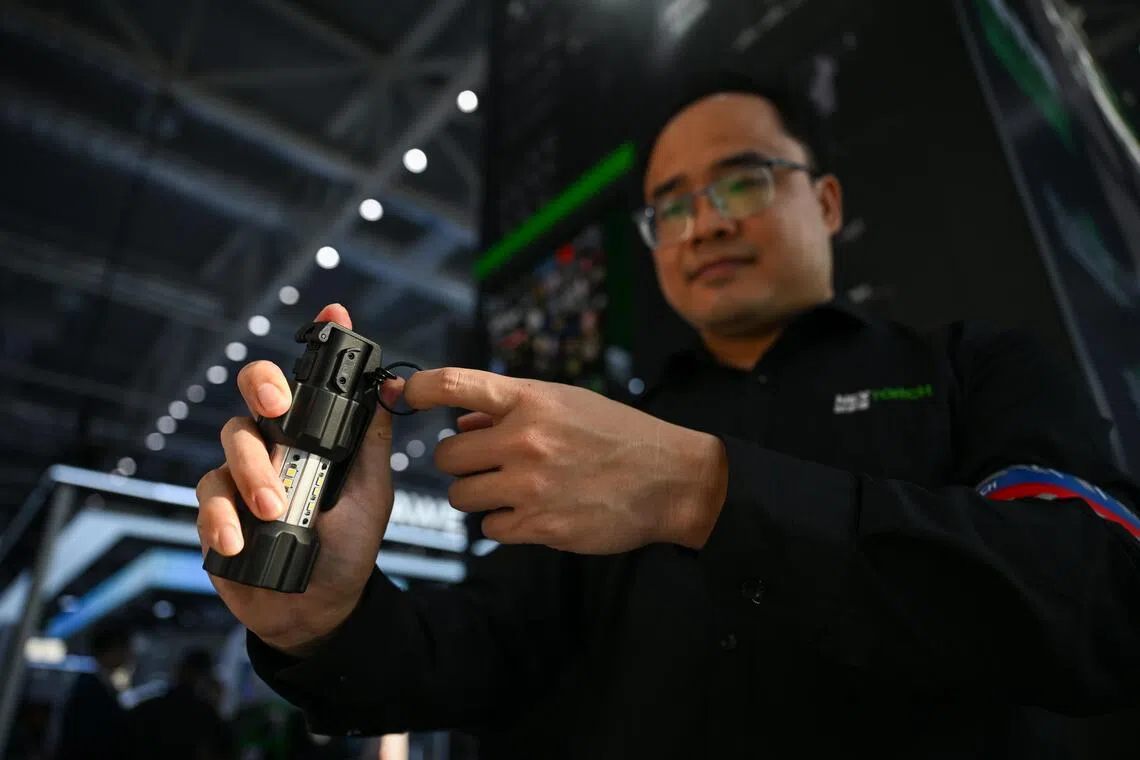
A man demonstrating the use of the Nextorch's ND30B tactical distraction device at the Public Security Tech Expo in Lianyungang, Jiangsu on Sept 10.
ST PHOTO: SHINTARO TAY
Rather than exploding and potentially causing injuries, the ND30B tactical distraction device created by tactical equipment company Nextorch emits a blinding strobe light as bright as 12 typical household LED bulbs and an ear-splitting siren that is slightly louder than a chainsaw, all designed to disorientate a target.
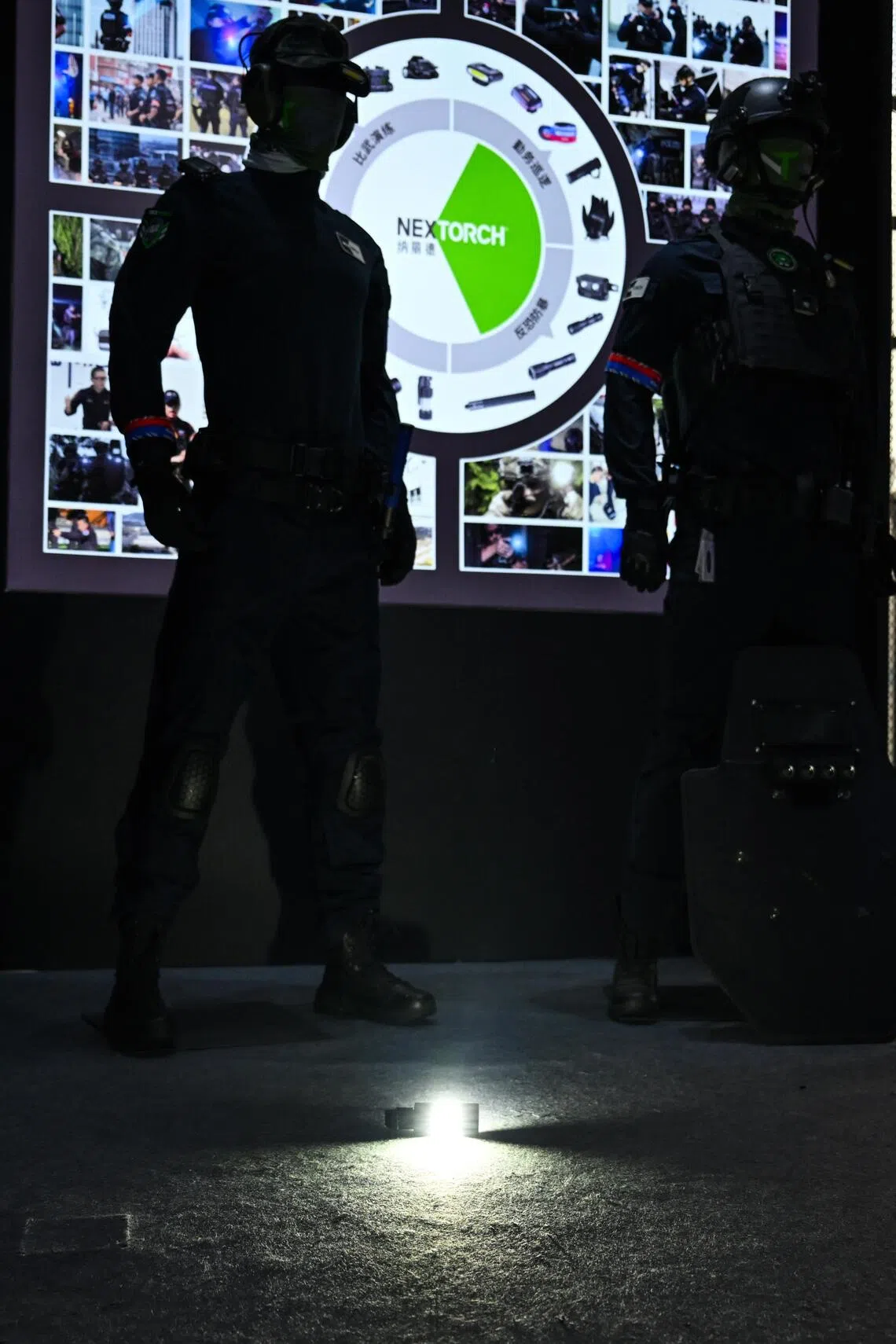
Nextorch's ND30B tactical distraction device, which is shaped like a grenade, can unleash 11,000 lumens of light and a 130-decibel siren to distract assailants.
ST PHOTO: SHINTARO TAY
Technology is also giving the police “wings”, extending their reach beyond ground vehicles.
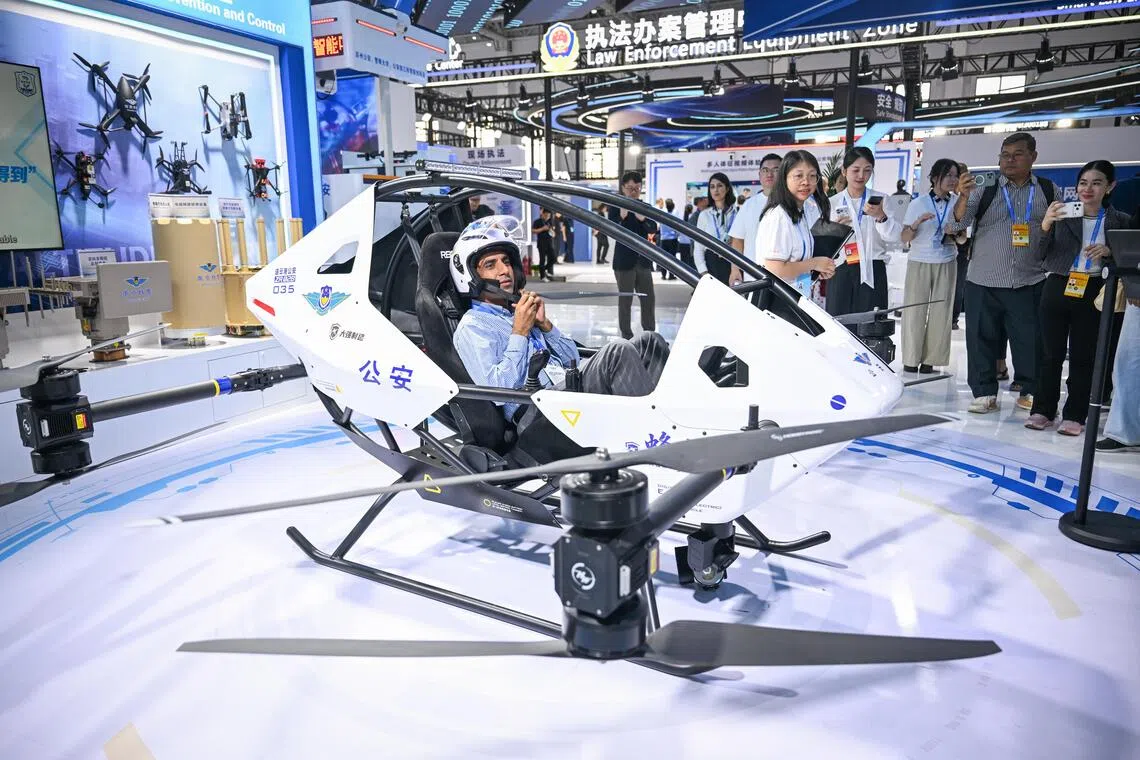
The ZR-028 lightweight single-seat aircraft which can take a high payload of 226kg and fly at 100 km/h.
ST PHOTO: SHINTARO TAY
The ZR-028 lightweight aircraft can carry one person weighing up to 226kg and travel at a maximum speed of 100km/h for up to 36 minutes.
Developed by Jiangsu Digital Eagle Group, the aircraft can be used for aerial patrols, mountain rescue operations and rapid transport for personnel who need to be on location during emergencies.
The aircraft was recently launched in the domestic market for police use. It is fitted with police warning strobes, searchlights and speakers, and equipment such as net launchers and tyre-spike deployers.
Overseas buyers use the aircraft – without the police equipment – for tourism, outdoor sports and sightseeing.
Then there is the use of technology, 30 years in the making, to enhance lie detection.
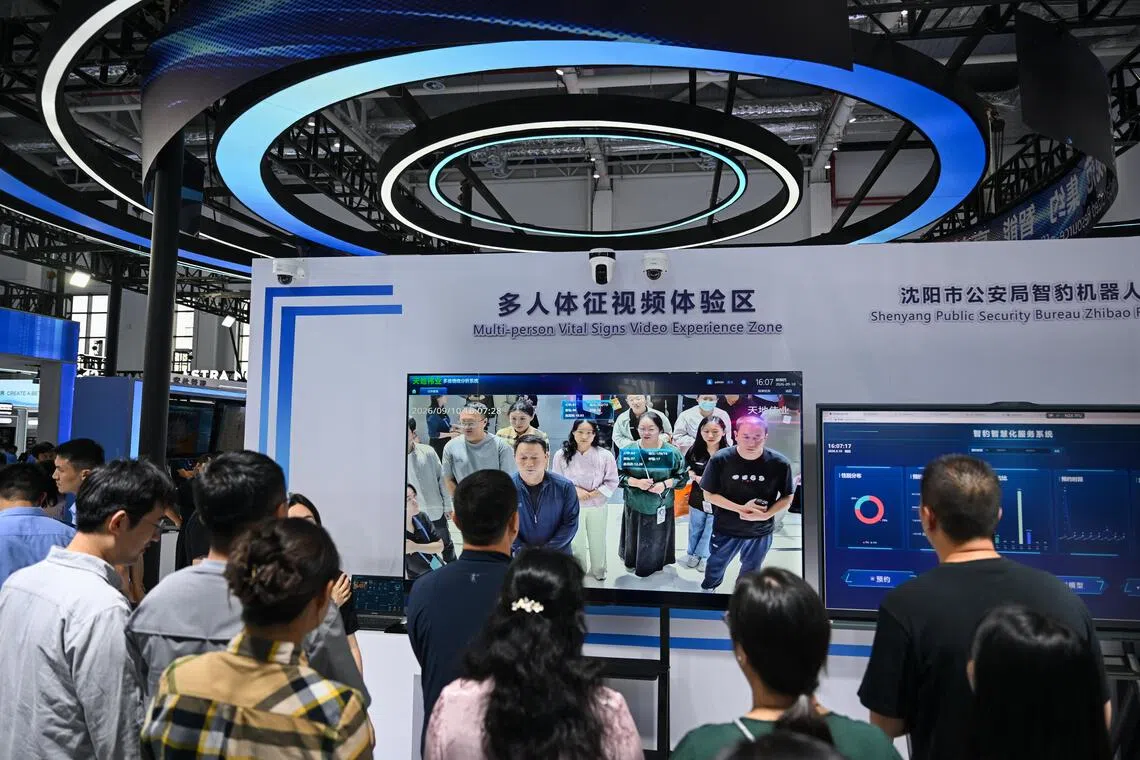
Tiandy’s MicroSense cameras use videos to obtain information about a person’s health and emotions.
ST PHOTO: SHINTARO TAY
MicroSense Solution, which was developed by Chinese company Tiandy with the Chinese government for more than three decades, uses artificial intelligence on videos of a person’s face to analyse micro-expressions.
The video camera can also detect changes in reflected light from the human face as blood flows through the body, to obtain physiological data including heart rate, blood pressure, blood oxygen levels and breathing rate.
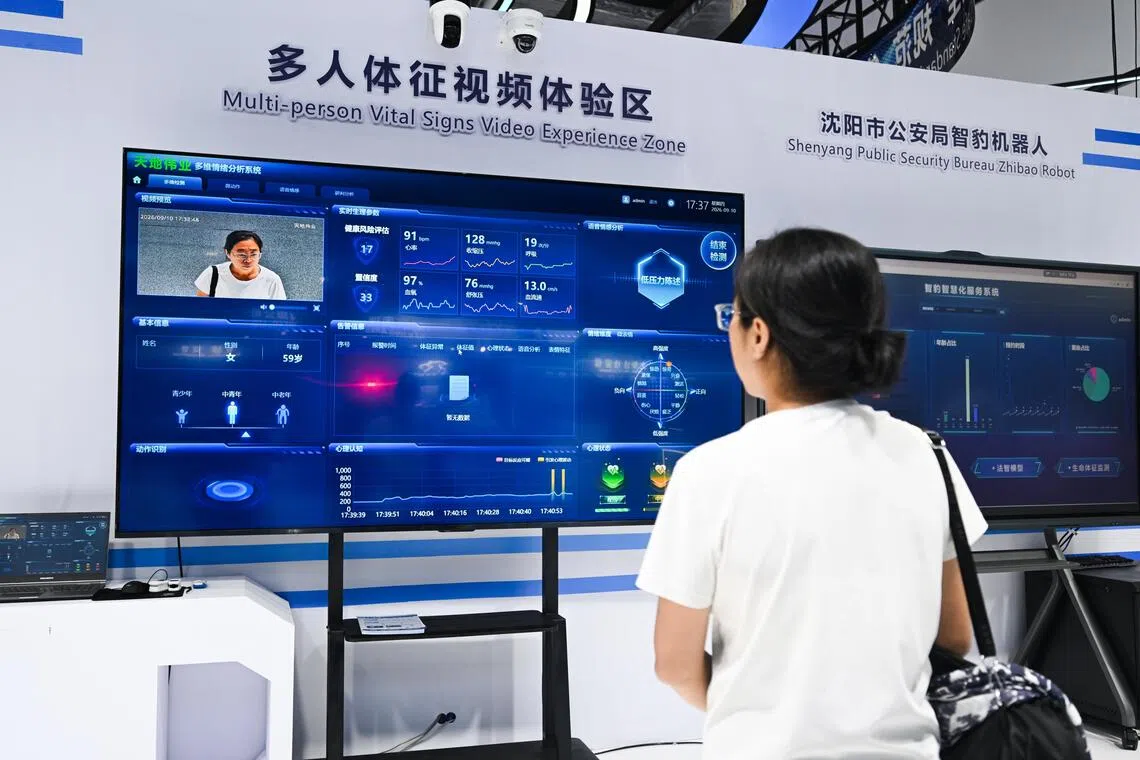
A demonstration of MicroSense Solution developed by Chinese company Tiandy, which uses cameras to pick up information about a person’s behaviour.
ST PHOTO: SHINTARO TAY
Tiandy global solution manager Becker Zhang said this helps to address a problem with conventional tools such as lie detectors, which suspects could potentially be trained to to manipulate to prevent an accurate reading.
The technology is presently being used by Chinese police in Beijing’s Haidian district and Jiaozhou city in Shandong province.
Some of the most innovative security devices featured at the expo, however, offered mechanical and not technological solutions.
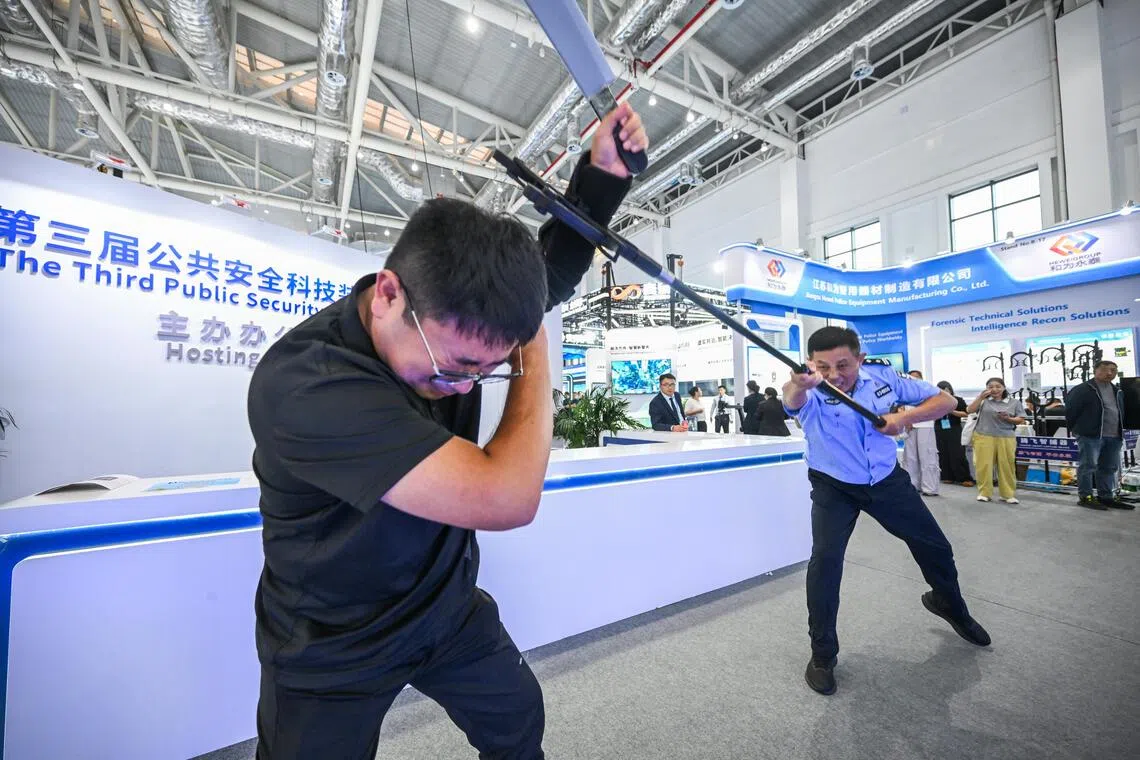
Police officer Zhang Tengfei, showcasing the use of the Feiteng Smart Trapper.
ST PHOTO: SHINTARO TAY
Police officer Zhang Tengfei had invented a device to safely and efficiently apprehend suspects, after sustaining a knee injury during a confrontation with a knife-wielding assailant in 2020.
“Traditional restraint tools don’t provide a reliable, effective or quick way to disarm someone. They were also difficult to deploy and suspects could sometimes escape,” Zhang told ST at the Expo.
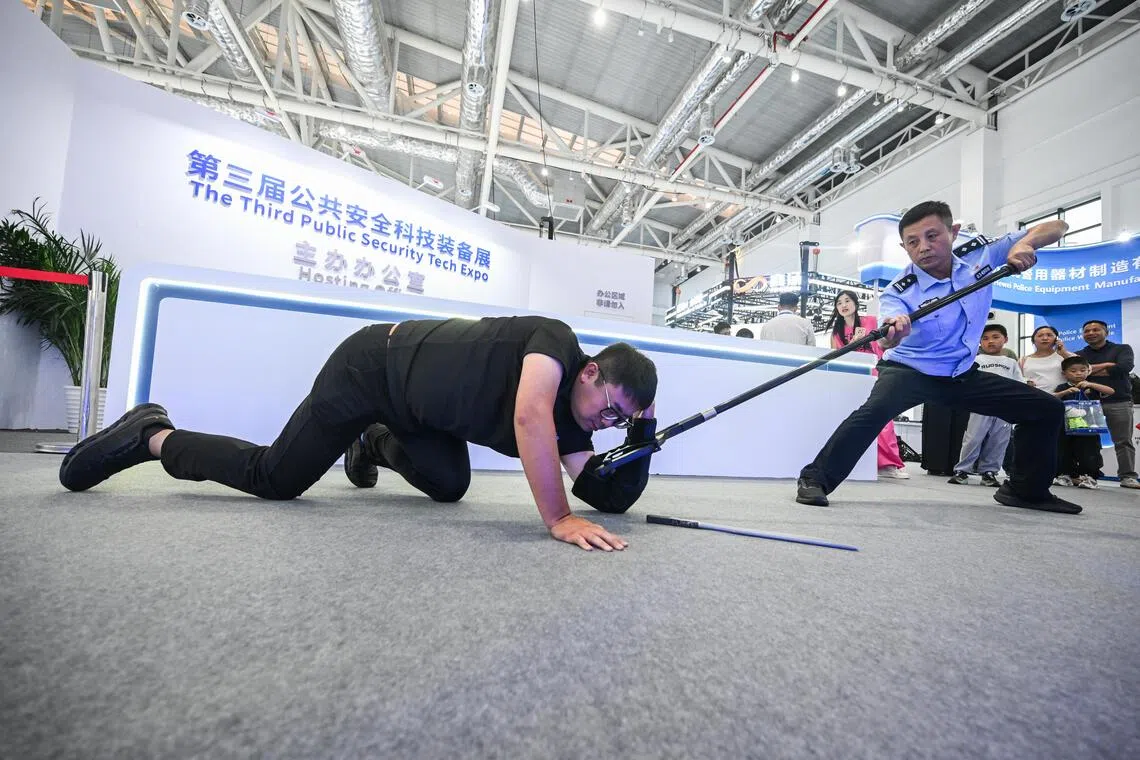
Police officer Zhang Tengfei, demonstrating the use of the Feiteng Smart Trapper, at the Public Security Tech Expo in Lianyungang, Jiangsu on Sept 10.
ST PHOTO: SHINTARO TAY
Zhang, who works at the Xuzhou Municipal Public Security Bureau in Jiangsu province, was then given time by his employer to come up with the Feiteng Smart Trapper.
The device comprises a spear with a forked head fitted with movable serrated teeth. When a suspect is caught, any attempts to pull away will cause the teeth to tighten their grip. It is also fitted with a nozzle to spray water or tear gas.
“The suspect can’t move: the more he struggles, the more painful it gets, and the tighter it locks. So the suspect essentially restrains himself,” Zhang said.
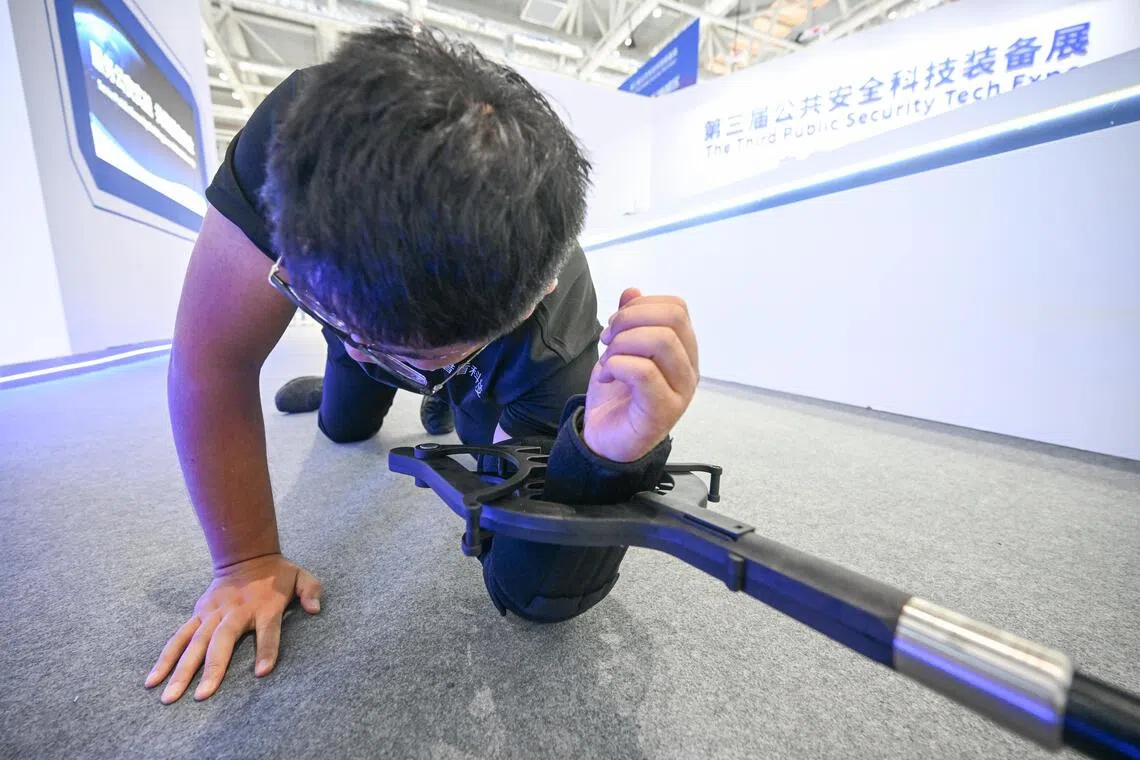
The device comprises a spear with a forked head fitted with movable serrated teeth. When a suspect is caught, any attempts to pull away will cause the teeth to tighten their grip. It is also fitted with a nozzle to spray water or tear gas.
ST PHOTO: SHINTARO TAY
Nearly 50,000 units of the device have been manufactured and are being used by police units, border-control agencies, hospitals, schools and courts, he said. It has also been exported to countries including Saudi Arabia, Indonesia and Kazakhstan.