By Literary Hub | Created at 2026-08-14 11:16:08 | Updated at 2026-08-14 12:54:31
3 hours ago
By Literary Hub | Created at 2026-08-14 11:16:08 | Updated at 2026-08-14 12:54:31
3 hours ago
In early 2014, a pair of political scientists published a striking study on the health, or lack thereof, of American democracy. Authored by Princeton University’s Martin Gilens and Northwestern Univesity’s Benjamin Page, the study combed through decades of data to try to answer a single question: When it comes to American politics, who truly governs?
Article continues after advertisement
The U.S. still had, at least for the time, all the trappings of a free and fair democracy. Elections were still routinely held, largely free from undue burdens or autocratic manipulation. American media still remained pointed and punchy, free from debilitating lawsuits or destabilizing pressures. The political opposition could still freely canvass, freely campaign, freely corral new voters into their camps. By all traditional metrics, American democracy appeared perfectly fine.
Yet as Gilens and Page discovered, that didn’t mean that the American people steered American politics. Instead, as their data laid bare, the levers of American political control remained in the hands of a group of “economically elite Americans.” This was a tiny group whose political influence stood out of all proportion to the size of their cohort—but which rose instead in direct relation to the size of their wealth. As the authors wrote, “Economic elites and organized groups representing business interests have substantial independent impacts on U.S. government policy, while mass-based interest groups and average citizens have little or no independent influence.”
Broken down, the authors discovered that policies with “high support” from a strong majority of these “economic elites” had remarkably high odds of succeeding. It wasn’t that such “economic elites” always got what they wanted, necessarily; rather, it was that their say and their sway dominated anything else in the American body politic. Even when a “majority of citizens” disagreed with the wealthiest Americans’ policy preferences, “they generally lose.”
The rise of this offshore world also led directly to the undoing of all the efforts to hold oligarchs and their wealth to account.
Coming in at around ten thousand words and littered with political science jargon, the study from Gilens and Page was an unfortunate example of academic overwriting. (When was the last time you enjoyed reading about “quadratic logistic regression” or “bivariate results”?) At its core, though, was one clear conclusion: American democracy was an oxymoron—a sham steered by the wealthiest Americans. “In the United States, our findings indicate, the majority does not rule,” the authors concluded. “[Our] analyses suggest that majorities of the American public actually have little influence over the policies our government adopts.” By the mid-2010s, as a BBC headline reported, the “U.S. [was] an oligarchy, not a democracy.”
At the time, the study caused few ripples. Issues like wealth inequality were far from the center of political discourse in the U.S.; the Occupy Wall Street movement had long ago petered out, while the rise of figures like Senator Bernie Sanders was still over the horizon. Gilens and Page’s study came and went, and little changed. It’s only in hindsight that the study proved both remarkably prescient and analytically accurate—a signal flare of where the U.S. was, and where it was headed.
Of course, as scholars like Winters wrote, this kind of oligarchy-hiding-in-plain-sight was part of the package of modern oligarchy—a kind of conscious cloaking that helped these figures rise in the first place, without any kind of public pushback. “The absence of the more frontal and visible aspects of oligarchy lead to the mistaken impression that there are no longer any oligarchs—only ordinary citizens who happen for the first time in history to enjoy politically neutral fortunes,” Winters wrote in 2011. Moreover, most Americans maintained the outdated notion that oligarchies couldn’t exist in nations that were at least nominally democratic.
But in Winters’s schematic, the kinds of “civil oligarchies” described in chapter 1 were perfectly compatible with nations that still held routine elections, that still maintained whole fleets of investigative journalists and opposition politicians and civil society groups banging on about policies and scandals and political preferences. There was no distinction between “civil oligarchies” and democracies; both could exist simultaneously.
Still, there was always the latent threat that someday, even in the distant future, the broader mass of American citizenry would elect politicians and pass policies to explicitly target the oligarchs’ assets. “Civil oligarchies” and democracies were compatible, until they weren’t—until a figure like Teddy Roosevelt rose, or until one like Richard Nixon flamed out, leaving nothing but angry egalitarian reformists in his wake. It was that future that, in oligarchs’ eyes, had to be prevented at all costs—regardless of what that meant for democracy in America or anywhere else.
*
But the new oligarchs had little to fear. By the 2010s it was clear they had already digested the Supreme Court rulings we saw in the previous chapter, the ones that pried the world of American politics wide open to the wealthiest Americans. As Gilens and Page discerned, those “economic elites” had already started using their wealth to effectively bid on American policies and politicians, all for their own benefit. It’s not that this hadn’t happened before, of course; American history is littered with previous examples of wealthy forces and factions pushing their policy preferences. This time around, though, these figures had one factor working in their favor that none of their predecessors had ever enjoyed: levels of wealth inequality that had spiraled far further than the Founders could have ever imagined, and beyond anything the world had ever seen.
If we were to focus only on the statistics of modern wealth inequality in America, this book would barely include anything else. Indeed, the past decade has seen an entire cottage industry of books erupt about wealth inequality accelerating not just in the U.S. but around much of the world. Sparked in large part by the publication of Thomas Piketty’s 2013 Capital in the Twenty-First Century, there’s now an entire library of material available on the topic, much of which touches on the rise and roles of many of the oligarchs detailed in this book. For the sake of brevity, let’s let a handful of data points highlight how monstrous American wealth inequality has become in recent decades—and how it’s now surpassed anything the country has ever known.
For instance, there’s the fact that between 1980 and 2014, the incomes of the top 0.001 percent of Americans exploded, rising by over 600 percent—even as the incomes of the millions of Americans in the bottom 50 percent flatlined. There’s the fact that America’s billionaire class, representing a fraction of a fraction of the nation, now holds more wealth than the bottom 50 percent of America combined. There’s the fact that the top 1 percent of Americans now make over twenty-six times more money than all the rest of the country. There’s the fact that the share of the national income that the country’s wealthiest controlled by the end of the 2010s had nearly doubled since the 1970s—but for the bottom 50 percent of Americans, it had been cut nearly in half. And there’s the fact that, in 2024 alone, the net worth of the nineteen wealthiest families in America expanded by about $1 trillion total, hashing out to approximately $53 billion per family.
The examples run on and on, and at a certain point the numbers begin blurring together. For those more visually inclined, just imagine a graph charting out the total assets held by Americans. Picture it as a boomerang lying on one side, with the flat, nearly horizontal edge representing the wealth holdings of America’s lower and middle classes; the boomerang’s joint, curving slightly upward, representing the American upper class’s holdings; and the vertical line, running up as high as the eye can reach, representing the wealth now held by the richest American figures and families. The wealth of the richest Americans has torqued upward, bursting through the top of the graph, with no end in sight, completely untethered from the rest of the United States.
Inequality has accelerated at an ever-growing pace, blowing past that of any previous eras, including the Gilded Age. By the early 2020s, it was clear that the wealthiest American cohorts now controlled a greater slice of the American economy than even the robber barons and plutocrats of the late nineteenth and early twentieth centuries. As Zucman calculated in 2025, the share of total American household wealth that modern American oligarchs owned was now more than double the size of the wealth owned by the Rockefellers, Carnegies, and others combined. As the most popular comment on an article summarizing Zucman’s 2025 research—written in The Wall Street Journal, never a bastion of leftist thought—read, “You don’t have to be a socialist to see there’s a problem here.”
*
This wasn’t just an American phenomenon. Such skyrocketing wealth inequality could be found in nation after nation in the modern world, whether Russia, China, Saudi Arabia, or elsewhere. Scratch a modern tyrant, and you’ll often find a billionaire, whether Vladimir Putin, Xi Jinping, Mohammed bin Salman, or plenty of others. Indeed, this spiraling wealth inequality seemed a distinctly global pattern in the early twenty-first century, infecting even places like Britain (where the top 1 percent owned 21.3 percent of the country’s total wealth), France (27.2 percent), and Germany (27.6 percent).
But this is an American book, focused on an especially American story (even with its global resonance), so it’s worth asking: What happened in the U.S. in the twenty-first century to rocket American oligarchs’ wealth into the stratosphere? Just how did these individuals—now worth not just billions, but hundreds of billions of dollars—break free from the gravitational pull of America’s previous efforts at reining them in?
The answer spans decades’ worth of policy shifts, both within and without the U.S. It involves thousands of lobbyists and analysts and middlemen looking to carve out entire careers for themselves to help the rich become richer, and protect their wealth from any and all. It’s also connected to the rise of the world we’ve dubbed “offshore,” of spiderwebs of shell companies and anonymous investments and financial secrecy, of tax havens and hidden bank accounts and impenetrable trusts, all of which have sucked generations’ worth of wealth out of country after country around the world, hiding it from any journalist, tax authority, or regulator who may come knocking.
Time and again, all these cuts redounded to only one cohort’s benefit: the wealthiest Americans.
The rise of this offshore economy over the past few decades is worth a book in and of itself. And, indeed, there are some phenomenal ones written in recent years: Oliver Bullough’s Moneyland, Nicholas Shaxson’s Treasure Islands, Atossa Araxia Abrahamian’s The Hidden Globe, and plenty more. For right now, though, just know the ease of access to these shell companies, these financial secrecy networks, these entire policies and industries and nations that comprise the offshore world helped the wealthiest stash ever more resources into their own kitties, beyond the reach of the rest of us. Thanks to the rise of this offshore world in recent decades, tens of trillions of dollars have simply disappeared from ledgers around the globe, slipping into a world that is largely untouchable and untraceable. It created, as Brooke Harrington, the Dartmouth University expert on the offshore world wrote, “the platform for an elite insurgency opposed to basic principles like equality before the law, economic stability, free markets, and social solidarity.”
Even then, the simple existence of such an offshore economy doesn’t necessarily explain how American oligarchs’ wealth drove to suffocating heights. The rise of this offshore world—in which wealthy forces can keep their lucre safe from any kind of transparency or democratic oversight—also sparked a global revolution in how to undo existing checks on oligarchs’ wealth. It wasn’t just that shell companies in the Cayman Islands or bought-off bank regulators in Germany or Denmark allowed oligarchs to safely stash and launder their money. It was that the rise of the offshore world also jump-started a shift in incentive structures—political, legal, social, and more—that began to prefer and prioritize the interests and whims of the wealthiest, to try to attract and protect their riches, at the expense of the rest of us. In the process, the rise of this offshore world also led directly to the undoing of all the efforts to hold oligarchs and their wealth to account.
In the U.S., this shift began decades ago. Despite the successes of income taxes—which reached over 90 percent under Franklin D. Roosevelt, Harry Truman, and Dwight Eisenhower—a new anti-tax sentiment began swirling in the 1960s, beginning under John F. Kennedy. Looking for a means to boost a flagging economy, Kennedy proposed gutting the income tax rates. As he saw it, the mile-high rates “exert[ed] too heavy a drag on growth in peace time,” and needed to be slashed. It was, in hindsight, a bizarre claim, given that the years before Kennedy’s speech saw some of the greatest economic growth America had ever known—and far greater than anything seen in the decades since. But no matter. After Kennedy’s assassination his successor, Lyndon B. Johnson, pushed through legislation paring back the requirements, bringing the income tax rates on wealthy Americans, which had been 91 percent the year Kennedy was murdered, down to some 70 percent in just a few years.
The bottom hadn’t quite dropped out, and wealthy Americans still paid taxes at a notably higher clip than the rest of the country. But the move was a watershed. For the first time since the Second World War, wealthy Americans watched their tax rates plunge, unleashing a genie that, in time, would shake loose any remaining restrictions on American oligarchs’ wealth.
As the years following Kennedy’s proposal wore on, the downward pressures on wealthy Americans’ tax rates only accelerated. By the time Ronald Reagan entered the White House in 1981, the right man met the right moment for the kinds of right-wing policies that wealthy Americans had long championed—including, most especially, the slashing of their tax receipts. Spun as a means for oligarchs’ wealth to “trickle down” to others, Reagan pulverized the tool that Teddy Roosevelt had once helped push for. When Reagan took office, income tax rates on wealthy Americans stood at 69 percent. By the time he left office, they had collapsed, coming in at a meager 28 percent—where they have largely stood ever since. Thanks to the combination of Kennedy and Reagan, income taxes were suddenly shadows of their former selves, eradicating any promise they once held as key tools in the anti-oligarch arsenal.
As if that weren’t enough, inheritance (or estate) taxes, that other pillar of Rooseveltian reforms to corral oligarchs, soon had their turn in the barrel. Where top inheritance tax rates had stood at nearly 80 percent for decades, helping dissolve the U.S.’s most significant estates and preventing the rise of a feudal aristocracy, Reagan’s rise once more shattered the consensus. Thanks to Reagan’s pro-oligarch leanings, his administration drove down inheritance tax requirements, pushing rates down to nearly 50 percent—leaving the heirs of oligarchs with more than enough to quickly rebuild their families’ financial empires.
And yet, if income tax cuts culminated with Reagan, inheritance tax cuts only began with him. By the end of the 2000s, those rates had crashed even further, allowing the wealthiest families to keep nearly two-thirds of an estate after a tycoon’s passing. Additionally, with the rise of a so-called estate tax exemption, which allowed certain wealthy families to skip inheritance taxes altogether, the number of Americans who had to pay any kind of inheritance tax took an even steeper nosedive, coming in by the end of the 2010s at a re-sounding 0.08 percent of the total population. The inheritance tax had become little more than a rounding error.
Charted out, the twin collapses of the income and inheritance taxes look like a roller coaster careening downhill, picking up speed toward and through the twenty-first century. It’s not that other Americans weren’t also seeing tax receipts slashed; administration after administration pushed tax cuts across the board while America’s federal debt ballooned beyond control. But time and again, all these cuts redounded to only one cohort’s benefit: the wealthiest Americans, watching opportunities to retain and entrench their lucre expand and expand.
___________________________
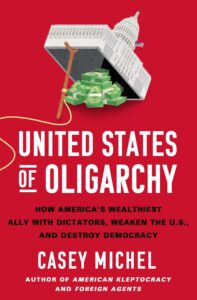
From United States of Oligarchy: How America’s Wealthiest Ally with Dictators, Weaken the U.S., and Destroy Democracy by Casey Michel. Copyright © 2026 by the author and reprinted by permission of St. Martin’s Publishing Group.