By The Rio Times | Created at 2026-08-27 04:50:01 | Updated at 2026-09-27 07:10:06
1 month ago
By The Rio Times | Created at 2026-08-27 04:50:01 | Updated at 2026-09-27 07:10:06
1 month ago
Key Facts
- Seaborne fines rise Mysteel’s 61% Fe fines index for seaborne iron ore rose US$0.95 to US$98.00 per dry metric tonne on Wednesday, August 26, 2026.
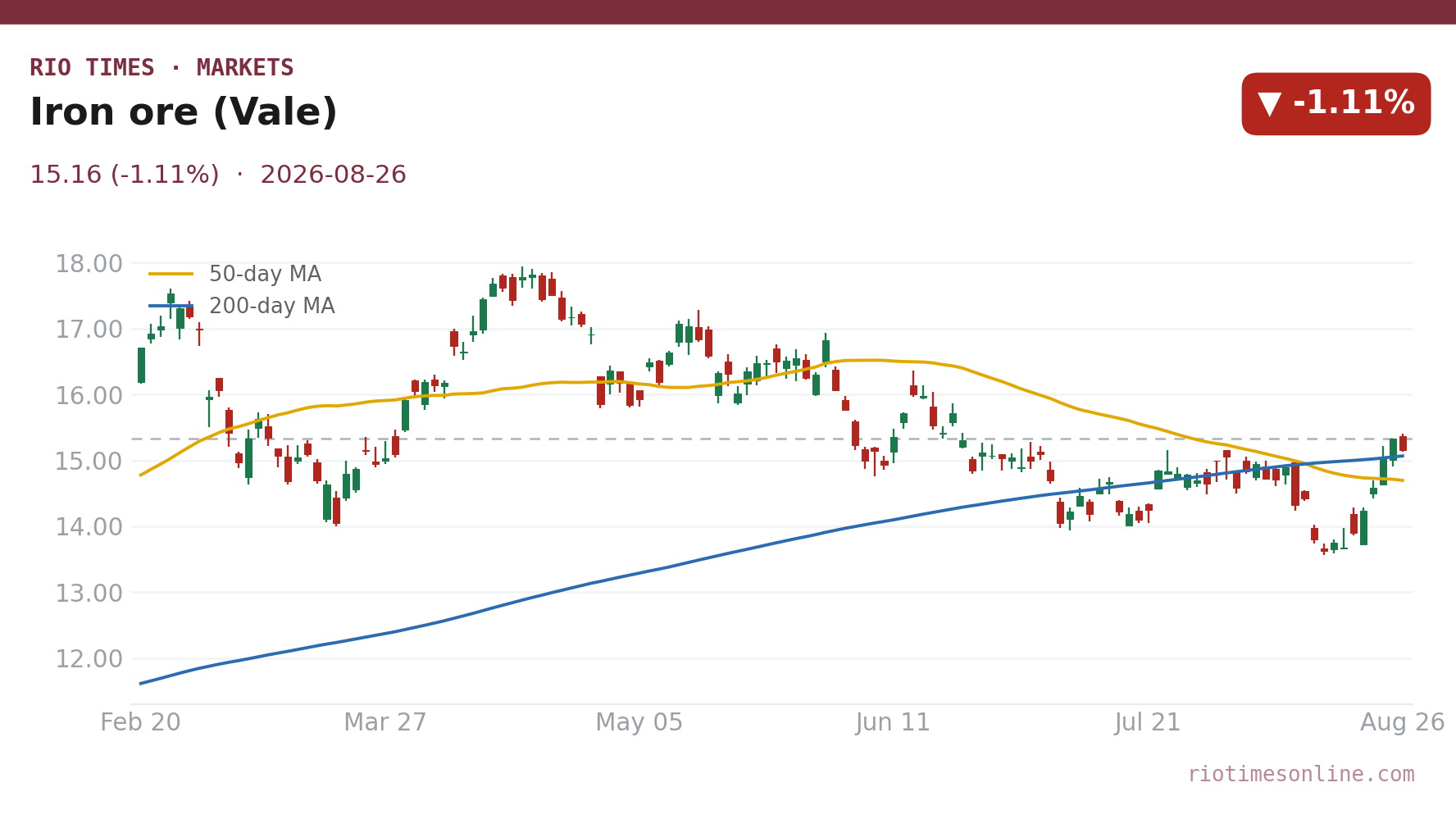
- Vale ADR Vale’s New York-listed shares closed at US$15.16, a decline of 1.11% against the previous session.
- China’s domestic contract The most-traded Dalian iron ore contract (I2701) closed at CNY 720 per tonne, up 0.49% — about US$107 at 6.72 yuan per dollar on August 26.
- Seaborne range Iron ore has traded in a narrow US$93 to US$100 range since June 2026, reinforcing a market in consolidation.
- Imports still solid Chinese iron ore imports in January to June 2026 reached 628.87 million tonnes, up 6.3% versus the same period in 2025, customs data show.
- Mills running hard An SMM survey put blast furnace operating rates at 89.13%, with daily hot metal output at 2.3953 million tonnes.
Today’s Focus
Iron ore’s global proxy board was mixed on Wednesday, August 26, 2026. Vale’s New York-listed ADR slipped 1.11% to US$15.16, while Brazil-listed CSN Mineração gained 1.87% to R$5.99, about US$1.16 at 5.15 reais per dollar.
The commodity itself held steadier ground. Mysteel’s seaborne 61% Fe fines index rose US$0.95 to US$98.00 per tonne, and China’s most-traded Dalian contract closed 0.49% higher at CNY 720 per tonne, roughly US$107.
This divergence reflects a market torn between firm physical imports and softer sentiment toward miner shares. China still buys around 75% of the world’s seaborne iron ore, and import volumes remain strong.
The takeaway for investors is nuance: steel demand is not collapsing, but it is not accelerating either. Ore looks rangebound, not breaking out.
What matters today. China’s steel cycle remains robust enough to hold iron ore in its current range, but not strong enough to lift miner share prices consistently.

01 The session in one read
Iron ore derivatives and producer shares told two slightly different stories on Wednesday, August 26, 2026. The seaborne benchmark inched higher while the biggest pure-play Latin American name, Vale, gave back ground in New York.
Mysteel’s 61% Fe fines index rose US$0.95 to US$98.00 per dry metric tonne. That keeps the commodity firmly inside the US$93 to US$100 band it has occupied since June 2026.
Vale’s American depositary receipts closed at US$15.16, down 1.11%. The move diverged from Brazilian-listed CSN Mineração, which climbed 1.87% to R$5.99.
Rio Tinto, the other global bellwether, fell 1.98% to US$104.70, a sign that investor caution was directed at diversified miners rather than at the iron ore price itself.
Assessment — Consolidation, not capitulation MEDIUM
The iron ore market is building a base within a well-defined band. Futures are steady but unspectacular, and the mixed signals from miner shares suggest investors are no longer chasing the strong 12-month run that lifted Vale. The variable to watch is whether China’s August daily crude steel output confirms the modest August construction recovery; if it does not, the lower end of the US$93 to US$100 range could be tested.
02 The board
The price board highlights the gap between the commodity and the companies that dig it up. Vale’s New York shares were the weakest of the three proxies, with a 1.11% fall to US$15.16.
CSN Mineração was the outlier, rising 1.87% to R$5.99 in São Paulo, possibly helped by domestic Brazilian factors rather than global commodity moves.
The steadiness of the underlying contract stands in contrast to the choppy share moves. Traders in Dalian pushed the most-active January contract to CNY 720 per tonne, up 0.49% — a firm close at roughly US$107.
| Iron ore (Vale) | US$15.16 | -1.11% |
| CSN Mineração | R$5.99 | +1.87% |
| Rio Tinto | US$104.70 | -1.98% |
Source: RT close, 2026-08-26. Where a commodity has no spot feed, an exchange-traded tracker or leading producer is shown as a labelled proxy.
Live Market IntelligenceThe live market boardInside: market breadth, the sector heatmap, currencies & rates, the Latin America scoreboard and the full instrument board.Rio Times · Live Market Intelligence
Latin America — Cross-Market Board
Regional
Aug 27, 2026 · 01:41
Ibovespa · benchmark
174,586.26 +0.01%
L 167,142day rangeH 168,310
+21.85% over 12 months
Market breadth · 5 names
60% advancing
3 ▲ advancing2 declining ▼
Currencies, rates & key inputs
Latin America scoreboard
IndexLastTodayStrength
IbovespaBrazil 174,586.26 +0.01%
S&P/BMV IPCMexico 66,644.91 +0.53%
S&P IPSAChile 11,369.18 -0.71%
S&P MERVALArgentina 3,024,971 +0.53%
MSCI COLCAPColombia 2,504.68 -0.15%
BVL S&P PerúPeru 60,449.35 +0.30%
Full instrument board
| IBOV | 174,586.26 | +0.01% | +21.85% | 174,576.80 | 168,310 | 167,142 | — |
| IPSA | 11,369.18 | -0.71% | — | 11,450.75 | 11,210 | 10,984 | 1,513,213,483 |
| IPC MEX | 66,644.91 | +0.53% | +12.17% | 66,293.07 | 66,121 | 65,405 | 108,886,187 |
| MERVAL | 3,024,971 | +0.53% | +30.51% | 3,022,485 | 3,042,365 | 2,991,150 | — |
| COLCAP | 2,504.68 | -0.15% | — | 9.04 | 9.05 | 9.02 | 4,133 |
| BVL PERÚ | 60,449.35 | +0.30% | — | — | — | — | — |
| USD/BRL | 5.16 | +0.01% | -5.13% | 5.16 | 5.18 | 5.14 | — |
| EUR/BRL | 5.95 | +1.01% | -5.83% | 5.89 | 5.98 | 5.94 | — |
| USD/MXN | 17.06 | -0.24% | -8.58% | 17.10 | 17.08 | 17.01 | — |
| USD/CLP | 913.98 | +0.04% | -5.67% | 913.65 | 915.11 | 906.68 | — |
| USD/COP | 3,140 | +0.03% | -22.04% | 3,139 | 3,141 | 3,105 | — |
| USD/PEN | 3.36 | -0.66% | -4.82% | 3.38 | 3.38 | 3.35 | — |
| USD/ARS | 1,493 | +0.10% | +12.96% | 1,491 | 1,494 | 1,480 | — |
| USD/UYU | 40.27 | +1.24% | +1.80% | 39.77 | 40.27 | 40.23 | — |
| USD/PYG | 5,939 | +1.68% | -19.54% | 5,841 | 5,939 | 5,925 | — |
| USD/BOB | 11.64 | -0.76% | +72.04% | 11.73 | 11.72 | 11.64 | — |
| USD/DOP | 58.34 | +1.25% | -3.44% | 57.62 | 58.34 | 58.04 | — |
| USD/CRC | 445.92 | +0.89% | -9.71% | 441.97 | 448.50 | 445.92 | — |
Largest moves today
USD/PYG 5,939 +1.68%
USD/DOP 58.34 +1.25%
USD/UYU 40.27 +1.24%
EUR/BRL 5.95 +1.01%
USD/CRC 445.92 +0.89%
USD/BOB 11.64 -0.76%
IPSA 11,369.18 -0.71%
USD/PEN 3.36 -0.66%
The session read
The Ibovespa rose 0.01%, with breadth positive — 3 of 5 names higher. IPC MEX led, while IPSA lagged.
V
◆ Live Company Intelligence
Vale
NYSE: VALEVALE3Basic MaterialsOther Industrial Metals & Mining65,805 employees
$65.24B
Market cap
Analyst target $16.74
Wall Street view
3.9Moderate Buy/ 5
14 Buy12 Hold0 Sell
Avg. price target $16.74 · +11% vs 200-day
Valuation & profitability
Market cap$65.24B
Revenue (TTM)$218.07B
P / E ratio30.1
Profit margin4.8%
Return on equity4.1%
Price & risk
52-wk low
$9.3052-wk high
$17.44
Beta (volatility)0.75
200-day average$15.04
Revenue trend · 6y
20202025
Latest $38.23B
Ownership
Institutions20.8%
Shares outstanding4.26B
Top holderCapital World Investors
Institutional holders5+ funds
Dividend
Yield36.4%
Payout ratio2.0%
Fwd. annual$1.20
What Vale does. Vale S.A., together with its subsidiaries, produces iron ore and nickel in Brazil, Asia, the Middle East, North Africa, Europe, the Americas, and Oceania. The company operates in two segments, Iron Ore Solutions and Vale Base Metals. It extracts, produces, and distributes iron ore, iron ore pellets, briquettes, nickel, copper, other ferrous…
03 What moved it
The quiet strength in Chinese futures was underpinned by real cargoes. Spot prices for mainstream iron ore varieties in China rose by CNY 2 to CNY 7 per tonne — about US$0.30 to US$1.00 — with traders maintaining steady shipments.
China’s import appetite remains the anchor for this market. The country bought 628.87 million tonnes of iron ore in the first half of 2026, up 6.3% from the same period in 2025, according to customs data.
Mill activity backs that up. An SMM survey put blast furnace operating rates at 89.13%, with daily hot metal output at 2.3953 million tonnes. That suggests mills are still producing at a strong clip even as steel prices stay subdued.
Yet construction steel remains soft. Mysteel assessed the national rebar price at CNY 3,271 per tonne, about US$487, on Monday, and the market held largely stable through Wednesday despite an expected mild recovery in contractor purchases this month.
04 The Latin American read
For Latin American investors, Vale remains the key transmission mechanism from China’s steel cycle to regional markets. Its New York ADR had a strong run over the past year, but momentum has cooled in recent months.
That cooling matters for Brazil’s trade balance and for funds that use Vale as a proxy for China exposure. A firm seaborne benchmark alongside a soft Vale share price suggests investors are de-rating the shares rather than the commodity.
CSN Mineração’s gain in reais shows that domestic investors can still find reasons to buy Brazil’s ore names even when the global mood toward mining shares is less generous. Rio Tinto’s US$104.70 close confirms the cautious tone in international mining shares.
05 The names to watch
Vale is the giant of the trade, the world’s second-largest exporter of the commodity and the most important single name for Latin American portfolios. Its US share moves are followed by international funds and Brazilian domestic investors alike.
CSN Mineração gives a purer São Paulo-listed read on Brazilian iron ore, and its premium on the day suggests some domestic rotation into the sector.
Rio Tinto, a global diversified miner, serves as a check on whether any move is Vale-specific or a broader shift in investor appetite for mining exposure. On this session, the US-listed ADR fell 1.98%, which frames the weakness as global rather than Brazilian.
06 The outlook
The iron ore market is not flashing danger and is not breaking upward. It is waiting for clearer evidence that China’s steel demand can move beyond the muted recovery now expected in the August construction season.
The import numbers argue against a sharp downside; the rebar price argues against a sharp upside. That stalemate favors rangebound trading in the near term, with the benchmark likely to hold between US$93 and US$100 per tonne unless Chinese mill margins deteriorate further.
07 What to watch
- China’s August steel output: Official data will confirm whether the modest construction recovery is translating into actual crude steel production, the direct driver of ore demand.
- Vale’s share-price premium: A continued divergence between stable ore prices and a slipping ADR could signal that investors expect weaker Chinese mill margins to squeeze miner earnings.
- Seaborne spot trades: Any change in premium for mid-grade cargoes will show whether Chinese mills are restocking aggressively or merely replacing depleted inventories.
- Brazilian export volumes: Weekly shipping data will reveal whether Latin American supply is increasing into an already well-fed Chinese market, which would cap a rebound in the benchmark.
Frequently Asked Questions
Why did Vale’s shares fall while iron ore prices rose?
Investors often re-rate mining shares based on future earnings expectations, not today’s spot commodity price. Chinese steel margins remain subdued, which can weigh on miner shares even when the commodity itself firms.
Is China’s iron ore demand still growing?
Yes, modestly. Imports in January to June 2026 reached 628.87 million tonnes, up 6.3% year-on-year, and blast furnace operating rates remain near 89%.
What is the main driver for the iron ore price?
China’s steel cycle. The country buys roughly 75% of all seaborne iron ore, so its construction and manufacturing activity sets the global price tone.
Where is the iron ore price likely to head next?
The market has been rangebound between US$93 and US$100 per tonne since June 2026. Without a decisive change in Chinese steel output, that consolidation is likely to continue.
Market data: RT
This article was produced by The Rio Times’ automated newsroom system. How we use AI · Report an error
LatAm Markets: Live Signals → — real-time movers, turnover leaders and FX across Latin America.
The Rio Times · Power Map
See who really holds power in Latin America
Click to open the Power Map →