By The Rio Times | Created at 2026-08-12 05:21:53 | Updated at 2026-08-12 06:35:16
1 hour ago
By The Rio Times | Created at 2026-08-12 05:21:53 | Updated at 2026-08-12 06:35:16
1 hour ago
Key Facts
- Brazil’s real weakened sharply past 5.16 against the dollar (USD/BRL 5.1629) mirroring a broad flight from regional assets as the Ibovespa suffered its sixth straight drop and the Merval in Buenos Aires plunged hard, while Colombia’s COLCAP managed a robust gain, defying the regional gloom.
- Argentina’s Merval index endured the session’s heaviest blow skidding heavily as investors braced for today’s closely watched inflation print, with local assets pricing in deep uncertainty ahead of the official data release.
- Colombia’s COLCAP index shone as the sole bright spot in the region climbing firmly in a counter-trend move that suggests selective bargain hunting or rotation into a market that had been previously lagging, making it the outlier on a deeply red board.
- The Japanese yen and Asian equities set a cautious tone overnight as Japan’s producer price index came in above forecasts for July, keeping alive the prospect of tighter policy from the Bank of Japan and nudging US futures slightly lower in the early Wednesday trade.
- All eyes are on the US core producer price index due later this morning with consensus expecting a steady monthly increase, a result that will shape the Federal Reserve’s messaging and directly impact dollar-denominated flows into Latin America’s high-beta equity markets.
Today’s Focus
A punishing risk-off wave swept through most of Latin America on Tuesday, leaving Argentina’s Merval index in Buenos Aires nursing the deepest wound and Brazil’s Ibovespa stretching its losing streak into a sixth painful session. The sole outlier was Colombia’s COLCAP, which climbed firmly and provided the only splash of green on an otherwise deeply red regional board.
The US dollar index held steady at low levels overnight, but the Brazilian real weakened past 5.16 against the dollar, signalling that domestic forces—including lingering inflation anxiety despite a Selic rate cut to 14%—are keeping local assets under heavy pressure. The onset of harsh losses across the B3 board, beyond just the commodity giants, points to a broad liquidation of equity exposure rather than mere profit-taking.
The overnight Asian session failed to provide a lifeline, with Japanese producer prices heating up and nudging global bond yields higher. This sets a cautious stage for the hemisphere as traders now fixate entirely on the US core producer price index data, where a hotter-than-expected figure could validate the Fed’s cautious stance on rate cuts and spark a fresh squeeze on Latin currencies and equities.
What matters today. Whether the US core PPI print lands above forecasts will determine if the current sell-off in high-beta Latin American markets intensifies, or if traders use the softness to buy the dip.

One-stop reference
Company Intelligence
Every listed company in Latin America — financials, ownership and structure for 1,450+ companies across 26 exchanges, in one place.
| Ibovespa (Brazil) | 167,875 | -2.50% |
| S&P 500 (US) | 7,728 | -0.32% |
| USD/BRL | 5.1629 | +1.04% |
| USD/MXN | 17.0959 | -0.26% |
| USD/CLP | 913.65 | -0.39% |
| USD/COP | 3,139 | -0.52% |
| USD/ARS | 1,491 | -0.49% |
Latin American markets — Source: RT close, 2026-08-11. Figures rendered directly from the feed.
01 The overnight tape in one read
Asian equities drifted lower on Wednesday after Japan reported a hotter-than-expected producer price index for July, with the year-on-year figure coming in above forecasts and fuelling expectations that the Bank of Japan may continue its tightening policy. European equity futures and US index futures edged slightly downward in sympathy, reflecting a cautious mood as the global bond market digested the tick-up in Japanese yields.
Crude oil prices were steady to slightly softer in the early hours, failing to provide any momentum boost for energy-heavy Latin American bourses. Gold, a traditional haven, also drifted lower overnight, suggesting that the flight-to-safety trade is not yet dominating, even as the US dollar index held flat near multi-month lows.
The overall tone is one of waiting—the entire tape is suspended ahead of the US core producer price index release and weekly jobless claims data, which land before the New York opening bell. With inflation dynamics still dictating the pace of Federal Reserve rate expectations, a deviation from the consensus could inject sharp volatility into the dollar crosses that matter most for Latin America.
Assessment — High-beta haemorrhage, awaits US catalyst HIGH
The evidence from the board is stark and consistent: highly liquid and cyclical markets like Brazil and Argentina are seeing aggressive selling while defensive or idiosyncratic bets like Colombia hold firm. The volume of money rushing out of Brazilian blue chips, combined with a surging dollar against the real, points to a genuine risk-off rotation rather than a passing wobble. The variable to watch is the US core PPI print—an upside surprise here could easily trigger a further 2-3% downside cascade in the Merval and the Ibovespa, while a soft read would likely ignite a potent reflex rally in the Mexican peso and the Colombian bourse.
02 The board before the open
| Ibovespa | 167,875 | −2.50% | Sixth straight decline, deep selling |
| Merval | 3,022,485 | −3.19% | Worst regional performer ahead of CPI |
| IPC (Mexbol) | 65,878 | −0.84% | Moderate drop in risk-averse tape |
| IPSA | 11,129 | −1.25% | Chilean equities sold off firmly |
| COLCAP | 2,423 | +2.14% | The sole bright spot, defying gravity |
| USD/BRL | 5.1629 | +1.04% | Real weakened past the 5.16 threshold |
| DXY | 99.832 | +0.02% | Dollar flat, local weakness is self-made |
The board captures a deeply uneven session where regional risk was priced with brutal efficiency. Argentina’s Merval suffered a heavy blow, dropping sharply as traders lightened positions before the country’s latest inflation print, which is expected to show a persistently elevated annual rate. The decline was violent enough to flag a possible liquidity vacuum in Buenos Aires, where political and monetary uncertainty remains extreme.
Critically, the US Dollar Index barely moved, yet the Brazilian real still weakened past the 5.16 mark—a classic sign that Tuesday’s selling was not a global dollar story but a locally driven vote of no confidence in Brazilian assets. The Mexican peso, by contrast, showed modest resilience, while the Chilean peso’s underlying equity market, the IPSA in Santiago, also fell firmly alongside the broader sell-off.
Live Market IntelligenceLatin America — Cross-Market BoardInside: market breadth, the sector heatmap, currencies & rates, the Latin America scoreboard and the full instrument board.
Rio Times · Live Market Intelligence
Latin America — Cross-Market Board
Regional
Aug 12, 2026 · 02:18
Ibovespa · benchmark
167,874.64 -2.50%
+23.78% over 12 months
Market breadth · 5 names
20% advancing
1 ▲ advancing4 declining ▼
Currencies, rates & key inputs
Latin America scoreboard
IndexLastTodayStrength
IbovespaBrazil 167,874.64 -2.50%
S&P/BMV IPCMexico 65,878.37 -0.84%
S&P IPSAChile 11,128.56 -1.25%
S&P MERVALArgentina 3,022,485 -3.19%
MSCI COLCAPColombia 2,423.37 +2.14%
BVL S&P PerúPeru 59,693.55 -1.60%
Full instrument board
| IBOV | 167,874.64 | -2.50% | +23.78% | 172,179.93 | — | — | — |
| IPSA | 11,128.56 | -1.25% | — | 11,268.86 | 11,308 | 11,064 | 1,513,213,483 |
| IPC MEX | 65,878.37 | -0.84% | +12.38% | 66,438.58 | 66,459 | 65,510 | 105,479,702 |
| MERVAL | 3,022,485 | -3.19% | +31.22% | 3,122,065 | 3,185,663 | 2,994,004 | — |
| COLCAP | 2,423.37 | +2.14% | — | 9.04 | 9.05 | 9.02 | 4,133 |
| BVL PERÚ | 59,693.55 | -1.60% | — | — | — | — | — |
| USD/BRL | 5.16 | +0.93% | -5.24% | 5.11 | 5.17 | 5.16 | — |
| EUR/BRL | 5.95 | +1.42% | -5.78% | 5.87 | 5.97 | 5.95 | — |
| USD/MXN | 17.06 | -0.44% | -8.51% | 17.14 | 17.08 | 17.06 | — |
| USD/CLP | 913.38 | -0.42% | -5.71% | 917.27 | 913.38 | 913.38 | — |
| USD/COP | 3,128 | -0.87% | -22.33% | 3,156 | 3,128 | 3,125 | — |
| USD/PEN | 3.38 | -0.02% | -4.25% | 3.38 | 3.38 | 3.38 | — |
| USD/ARS | 1,491 | -0.53% | +12.81% | 1,498 | 1,491 | 1,491 | — |
| USD/UYU | 40.23 | +1.56% | +1.72% | 39.61 | 40.23 | 40.23 | — |
| USD/PYG | 5,925 | +1.88% | -19.73% | 5,816 | 5,925 | 5,925 | — |
| USD/BOB | 11.72 | +0.37% | +73.22% | 11.68 | 11.72 | 11.72 | — |
| USD/DOP | 58.20 | +1.20% | -3.67% | 57.51 | 58.20 | 58.04 | — |
| USD/CRC | 447.79 | +1.51% | -9.33% | 441.12 | 447.79 | 447.79 | — |
Largest moves today
MERVAL 3,022,485 -3.19%
IBOV 167,874.64 -2.50%
COLCAP 2,423.37 +2.14%
USD/PYG 5,925 +1.88%
BVL PERÚ 59,693.55 -1.60%
USD/UYU 40.23 +1.56%
USD/CRC 447.79 +1.51%
EUR/BRL 5.95 +1.42%
The session read
The Ibovespa eased 2.50%, with breadth negative — 1 of 5 names higher. COLCAP led, while MERVAL lagged.
03 What the data shows — broad liquidation in the B3 cash market
| ORVR3 | −75.7% | R$49m | Corporate action or ex-dividend, anomalous move |
| CMIN3 | +2.0% | R$21m | Bucking the trend, small-cap mining play |
| NATU3 | +1.5% | R$73m | Defensive consumer name eking out a gain |
| VALE3 | — | R$2,691m | Massive turnover leader, heavy blue-chip flow |
| PETR4 | — | R$2,248m | Second highest turnover, oil giant in play |
| HAPV3 | −5.0% | R$62m | Healthcare operator hammered, risk-off signal |
Behind the headline index moves, the turnover data from Brazil’s B3 exchange reveals a scramble for the exits. Turnover leaders Vale and Petrobras saw monstrous volumes as institutional investors rebalanced, while the list of heavy losers ran deep into economically sensitive sectors. The sheer breadth of selling, with multiple names dropping hard, underscores a market that is not merely correcting but actively pricing in a tougher macro environment.
The sharpest individual move came from a stock plunging by over three-quarters, though this almost certainly reflects a corporate event such as a rights issue or spin-off rather than pure price discovery. Among genuine movers, the healthcare and education sectors were hit hard, suggesting that domestic fund managers are rotating away from growth-dependent names into cash or fixed income, a classic defensive posture ahead of a volatile data session.
04 Brazil and the currencies
The Brazilian real’s slide past 5.16 to the dollar is the clearest alarm bell for the session ahead. The central bank’s fourth consecutive interest rate cut to 14%, aimed at nursing a fragile economy, has put the currency under renewed pressure by narrowing the carry-trade premium that had previously attracted foreign hot money. With inflation still running hot and the bank signalling it may mix pauses with future cuts, the real lacks the yield buffer to withstand a risk-off shock.
Mexico’s peso, trading relatively flat, once again demonstrates its split personality—acting as a liquid proxy for global emerging-market risk during placid hours but remaining vulnerable to a sudden squeeze if today’s US PPI data prints above forecast. The Colombian peso was the quiet gainer in the background, enjoying the reflected glow of a domestic equity market that is staging a catch-up rally after a period of underperformance.
The Argentine peso’s official rate showed a controlled depreciation, but the street-level gap between official and parallel rates remains the true thermometer of fear, and it has been edging wider in recent sessions. With Argentina’s year-on-year inflation rate stubbornly high and today’s monthly print expected to show another chunky increase, the currency dynamic is set to remain strained, directly feeding the near-term volatility captured in the Merval’s extreme moves.
05 The regional setup
| Merval | Argentina | −3.19% |
| Ibovespa | Brazil | −2.50% |
| BVL Perú | Peru | −1.60% |
| IPSA | Chile | −1.25% |
| IPC (Mexbol) | Mexico | −0.84% |
| COLCAP | Colombia | +2.14% |
The regional scoreboard is a map of pain with one defiant outlier. Argentina’s market was the hardest hit, weighed down by the twin fears of an ugly inflation print and an unanchored policy framework that makes long-term equity holding a white-knuckle experience. Brazil and Peru followed closely behind, dragged lower by a combination of raw-material sensitivity and thin domestic liquidity.
Colombia’s COLCAP index surged notably in a session where almost every other peer bled, suggesting that local pension funds or foreign bargain hunters saw value after a rough patch for the Andean nation’s equities. Chile’s IPSA and Mexico’s IPC slipped in a more orderly fashion, reflecting their higher-quality liquidity and the presence of global passive funds that tend to dampen extreme daily swings.
06 The technical picture
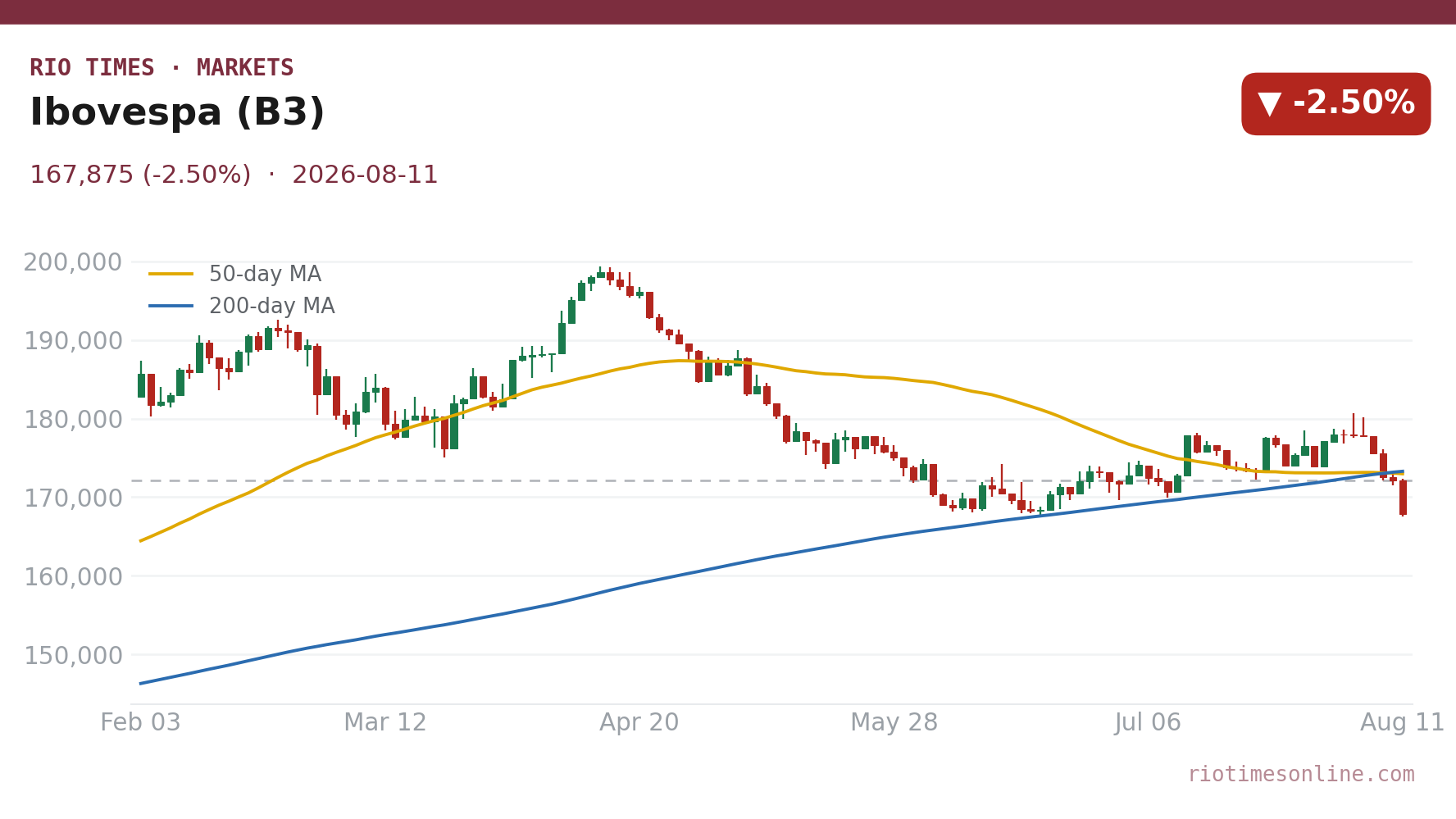
The Ibovespa’s sixth consecutive down day has dragged it firmly below its 50-day moving average, with the 52-week low now within plausible striking distance if the US data surprises to the upside. The Merval in Buenos Aires, often a sentiment-driven chart, is testing a psychologically significant support zone, and a failure here could trigger a sharp, fast move lower towards the year’s worst levels given the index’s high beta.
The Mexico City IPC, despite falling, is holding up much better on a relative basis against its regional peers, trading within a structured range rather than breaking down. The standout technical signal remains the COLCAP’s rare rally—if that index can build on Tuesday’s strength and push through the next resistance level, it could attract momentum-following cross-border funds seeking a rotation play within the Andean bloc.
07 What to watch
- US core PPI and jobless claims: today’s 12:30 GMT release will either validate or challenge the Fed’s cautious stance, instantly moving all five Latin American currency crosses and setting the equity tone for the rest of the week
- Argentina CPI print: the 19:00 GMT release is expected to show persistent price pressures; any deviation from the consensus will drive the Merval and the parallel currency market into a sharp move either way
- Brazil’s retail sales and business confidence: the 12:00 and 14:00 GMT releases will test the thesis that the economy is cooling just as the central bank pauses its easing cycle, a critical input for Ibovespa bottom-fishers
- Chile’s monetary policy minutes: the mid-session release in Santiago will be scoured for clues on the pace of rate normalization, directly affecting the IPSA’s interest-rate-sensitive financial and retail stocks
Frequently Asked Questions
Why did Argentina’s Merval drop so hard?
The Merval plummeted as traders dumped Argentine equities before today’s official inflation report, which is expected to show a stubbornly high annual rate that will complicate the central bank’s policy path and potentially widen the dangerous spread between the official and parallel exchange rates.
What is the Selic and why does it matter for foreign investors?
The Selic, Brazil’s benchmark interest rate, is the main tool of the country’s central bank to control inflation. For a foreign investor, a higher Selic attracts dollar inflows because it pays out more in local bond yields, but the recent cuts to 14% are narrowing that premium and weakening the real, which can reduce foreign returns when converted back to dollars.
Why is the US PPI data so important for Latin America today?
The US producer price index is a key inflation gauge watched by the Federal Reserve. A higher-than-expected print signals the Fed may keep interest rates higher for longer, which typically strengthens the US dollar and pulls hot money out of riskier Latin American equity and currency markets.
What makes Colombia’s COLCAP the standout performer?
The COLCAP index rose firmly in a session where every other major regional index fell, suggesting that local institutional buyers or foreign value investors are selectively rotating into Colombian stocks, which had previously lagged behind the recovery seen in Brazil and Mexico earlier in the year.
This article was produced by The Rio Times’ automated newsroom system. How we use AI · Report an error
LatAm Markets: Live Signals → — real-time movers, turnover leaders and FX across Latin America.
The Rio Times · Power Map
See who really holds power in Latin America
Click to open the Power Map →