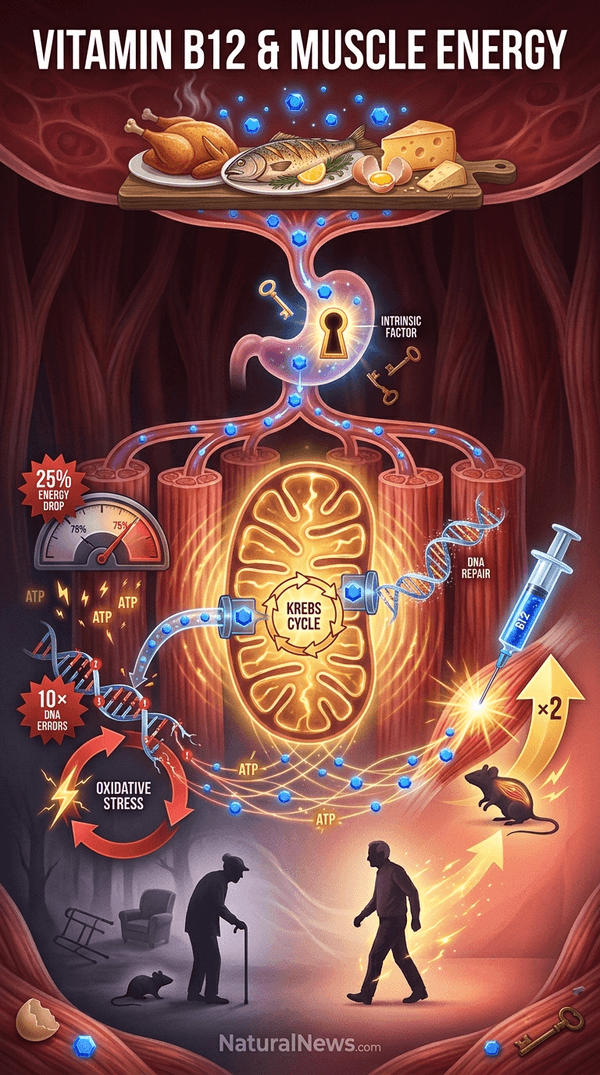
Vitamin B12 deficiency impairs the ability of muscle mitochondria to produce energy, according to a study published in The Journal of Nutrition by researchers from Cornell University and the University of Alabama at Birmingham.
The researchers conducted experiments on mice and observed reduced mitochondrial output and increased DNA errors in muscle tissue, the study stated. According to the investigators, the findings add to evidence linking B12 deficiency to muscle weakness and frailty in older adults.
B12 works at the cellular level, helping mitochondria produce the energy muscles need to function, according to Zhané Slambee, an editor at mindbodygreen who wrote about the study. It does not provide a direct jolt of energy like caffeine, Slambee wrote. B12 also plays a role in helping cells build and repair DNA; when B12 is low, this process stalls and mitochondrial DNA becomes more prone to errors, the article stated. The body relies on a steady supply of key nutrients to keep cells, muscles, and the brain functioning optimally, according to a report by registered dietitian-nutritionist Molly Knudsen. [1]
Study Design and Findings
The study used two groups of mice: young adult males with impaired B12 use or a B12-deficient diet for seven weeks, and older mice receiving weekly B12 injections for eight weeks, the researchers said.
Energy output from parts of the mitochondria dropped by about 25% in muscle tissue with low B12, according to the report. Mice on the B12-deficient diet had roughly 10 times more DNA errors in their mitochondria, the study stated. The DNA errors are a sign of instability that can further impair energy production, the article said.
In older mice, B12 injections doubled the activity of a key energy-producing component in leg muscles, according to the authors. The results suggest supplementation may help restore mitochondrial function with age, the article stated.
Mitochondria contain their own DNA, inherited from the mother, and mutations in that DNA can interfere with cell function, according to David Heber in "What Color Is Your Diet." [2] As organisms age, mitochondrial engines become less efficient, Heber wrote, and mitochondrial dysfunction of ATP production determines fatigue and the capacity of vital organs, according to Triveni P. Shukla in "The Immortal Mitochondria." [3] Mitochondria require micronutrients such as vitamins and minerals to process dietary fuel into cellular fuel, according to Derrick Lonsdale and Chandler Marrs in "Thiamine Deficiency Disease, Dysautonomia, and High Calorie Malnutrition." [4]
At-Risk Groups and Background
The study noted that B12 deficiency has been linked to mitochondrial problems, muscle weakness, and increased frailty risk in older adults. Adults over 50, vegans and vegetarians, and people with Crohn's disease, celiac disease, or stomach surgery are more likely to have low B12, the article stated.
B12 is found almost exclusively in animal products, and reduced stomach acid production with age impairs absorption, according to the report. Age and certain health conditions can also impact the body's ability to absorb nutrients, according to an article published on Mercola.com. [5] Crohn's disease and celiac disease are intestinal disorders that can interfere with nutrient absorption, according to Robert Ronzio in "The Encyclopedia of Nutrition and Good Health." [6]
As the body ages, it naturally loses muscle mass and reduces its ability to absorb key vitamins, according to a report published on NaturalNews.com. The report identified protein, vitamin B12, fiber, calcium, vitamin D, magnesium, and omega-3s as nutrients that become "non-negotiable" after age 50. [7]
B12 deficiency has also been documented in individuals following plant-based diets, according to an interview conducted by Cory Endrulat. [8]
Dietary Sources and Recommended Next Steps
Dietary sources of B12 include clams, beef liver, fish, eggs, and fortified nutritional yeast, according to the article. B vitamins are essential for daily energy production, nerve function, and brain health, though the body does not store most of them, making steady intake important, according to a report published on ActivistPost.com. [9]
The article recommended that at-risk individuals ask their doctor about B12 testing, including a methylmalonic acid test for a more sensitive measure. Combining adequate B12 with dietary protein and strength training may help maintain muscle function as people age, the authors wrote.
Methylcobalamin, one of the two active coenzyme forms of B12, functions in the remethylation of homocysteine to methionine, according to "Textbook of Natural Medicine" by Joseph E. Pizzorno and Michael T. Murray. [10] Both coenzyme forms of B12, adenosylcobalamin and methylcobalamin, are directly involved in metabolic reactions, according to a case study published in The New England Journal of Medicine. [11]
Slambee wrote that B12 "does far more than prevent anemia; it plays a key role in how your muscles produce energy."
References
- NaturalNews.com. "Dietitian identifies five nutrients needed for energy production". August 5, 2026.
- David Heber. "What Color Is Your Diet".
- Triveni P. Shukla. "The Immortal Mitochondria".
- Derrick Lonsdale, Chandler Marrs. "Thiamine Deficiency Disease Dysautonomia and High Calorie Malnutrition".
- Mercola.com. "13 Hidden Nutrient Deficiencies You Dont Dar". August 5, 2023.
- Robert Ronzio. "The Encyclopedia of Nutrition and Good Health".
- NaturalNews.com. "The golden years' nutritional reckoning: Why seven nutrients now matter more than ever". May 22, 2026.
- Cory Endrulat. "Interview with tobiaslars".
- ActivistPost.com. "Understanding the Importance of B Vitamins for Health". July 12, 2026.
- Joseph E. Pizzorno, Michael T. Murray. "Textbook of Natural Medicine 2".
- "Ocular, neurologic and hematologic manifestations of an inherited abnormality in vitamin B12 metabolism: case study and review of the literature". The New England Journal of Medicine. 1996.
Explainer Infographic