 By The War Zone | Created at 2026-10-15 23:00:37 | Updated at 2026-10-15 23:39:24
42 minutes ago
By The War Zone | Created at 2026-10-15 23:00:37 | Updated at 2026-10-15 23:39:24
42 minutes ago
Airbus recently put the demonstrator for its MQ-72C drone helicopter through the paces for the U.S. Army. The MQ-72C has been in development for several years now for a U.S. Marine Corps competition seeking a new uncrewed cargo-carrying Aerial Logistics Connector (ALC). The Marines see uncrewed logistics ‘connectors’ as key to future expeditionary and distributed operations, and a similar Army requirement could be on the horizon, especially to support long-range air assaults.
Jaysen Yochim, Senior Director for the ALC program at Airbus, talked about the demonstration for the Army with our Howard Altman at the Association of the U.S. Army’s (AUSA) main annual convention on Monday. Airbus is currently teamed with L3Harris Technologies, Shield AI, and Parry Labs on development of this drone helicopter for the Marines, as you can learn more about here.
The current iteration of the MQ-72C is based on the crewed UH-72B Lakota, which is in turn a variant of Airbus’ H145 twin-engine light helicopter. The Army operates crewed UH-72s today, but only in non-combat roles, including counter-drug and border patrol missions, and almost exclusively within the borders of the United States.
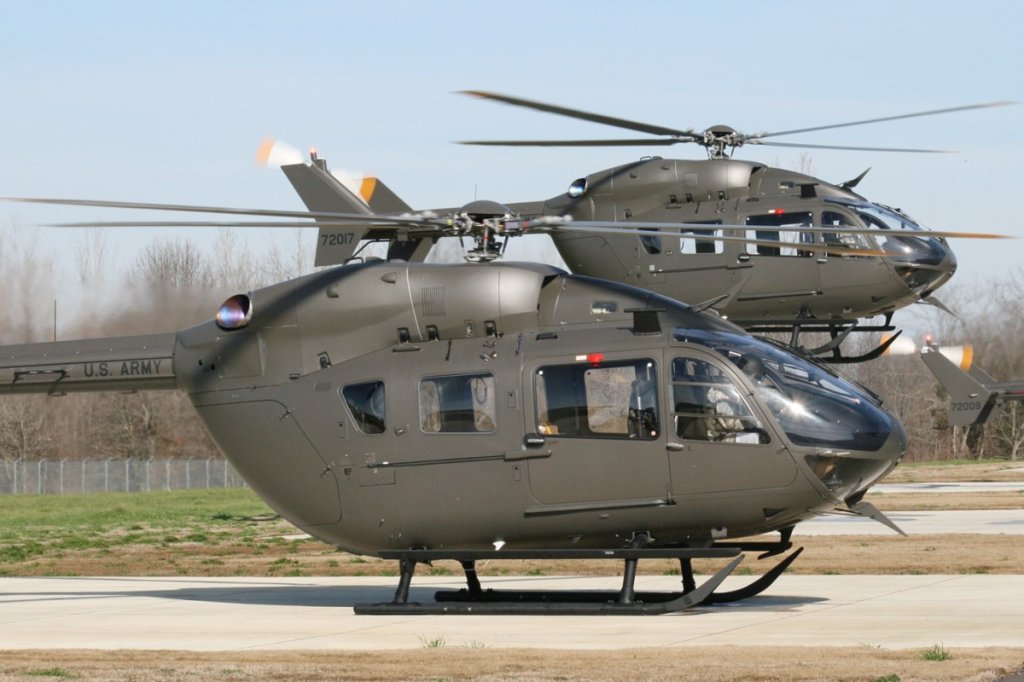 US Army crewed UH-72 Lakota helicopters. US Army US Army UH-72A Lakotas. US Army
The MQ-72C demonstration for the Army, which Airbus self-funded, took place last week at Huntsville Executive Airport just outside of Huntsville, Alabama. The service has a major presence in the Huntsville area, which is focused heavily on supporting aviation and missile developments. As of April of this year, Airbus and its partners had already conducted four rounds of autonomous flight testing of the initial demonstrator version of this design, which is not in a fully uncrewed configuration.
“We did a demonstration for the Army down in Huntsville, really to show all the capabilities that we’ve been able to develop so far on the Marine Corps-funded program,” Yochim said. “We had a total of five demonstration flights that we did down there, showing everything from the autonomous capability of the aircraft in a hover.”
This included “complex hovering patterns, both step turns and fly-through turns, similar to what you’d see on an airfield, to just show how it can be integrated onto an airfield inside of the existing routing structure and everything that exists on an airfield,” he continued. “We did multiple traffic patterns to demonstrate just a normal traffic pattern, like a normal day would be, but also traffic patterns or a flight with a no-fly zone popping up in the middle of the flight.”
The video below shows previous flight testing of the MQ-72C demonstrator.

First Autonomous ALC Flight
In that latter instance, the MQ-72C had to “autonomously make decisions” about how it was “going to route itself around the no-fly zones” once they popped up, he added. The human operator did provide the initial flight plan. There was also a pilot on board during the autonomous flight demonstrations, but only as an added safety margin, and they “never had to take control of the aircraft once,” according to Yochim.
Though the demonstrator now has provisions for a pilot, the intention is for the MQ-72C to eventually operate in a completely uncrewed mode. The current version of the design has two LIDAR sensors, facing front and back, as well as an electro-optical camera at the nose end, to help with navigation and otherwise provide situational awareness while operating in the uncrewed mode.
Those sensors feed “imagery into the flight computer with HiveMind that’s interpreting that through its perception systems to make decisions on the go,” Yochim explained. HiveMind is an autonomy software package from Shield AI, which is in use on a growing number of other uncrewed platforms, as you can read more about here.
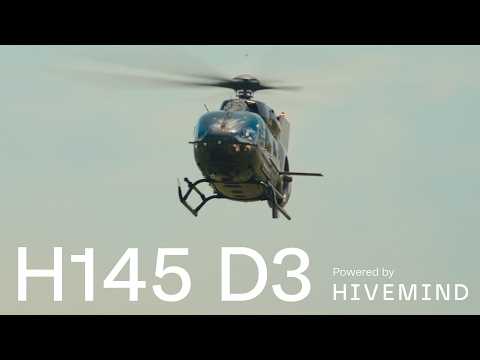
AI Piloted Helicopters | Lakota Connector Powered by Hivemind
Yochim also talked about work that has already been done to start laying the groundwork for controlling the MQ-72C in the fully uncrewed mode. Parry Labs has been leading ground control station work.
“Over the summer is really where now the aircraft, rather than having a pilot inside the aircraft, or sorry, an autonomous operator inside the aircraft, using a gaming computer to tell the aircraft what to do, now the aircraft is receiving commands from a ground control station,” he told us. “That is that human in the loop, sending commands to the aircraft over Starlink, so that it has beyond line-of-sight. We’ve had flights that have been autonomously commanded from up to 70 miles away. All of that is stuff that’s happened in the last year. We also have where the aircraft can be commanded from both a ground control station like this and also with the Samsung tablet.”
SpaceX’s Starlink space-based network and its more secure, government-focused cousin, Starshield, are in increasingly widespread use across the U.S. military for communications and other purposes. At present, Starlink also dominates the commercial market for these services globally. Starlink and Starshield offer highly persistent and robust connectivity that is ideal for uncrewed aircraft command and control operations.
The current MQ-72C demonstrator also lacks certain features that are expected to be found on the final configuration. Plans for a set of clamshell doors at the nose notably still have yet to be realized. The UH-72 design already features clamshell doors at the rear of the fuselage, as seen below. The end goal is for the uncrewed version to have an open pass-through main cabin, offering major advantages for loading and unloading cargo, and doing so rapidly.
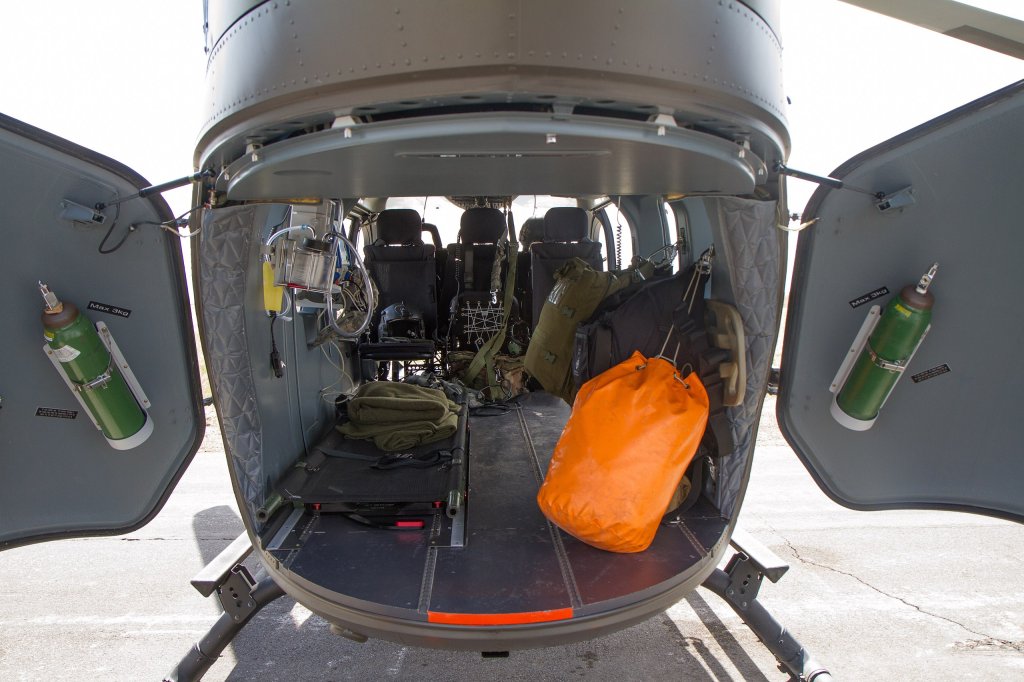 US Army National Guard A look in through the rear of a UH-72A in a medical evacuation configuration. US Army National Guard
The nose door arrangement has been “designed. It’s been 3D rendered. It’s gone through some testing on that end, but not flight testing,” Airbus’ Yochim told us. “The flight testing, wind tunnel testing, things like that, take time, and it’s just not been the priority to get there with getting the aircraft ready.”
Yochim said that Airbus is now looking toward the 2029-2030 timeframe for integrating the nose doors. This is tied, in part, to the Marine Corps’ ALC program, where delayed funding has shifted the schedule to the right. On that front, the Marine Corps is aiming for demonstration of this capability in an operationally relevant context next year. The Airbus-led team is also not the only one under contract for that program, with Near Earth Autonomy and Honeywell are also working on a design based on the Leonardo AW139 helicopter. The expectation is that the Marines will eventually pick a single ALC design to actually acquire.
In the meantime, Airbus is clearly eyeing other opportunities, including with the U.S. Army. The company’s main arm in Europe is also now pitching a functionally identical U145 drone helicopter based on the current generation H145 design.
Airbus did the “demonstration to just show the Army the capabilities that we’ve been developing with the Marine Corps,” Yochim told us. “So the Marine Corps has been funding the program up to now, and so the message we are giving the Army is this is how far your sister unit [sic; service] has been able to get us with the funding that we’ve had. It’s already product that’s out there. It’s already product that’s working.”
As mentioned, the Marines see ALC as part of a larger family of uncrewed logistics ‘connectors,’ in the air and on the surface, which will be critical to supporting expeditionary and distributed operations involving units spread across far-flung forward locations. The service sees this as particularly central to an island-hopping campaign scenario in the context of a larger potential high-end fight with China in the Pacific, where traditional logistics chains will be top targets. The conflict with Iran has only underscored how disruptive those threats can be.
The Army is facing many of the same kinds of future operational scenarios, especially when it comes to supporting future airmobile operations. The service is already expecting air assaults to take place over far greater distances in the future thanks to the introduction of the MV-75A tiltrotor. Those units will need to be supported once they arrive at their objectives, which could be heavily contested.
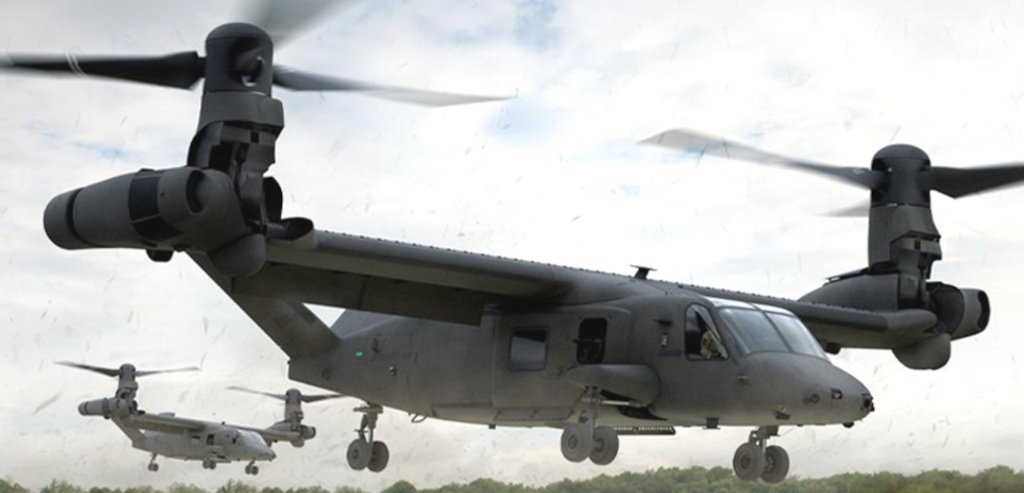 A rendering of a pair of MV-75A tiltrotors. Bell
 “We did several [air assaults] over the last few years directly from Fort Campbell to the Joint Readiness Training Center, which is 500 miles, give or take. The [Marine Corps’ MV-22] Osprey can do that very fast and in one leap,” Army Maj. Gen. David Gardner, head of the 101st Airborne Division, told our sister site Task & Purpose at AUSA. “Our current helicopters, you’ve got to make some fuel and re-arming stops along the way, and the distance isn’t there. But now that helped us think through as a division how we were going to command and control something that moved, expanded our battlefield, so to speak, twice as far, three times, four times as far, and twice as fast.”
The 101st is the Army’s premier air assault formation and is set to be the first to fly MV-75As operationally.
“We can put some things inside the helicopter, and we can put some things under a helicopter with a sling load. We’re not going to sling load something moving 250-ish knots for 500 miles. We’re not going to hang Humvees under that,” Gardner also told Task & Purpose. “We learned some things about how we need to get our equipment to the battlefield, how we need to get our sustainment to the battlefield at those distances, how we might need to rely on autonomous logistics delivery systems.”
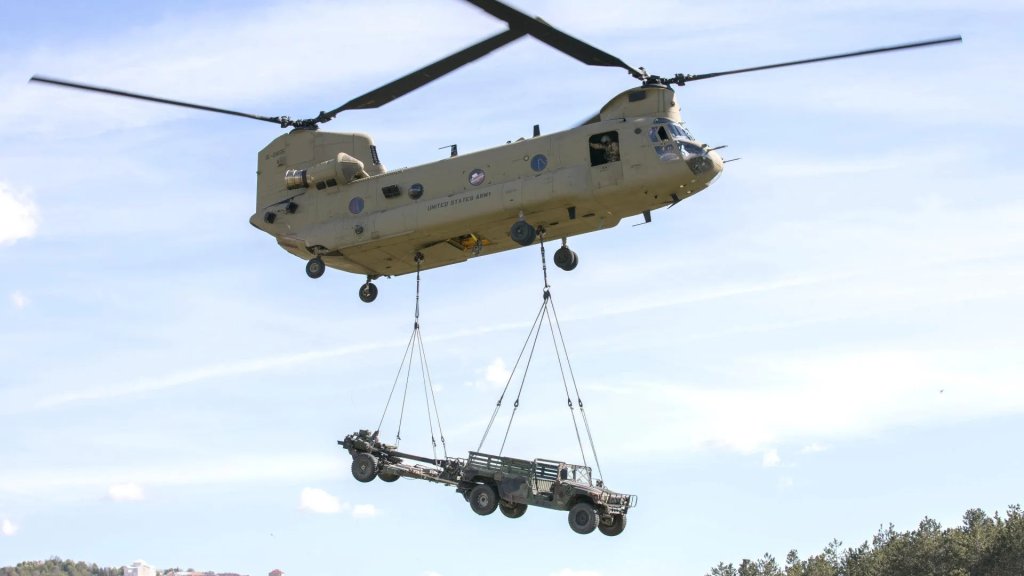 A US Army CH-47 Chinook helicopter seen carrying a Humvee and an M119 105mm towed howitzer slung underneath. US Army
 It should be stressed that the market for semi-autonomous aerial logistics support is heating up, and that the MQ-72C is not the only option to meet such a requirement. As noted, there is another competitor in the running just for the Marines’ ALC effort, the AW139-based offering from Near Earth Autonomy and Honeywell.
Last year, Sikorsky, now a subsidiary of Lockheed Martin, revealed that it was working on a fully uncrewed version of the Black Hawk helicopter that also features a clamshell nose. Sikorsky has also been working with Robinson Unmanned on a pilotless version of the smaller R66 helicopter that again features clamshell doors at the front of the fuselage. Bell, together with Near Earth Autonomy, is developing an uncrewed cargo-carrying version of its Model 505 Jet Ranger X, as well. The drone versions of the R66 and Jet Ranger X are aimed primarily at another Marine Corps ‘connector’ program called the Medium Aerial Resupply Vehicle-Expeditionary Logistics (MARV-EL).

Introducing the S-70UAS™ U-Hawk™

Robinson Unmanned | The Future of Autonomous Rotorcraft is Here
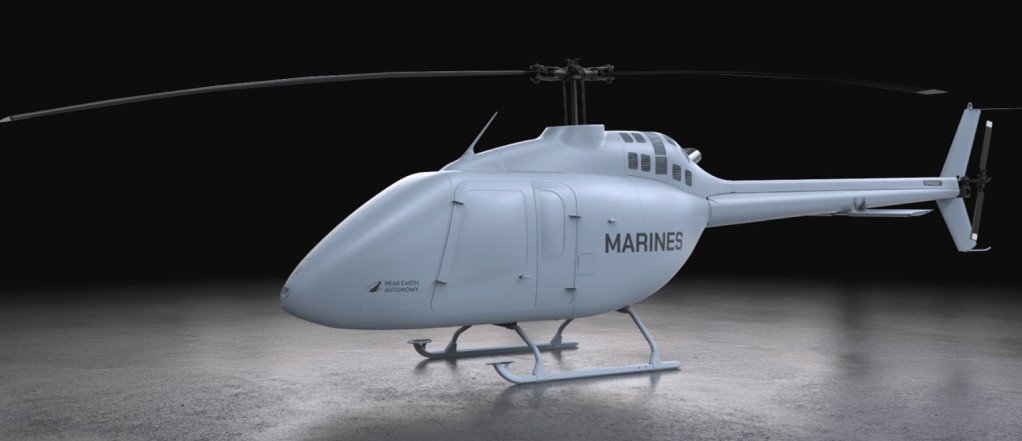 A rendering of the uncrewed Bell 505. Near Earth Autonomy
 As mentioned, the Army does already operate crewed UH-72s, but it also flies Black Hawks. The service is also expanding its use of contractor-operated R66s for pilot training.
The Army does not appear to have formalized any requirement for a cargo-carrying drone helicopter yet. At the same time, the comments from Maj. Gen. Gardner certainly suggest one may be emerging now.
There was at least enough interest within the Army already to accept Airbus’ offer of a demonstration of its MQ-72C last week.
Contact the author: [email protected]