By CryptoSlate | Created at 2026-10-16 16:21:52 | Updated at 2026-10-16 16:53:37
33 minutes ago
By CryptoSlate | Created at 2026-10-16 16:21:52 | Updated at 2026-10-16 16:53:37
33 minutes ago
MSCI approved rules threatening Strategy's index membership as its shares trade nearly 69% below their peak.
On Oct. 15, the global index provider announced that it would adopt a new methodology excluding companies classified as non-operating businesses from its Global Investable Market Indexes. The changes take effect after the Nov. 30 market close, with the final list of affected companies scheduled for Nov. 11.
The decision puts Michael Saylor's Bitcoin treasury company at risk of losing access to billions of dollars in index-linked investment at a time when its stock has suffered one of its deepest declines since it adopted Bitcoin as its primary treasury asset in 2020.
Strategy's MSTR faces MSCI threat
MSCI had already identified Strategy, Japan's Metaplanet and uranium investment company Yellow Cake for potential deletion in an August simulation using May financial data. Ethereum treasury company SharpLink was also among three firms placed on a proposed watchlist.
MSCI will first assess whether a company has substantial operating assets. Companies that fail this initial screen will face five financial-ratio tests; being flagged on at least four makes them ineligible. Existing constituents must fail the eligibility screen in both of their two most recent annual filing periods before removal. MSCI may also use the most recent interim filing.
The framework replaces interim restrictions targeting companies whose digital assets represented at least 50% of their total assets. MSCI had abandoned an earlier outright exclusion proposal in January before expanding its review to businesses whose activities resemble investment vehicles.
For Strategy, the decision revives a threat that executives had spent months challenging. In September, the company argued that excluding Bitcoin treasury businesses would undermine MSCI's neutrality and impose an arbitrary distinction between operating companies and investment vehicles.
A chart shared by market commentator Mark Harvey, based on Yahoo Finance daily closing prices, puts MSTR 68.7% below its running high over the period shown. It also shows a drawdown exceeding 80% earlier in 2026 and a previous low of 89.3% below the running high.
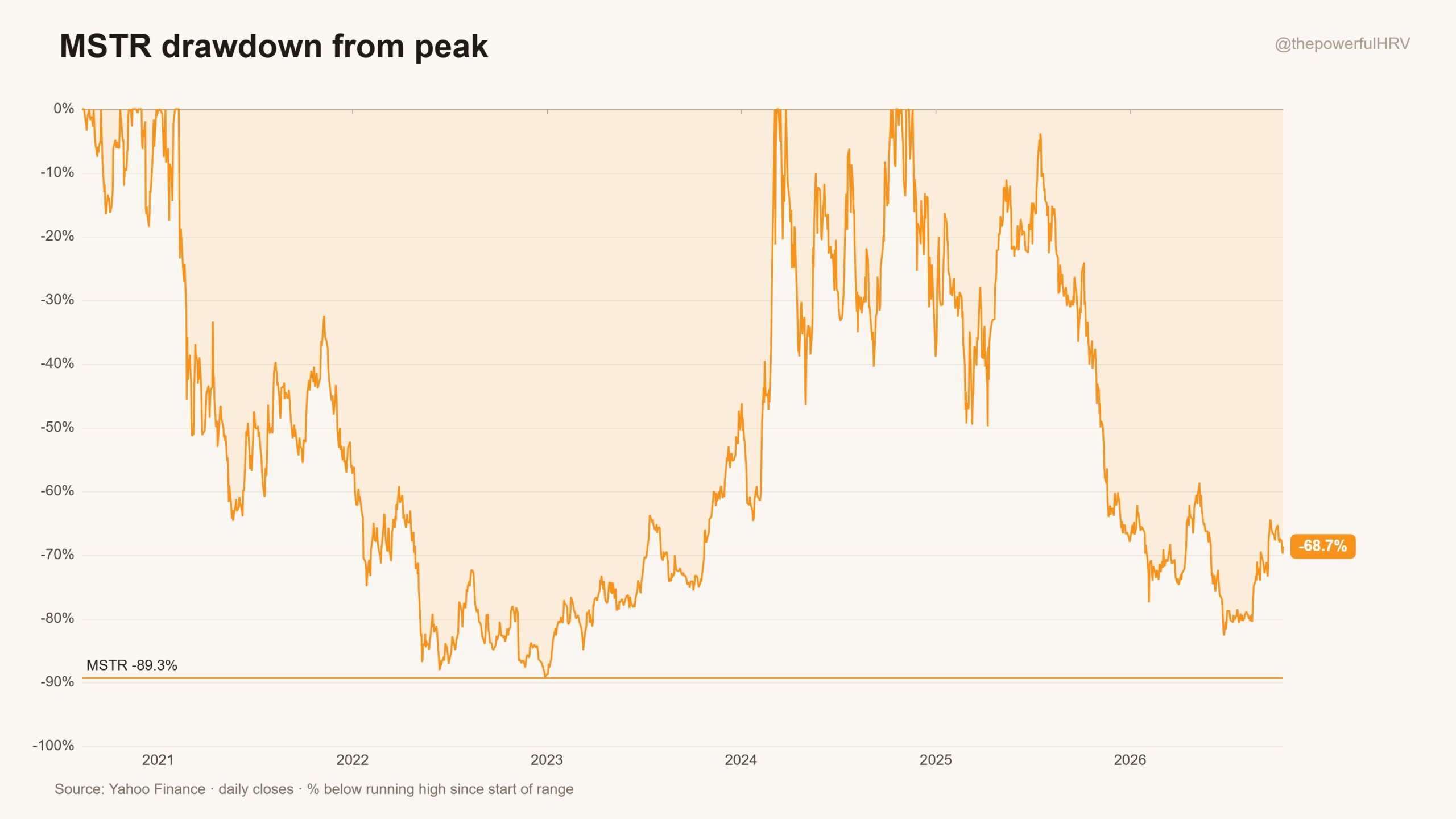 Chart Showing MSTR Drawdown From Peak (Source: Mark Harvey)
Harvey described the depressed valuation as a generational buying opportunity, reflecting expectations that the company's long-term Bitcoin exposure could outweigh its current difficulties.
JPMorgan analysts estimated in November 2025 that MSCI removal could trigger approximately $2.8 billion in passive selling of MSTR shares.
Strategy's Bitcoin financing model faces another test
Market observers disagree over how severely MSCI-related selling would affect Strategy, particularly given the stock's substantial trading volume.
Bitcoin analyst Adrian Morris argued that predictions of a destabilizing selloff overlook the liquidity available in MSTR shares.
According to figures he shared, Strategy generated approximately $565.25 billion in dollar trading volume this year, averaging $2.91 billion daily and $13.79 billion weekly. Trading volume reached $15.29 billion during the week ending Oct. 9.
At those levels, JPMorgan's $2.8 billion selling scenario would represent approximately 96% of one average trading day's volume, 18.3% of the previous week's trading and just 0.5% of year-to-date turnover.
Morris said these figures suggest that index-related selling could be absorbed through normal trading activity and scheduled portfolio rebalancing without creating an existential liquidity problem.
His assessment broadly aligns with Strategy's September submission to MSCI, which estimated that funds tracking the provider's indexes held around 13 million MSTR shares, equivalent to just 3.1% of its basic shares outstanding.
That exposure represented approximately 60% of Strategy's average daily share trading volume over the preceding 30 days, according to the company.
The immediate effect would depend on demand for MSTR shares during the rebalancing period, particularly if investors adjusted positions ahead of the formal exclusion.
Nic Puckrin, CEO of Coin Bureau, identified a potentially larger risk involving Strategy's ability to finance future Bitcoin purchases.
He warned that sustained selling could compress the premium at which MSTR trades relative to the value of its Bitcoin holdings, weakening a mechanism that has supported the company's aggressive accumulation strategy.
Strategy has historically benefited from issuing common stock at valuations above its underlying Bitcoin net asset value. That premium allows it to raise capital for additional purchases on more favorable terms, potentially increasing Bitcoin exposure for existing shareholders.
A sustained reduction in the premium would make future common-stock issuance less attractive and could force greater reliance on preferred securities, debt or existing liquidity.
In its latest disclosure, the company reported acquiring just 250 BTC for $21.5 million during the week ending Oct. 11, funded primarily through $21 million raised by selling common shares.
During the same period, Strategy spent $192.4 million repurchasing its STRC preferred stock, considerably more than it allocated to Bitcoin acquisitions.
The transactions brought Strategy's holdings to 848,250 BTC, acquired for approximately $64 billion, while its dollar reserve stood at $4.88 billion. The company also reported an additional $640.5 million in cash available for broader treasury purposes.
MSCI will publish the final constituent changes on Nov. 11. If Strategy is removed, index-tracking funds would rebalance for implementation at the Nov. 30 close.