By The Straits Times | Created at 2026-10-04 21:01:46 | Updated at 2026-10-04 22:01:38
1 hour ago
By The Straits Times | Created at 2026-10-04 21:01:46 | Updated at 2026-10-04 22:01:38
1 hour ago
BENGALURU – In the last week of September, I joined dozens of people standing in line at a government school in Bengaluru, fretfully clutching paperwork to try and fight to regain my right to vote.
We had all been struck off the voter list for various reasons over the past few months as India conducts a Special Intensive Revision (SIR) in many states to try and “clean up” the voter rolls of inaccuracies and duplications. The exercise has been a cruel, bureaucratic nightmare for millions of Indians.
We had been served notices to prove our identity to a local election officer.
After waiting for 3½ hours, the time was clearly ripe for queue solidarity. Angel, in her 30s, was in the queue with her brother. She asked: “Our notice says our parents’ names are unclear. Yours?”
I told her my reason for deletion was “self-name mismatch”. Apparently, I was listed as Rohini, daughter of Mohan, in a 2002 voter list; but the 2025 list showed me as Rohini Mohan, daughter of Mohan.
The SIR requires people to show that they, or a parent or grandparent, was on a voter roll prepared nearly a quarter of a century ago. Any mismatch or anomaly needs to be explained in person to an election official.
The AI-based software flagging “logical inconsistencies” in voter lists for the SIR could not fathom that the two could be the same.
So who was I, really?
My minor data entry error had not mattered until now. The officials in the polling booths had not doubted it for the 24 years that I had been voting. But today, the error threatens my right to vote and perhaps even my citizenship.
I am one of millions of people in this situation in the world’s largest democracy, many with none of my privileges of time, education and documentation to navigate this quagmire.
Arbitrary deletions, exhausting reinstatements
The SIR has been implemented state by state since late 2025 to clean up voter rolls by removing duplicate and dead names, as well as those ineligible to vote, such as those under 18, foreigners or undocumented immigrants.
Such a nationwide exercise has never been held at this scale, and is in line with Prime Minister Narendra Modi’s increasingly strident rhetoric about illegal immigration.
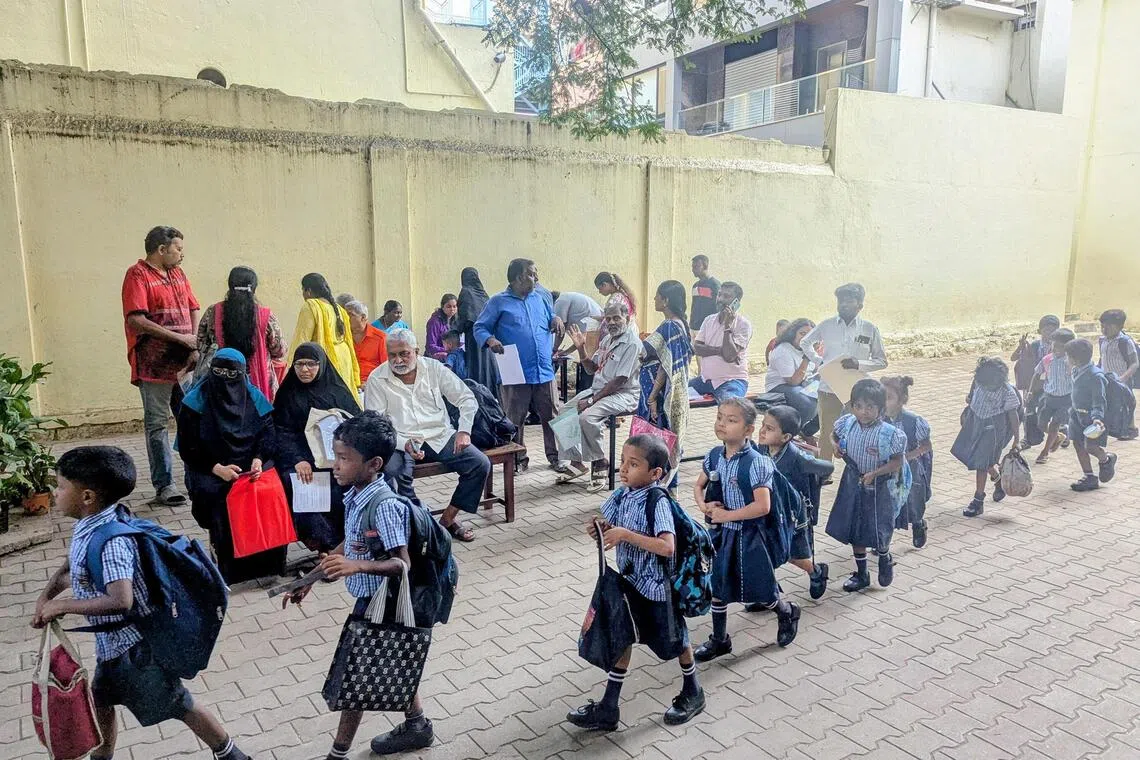
Voters whose names have been flagged for deletion under the Special Intensive Revision in India waiting at a Bengaluru school to get their identification documents verified by election officials.
ST PHOTO: ROHINI MOHAN
The SIR’s stated intent is indisputable, but its execution by the Election Commission of India has been chaotic, arbitrary and exclusionary. A spelling mistake, an inconsistency in an address, a parent’s wrongly estimated age – common paperwork mistakes in India – now have disproportionate consequences.
In just one year, SIR has removed at least 130 million names from draft rolls in 12 states – for instance, a third of Delhi’s voters and 19 per cent of Karnataka’s.
In West Bengal, where the exercise was completed in February, around 2.2 million deleted voters are appealing against their exclusion, which by some estimates will take years to complete.
Around 34 per cent of the deleted names were of Muslims, who tend not to vote for Modi’s Hindu nationalist Bharatiya Janata Party, though they comprise only 27 per cent of the state’s population.
In July, I volunteered with a group of lawyers and professionals to run helplines and camps in Bengaluru’s poorest neighbourhoods to help residents fill up and submit SIR forms.
As we navigated the glitchy online databases of the Election Commission on our laptops to find addresses, constituencies and booth numbers, I found translation errors that turned Tamil names like Sagaya Mary into Sahaya Merry in English. A 53-year-old man’s age was listed as 35. An Iqbal Ahmed, male, was puzzled to find himself listed as Iqbal Bano, female.
When I told 76-year-old Narayanswamy, a retired sanitation worker, that his name was not in the database, he could not believe it. He had voted 20 times including in local body elections; he had to be there.
I tried searching for his name in Kannada and English for 30 minutes, trying various spelling combinations, to no avail.
“Why?” he asked blankly. He sat on the roadside holding his head. “Will this mean they will stop my pension?”
We filed a new voter application for him and hoped for administrative magic.
Losing more than a vote
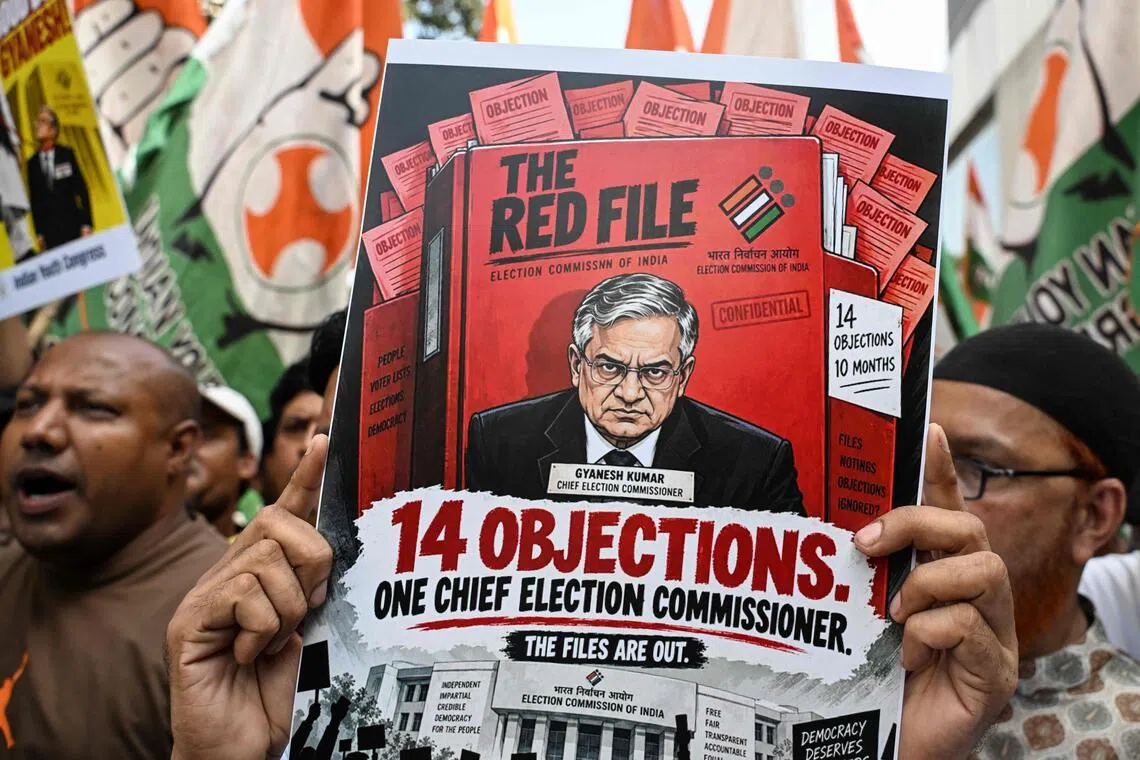
Indian Youth Congress activists shouting slogans against India's Chief Election Commissioner Gyanesh Kumar, demanding his resignation over alleged electoral malpractices in the Special Intensive Revision of electoral rolls.
PHOTO: AFP
For many like Narayanswamy, being a registered voter proves citizenship, which qualifies him for welfare access including subsidised rations, cooking gas, disability payouts or old age pensions.
The SIR demanded at least one of 11 identification documents. When I appeared for my hearing, I had two: my sepia-tinted 10th grade marks certificate that had not seen the light of day for two decades; and my navy-blue passport with stamps of visas to 14 countries, all of which believed I was an Indian citizen more readily than my own.
Many in line did not have even these documents. As I helped a young man – whose entire family had been deleted over age discrepancies – sort out his thicket of paperwork, he said: “This is torture. And what is the point?”
The crude and chaotic SIR system has eroded many people’s faith in the Indian election system, once celebrated as the country’s most well-coordinated, modern, transparent and inclusive process.
The Election Commission, once lauded for having officials scale mountains and cross rivers with ballot boxes to leave no voter behind, is gaining a reputation for callousness.
The day before my hearing, The Indian Express newspaper reported that the Chief Election Commissioner of India, Gyanesh Kumar, had pushed through decisions that disadvantage voters and disempower local election officers, despite his two colleagues’ opposition.
The commission itself has been accused by opposition parties and former election officers of favouring the ruling BJP in previous elections, and maliciously failing to address simple concerns to make the SIR process fairer and easier.
After the news report sparked outrage, the commission announced that some complaints would be addressed.
If nothing else, the shared misery is making philosophers of us. A fellow journalist shared a quote by the German poet Bertolt Brecht: “The people/Had forfeited the confidence of the government... Would it not be easier/in that case, for the government to dissolve the people/ and elect another?”
I thought of the quote as I submitted my documents and stood for the mandatory photograph with the election officer. None of us smiled.
When I left the room, I wished Angel all the best.
“Hope to see you at the next election!” she said, with a cheery optimism that is as Indian as it gets.