By Literary Hub | Created at 2026-06-23 10:41:40 | Updated at 2026-06-23 17:09:06
7 hours ago
By Literary Hub | Created at 2026-06-23 10:41:40 | Updated at 2026-06-23 17:09:06
7 hours ago
The black-and-white booklet is meant to fit easily in a pocket or slip into the palm of a polite stranger, anyone whose willingness to make eye contact left them open to learning about race relations in America. On the cover are two men in suits sitting across from one another at a desk, one white and the other left open to interpretation. All our infinite shades of Blackness reduced to subtle crosshatching and a best guess. The inside is flip-book advocacy, a gallery and guide to challenges like “industrial relations” and “racial tension” softened through sparse mid-century modern illustrations. The Minneapolis Urban League wanted the message to be clear, but nonthreatening: “To improve the social, economic and spiritual conditions among Negroes thru…Interracial Co-operation” read the cover.
Article continues after advertisement
I developed the habit of snapping photos of the documents and clippings I uncovered during my time in various archives, at least the ones I could get access to in the winter of the first year of COVID. Taken alone, it was startling enough to see a plea for the humanity of Black folks sung in the same tune as a 1940s postcard for a motor lodge that promises color TV. There was a ring of something familiar in the visual language of the booklet, Black and white coming together for a literal fair shake.
In this new phase of “interracial cooperation,” what would be the cost to Black families for finding people who believe in your right to exist?
I, too, had been fed a diet of this marketable harmony from a young age. I’d even played a part in the campaign. My Auntie Carla had discovered a photo of me, the high-tops and baggy polo said it had to be my high school years, sitting with a perfectly diverse coalition of teens chatting with Mayor Sharon Sayles Belton in the 1990s. I couldn’t remember why I was there or what was discussed. But all of us were clearly there to help tell a story. The same one in brochures for after-school programs, bus ads for clinics, the campaign literature that inundated mailboxes in election season. The settings and causes might have changed, but it was always the same cast of characters, the rainbow connection of humanity working together for some cause greater than all of us.
But the Urban League’s guide to interracial cooperation from the 1940s was an artifact from the era when it was critical to find willing partners who could support equal rights not just in theory, but in the practical world. The decade that saw the end of World War II and the beginning of America’s expansionist era at home was the unfolding of a liberal dream made real, a government that could wrap its arms around Americans and help create enough stability for the country to find its way out of the Depression. Whether that prosperity would be shared among all Americans was another matter entirely.
Waves of new families would join the Great Migration following the war and make the complication of Black life harder for northern cities to ignore. In 1940 Chicago’s Black population was more than 277,000; Detroit’s was 149,000. In Minneapolis that number was 4,646. Statistically we were a blip.
If the laws of the state said Minnesota did not discriminate, the reality gave up the lie. In Minneapolis jobs for Black workers were scarce outside the service industry and the patriotic desperation of wartime hiring. Harassment by police was common for Black families and their Jewish neighbors. For the Black families that found their way into the middle class, buying a home was nearly impossible.
In the origin story of progressive politics in modern Minneapolis, these years were a crucible. Black workers would begin to find a home in the city’s labor movement and the Democratic Party. Benevolent capitalists would take up the cause of fair housing. The city would attempt to reconcile the ways it failed Black families by embracing the nebulous and seemingly race-blind concept of “human relations.” It would attempt to analyze its way out of segregation.
All this was made possible through newfound allies in the fight for equal access to the American dream. These were the good whites that had been promised. The question remained, how committed were these allies to the cause of improving “the social, economic and spiritual conditions among Negros,” and what would they be willing to sacrifice in the fight? The simple math in Minneapolis meant Black folks could not ensure their own future. But in this new phase of “interracial cooperation,” what would be the cost to Black families for finding people who believe in your right to exist?
*
If you found yourself inside the corridors of the Curtis Hotel or the Minneapolis Athletic Club in the 1930s, you could see the wealth of this city as it began to crest. The Curtis occupied a city block, a sprawling classical-revival-style hotel complex, billed as “the largest in the Upper Midwest.” Down the corridors you would find lounges and a coffee shop before stepping into the East Ballroom, with its Kimball pipe organ for wedding receptions, award dinners for insurance underwriters, or the receiving line of the Swedish Society of Minneapolis.
While working as a waiter at the Curtis Hotel, Anthony Cassius discovered that white waiters were making $50 more a month than the Black wait staff. This was likely not a shock to him. Cassius had found work in hotels early on in life after coming up from Oklahoma with his brother at the age of thirteen. He got his start cleaning spittoons and toilets at the Merchants Hotel in St. Paul while sleeping on a mattress in the basement. But if he were to fight for equal pay, Cassius knew he would have to do things by the book, and that meant first making his case to the Hotel and Restaurant Workers Union at the hotel. They waived him off. Minneapolis had gained a reputation as a union town following the Teamsters battle to unionize in 1934, where a general strike spiraled into open street fighting that left more than sixty unarmed union members wounded and two dead. The Teamsters eventually won recognition and better wages. But protections like these were rarely extended to Black workers, as most unions froze out minorities.
That willingness to admit Black members was not universal among unions within the city or the state. It was imperfect, but it was a start.
Cassius formed a union at the hotel specifically for Black workers and sued the Curtis Hotel for back pay. Around the same time he began meeting up with other workers who had been marginalized or otherwise left outside the bargaining table. In 1935 Cassius’s group broke bread with the Bulgarian-Macedonian Workers Club and the Swedish Workers Club, and not long afterward they decided to form Local 665 of the Hotel and Restaurant Workers International Union, one of the earliest integrated unions in the state. Cassius found a home with radical labor activists, lawyers who were sympathetic to Black workers at the Curtis, even an alliance with the Teamsters. His show of strength and solidarity worked; in 1940 the hotel agreed to the wage increase for Black waiters along with $3,500 in back pay. Interestingly this received little mention in the city’s daily newspapers, the exception being the Black press, where the news was given the front-page treatment worthy of such a significant victory: “WAITERS WIN $13,000 RAISE.”
It felt like a fertile time to be organizing in Minneapolis, particularly if you found yourself on the lower rungs of the caste system within Minnesota. The jobs that were available for Black people in Minneapolis were merely an echo of the near past; the corridors of the big house had been traded for paying customers. For Jewish workers it was only marginally better. Minneapolis was quickly gaining a reputation as an outpost for antisemitism in the new west. This is why an integrated union was possible, a place where Black workers, Jews, and Eastern European immigrants whose English put them outside the bounds of politeness could come together to raise the prospects of everyone. Socialist, communist, they all found cause together. They occupied the same space in the back of the house. All they had was bad pay and little else to show for it, all the while catering to a class of politicians and bank presidents who would not otherwise give them the time of day. Solidarity became a numbers game.
A similar scene to the organizing at the Curtis was playing out blocks away at the Minneapolis Athletic Club. Billed as a mens club dedicated to fitness, the fourteen-story building became a gilded clubhouse. The lobby was wainscoted in lush mahogany, and the ceilings above had recessed panels in ivory and bronze tones to evoke an earlier Greek empire. Walking the entirety of the building you would find squash courts, a bowling alley, and an underground pool. On the thirteenth floor sat the four-hundred-seat dining room, surrounded by columns running from the floor up to a spectator deck where you could take in the full scope of the night’s entertainment. Money walked the hallways, made itself comfortable in the lounges, reveled in the company of friends. And behind the scenes, in the elevators and kitchens and basements, you would find the people who kept it all running. The porters and coat check attendants, the service elevator operators, all Black. The waiters and maids, the managers who ran departments, white. “Black departments” is the phrase some would start to use to describe the status quo. An informal label for the segregation that existed absent any outright laws. They ate lunch in separate spaces when the day started, and by the time it ended they changed out of uniforms in their own spaces.
Nellie Stone Johnson was a service elevator operator at the Minneapolis Athletic Club when she was approached by George Naumoff, a Greek worker who operated the freight elevators at the club. He had been conspiring with Cassius about the idea for the integrated hotel workers union, and they needed more people to join the cause. There were a number of reasons Johnson was the person to see when it came to organizing. She was the daughter of Black farmers who had organized a farming cooperative in Dakota County, twenty miles south of the Twin Cities. During a time studying at the University of Minnesota, Johnson had just as much interest in the meetings with young socialists and communists as she did in the classroom. She was curious and had a talent for bringing people together. At the athletic club her job as an elevator operator meant that a day spent riding between floors would put her face-to-face with just about every Black worker in the building. This face time gave her a chance to make the union pitch.
Like Cassius, Johnson found something tangible in unions. Joining Local 665 gave her the leverage she needed to help raise wages for Black workers as well as women at the athletic club. Johnson was elected vice president of Local 665 in 1936, a move that elevated her into statewide union discussions for restaurant and hotel workers. Here she could sit at the table and help dictate the terms of life for Black workers. It was real agency, none of the well wishes and pantomime of philanthropy. That willingness to admit Black members was not universal among unions within the city or the state. It was imperfect, but it was a start.
_______________________________
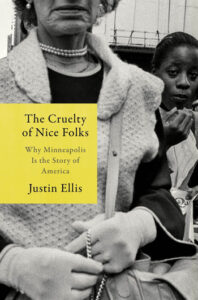
From The Cruelty of Nice Folks: Why Minneapolis Is the Story of America by Justin Ellis. Copyright © 2026 by Justin Ellis. Published by Harper, an imprint of HarperCollins Publishers. Reprinted by permission.