By Literary Hub | Created at 2026-08-18 09:52:06 | Updated at 2026-08-18 12:41:24
3 hours ago
By Literary Hub | Created at 2026-08-18 09:52:06 | Updated at 2026-08-18 12:41:24
3 hours ago
Shakespeare and friends would call punctuation “distinctions,” according to the Latin tradition, or “pointing,” because of the medieval practice of placing dots or points at different levels of the line. The first occurrence of the word “punctuation” happens in the French dialogue book Orthoepia Gallica from 1593 by translator and language teacher John Eliot, whose funny and colloquial conversations in facing columns on the page influenced Shakespeare’s witty repartee. Eliot challenges London French teachers to “find fault” with his “pricks, nicks, and tricks,” referring to his punctuation and rhetoric.
Article continues after advertisement
He was certainly a flamboyantly creative writer and inspired teacher; yet one can take him seriously here: “Pricks” performed “tricks” as punctuation became a vehicle to think about the technological revolutions of the time, gender relationships, and literary genres reflecting social and historical concerns like kingship or geographical exploration.
Punctuation was also a channel for exploring interior worlds: the mind, memory, emotions. Particularly when something wasn’t working quite right: In a society that prized eloquence above all else, writers became more interested in depicting the delay, interruption, or even failure of speech rather than its glorious fullfilment. Perhaps the sons (and some daughters) of the humanists hesitated to put their faith in language quite as much as previous generations had.
Yet, considering how his own life was cut short so tragically at the height of his social and literary success, it’s hard not to entertain interpretations of the interrupted sentence as an eerie omen.
And perhaps it was precisely the opposite: Writing had become so powerful at expression that it could now subvert itself without losing any of its magic. One such master of consciously suspended speech was the uncontested king of brackets: Sir Philip Sidney.
On October 16, 1586, a young man writes a desperate letter to his friend: “My dear Weyer: Come. Come. My life is in danger and I long to see you.” Weak from the festering wound in his thigh, he scribbles those few lines in a shaky, hardly legible hand. Will the famous doctor be able to save him? When Weyer arrives the next day, the letter writer is already dead. Sir Philip Sidney, courtier, poet, and fervent Protestant soldier under Queen Elizabeth I, had been fighting Catholic Spain in the Netherlands when a bullet struck him, burying itself deep in the flesh of his thigh. The life of the dazzling superstar of Tudor high society was cut short, at the age of thirty-one, in a way eerily mirrored by his own writing: Just before leaving for his holy war, Sidney interrupted the epic story about erring knights, which he had been working on for years, in the middle of an exciting battle, leaving the action hanging mid-sentence. On a parenthesis.
Anaxius lept away. Whereat ashamed (as having never done so much before in his life)
Readers, like the sentence and the plot, are on tenterhooks about what comes next. The work, of course, remains unfinished, although the parenthesis’s open-endedness functioned like a magnet for countless later writers, inviting them to graft their versions of how the book should continue. Sidney was merely following a common composition practice of pausing mid-sentence or mid-matter, only to use the parenthesis as memory springboard when it was time to pick up the pen again (or quill rather).
Yet, considering how his own life was cut short so tragically at the height of his social and literary success, it’s hard not to entertain interpretations of the interrupted sentence as an eerie omen.
Irrespective of his death in parentheses, Philip Sidney wielded the two typographical boomerangs with aplomb in his brilliantly stylish and dizzyingly chaotic Arcadia. Two princes meet two princesses, and much drama ensues, including multiple disguises, poetry competitions, shipwrecks, abductions, a climactic court case, war, and, much, much more dangerous than all of those adventures combined: love and lust. There are shepherds, pirates, kings, queens, and love triangles (polygons?) en masse, including amorous escapades involving men dressed up as Amazons (don’t ask, just read it). What’s not to like?!
To make matters messier for the Arcadia’s characters, readers, and future editors, Sidney produced two substantially different versions of the story, one between 1577 and 1581 and a revised (some would say completely new) work between 1581 and 1584, shortly before setting off across the channel to his untimely end. In 1590, four years after Sidney’s death, his best friend, Fulke Greville, published the “new” Arcadia with its abrupt cutoff.
In 1593, Sidney’s beloved sister Mary brought out a rival work in a bigger and more luxurious format, starting with the “new” version and attaching a heavily edited finale drawn from the old version, resulting in a clumsy, incongruent centaur nobody liked. Crucially, though, in the parts of the new and old Arcadias that correspond, nearly all 2,400 brackets are identical. We don’t have a definitive Sidney autograph (a manuscript written by himself) of one fused final version, so this is as good as it gets concerning his own punctuation. Sidney was clearly an enthusiastic bracketeer.
On the one hand, the parenthesis is disposable. It’s useless. Stuff. Waste.
While there were contemporary writers who also heavily implemented parentheses, none did so as much or as well as Sidney did. The popularity of his Arcadia helped spread both the use of brackets and the perception of their sophistication. After all, the Renaissance loved intricate structures of all kinds, from architecture to fabric patterns to language. The more complicated the better! Philip Sidney’s brackets provided a blueprint for elevated expression, and writers loved imitating him.
Some, in fact, felt so inspired by the provocative unfinished sentence that they picked up the narrative thread of the new Arcadia from where Sidney had left off! Gervase Markham published an ending in 1607, and Sidney’s niece Lady Mary Wroth (the Sidney family was amazingly literary) wrote a long, two-part prose novel called Uranian in the 1620s, which also employed her uncle’s trademark parentheses as a sneaky claim to his legacy.
When Coluccio Salutati invented the parenthesis nearly 200 years before Sidney’s consummate bracket art, he rendered visible an age-old rhetorical practice of inserting a particle of a sentence into a greater whole. Remember, the Roman rhetorician Quintilian called it interpositio, drawing attention to putting something in the middle of something else. The question is how long the mini-digression can become without hijacking the main sentence (or story). There was no rule on the length of a parenthesis; it was up to the discretion of the writer to adjudicate appropriate delay.
It makes sense, then, that Sidney’s near-contemporary, the schoolmaster John Hoskins, wrote in his Directions for Speech and Style (1600) that a parenthesis “in extremities” can become a (dis)grace: It can go both ways, depending on how masterfully the bracket is wielded. This paradoxical potential created a certain nervousness in style recommendations. In his 1589 Art of English Poetry, George Putten ham offers an exaggerated example, commenting, “This insertion is very long and utterly impertinent to the principal matter, and makes a great gap in the tale, nevertheless is no disgrace but rather a beauty and to very good purpose, but you must not use such insertions often nor too thick, nor those that be very long as this of ours, for it will breed great confusion to have the tale so much interrupted.” On the one hand, the parenthesis is disposable. It’s useless. Stuff. Waste.
Thrust into the middle for want of wit, somewhere, anywhere. On the other hand, it is “grafted” onto the host sentence, as Puttenham continues, as if it were a branch of another tree that improves on its new stem precisely because it is foreign. The problem is not so much that a parenthesis intrudes on a sentence—it does; there’s no denying it. The question is rather how.
In The Garden of Eloquence, Puttenham’s fellow rhetorician Henry Peacham believes ambling on the syntactic and narrative line is permissible provided that one is “going out from order, but yet for profit of some pertinent sense.” He continues, “We must have a perfect way provided aforehand, that we may go fourth aptly, and making no long tarrying return in again cunningly.” Inserting the insertor requires foreconceit, an inkling of how a sentence or a plot is going to develop. If a writer is going to stray, they should stray strategically, spanning the internal parenthesis like an arch.
The parenthesis cuts, but it also stitches the before and after together again, unfolding left and right from the typographical boundaries of the punctuation mark.
Parentheses, turning the inside of a sentence out and the outside in, ask readers to shuttle back and forth, exercising mental agility that nurtures a flexible set of thoughts and feelings.
At the beginning of the Arcadia, one of the princes, Musidorus, courts Pamela, one of the sister-princesses, by communicating to her that his shepherd apparel is just a disguise. Or at least, he’s trying to tell her as much:
In the country of Thessalia, (alas why name I that accursed country, which brings forth nothing, but matters for trage dies? but name it I must) in Thessalia (I say) there was (well may I say, there was) a Prince (no, no Prince, whom bondage wholly possessed; but yet accounted a Prince, and) named Musidorus.
Why all these parentheses? He could have just said, “In the country of Thessalia there was a prince named Musidorus.” Instead he interrupts himself almost obsessively, trapped in his fake identity, not only in the story but in the sentence too. The bracket interruptions perform the delays he is experiencing in his own life due to his love for Pamela and the disguise he upholds to be able to court her.
Parentheses, turning the inside of a sentence out and the outside in, ask readers to shuttle back and forth, exercising mental agility that nurtures a flexible set of thoughts and feelings. Sidney’s brackets include qualifications of the thrust of the main sentence, comparisons, doubts, metaphors, and examples, all of which dilate the narrative into a complex, three-dimensional woven tapestry, accommodating innumerable opinions and interpretations. The parenthesis in word and deed is an ethical way of life: We pause for thought.
There’s something mysterious about the “little moons,” as Erasmus called them. The moon represents creation and destruction, rebirth, eternity, the feminine, time, marking time, mystery, the night, and secrets. And so does the parenthesis. The convex-concave curves of the open and closed parentheses cup something said by the way, whisperings, secrets mouthed into the reader’s ear, mumbled under the author’s breath.
For Renaissance writers, punctuation belonged to the visual-grammatical and the spoken-rhetorical. Headmaster Richard Mulcaster categorizes parentheses as “creatures to the pen and distinctions to pronounce by”: They’re amphibian in striking out a precarious existence as belonging to both the water of the spoken and the land of the seen. The (two) visual walls make meaning discrete, even as they remain permeable enough for the eye to slip in and out. You can’t overlook a bracket. Yet you can also read right through it. How does one read a bracket? How does one read it out? Mulcaster suggested that “the words enclosed by them are to be pronounced with a lower and quicker voice than the words either before or after them.” Both visually and aurally, then, what’s inside nestles safely between parenthetical palms, protecting tender expressions of intimacy.
Brackets establish a special magic between reader and writer. Perhaps that’s why Sidney used them to dedicate his work to his sister Mary, a gifted translator and accomplished poet in her own right:
Here now have you (most deare, and most worthy to be most dear Lady) this idle work of mine: which I fear (like the spider’s web) will be thought fitter to be swept away, than worn to any other purpose. For my part, in very truth (as the cruel fathers among the Greeks, were wont to do to the babes they would not foster) I could well find in my heart, to cast out in some desert of forgetfulnes this child, which I am loath to father.
Sidney is hedging his words in ever more delaying parentheses. He adds comparisons (“like the spider’s web” and “as the cruel fathers”), classical allusions to Greek myth, and appeals to the reader (“most dear Lady”). Parentheses encase words, keeping vulnerable admissions safe and visually private. An open bracket is always twinned with a closed bracket—the words inside are never left out in the cold; there is never just the waning crescent without trailing its mirrored waxing crescent. The parenthesis is a gentle kind of interruption, stable and predictable and balanced.
Punctuation, it turns out, not only assisted writers and printers in making the reading of drama lively but also promised added value precisely because it was a denizen of the book world.
__________________________________
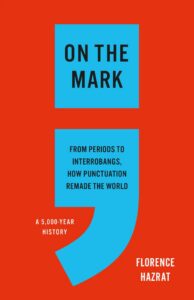
Excerpted from On the Mark: From Periods to Interrobangs, How Punctuation Remade the World by Florence Hazrat, copyright ©2026 by Florence Hazrat. Used with permission of Basic Books, a division of Hachette Book Group, Inc.