By Literary Hub | Created at 2026-08-18 09:52:08 | Updated at 2026-08-18 12:47:20
3 hours ago
By Literary Hub | Created at 2026-08-18 09:52:08 | Updated at 2026-08-18 12:47:20
3 hours ago
It might be the simplest thing I’ve ever done.
Article continues after advertisement
Which is not to say the easiest, because I was hurting from the first minute, and kept hurting through every minute after. Cramps racked my legs. My shoulders, hips, and feet ached even while I slept. I courted hypothermia and heat exhaustion, usually nursed at least one actively bleeding wound, and passed my days bug-bitten, bruised, chafed, and filthy. My beard clumped and knotted into an itchy, feral nest. I reeked with such paint-peeling ferocity that my body’s immune system seemed, in the name of self-preservation, to dampen my sense of smell—and even so, a whiff sometimes snuck past my defenses to nearly knock me off my feet.
I spent my waking hours hungry. My body torched the calories I forced down each day and went scrounging for more, so that I dwindled to a rawboned shadow of myself, a scarecrow of jutting ribs, sunken eyes, hollow cheeks. I craved fats so desperately that I chugged squeeze cheese from the bottle. I saw others do the same with liquid margarine.
At night I writhed with longing. I missed my girlfriend. I missed my family. I missed air conditioning. I missed cold beer and hot showers. I missed freedom from lightning, rattlesnakes, high rock ledges, and toppling trees. And my discomfort and exhaustion and stink and hunger and homesickness rarely waned, for more than five months.
So, no, not the easiest. But wonderfully simple, because all I had to do was something I’d been doing since around my first birthday, and that I’d honed with daily practice over decades. I had only to maintain my balance while putting one foot in front of the other. The whole of my mission was to walk.
I took my first step on a mountaintop in Maine. When my journey ended 157 days later, I’d taken an estimated five million more—and in so doing, had traipsed nearly 2,200 miles across fourteen states. That sounds like a lot of walking, and I’m here to testify that it was; but when that’s all you’re called upon to do, it’s only so big a challenge.
I emerged with a new sense of the vastness, beauty, and hospitality of a country I thought I knew. Turned out I didn’t. It was bigger and lovelier than I realized. More inspiring than I imagined. Kinder than I hoped.
Granted, this was not a smooth, flatland odyssey. My walk took me over the peaks and ridges of the Eastern highlands, on a narrow footpath that rose and fell thousands of feet in the course of an average day. In places, the path nosed up rock so steep I had to hoist myself hand-over-hand; in others, it tiptoed across fields of sliding scree, stumbled through gale and blinding fog high above treeline, and forded rushing streams. It slopped into wallows of loose mud, mazed through boulder fields, and shoved its way past grasping thickets of blackberry, rhododendron, and mountain laurel.
Here and there, the path ran level and soft underfoot, and the walking felt nearly effortless. Far more often, it required gasping toil. It provoked cascades of sweat on frigid mornings. It made my muscles shriek, my knees tremble, my lungs burn. But again, there was just that to do. I didn’t have any complex problems to solve, any thorny decisions to make. I didn’t really have to think much at all: The path was already there. I merely followed it.
Besides, the payoffs eclipsed most of the discomforts I suffered. The trail led the way to windswept heights from which I could gaze down on multiple states at once, into secretive, mossy woods that stretched unbroken and dark for days, and down the main drags of a half-dozen cheery villages. It dropped me into cornfields and barnyards and pastures busy with curious cows, and into close company with bears, moose, snakes, deer, and crazy, wing-thumping grouse that charged me on foot all through the state of Maine. It introduced me to big-hearted humans from every walk of life. I emerged with a new sense of the vastness, beauty, and hospitality of a country I thought I knew.
Turned out I didn’t. It was bigger and lovelier than I realized. More inspiring than I imagined. Kinder than I hoped.
This came into focus bit by bit, as I made my way southward at just over two miles an hour, my pace checked not only by diabolical terrain but by the bag strapped to my back—a pack crammed with the food, water, clothing, and shelter I needed to survive the days and nights between my irregular brushes with civilization. Freshly provisioned, my payload equaled a third of my own weight.
Some days, when my burden seemed especially heavy, I thought of little else. Some days, the weight of that pack had me convinced that I would not, could not, finish the walk. On a few occasions, when it threw off my balance or snared the wind like a spinnaker, it seemed I might not survive it.
But how hard was it, really, next to so much that we’re called upon to do in life?
It’s not like I was studying particle physics.
I just walked.
*
All these years later, that’s what I marvel over most when I reflect on hiking the Appalachian Trail: that a walk from the North Maine Woods to the hogbacks of northern Georgia was so straightforward in its demands. At no other time as an adult have I enjoyed such uncomplicated days. I woke up in the woods. I ate. I broke camp. I walked all day, then set up a new camp. I ate. I was asleep before nightfall. The next day, I did it all again. I achieved a sort of rustic luxury with a few carefully curated possessions.
My fondest memories of the hike speak to that simplicity, and to the unmatched freedom that sprang from it. For twenty-two weeks I enjoyed an enchanted escape from the mundane turns and everyday worries of my life in the city. I lived as a vagabond—free to go where I wished, when I pleased, for as long as I wanted, all the while beholden to no person, job, or itinerary. I dispensed with the clock and calendar. I broke free of the dragging anchor of stuff.
The effects of this uncomplicated venture lingered. Years later, it had become the signature life event around which I organized all others, a point of inflection marking my graduation from immature, unfocused, and selfish youth to (according to some sources) a more thoughtful and self-reliant grownup. It helped make me a more productive worker. Prepared me for the task saturation of parenthood. Deepened my passion for the wilds, and graced me with know-how I have used ever since. It shot my confidence sky-high.
It also proved a theorem that I did not take to heart until I saw it demonstrated every day in the woods: I could accomplish virtually anything, no matter how impossibly large or difficult or complex, as long as I broke it down into its component parts—then broke those parts into their individual ingredients, and those into theirs, and tackled the resulting, manageable fragments of the whole in sequence. It’s borderline nuts to decide you’ll take five million steps across the roof of the eastern United States. It’s a lot more reasonable to commit to thirty thousand by sundown.
In short, my 1990 hike became, and remains, central to who I think I am. Which partly explains why, almost as soon as I reached the trail’s end in the mountains north of Atlanta, I felt pulled back into the woods. I lived hours east of the trail in Norfolk, Virginia, amid coastal marsh the tides flooded twice a day, so for years I answered this siren song with lowland variations on backpacking—a six-week sea kayaking expedition around the Chesapeake Bay, a 435-mile canoe trip down the James River, various adventures by bike. Eventually, though, my work shifted me inland to Charlottesville, in the shadow of the Blue Ridge. I began hiking on the A.T. several mornings a week.
In the process, I rediscovered all I had been missing. Under the canopy, I could lose myself to the sound of my breathing, trade conscious thought for brainstem reflex, and in this Zen state happen upon truths that eluded me at home. As my daily five-milers became sacrosanct, I moved to a house a dozen miles closer to the trailhead at Rockfish Gap—and, later still, to the gap itself, into an apartment carved from a moldering former roadside inn that travelers once prized for its Brunswick Stew. The place looked every second of its hundred years—it would be fair to call it “tumbledown,” or “timeworn,” or even “a goddamn eyesore”—but it stood just a mile from the spot where the trail, the Blue Ridge Parkway, and Shenandoah National Park meet. From my living room windows, I could admire the farms and vineyards of the Rockfish Valley from a thousand feet up, and trace the A.T.’s course across the great gray bulk of Humpback Mountain, on the valley’s far side. In less than five minutes I could drive to the park, check in with the rangers, and head up Skyline Drive to a trailhead.
I banged out more than thirteen hundred miles a year after moving there. Without fail, I ended each hike wanting more. I’d get to a turnaround spot and pause for a long moment to consider the trail ahead as it curved from view beyond timber and stone. I knew where it went. I’d walked it before. Yet, standing there, I had to fight the urge to keep going.
Until I realized one day I didn’t have to fight the urge. I didn’t need to stop.
A second hike would be a very different experience from my first. The trail itself hasn’t changed much, but everything around it has. Would-be through-hikers now number in the thousands each year, rather than the mere hundreds of yore. Hiking gear weighs a fraction of what it did. Smart phones have replaced cameras, radios, paper maps, and long road walks to telephone booths. An elaborate cottage industry has sprung up along the A.T.’s flanks, catering to hikers’ willingness to pay for beds, showers, laundry, and shuttles into town. All of that is window dressing next to the biggest change of all: I am more than twice as old as I was the first time around. But the pull is strong, because one aspect of the long walk has not changed since 1990—that beautiful simplicity, which remains as essential to the experience as ever.
One other thing. I want another shot at an end-to-end hike because my first, for all of its wonders, was colored by tragedy. Alongside my memories of sylvan bliss lurk the discordant effects of terrible violence in a place that almost never sees it.
It did not touch me directly: When it struck I was 120 miles away, asleep and safe in my tent. Even so, that violence has haunted me for more than three decades. It defied my understanding then, and continues to confound me half a lifetime later.
Another long walk, I think, might put it in perspective.
Another walk might answer questions I don’t even know to ask.
*
Let’s come to an understanding, right off the bat: I’m no Daniel Boone.
I was not raised an outdoorsman. I have never killed an animal for its meat. I could not start a fire using string, sticks, and wood shavings to save my life. I’m the store-bought brand of adventurer, capable of surviving weeks in the wilderness if equipped with a pile of gear and food—and only if equipped with it. If I were lost in the backcountry and had to rely on my orienteering skills to get to safety, I would stay lost.
My first backpacking experience, at age twelve, took me into the Big Thicket of East Texas with my Boy Scout troop, and without an atom of preparation. I carried a canvas Scout backpack crammed with canned chili, cotton clothes, and a flannel sleeping bag intended for slumber parties—a load that probably weighed fifty pounds, on a hiker who weighed less than ninety, in a pack that didn’t feature a hip belt. That weekend was a study in deprivation and pain. Especially pain.
A clever boy would have moved on to other hobbies. Not me. My subsequent backpacking trips were every bit as miserable as the first. My leaden pack tortured me to tears. My cotton socks invited blisters by the dozen. Mosquitoes and ticks feasted on my young flesh. I lay scratching in my fifteen-pound sleeping bag under a tarp that provided almost zero protection from the elements, wondering why I wasn’t slouched on the sofa at home, watching Star Trek reruns. Only after I suffered through two years without a good answer did I decide that I was done.
I stayed that way for years. I camped a lot in my teens, but I had no desire to strap on a backpack; I didn’t find much value in elective pursuits that made me cry. Not until I was in my early twenties did I reopen my mind to the idea, and it happened in roundabout fashion. On a camping trip with college friends, I explored a cave punched into a high limestone bluff along Missouri’s Meramec River: a wild cave, minus the piped-in music, recessed lighting, and chirpy tour guides of the caverns I’d braved before. In profound dark a quarter-mile from the entrance, a succession of breathtaking flowstone formations appeared in the flickering yellow glow of our candles—in testament to just how stupid we were, yes, we lit our way with candles—and I returned to daylight eager for more. My enthusiasm for caving gave way, in time, to a broader hunger for the beauty and freedom of the outdoors, and the excitement of exploring the wilds far from the nearest road. That, by necessity, meant traveling on foot, while carrying all I needed to survive.
One aspect of the long walk has not changed since 1990—that beautiful simplicity, which remains as essential to the experience as ever.
Later, living in Alaska, I bought my first serious gear, including a then-cutting edge external-frame Kelty backpack. I did not put it to much backcountry use up there, as I found it hard to relax while sharing the Bush with half-ton carnivores that viewed me as (a) a trespasser, (b) a threat to their offspring, and (c) delicious. Rather, I bided my time until I moved back to the Lower 48. I settled in Norfolk, dimly aware that two hours to the west, a rough footpath meandered along the crest of the Blue Ridge. I don’t recall whether I understood that a hardy band of adventurers set out each year to hike the entire path, but if I did, it was in the vaguest terms. Then, in the spring of 1987, a feature appeared in National Geographic about that path and those hikers. Titled “A Tunnel through Time: The Appalachian Trail,” the story was the first I read that explained through-hiking in detail—not to mention in lyrical, wonderfully descriptive prose. It lit a fire in me.
It burned brighter and hotter the following year, when I convinced my newspaper to let me spend two weeks on the trail for my own story. A photographer and I covered roughly eighty miles of the A.T., during which I fell comfortably into the rhythm of hiking for eight to twelve hours a day—and discovered, to my surprise and delight, that backpacking was no longer the excruciating hell it had been in my youth. My Kelty didn’t feel good on my shoulders, but it didn’t carve deep trenches into them, either. I reckoned I could hack a long trip.
And by long, I meant really long. I got it in my head that I should hike all of the trail, that I should follow that rough footpath on its crooked course down the whole of the Eastern Seaboard. I imagined myself striding over windblown mountain peaks, sturdy-legged and resolute. I pictured myself camped in peaceful glades, lulled to sleep by the chatter of gin-clear brooks and waking to the trill of friendly songbirds. I would become a creature of the forest, a brother to the bears, bobcats, and coyotes that shared it with me.
The specifics of the odyssey took shape over the next two years. Most through-hikers, then and now, start at the A.T.’s southern end, at Springer Mountain, Georgia, and travel north to Maine. Northbounders, or NOBOs, usually begin in the spring and finish in the late summer or early fall, so the weather is decent for most of the way—cool in the early going, hot for a brief while in the Mid-Atlantic, and cooler once again in New England. Another plus: They conclude their journeys with a dramatic flourish at the trail’s northern terminus, up top of mile-high Katahdin, Maine’s tallest peak. And for those seeking a social experience as well as an outdoor adventure, northbound is the way to go, because from the first day, they have company. Sometimes they have too much of it.
A far smaller share of end-to-enders—maybe one in ten—hike the other way, starting at Katahdin. This is, by most accounts, the hardest way to attempt a through-hike, in that southbounders make the trail’s longest, toughest ascent on their first day, and on the second are thrust into the Hundred-Mile Wilderness, a rugged and remote week of hiking through boreal forest. The going stays tough from there. Many of Maine’s streams and rivers are unbridged. The weather can turn nasty with little warning. The summertime trail is swarmed by black flies, tiny but blood-crazed. And all the way to Georgia, solitude abounds, except during the few weeks that a SOBO passes through the migrating herd of NOBOs.
Despite its difficulties, a southbound hike called to me. My newspaper assignment had offered a glimpse of the northbound hordes, and I didn’t see much appeal in joining a veritable city on the hoof. I preferred quiet communion with the woods, even if it meant occasional bouts of loneliness. Besides, I was of the mind that, once I got through the Hundred-Mile Wilderness, going south couldn’t be that much tougher than the reverse. After all, the same mountains stood in the way in either direction: Both NOBO and SOBO hikers gained more than 464,000 feet in elevation over the length of the A.T., roughly equivalent to summiting Mount Everest from sea level sixteen times. Rather than hair-splitting over which way was easier, it seemed better to assume that regardless, I was in for a workout.
So in the spring of 1990, I sent away for a pile of freeze-dried food, and packed it into thirteen boxes addressed to myself, care of general delivery, at post offices up and down the trail. I walked the streets of Norfolk with a fully provisioned pack on my back, trying to forge a partnership with my load. I broke in a new pair of all-leather hiking boots. I practiced setting up a featherweight tent the size of a coffin. I landed a six-month leave of absence from my job. In mid-June, I flew to Maine and climbed Katahdin with my then-girlfriend.
I don’t recall much about the four thousand-foot ascent—certainly not that it felt like I’d nailed down the longest and hardest climb of the whole journey. The next day I hiked ten miles to the edge of a sprawling state park surrounding the mountain, bid my girlfriend goodbye—“There are a lot of people counting on you to come home,” she told me. “Be smart.”—and stepped into the Hundred-Mile Wilderness. Five months and four days later, I reached Springer Mountain.
Was it hard? Hell, yes, it was hard, a thousand times harder than I imagined. But once back home, and subsumed into the routines of my job, bills, the hassles of the city, I missed it—I pined for the hike’s constant movement, each day’s measurable progress, the simple comforts of camp. I longed for its unavoidable beauty. I even missed the spiders, mice, and snakes. Plus, I quickly lost my physical edge: I reached Springer a tight bundle of muscle, gristle, and testosterone, which morphed to fat and flab once I was back behind a desk five days a week. Regular life seemed sedentary, safe, and predictable.
Fast-forward more than three decades. While planning my second through-hike, I remained uninterested in traveling northbound. America had discovered the trail, and the annual “bubble” of hikers starting in Georgia, thousands strong, flattened or consumed everything in its path like a column of army ants. At the same time, I realized that work obligations would prevent me from retracing my SOBO expedition. My schedule cornered me into starting in the late fall, well past the first snows on Katahdin.
What made sense was a third approach to through-hiking, an option that had not yet taken root in 1990, but which had blossomed in popularity since: the flip-flop. This called for starting the trail near its middle, hiking to one end, then either flipping to the other end and hiking back to the middle, or flipping back to the middle and hiking to the other end. By flip-flopping, I’d begin my hike with the trail’s easiest stretch, the relatively flat middle, which would give me time to get in shape—to grow “trail legs”—before coming to the craggier, more demanding country at either end.
I hatched a plan to start in Duncannon, Pennsylvania, just north of Harrisburg, and to hike south to Springer Mountain over the winter and spring; I’d then flip up to Katahdin, and head back to Duncannon over the following summer and fall.
So it is that I come to be standing on Duncannon’s central square early one Monday morning, hunched under the weight of a backpack stuffed with new gear and four days’ worth of food.
_______________________________
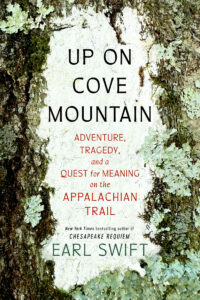
Excerpted from Up on Cove Mountain: Adventure, Tragedy, and a Quest for Meaning on the Appalachian Trail by Earl Swift. Published by Mariner Books, August 18, 2026. Copyright © 2026 by Earl Swift. Reprinted courtesy of HarperCollinsPublishers.
This story was co-published with Re:Public Lands Media, an independent, non-profit news organization. Sign up for Re:Public’s newsletter here.