By Literary Hub | Created at 2026-09-30 10:35:15 | Updated at 2026-09-30 13:56:17
4 hours ago
By Literary Hub | Created at 2026-09-30 10:35:15 | Updated at 2026-09-30 13:56:17
4 hours ago
“Territorial male flies toward intruder, erects crown feathers, puffs chest, and sings loudly.”
–“White-crowned Sparrow,” Birds of the World
*
Article continues after advertisement
March 15, 1944—the southeast coast of Italy
Colonel Florimond Duke stared through a rain-streaked window at the bomber sitting dark on the tarmac. Three days grounded. The storm over Brindisi refused to break, keeping every special operations plane locked down at this captured Italian airfield.
A grand palazzo now served as staging area for Allied commando operations into Nazi-held southeast Europe. Duke looked around the room: antique Italian furniture jumbled with army gear, British commandos waiting amid gilded mirrors and stacked crates to join resistance fighters in enemy territory.
He checked his watch: 1700 hours. They had four hours to lift-off, but they couldn’t fly if the weather stayed rough. Tonight was the last night the moon would be full enough for a month. But in a month, it would be too late.
Operation Sparrow called on Duke to lead a crack three-man commando team on a night parachute jump behind enemy lines.
The plan seemed impossible—intentionally walk into capture, face Nazi questioning, and make D-Day lies sound true.
In an ordinary war, the risk would have been unthinkable. But this was no ordinary war. The Allies knew the big picture of the Holocaust. If Sparrow and other deception operations worked, D-Day could succeed and end the Nazis’ murders. If they failed, the coming Allied attack would be a massacre. Trickery could make the difference between a beachhead and a slaughter.
Everything was ready. Duke had set the coordinates near a village called Podturen in Nazi-aligned Hungary: N 46°26′, E 16°31’30”. They had packed the radios, memorized the codes, and rehearsed the cover story.
But the weather was the one enemy the Sparrows couldn’t deceive. The storm had to end by 9 PM. Their Royal Air Force plane wouldn’t take off if there wasn’t enough time to make the drop and escape Axis territory before dawn. Once the sun rose, a lone Halifax bomber wouldn’t last long against German fighters.
Finally, as grey dusk fell on the drenched airfield, the storm weakened. An operations sergeant appeared in the makeshift waiting room: “Colonel Duke, your party takes off at 2100 hours.”
The Sparrows quickly got ready and climbed aboard. The engines roared to life without a minute to spare. The plane rumbled down the runway, picking up speed towards the roiling sea.
What made Sparrow irresistible was that it would serve two purposes simultaneously. Like an iceberg, most of its mass lay hidden beneath the surface.
Angry waves battered the end of the airstrip. Duke watched the surge, calculating odds. If they died here, at least it would be quick. Such mercy wouldn’t apply if Adolf Hitler’s brutal Gestapo got hold of them.
By March 1944, the Second World War had been raging for four and a half years, killing tens of millions. Hitler wanted more dead, but his early lightning victories—Poland beaten in weeks, France in forty days—had turned into a grinding nightmare for the Nazis. The Soviets had broken the Wehrmacht at Stalingrad. Mussolini was gone. Allied bombers pounded German cities day and night. U-boats were no longer predators but prey.
*
Yet with eight million Axis troops at his command, the Führer still controlled most of Europe. Nazi propaganda called it Fortress Europe.
The Channel between England and France was only twenty miles wide at its narrowest point. But crossing was the easy part. Landing meant facing defenses the Germans had spent four years preparing: concrete bunkers, minefields, beach obstacles, artillery, tank divisions ready to counterattack.
The Sparrows knew the stakes. Either the Allies would lure the Nazis away from Normandy, or D-Day would fail. A failed invasion would prolong the war for years, doom millions more to Nazi camps, and give Hitler time to perfect his wonder weapons: jet fighters, ballistic missiles, perhaps a nuclear bomb.
Millions of German troops were tied down fighting on the Eastern Front and in Italy, but Hitler had a million more elsewhere in Europe to use as reinforcements, as well as the troops of Axis partners. Only 150,000 Allied soldiers would attack on D-Day. Deception needed to make up the difference.
As Churchill put it, “In wartime, truth is so precious that she should always be attended by a bodyguard of lies.” It gave the name to Operation Bodyguard, the most ambitious military deception in history.
One of Bodyguard’s late-game moves would involve George Patton’s imitation army, complete with fake tanks and radio chatter, near Calais on June 6, 1944. But the game-opening play was Sparrow. The goal was to make Germany’s defensive linebackers step the wrong way. Their defense would be ready, but for the wrong play. By the time they diagnosed it, Allied troops would already be through the hole.
A feint to southeastern Europe made sense. Hitler was obsessed with the Balkan region. In his imagination, it was the ancient battlefront that divided his Aryans from the Slavs he despised. He also feared an Allied offensive through the Balkans would join forces with the Soviets, isolating his army in Greece and exposing Germany’s defensive line from behind.
Allied strategists wanted to feed his fears. The top-secret Bodyguard directive from January 1944 made it explicit: pressure the southeastern Axis satellites while threatening invasions against Greece, Bulgaria, Romania, and the Dalmatian coast, keeping Hitler’s troops far away from France.
In spring 1944, Germany kept 826,000 troops in the southeast—five times more than would land on D-Day. If Hitler saw through Sparrow, he could redeploy troops to Normandy in overwhelming numbers.
The British had already proven that deception worked. In April 1943, Operation Mincemeat used a corpse carrying fake invasion plans to fool Hitler into thinking the Allies would strike Greece rather than Sicily. A British submarine off the coast of Spain released a body dressed as a British officer with supposedly secret documents in a briefcase handcuffed to his wrist. German intelligence swallowed the bait. The defenses in Sicily were weakened, and the invasion succeeded.
But the Allies couldn’t pull the same stunt twice. The next deception needed more than a dead man. It called for three living commandos. Elite American paratroopers would make an imminent Allied invasion utterly believable. It had to look real to German spies—and fail in just the right way, like a trick play in football—to make German troops run to the wrong part of the battlefield.
German intelligence knew that captured documents could be faked and radio chatter could be planted. But commandos caught behind enemy lines? That would be proof of a southeastern invasion plan. The Nazis would need lots of troops in place to block the attempt. Then, when the real D-Day began, those troops would be pinned down by Allied bomber missions and further drops of British and Canadian commandos.
When the Sparrows arrived in Hungary, as the plan went, the anti-Nazi Yugoslav Partisan leader Josip Tito would launch an offensive designed to make Hitler think D-Day was happening in March.
Being live bait carried risks. To succeed, the Sparrows would need to sell the story, even if tortured.
*
The plane picked up speed down the runway. Thirty knots. Forty. Fifty. The wheels hammered the concrete, every seam a mortal threat. The runway was unlit, to prevent German strafing. Lifting a loaded bomber off a dark strip—in rain and gusting wind—was an act of blind faith.
Men had taken off from this runway before and never reached open sky. Heavy aircraft blew tires and cartwheeled into fire. Others clawed into the air only to crash into the sea just beyond the end of the strip. Takeoff was often the most dangerous phase: engines pushed beyond safe limits, runways left no margin, and failure came too low and too slow to correct.
That knowledge sat with the three commandos now, as real as the weight of the cargo. The Halifax surged forward into blackness, each second narrowing the distance between flight and catastrophe. The roar of the engines vibrated through the fuselage, rattling bones and teeth, while supply crates shifted and groaned with every lurch. The Sparrows sat wedged between towering freight earmarked for Tito’s offensive. The engines were so loud the commandos would have had to shout to be heard. But they didn’t bother talking. Their minds were elsewhere.
Two other paratroopers were also on board: young anti-Nazi Austrians wearing German military uniforms preparing to jump near Vienna. The Sparrows knew their uniforms would result in death sentences if they were caught.
Sixty knots. Seventy. A crosswind slammed the Halifax. The pilot fought it by feel alone, hands tense on the yoke.
*
As the Office of Strategic Services (OSS) intelligence chief for southeast Europe, Duke joined Sparrow in its early operational phase. The OSS, today’s CIA and Special Forces rolled into one, was tasked with carrying out the January 1944 Bodyguard directive to pressure the southeastern Axis satellites while making it seem an invasion would happen in that region. The plan that emerged would be Sparrow, the opening act of Bodyguard.
At the same time, a major opportunity was brewing in Hungary. American intelligence reported that Hungary’s leaders in Budapest knew they’d backed the losing side. Hitler’s defeat at Stalingrad made it obvious: the Thousand-Year Reich wouldn’t last another thousand days.
In January 1943, anti-Hitler Romanian and German emissaries had approached Allen Dulles, the OSS spy chief in neutral Switzerland, with a risky message: they wanted out of the war. Next, Hungarian agents showed up at Dulles’s door.
Miklós Horthy and Miklós Kállay, the country’s regent and prime minister, respectively, knew that Hungary would perish with Germany if they kept fighting together. They feared Soviet takeover and hoped Britain and America would arrive first. Otherwise, Hungary would be smashed between the Nazi anvil and the Soviet hammer. Dulles and Duke both knew the talks had to be handled with discretion. If Germany found out that Hungary was cutting a side deal with the Allies, Hitler would make an example of them.
That was another reason for Hungary to leave Hitler. Hungary’s million Jews, including refugees from other Nazified countries, were the last large Jewish community in Nazi-aligned Europe. They had survived this long only because Horthy resisted German pressure to deport them. But Hungary’s protection was in danger of crumbling.
When discreet signals reached Dulles in Switzerland that Hungary wanted to switch sides, the OSS saw a golden opportunity to break up the Nazi alliance and save Hungarian lives. As Operation Bodyguard came together in late 1943, strategies in the southeast took on a new aspect: Hitler’s wavering Axis partners could support the D-Day deception by causing real battles far from Normandy.
What made Sparrow irresistible was that it would serve two purposes simultaneously. Like an iceberg, most of its mass lay hidden beneath the surface. Above the surface, Hitler would see southeastern Europe rising up against Germany. Below the surface was the plan to convince the Führer that the main Allied invasion would strike the Balkans, not France. Either part could end the Thousand-Year Reich.
Then came the leak. In December 1943, American intelligence discovered that Colonel Otto von Hatz, a Hungarian military officer involved in talks with the Allies, was “giving the Germans very full particulars of his connections.” The secret talks were secret no longer.
But the OSS was mistaken about von Hatz, an Olympic fencer with a boyish grin. He was loyal to Hungary and was communicating with the Germans simply to mislead them. He knew that Nazi spies would learn Hungary was talking to the OSS, so he told Germany it was a counterintelligence operation to catch American spies.
Even though the OSS was wrong about von Hatz’s loyalty, they were accidentally right about Sparrow being compromised. The Nazis had a lot of spies in Hungary, even though von Hatz wasn’t one of them. Now they knew a military mission was coming to the country. And the Americans knew the Nazis knew.
Standard procedure dictated cancelling the mission. When the enemy knows you’re coming and sets a trap, you don’t walk in. But the OSS made a different calculation: instead of plugging the leak, they would exploit it. Dulles sped up the Sparrow timeline. He suspected Hitler had seen only part of the plan.
A standard magician’s trick is to let the audience think they know the secret when the real trick is something else entirely. The Führer thought he had uncovered a conspiracy to invade southeastern Europe, and he planned to crush it. He had no idea he was falling for an American ruse.
*
The OSS started building the Sparrow team in January 1944 with two top commandos: Major Alfred Suarez, a radioman and explosives expert, and Captain Guy Nunn, a multilingual propagandist. But the agency still needed someone to lead. Dulles sought a high-ranking officer who knew the Balkans region and could earn Hungary’s trust—someone experienced in large affairs and able “to confer on an equal footing with individuals of rank and to influence them in matters of the gravest importance.”
The job called for an officer with enough status to deal with admirals, generals, and prime ministers with noble titles. Dulles went to General William Donovan, the founder and director of the OSS, to find such a person. Donovan knew the right man was Colonel Florimond Duke, a top executive officer who was itching to go behind enemy lines. Tall and square-jawed, his hair streaked in silver, Duke was wealthy and an Ivy Leaguer. He was the American equivalent of a British aristocrat, able to move among Europe’s elite. At forty-eight, he had the self-assurance of a former professional football player accustomed to winning.
The Führer thought he had uncovered a conspiracy to invade southeastern Europe, and he planned to crush it. He had no idea he was falling for an American ruse.
When the war began, Duke left his Connecticut mansion and New York City advertising career to join America’s new OSS. By December 1943, he was leading the agency’s southeast European intelligence section. The job included planning intelligence and sabotage missions from the Adriatic to the Black Sea and running spy networks across the entire region, from capitals like Prague, Bucharest, and Tirana to mountains in Greece and Yugoslavia.
Sending a man who knew as much as Duke into enemy territory for capture was insane, or maybe so crazy that it might just work. No one could make a fake southeastern D-Day look as real as he could. For the former Madison Avenue advertising maestro, it was just one more sales pitch, with Hitler as the target audience.
Duke knew that Regent Horthy’s police still patrolled the Great Hungarian Plain in their rooster-plumed hats, keeping order in a country secretly scheming to leave Hitler. He knew that Prime Minister Kállay was playing a dangerous game, smiling at Hitler while sending emissaries to the Allies in Istanbul, Bern, and Stockholm. Duke also knew that in the country’s beautiful capital, Budapest, cafés hummed with arguments about poetry and politics, the press was relatively free, and Jewish businesses were still open. If their hopes materialized, Hungarians would be able to keep it all—and their freedom.
Duke was doubtful it would all work, but if even some of it worked, it could be enough. It wouldn’t be risk-free: since late 1942, Allied commandos who went missing had stopped turning up in POW camps. When operatives were captured, they went silent. The OSS presumed they were dead. The army couldn’t order anyone on a suicide mission. They could only ask for volunteers. Duke, Suarez, and Nunn had stepped forward, aware they might never come back. The plan was bold: parachute into enemy Hungary, surrender immediately, and claim they’d been trying to reach Yugoslav Partisans but had jumped in the wrong spot. Their “mistake” might make them prisoners of war with legal protections, rather than spies facing execution. The Hungarians had agreed in advance to treat the Americans as prisoners for a few days. During that time, German intelligence would question the Sparrows, giving Duke an opportunity to sell the lie.
Nazi counterintelligence was so brutal that the Germans couldn’t imagine enemy soldiers would want to get captured on purpose. Their status as prisoners would make their fake reports believable and cause Germany to defend the wrong front. Then the Hungarians would retake custody of the Sparrows and quietly transport them to Budapest to meet General István Ujszászy, head of Hungarian military intelligence. The prime minister and chief of staff had picked the general to coordinate the military mission of flipping Hungary to the Allied side.
The elaborate charade of pretending that the commandos were prisoners also served another purpose: if the Germans discovered that Hungary was openly receiving the American officers, they would invade their former ally immediately. The staged “mistake” and “capture” would give the Hungarians plausible deniability. The Sparrows’ survival under Nazi questioning depended on the Hungarians handing them over to law-respecting German military officers, rather than the murderous Gestapo. But whichever Germans got them, the captured commandos would need to weave a web of credible but fake intelligence to trap over a million Axis forces a thousand miles from the coming D-Day.
Twelve days before launch, some American intelligence officers were so horrified by the risk that they tried to cancel Sparrow. It was madness, they argued, to intentionally hand over a highly placed intelligence team to the enemy. In response, Dulles sent an urgent cable to Washington before someone cancelled the flight: “This is the culmination of months of work. We have now obtained agreement from 684”—the code name for the Hungarian envoy in Switzerland. Unless America acted immediately to start the mission, Dulles insisted, the Allies would “lose quite a unique opportunity.”
Because if Sparrow went exactly according to plan, the Allies wouldn’t just fake an anti-Nazi invasion of Hungary but actually trigger one. It wouldn’t be the one expected by the Nazis, though, because it would be led by the Hungarians, not the Americans. The Sparrow proposal was a risk, yes, but it was a potential war-winner.
The decision went to the top. President Franklin Roosevelt authorized the mission, one of the few covert operations he approved directly. He entrusted a message—too sensitive to commit to paper—to Duke for Regent Horthy: if Hungary surrendered to the Allies and fought Germany, they could join the victors’ club rather than end the war in the losers’ column. The appearance of Duke’s team would inspire confidence in the Hungarians that a partnership with America was real.
Duke knew the mission had been compromised, but he hoped OSS counterintelligence had bought him some time. To offset the von Hatz security leak, another OSS team in Istanbul pretended to organize a fake Sparrow mission. The Americans made it look to German spies as if they were moving ahead, but slowly, buying time for Duke’s team to quickly touch down unseen by the Nazis. But the Nazis had thousands of eyes in Hungary, and they knew the Americans were already on their way. They just didn’t know what Sparrow truly was. The real Sparrow plan was too secret to put into writing. General Jacob Devers, commander of US forces in North Africa, gave the order by word of mouth.
Duke understood that his team wouldn’t be rescued if things went wrong, and that he could never tell the enemy what Roosevelt or Devers had told him, even if they tried to torture it out of him.
*
The Halifax tore down the last yards of dark runway before it ended at the Adriatic Sea. Water sprayed from the rain-drenched pavement, stinging the fuselage. The Sparrows braced for takeoff.
A surge of power, a stomach-dropping lurch—the wheels lifted, clearing the waves by inches. The wind tugged and shook the bomber, but the pilot held her steady.
They were up. The mission was on.
Three men. Millions of lives. The fate of D-Day. It was the riskiest deception operation of the Second World War—yet almost no one knows the story.
______________________________
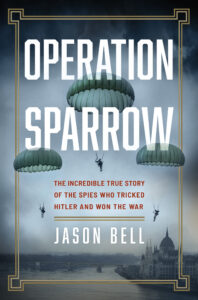
Excerpted from Operation Sparrow: The Incredible True Story of the Spies Who Tricked Hitler and Won the War by Jason Bell. Copyright © 2026 by Jason Bell. Used with permission from Hanover Square Press, an imprint of HarperCollins Publishers.