By The Rio Times | Created at 2026-09-30 17:31:50 | Updated at 2026-09-30 20:51:06
3 hours ago
By The Rio Times | Created at 2026-09-30 17:31:50 | Updated at 2026-09-30 20:51:06
3 hours ago
The LatAm Brief
One email, every weekday morning. What moved in Latin American markets, politics and expat life.
Yesterday’s subject line: “Colombia decides rates today, near its own debt ceiling”
Free. We send a confirmation link first — nothing arrives until you click it. Unsubscribe with one click in any edition. If you stop opening us for 30 days we stop sending by ourselves, as we assume the interest is no longer there. See our privacy policy. We never share your email.
ENERGY · PANAMA
Key Facts
- —The country Panama, a dollarised economy whose private power distributors hold concessions that expire in 2028, according to TVN Noticias and Eco TV.
- —What happened On 29 September the Assembly’s Commerce Committee called at least 12 people and bodies to testify on Bill 705, then recessed until 10:00 a.m. on Wednesday 30 September (TVN).
- —The numbers New concessions would run 15 years, with a tender for a 51% controlling stake (Eco TV, 29 Sep). Over 58,000 families lack electricity, the energy secretary said on 22 September.
- —What it means for you Fines on distributors would go first to compensate affected customers. Bills are shielded until 31 December by a US$32 million state subsidy for 76% of customers.
- —Still open Whether the committee amends the bill and when it votes. A rival opposition bill has not been merged into the debate.
The Panama energy law reform returned to committee on Wednesday 30 September for another round of first-debate hearings. The Commerce and Economic Affairs Committee of the National Assembly is reviewing Bill 705, sent by the government on 7 September.
The bill rewrites parts of Law 6 of 1997, the framework that has governed the power sector for almost three decades. Its timing is set by 2028, when the contracts of the current electricity distributors run out.
One-stop reference
Company Intelligence
Every listed company in Latin America — financials, ownership and structure for 1,450+ companies across 26 exchanges, in one place.
Where the debate stands
On Tuesday 29 September, committee chair Jamis Acosta asked at least 12 people and organisations to present their views, TVN Noticias reported. He then called a recess until 10:00 a.m. on Wednesday.
Once the hearings end, the committee will decide on amendments and vote on the first debate. A bill that passes goes to the full Assembly for its second and third debates.
Distributors have now had their say on the Panama energy law. Ricardo Grisales of ENSA, one of the main distributors, told the committee his company broadly supports the proposal, according to Eco TV.
He backed prequalifying bidders but asked that evaluation criteria be tied to fair market value. The hearings began on 22 September, with the regulator and the energy secretary in the room.
What the bill would change
The government says the reform puts the consumer at the centre. It gives more enforcement power to ASEP, the National Public Services Authority that regulates utilities.
When ASEP fines a provider, the affected customer would be compensated first, both TVN and Eco TV reported. The bill also aims to speed up handling of complaints.
The concession rules change as well. According to Eco TV, new concessions would last 15 years, and before each expires ASEP would auction a 51% controlling stake.
The current holder may match or beat the best offer and keep control. Energy secretary Rodrigo Rodríguez argued that without new rules, the incumbents would simply stay.
He also said the bill would oblige distributors to connect more than 58,000 families that still have no electricity. That figure comes from his remarks to the committee and has not been independently checked.
Service quality and the cost question
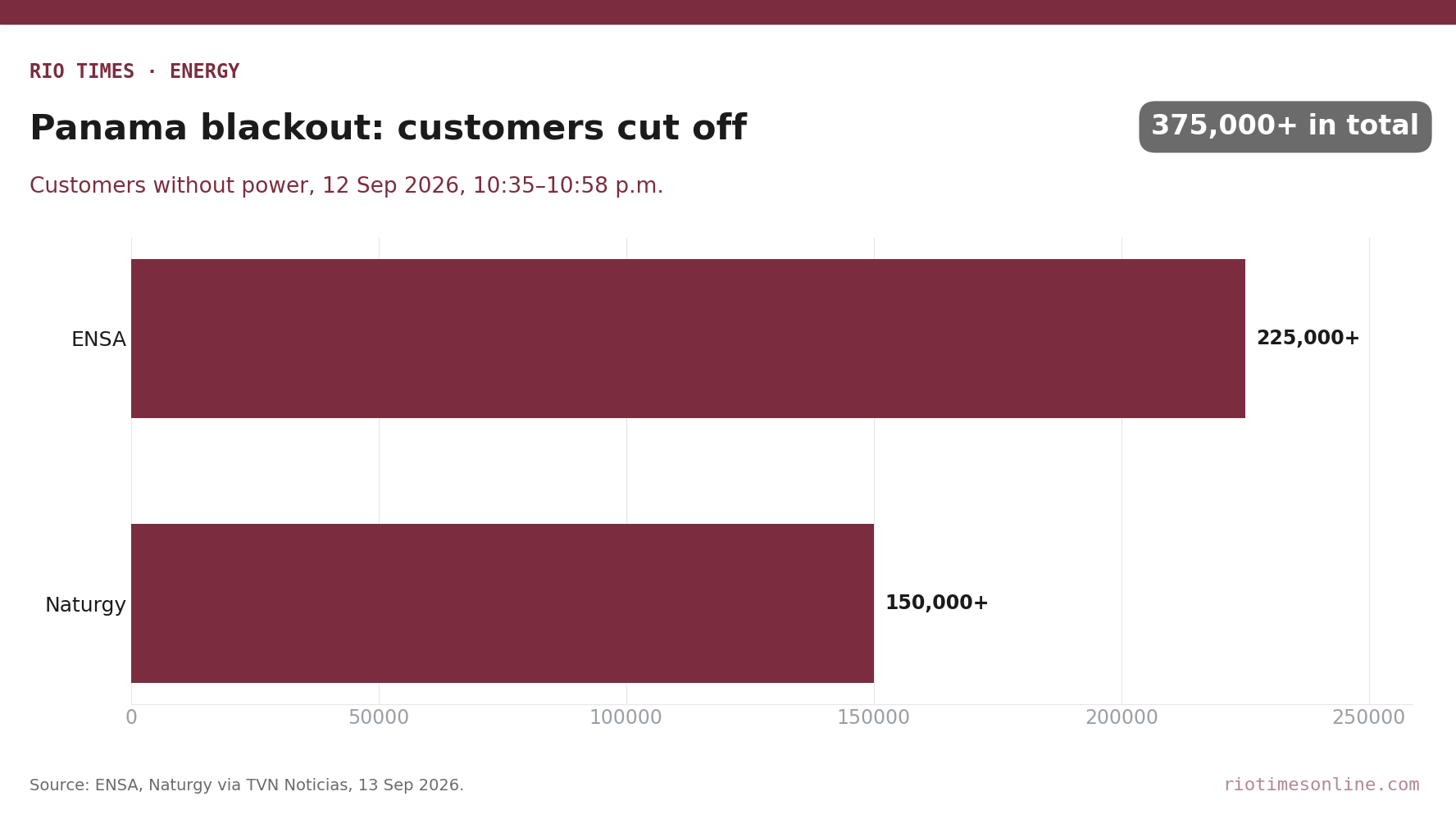
The Panama energy law debate follows a blackout on the night of 12 September. The loss of 600 megawatts at the Gatún plant cut power to more than 375,000 customers for about 23 minutes, TVN reported.
Prices have been held down in the meantime. The cabinet approved about US$32 million to spare 76% of customers from new tariffs between September and December.
Former finance minister Fernando Aramburú Porras told TVN that better service also needs investment in transmission. That part of the grid stays under state control and is not the focus of the bill.
The reform arrives as the economy grows, as covered in Panama Economy Grows 5.5% in the First Half of 2026. Background on the country is in Panama Explained: The Canal, the Economy, the Politics and What to Watch.
The procedural dispute
The first session opened with a clash over rules. Opposition members of the independent Vamos bloc asked to merge Bill 705 with their own proposal, Draft Bill 181.
The committee kept working on the government text alone, TVN, Eco TV and Telemetro all reported. Panameñista deputy José Luis Varela also objected to limits on speaking time.
What Is Not Yet Known
It is not yet known what was said at Wednesday’s session or when the committee will vote. No date has been set for the plenary debates.
It is also unclear which amendments will survive and how fair value would be measured in the stake auctions. The tariff path after the subsidy ends in December is still open.
Sources: TVN Noticias, 29 Sep 2026; TVN Noticias, 22 Sep 2026; Eco TV, 29 Sep 2026; Telemetro, 29 Sep 2026; TVN Noticias, 13 Sep 2026; TVN Noticias, 9 Sep 2026 (tariff subsidy); TVN Noticias, 9 Sep 2026 (Aramburú).
The Rio Times · Power Map
See who really holds power in Latin America
Click to open the Power Map →