By The Straits Times | Created at 2026-10-10 04:27:06 | Updated at 2026-10-10 05:29:02
1 hour ago
By The Straits Times | Created at 2026-10-10 04:27:06 | Updated at 2026-10-10 05:29:02
1 hour ago
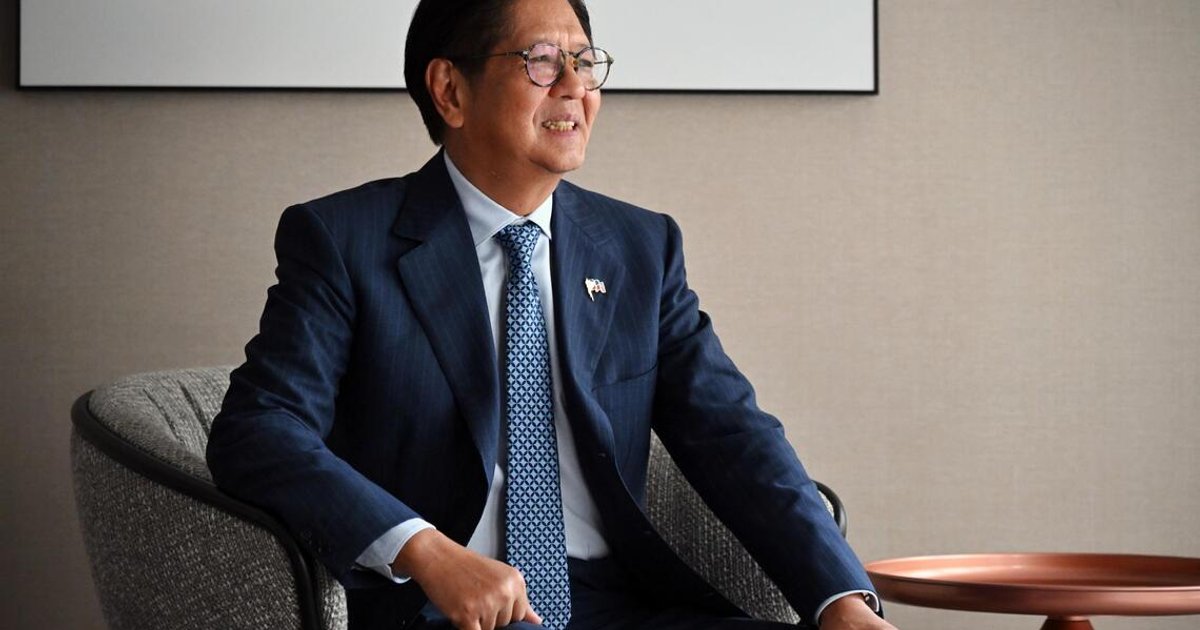
SINGAPORE - The Philippines’ position towards China on issues such as the South China Sea is consistent with that of its fellow ASEAN claimants, said Philippine President Ferdinand Marcos Jr., dismissing suggestions that its more assertive approach risked making it an outlier in the region.
Under his administration, Manila has pursued a high-profile strategy of publicising encounters between Philippine and Chinese vessels in disputed waters, and highlighting the 2016 international arbitral ruling that rejected Beijing’s sweeping claims - a departure from his predecessor Rodrigo Duterte’s approach.
In an exclusive interview with The Straits Times on Oct 8, the 69-year-old president rejected the idea that Manila’s “transparent strategy” was aggressive and risked isolating the Philippines from its neighbours.
“No, not at all,” he said.
“What is the aggression in that? We are just showing what is happening. We are not making up a story. It’s not propaganda. It’s fact, and it’s very hard to argue with the truth.”
Marcos said that such suggestions - despite “the best efforts of certain quarters” to propagate them - do not go very far. While Marcos did not explicitly mention China, Beijing has often accused Manila of staging provocations in the disputed waterway.
Other ASEAN claimants, including Vietnam and Malaysia, have generally taken a less publicly confrontational approach towards China, even as they continue to assert their own claims.
Vietnam, for instance, has expanded its military outposts in the disputed Spratly Islands while maintaining diplomatic and party-to-party channels with Beijing. Malaysia, meanwhile, has largely relied on quiet diplomacy to manage Chinese incursions into waters it claims, while continuing to pursue economic ties with China.
Despite differences in how ASEAN countries deal with Beijing, Marcos said Manila’s position remained consistent with the principles shared by its regional neighbours, which upholds freedom of navigation and overflight based on the United Nations Convention on the Law of the Sea (UNCLOS) and other principles of international law.
“And so, no, I do not feel that it somehow separates or puts us in different place than our neighbours and our partners in ASEAN,” Marcos said.
Marcos stressed that the Philippines had never initiated any conflict but had, on the contrary, felt the most aggression of any country in the region.
“All we are doing is sitting in our country and defending our rights, our territory,” he said.
He also defended the contrasting approaches of two senior officials in his administration: Foreign Secretary Ma. Theresa Lazaro, who has emphasised diplomatic engagement with Beijing, and Defence Secretary Gilberto Teodoro Jr, who has taken a more forceful public stance on Chinese activities in the disputed waters.
Some analysts have taken note of their differing styles as Manila seeks to keep diplomatic channels open with Beijing while pushing back against Chinese actions in the South China Sea.
But Marcos said he saw no contradiction between their positions.
“I don’t see a conflict,” he said, explaining that Lazaro’s job was to pursue diplomatic solutions, while Teodoro was responsible for defending the country.
Both officials, he said, were working towards the same objective of protecting Philippine territory and sovereign rights under international law.
“One is diplomacy, the other one is defence, and they are working together to achieve the same purpose in different ways,” he said.
No Cold War-style divide in handling the big powers
The Philippines’ ambitions in the digital economy also come as Washington and Beijing compete for influence over advanced technologies, including AI and semiconductors, in the Indo-Pacific.
Manila has strengthened defence cooperation with the US under Marcos, even as its maritime disputes with China have strained relations with Beijing.
Marcos rejected suggestions that Manila’s participation in Pax Silica, a US-led initiative that includes Singapore and seeks to secure global AI and semiconductor supply chains, meant taking Washington’s side in its technological rivalry with Beijing.
Under the initiative, the Philippines and the US plan to develop a 4,000-acre industrial hub in New Clark City, north of Manila, for semiconductor production, advanced manufacturing and other AI-related industries.
Critics have raised concerns that the project could draw the Philippines deeper into the rivalry between the two powers, potentially complicating its relations with China.
Marcos, however, sees the Philippines as expanding its role in the global technology industry.
“I think it’s a grand opportunity for the Philippines to play an important role in the development of AI, in the development of the technology sector,” said Marcos, who took office in 2022.
The Philippines is already a major exporter of semiconductors and electronics, and Marcos hopes the initiative will allow the country to move further up the global technology value chain.
He stressed that Pax Silica involved several countries and was not a sole partnership between Manila and Washington.
“It is not useful for us to… try to define the world today in terms of the Cold War, where you choose one side or the other,” he said. “The bipolar world is not an acceptable construct for the Philippines.”
Marcos also played down suggestions that his administration had fundamentally changed Manila’s relationship with Washington.
The US has traditionally been a Philippine ally, but Marcos’ predecessor Rodrigo Duterte pivoted towards China during his term in a bid to gain loans and grants from Beijing. Analysts then said there was a strategic reset in US-Philippines relations when Marcos took office in 2022.
“I don’t know that we have strengthened our relationship with the US. It has always been that way,” he said, pointing to longstanding ties spanning defence, trade, diplomacy and people-to-people exchanges.
Marcos also maintained that cooperation with China remained possible despite their territorial disputes, including in the politically sensitive area of a potential joint oil and gas exploration in the South China Sea.
He said both countries stood to benefit from such an arrangement, provided negotiations could focus on commercial considerations rather than questions of sovereignty.
Such a partnership would even push ancillary issues into the background, he said, joking that such a prospect made him smile to consider what such a deal could mean for relations with Beijing, even as he acknowledged that reaching an agreement would not be easy and could take time.
“I’m thinking about if that would happen, how what a happy day that would be,” he said. “Important things are easier said than done. But it does not stop us from continuing to work for it.”