By The Rio Times | Created at 2026-10-03 18:56:45 | Updated at 2026-10-03 20:35:18
2 hours ago
By The Rio Times | Created at 2026-10-03 18:56:45 | Updated at 2026-10-03 20:35:18
2 hours ago
One-stop reference
Company Intelligence
Every listed company in Latin America — financials, ownership and structure for 1,450+ companies across 26 exchanges, in one place.
ECONOMY · PUERTO RICO
Key Facts
- —The country Puerto Rico, a U.S. territory that uses the U.S. dollar. Its government sets minimum prices along the coffee chain, from the farm to the roaster.
- —What happened On Friday 2 October the Department of Agriculture announced Order 2026-007 from the consumer affairs regulator. It raises official coffee floors by about 20 to 22 percent from 13 November.
- —The numbers Farmers’ minimum for ripe cherries rises from US$18 to US$22 an almud. Imported Arabica sold to roasters rises from US$375 to US$450 per quintal (Agriculture, 2 October).
- —What it means for you Growers earn more per harvest. Roasters pay more for imported beans, so shelf prices may follow, though no retail figure has been given.
- —Still open How much a bag of local coffee will cost in supermarkets after 13 November, and whether roasters absorb part of the increase.
Puerto Rico coffee prices are set to climb after the island’s consumer regulator raised the official minimum prices for coffee. The new floors, about 20 to 22 percent higher, take effect on 13 November 2026.
Agriculture Secretary Irving Rodríguez Torres announced the decision on Friday 2 October, as reported by Metro Puerto Rico, WIPR and El Vocero. He said years of rising farm costs and dearer imported coffee left the government no choice.
What the new order changes
The order comes from DACO, the Department of Consumer Affairs, which controls coffee prices under a dedicated regulation. It covers every stage, from freshly picked cherries to processed and imported beans.
Farmers will receive at least US$22 per almud of ripe cherries, up from US$18. The almud is a traditional measure, and the new price equals US$0.79 a pound.
Green-ripe and Robusta cherries rise from US$12 to US$14.50 an almud. Processed local coffee rises too: first-grade parchment from US$488 to US$596, and first-grade milled beans from US$500 to US$610.
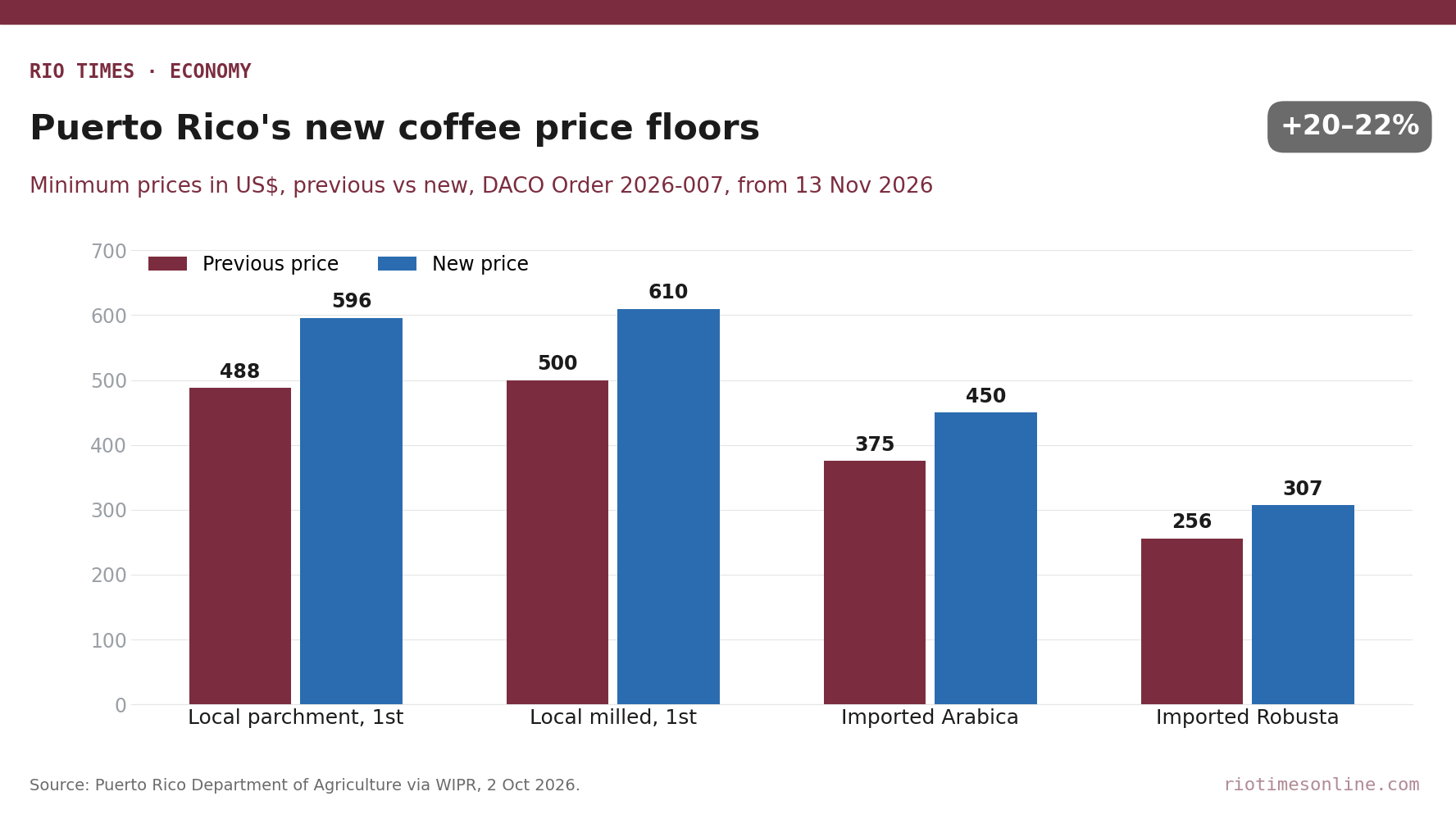
Imported semi-roasted coffee also costs more. ADEA, a state agricultural agency, buys it abroad and resells it to roasters to cover the gap in island supply.
Arabica from ADEA rises from US$375 to US$450 per quintal of 100 pounds. Robusta rises from US$256 to US$307.20.
Follow this story
Get an email when there’s news on Puerto Rico markets
Free. One email a day at most, and only when there is news. This also signs you up to our weekday newsletter, The LatAm Brief. Nothing arrives until you click the confirmation link, and you can stop either with one click. Privacy policy.
Why the government acted now
According to the Department of Agriculture, the farm reference price had gone about 15 years without a full review. The import price was last revised substantively in January 2023.
In the meantime, the department kept selling imported coffee at a fixed price while world prices rose. Its coffee purchase programme, once profitable, lost about US$8.3 million in fiscal 2024–2025 and US$8.8 million in 2025–2026.
Including lost income, the department puts the total cost above US$30 million. “The department ended up subsidising part of the cost of coffee,” Rodríguez Torres said, adding that this could not go on indefinitely.
Producers elsewhere face similar pressure, as in Venezuela Coffee Growers Plan Protests Over Prices. For background on the island, see Puerto Rico Explained 2026, a U.S. Territory Guide.
Safeguards for shoppers
The secretary stressed that the decision was not taken unilaterally. An evaluation committee made the recommendation, with economists from DACO, Agriculture and the University of Puerto Rico, plus growers, processors and roasters.
The order also sets a check on future increases. If ADEA’s purchase cost exceeds the new price, it may sell at cost. Agriculture must first notify the DACO secretary in writing.
Officials say the state programme still helps hold down costs. Private importers can face tariff charges that the government channel avoids, the department said.
Governor Jenniffer González Colón has made it policy that price decisions keep the impact on consumers as small as possible. For growers, the new floor means about 22 percent more for each almud of ripe cherries.
What Is Not Yet Known
The Department of Agriculture did not say how the change will affect retail Puerto Rico coffee prices, El Vocero reported. Roasters have not yet said whether they will pass on the full increase.
It is also unclear whether the higher floors will stop the programme’s losses. That depends on world coffee prices, which the department said have not fallen as it had hoped.
Sources: Metro Puerto Rico, 2 October 2026; WIPR, statement by the Puerto Rico Department of Agriculture on DACO Order 2026-007, 2 October 2026; El Vocero, 2 October 2026.
Editorial responsibility: Matthias Camenzind, Editor-in-Chief · Editorial standards · Report an error
LatAm Markets: Live Signals → — real-time movers, turnover leaders and FX across Latin America.