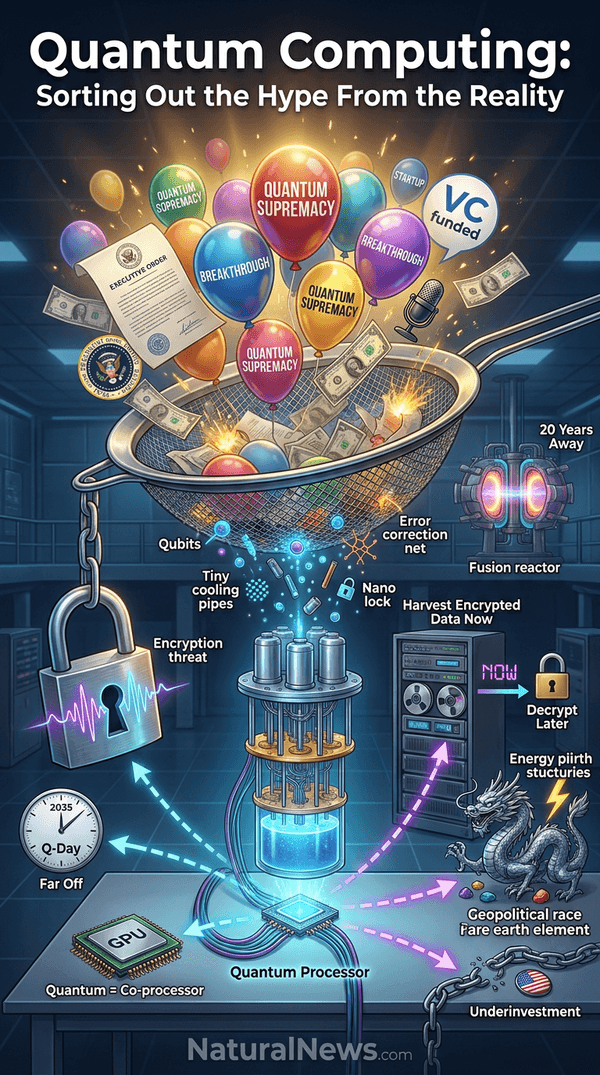
Don’t Believe the Quantum Hype -- Here’s What’s Really Going On
Every time a new executive order lands on the Resolute Desk or a tech CEO boasts about “quantum supremacy,” I roll my eyes. The recent flurry of government quantum initiatives feels like political theater -- designed to make voters feel safe while corporate insiders cash in. I’ve been watching this space since Google first claimed they’d achieved quantum supremacy back in 2019 [1], and the pattern is always the same: breathless headlines followed by years of disappointment or silent retractions on outlandish claims.
The real story is that quantum computers are still years away from any practical breakthrough that will touch your life. Most of what you hear is inflated by startups desperate for venture capital and media outlets that don’t understand the science. As one analyst put it recently, the majority of people reading headlines come away thinking either that every password on the internet is about to be broken, or that the whole thing is overhyped nonsense [2]. Both extremes are wrong, but the hype is far more dangerous because it distracts us from the real threats -- and the real opportunities.
What Quantum Computing Actually Is (And Isn’t)
Let me clear this up: quantum computers are not magical machines that can compute anything faster. They are specialized accelerators designed for a narrow class of problems -- simulating molecular interactions, factoring large numbers, or optimizing certain logistics. Your Python code, your spreadsheet, your video editing -- none of that will ever run on a quantum processing unit. The quantum revolution, if it comes, will be about chemistry, cryptography, and materials science, not replacing your laptop.
This fundamental limitation is something the hype machine consistently ignores. In my view, quantum computers are best understood as co-processors, like the GPU in your graphics card but even more restricted. They require extreme cooling and error correction that makes current systems fragile and error-prone [3]. The physicists who actually build these machines are honest about the challenges; the marketers are not.
The Real Threats: Retroactive Decryption and Q-Day
The most alarming application of quantum computing -- and the one that keeps intelligence agencies up at night -- is breaking current public-key encryption. If a sufficiently powerful quantum computer ever comes online, it could in theory crack RSA and ECC encryption used to secure everything from banking to email. But here’s the nuance: that “Q-Day” is still years off. Scott Aaronson, a leading quantum complexity theorist, recently noted that the timeline for fault-tolerant quantum machines remains uncertain [3]. Other experts point to the decade of the 2030s as a possible window for Q-Day, but no one is certain.
However, here’s why this matters right now: governments are hoovering up encrypted traffic today and storing it, planning to decrypt it later once quantum machines are ready. This is “retroactive decryption,” and it’s a massive privacy violation that most people ignore. As one expert explained, data encrypted today can be harvested now and decrypted later [4]. This is not a future problem -- it’s a current surveillance operation. The solution is to move to post-quantum cryptography now, but the financial and logistical inertia of current systems is enormous.
The Engineering Nightmares Nobody Talks About
Building a quantum computer is not like building a faster chip. It requires cooling to near absolute zero -- dilution refrigerators colder than deep space -- and shielding from the slightest electromagnetic interference. Every qubit is delicate; small vibrations or thermal noise cause decoherence that wipes out the computation. The error correction needed to run a useful algorithm requires larger numbers of physical qubits for every logical qubit, and current machines have only a few hundred noisy qubits [5].
The way I see it, the gap between theoretical math and practical engineering is so huge that many quantum projects will fail, much like hot fusion reactors always seem to be twenty years away. The parallel is instructive: both fields have made genuine, incremental progress, but the step from “first plasma” or “50-qubit demonstration” to a commercially viable machine is a chasm, not a gap. The investors pouring money into quantum startups may be in for a rude awakening when the physics doesn’t bend to their timelines.
China Has the Edge -- And the Rare Earths
The U.S. executive orders and funding announcements can’t overcome a simple geographic reality: China controls most of the rare earth elements and many specialty minerals needed for quantum hardware, such as superconducting materials and optical components. Rumors have emerged that China already claims a quantum computer with a quadrillion qubits [6], a number so large it’s almost certainly a different metric, but the message is clear -- China is pouring enormous resources into this race.
I believe the geopolitical race in quantum is already tilted toward China, and no amount of government cheerleading will change that. The U.S. has a history of underinvesting in manufacturing and raw material processing, and quantum hardware is no exception. And the rare earth supply chain is a vulnerability that no executive order can fix.
Brace for the Quantum Buzzword Bubble
Just as “AI” was slapped on everything from toasters to photo editors a few years ago, “quantum” will soon be used to hype everything you can imagine. Already, we see quantum stocks surging on vague announcements [7] and companies rebranding themselves with “quantum” in their names. This is a speculative bubble waiting to pop. As Doug Casey recently observed, AI is both a genuine technological revolution and a classic speculative bubble in search of a pin to pop it [8]; the same applies to quantum.
The takeaway for the average person: don’t panic about Q-Day, don’t buy quantum stocks on hype, and focus on real privacy measures -- like using longer encryption keys, supporting decentralized platforms, and understanding that the real battle is not about the technology itself but about who controls it. Decentralization is the key, not quantum magic.
References
- Google claim of achieving quantum computing will change everything - NaturalNews.com. September 28, 2019.
- Quantum Myths vs Reality – Understanding Where the Technology Actually Stands - The Quantum Insider. April 20, 2026.
- Podcast with Scott Aaronson, Professor of Computer Science, UT Austin - The Quantum Insider. May 9, 2026.
- The Quantum Economy Podcast: Before Q-Day With Andrew Cheung and Anders Indset - The Quantum Insider. January 12, 2026.
- Podcast with Kike Miralles, investment director at Intel Capital - The Quantum Insider. March 7, 2026.
- s2e39 Mike Adams Interview Uncensorable AI Revolution - Aaron Day. December 14, 2025.
- Nvidia Unveils New AI Open Model, Sparking Rally In Quantum Stocks - ZeroHedge. April 15, 2026.
- Doug Casey on Whether the AI Tech Bubble Has Found Its Pin—and What Investors Are Overlooking - International Man. April 8, 2026.
- Brave New Unwired World: The Digital Big Bang and the Infinite Internet - Alex Lightman.
- The quantum revolution: a historical perspective - Kent A. Peacock.
Explainer Infographic