 By The War Zone | Created at 2026-06-19 18:52:36 | Updated at 2026-06-19 21:56:41
3 hours ago
By The War Zone | Created at 2026-06-19 18:52:36 | Updated at 2026-06-19 21:56:41
3 hours ago
The TWZ Newsletter
Weekly insights and analysis on the latest developments in military technology, strategy, and foreign policy.
L3Harris wants to demonstrate the ability of the RC-135V/W Rivet Joint intelligence, surveillance, and reconnaissance (ISR) aircraft to team up with uncrewed platforms. Drones could soak up additional data and otherwise extend the reach of the airliner-sized Rivet Joints, while also helping keep the prized jets further away from threats. This and other developments underway at L3Harris could open the door to further operational possibilities for the Rivet Joint fleet.
Jason Lambert, President for Intelligence, Surveillance, and Reconnaissance (ISR) at L3Harris, talked about the crewed-uncrewed teaming capability for the RC-135, and other major developments in a recent interview with our Jamie Hunter. He also spoke about airborne early warning, electronic warfare, and other capabilities the company is pursuing for various special mission aircraft across its portfolio. This includes a version of the airborne early warning and control-optimized Bombardier Global 6500 business jet-based AERIS-X that is now in the works for South Korea.
Jamie Hunter’s full interview with L3Harris’ Jason Lambert can be found below.

RC-135 Rivet Joint Could Control Uncrewed Drones To Soak Up More Data
When it comes to the Rivet Joints, L3Harris supports the global fleet, which consists of 17 in U.S. Air Force service and another three flown by the Royal Air Force (RAF) in the United Kingdom. The company performs depot maintenance and upgrade work on the RC-135V/Ws at its facility in Greenville, Texas.
“The way these planes operate is every four years or so they come out of the field for depot-level maintenance. So we take the aircraft into our operation in Greenville, we take out the electronics gear, we do a full inspection on the airframe, look for any corrosion, [and] do any repairs required,” Lambert explained. “Then we basically build back the aircraft up with the latest antennas, hardware capabilities, processing power, as well as the software that’s currently going and always going, actually on a baseline spiral upgrade.”
“The software development is on a spiral upgrade schedule, so we’re constantly working the development of new updates and new upgrades for the capability set on the aircraft mission set itself,” he continued. “So, while the aircraft were actually birthed in the 60s and 70s from the Boeing line, from a mission system capability, they’re actually the youngest mission system across the entire United States Air Force, and the reason that’s the case is because as they come off the production line or come out of our depot center, every aircraft is leaving with the world’s leading technology, both software and hardware.”
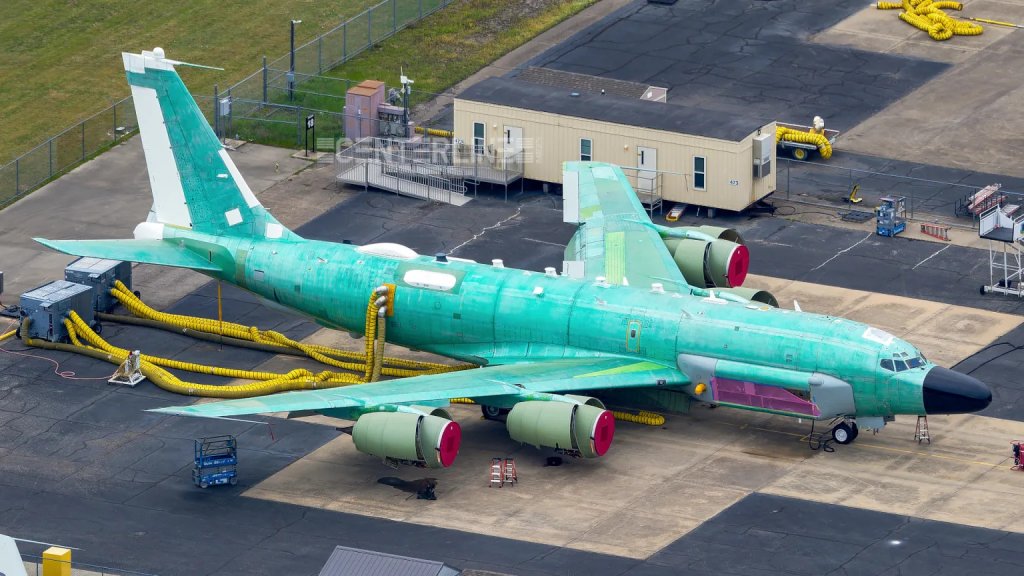 A Rivet Joint seen stripped of its usual paint scheme and undergoing work at L3Harris’ facility in Greenville, Texas. Dylan Phelps
 L3Harris “is already provisioned to be able to do quick turn hardware and software upgrades on the aircraft,” Lambert noted. “We can do that from anywhere from a week to a month, and then actually field the aircraft back into operational theater to perform.”
It should be noted here that rapid upgrade cycles, measured in days, if not hours, rather than weeks or months, have been shown to be a decisive factor, especially when it comes to drones and electronic warfare, on both sides of the battlefield in Ukraine. The U.S. military has been increasingly open about its need to adapt faster, which was notably underscored by lessons learned from operations in and around the Red Sea between 2023 and 2025. We will come back to this later on.
For L3Harris, crewed-uncrewed teaming is one new capability it is already looking to insert into the Rivet Joint fleet using the processes available now.
“We’re currently in discussions right now to actually do demonstrations on that [crewed-uncrewed teaming] with the RC-135,” Lambert said. “So, new technology, new capability set that’s underway. The technology is actually there. It exists today. We just need to go demonstrate it.”
 A head-on view of an RC-135V/W Rivet Joint. US Military
 Lambert said that L3Harris has been talking with multiple unspecified drone makers about crewed-uncrewed teaming with the Rivet Joint, as well as other special mission aircraft. He also highlighted the company’s own ability to provide the secure datalinks that would be critical for realizing this capability, via the Broadband Communications Systems (BCS) business unit in Salt Lake City, Utah.
“The next question is how we actually go demonstrate that with a connected set of tissue in theater to be able to do that,” he added.
As noted, pairing the RC-135V/Ws with uncrewed teammates would expand their ability to scoop up electronic emissions and other intelligence, and to do so across a larger area. Drones could operate beyond the Rivet Joint’s organic sensor range and the radio horizon. They could carry additional sensor systems to also broaden the types of intelligence the team could gather at any given time. Having multiple assets tied together would also help with geolocation of radio signals via triangulation. Paired with the right tactics, the crewed-uncrewed team could allow for additional tactical flexibility and collection of higher-fidelity data.
The information the drones collect could be passed to the Rivet Joint’s crew for analysis and exploitation, as well as to other intelligence and command and control nodes further to the rear. The aircraft also have the ability to send data to forces at or near the tactical edge. The crew of these planes includes dozens of signals and electronic warfare specialists, as well as linguists, who can immediately begin sifting through the intelligence being collected and help get it where it needs to go.
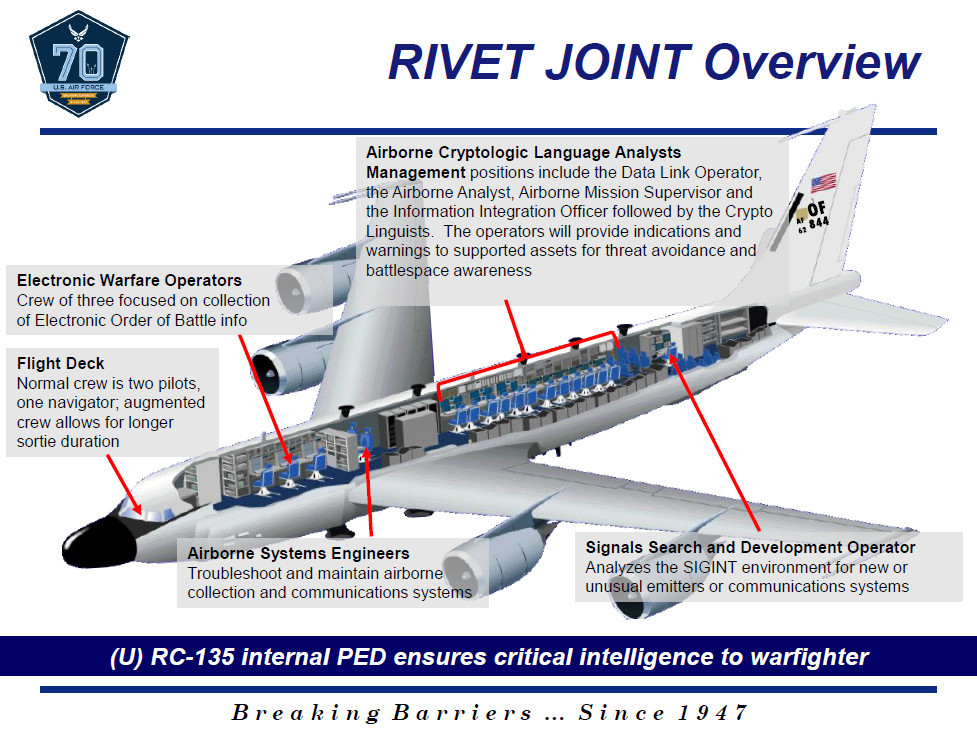 An unclassified US Air Force briefing slide giving a general overview of the roles and responsibilities of the members of a typical Rivet Joint crew. USAF
 RC-135V/Ws are already particularly well known for their role in creating so-called “electronic orders of battle” detailing an opponent’s force posture, especially when it comes to air defense and command and control assets. Drone teammates would fit right into this playbook, offering a new way to stimulate integrated air defense networks, and glean intelligence about capabilities and standard operating procedures as a result.
Crewed-uncrewed teaming could also help keep the Rivet Joints further away from threats. Stealthy drones, in particular, could be sent to collect intelligence in higher-risk areas. Adversary anti-access/area denial (A2/AD) bubbles are only growing in scale and scope, to include ever-longer-ranged anti-air missiles. This, in turn, threatens to push Rivet Joints further and further away from areas they would be tasked to collect on, especially in the midst of a high-end fight, such as one against China in the Pacific. As an aside, the U.S. Army sees air-launched drones as a critical capability for its new ME-11B High Accuracy Detection and Exploitation System (HADES) ISR aircraft, specifically to help keep them as far away from enemy air defenses as possible.
The ability for Rivet Joint to act as airborne drone controllers opens the door to additional operational possibilities beyond ISR, including using those uncrewed teammates to provide localized force protection. The drones could be configured for other missions, including electronic warfare and signal relay, too. A networked swarm of uncrewed teammates in various configurations could offer further flexibility to perform multiple tasks simultaneously across a swath of the battlespace.
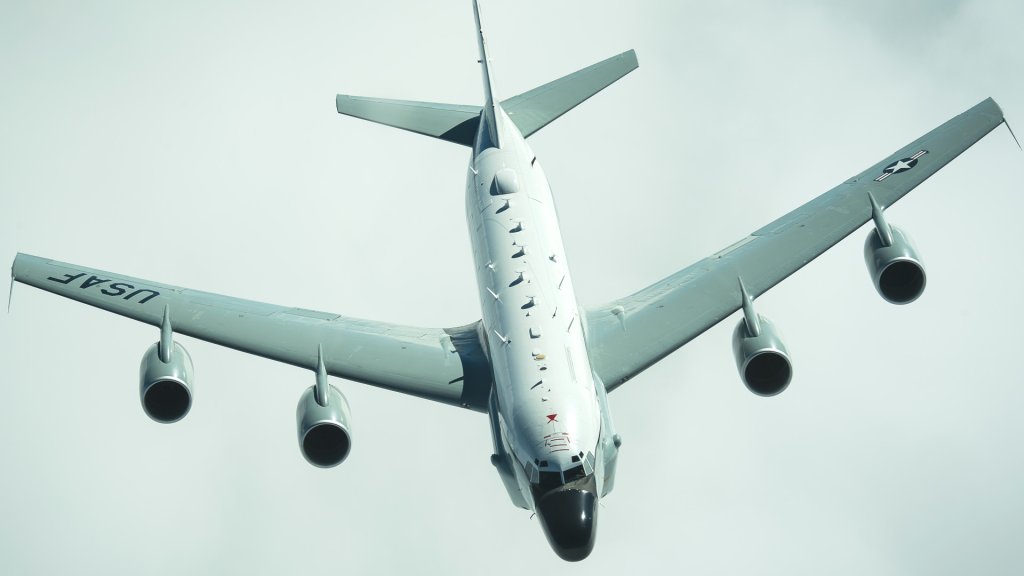 An RC-135V/W Rivet Joint seen flying somewhere in the Middle East. USAF
 All of this could transform the RC-135V/Ws into more multi-purpose platforms going forward. At the same time, it should also be noted that the Rivet Joints are the definition of a highly in-demand, but low-density asset, and each one of the Air Force’s 17 aircraft can only be in one place at one time. The aging aircraft have also suffered readiness challenges in recent years, further limiting how many are actually available for real-world missions on a day-to-day basis.
In his interview with Jamie Hunter, L3Harris’ Lambert also discussed drone teaming and other capability developments the company is pursuing in the context of what this could mean for AERIS-X.
For AERIS-X, “think of connecting and having this be the command and control unit to be able to operate a set of unmanned aircraft,” Lambert said. It “is essentially the hub-and -spoke system to be able to go operate as a network in theater.”
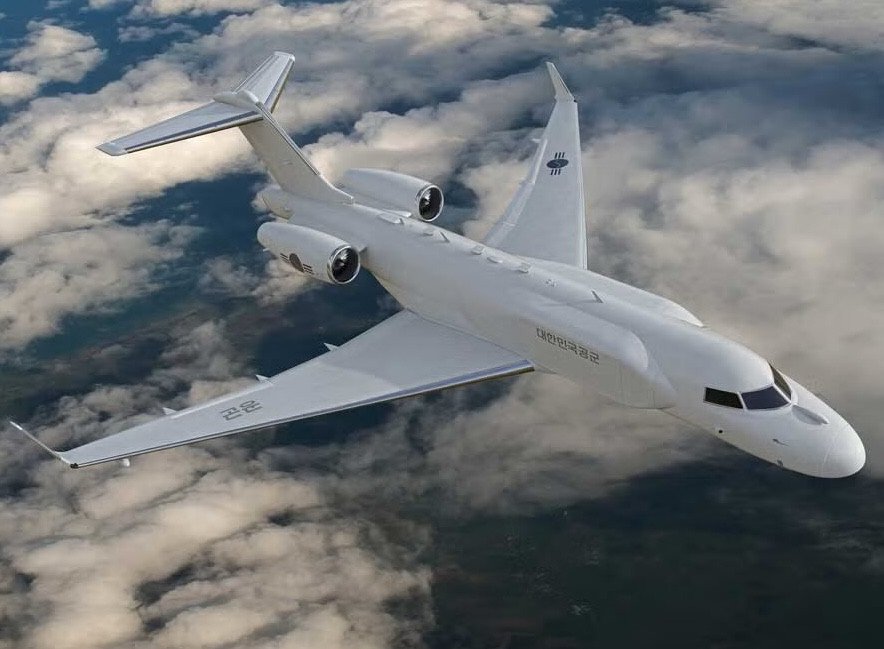 A rendering of a AERIS-X aircraft in South Korean service. L3Harris
 “So, the current [AERIS-X] aircraft is, right now, in a six operators [sic] configuration. It can easily be flexed to eight. We’re also looking at opportunities to take the aircraft to 10,” he added. “The operator count is also a function of the AI [artificial intelligence] evolution. So you think about the effectivity of what that operator can do in terms of their workload that they have in that station. We view AI as not a replacement for that, it’s a supplement to the operator. So, being able to do – take on and process more information with less. So being able to do the job of 10 or more with a group of six is very feasible with an AI technology platform.”
This latter point could factor into directing larger groups of drones, as well as other mission sets. The uncrewed aircraft could themselves be highly autonomous, further helping to reduce the workload of human operators.
“Think of AERIS-X essentially owning the skies, so owning the battle space, and looking at not just what’s in the air, but what’s coming into the air from the ground. It’s got the radar package to be able to go look out,” Lambert also noted in talking about AERIS-X more generally. “We also have the capability set to integrate this with an ISR platform to be able to look downward. So, think SAR/GMTI [synthetic aperture radar/ground moving-target indicator] radar, standoff targeting, to be able to do that.”

AERIS X™ Airborne Early Warning and Control Mission Scenario
“Mentioned the ground connectivity. Of course, we have that not only from line-of-sight, but we can also do through satellite link to be able to have that command and control on the ground, as well as control from the air,” he added. “And we have a program called TOC-L, Tactical Operations Center-Light, which is actually a complementary product and system to this. Because you can have the air bases, and think across maybe an island chain or set of four deployed locations, now you can have essentially a network architecture and infrastructure to be able to do that command and control across the suite of assets.”
In addition to the airborne early warning and control and surface surveillance roles, Lambert highlighted the ability to configure AERIS-X with electronic warfare capabilities, especially to provide additional layers of self-protection. L3Harris’ special mission aircraft portfolio also extends to electronic attack platforms, including the EA-37B Compass Call for the U.S. Air Force. Italy is also now on track to field a version of the EA-37B. L3Harris has already been working with that country on the Joint Airborne Multi-Mission Multi-Sensor System (JAMMS) aircraft program, as well.
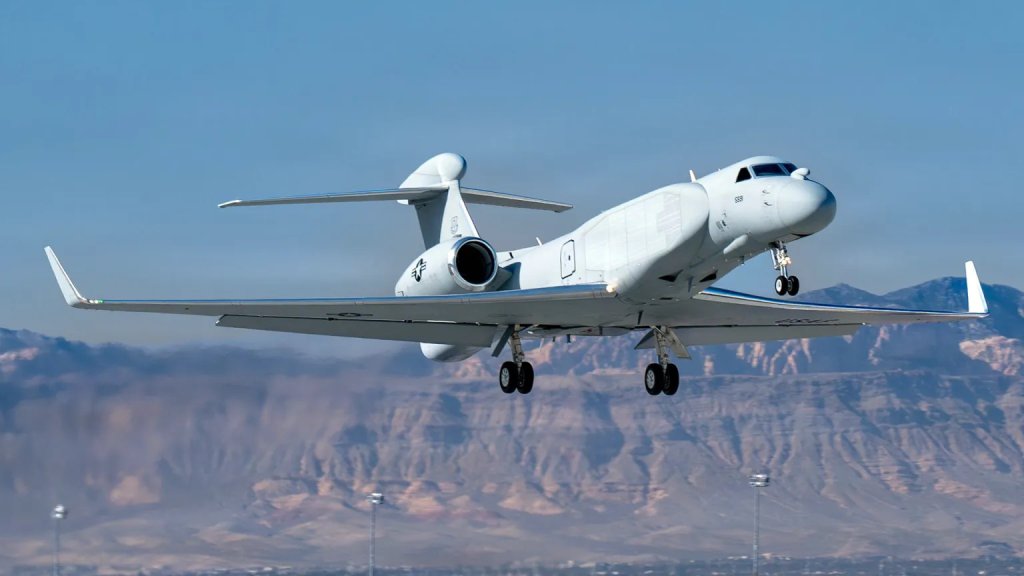 A US Air Force EA-37B Compass Call electronic warfare aircraft. USAF
 In speaking with Jamie Hunter, Lambert also highlighted how L3Harris had leveraged technology from the Rivet Joint fleet for the MC-55A Peregrine for the Royal Australian Air Force (RAAF). The Australians notably describe the MC-55A as an “airborne intelligence, surveillance, reconnaissance, and electronic warfare” platform.
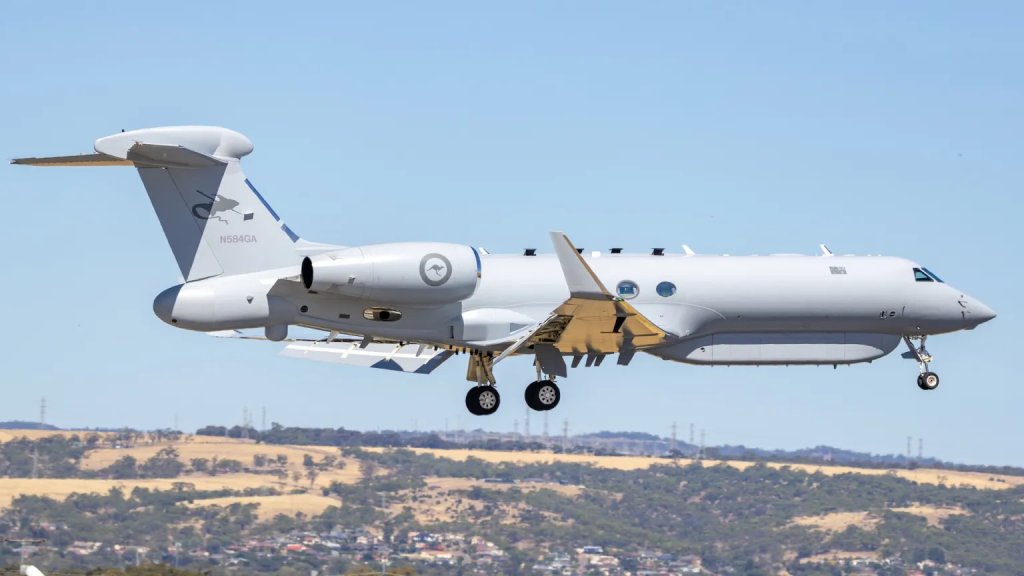 The first MC-55A for the Royal Australian Air Force arrives in that country in January 2026. @airman941
 It’s possible that the Rivet Joint fleet could gain electronic warfare capabilities, if they haven’t already. The Air Force has already been openly exploring the capabilities to be gained by teaming crewed Rivet Joint and Compass Call aircraft directly together during operations.
The electronic warfare domain is also an area where the aforementioned comments about rapid upgrade cycles are especially pertinent. Electronic warfare systems have to receive regular updates to ensure their effectiveness in an ecosystem where threats can evolve very quickly by changing waveforms or otherwise modulating the signals they pump out. The data that ISR platforms like the Rivet Joint collect is critical to staying ahead of adversary developments, but getting upgrades to systems in the field as fast as possible is also essential. If updates come too slowly, they could easily be out of date before they even arrive. A vital set of capabilities to further truncate these upgrade processes is now being developed under the umbrella of what is known as cognitive electronic warfare. Major leaps are already being made in shortening the time required to make these updates. The absolute “holy grail” of the concept would be an electronic warfare system that could adapt autonomously by itself in real-time, even in the middle of a mission, based on any new data it is presented with.
For its part now, L3Harris seems very interested in demonstrating how pairing drones with the Rivet Joint, as well as other ISR, early warning and control, and electronic warfare aircraft, could create new powerful airborne teams better suited to tomorrow’s potential conflicts.
Contact the author: [email protected]