Congressional resistance to law enforcement’s increasingly using Flock cameras to code and trace the activities of Americans without a warrant is growing rapidly. The concern: The cameras are a mass-surveillance tool that permits cops to skirt the Fourth Amendment to the federal Constitution.
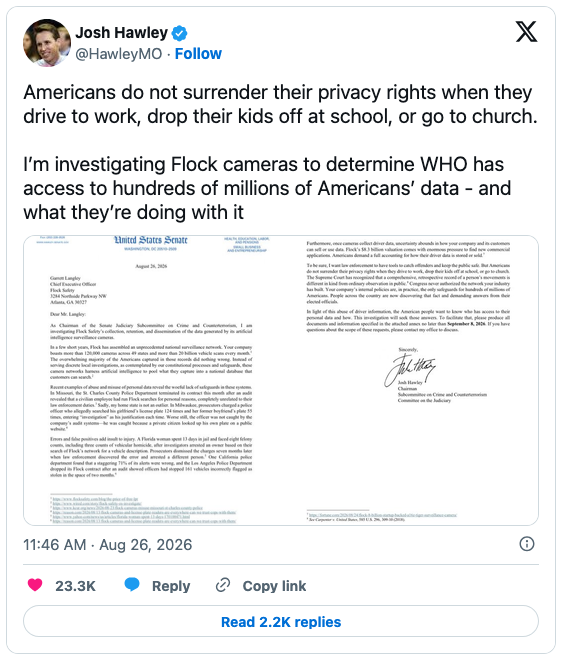
Last week, GOP U.S. Senator Josh Hawley of Missouri wrote to Garrett Langley, chief executive officer of Flock Safety, to demand he produce documents and other information about the widespread surveillance.
And just last night, U.S. Representatives Thomas Massie, Kentucky Republican, and Ro Khanna, California Democrat, announced legislation that would ban the federal government from funding the all-seeing electronic eyes.
Also, yesterday, GOP Representative Lauren Boebert of Colorado warned about the loss of legal rights because of the cameras. In April, she and Massie introduced legislation that would require a warrant for government authorities to seek Flock camera data.
Hawley’s Letter
Noting that Flock “has assembled an unprecedented national surveillance network” with 120,000 cameras and “more than 20 billion vehicle scans” monthly, Hawley averred that the Americans captured on the surveillance have done “nothing wrong.”
Thus, “instead of serving discrete local investigations, as contemplated by our constitutional processes and safeguards, these camera networks harness artificial intelligence to pool what they capture into a national database that customers can search,” the Show-Me-State senator wrote.
Hawley cited multiple examples of how the cameras are abused.
Missouri’s St. Charles County cops ended Flock surveillance because a civilian employee was running Flock searches “for personal reasons, completely unrelated to their law enforcement duties.” So did Los Angeles County, which found that Flock cameras wrongly identified 161 vehicles as stolen.
Prosecutors in Milwaukee, Wisconsin, alleged that a cop “searched his girlfriend’s license plate 124 times and her former boyfriend’s plate 55 times.” Justification: “investigation.”
In Florida, a “woman spent 13 days in jail and faced eight felony counts, including three counts of vehicular homicide, after investigators arrested an owner based on their search of Flock’s network for a vehicle description,” Hawley continued:
Prosecutors dismissed the charges seven months later when law enforcement discovered the error and arrested a different person. …
Hawley warned Langley that Congress “never authorized the network your industry has built.” He told the CEO to produce myriad documents and information by September 8.
Included in that list are the guidelines under which customers can search data about drivers and vehicles, how long data is retained, and the “confirmed instances of misuse of Flock systems or data known to Flock, by year, since January 1, 2021.”
Hawley also wants to know how a user justifies a search and whether the company has suffered security breaches.
Massie and Khanna
Massie and Khanna share Hawley’s concerns. Speaking to CNN’s Kaitlan Collins, the two said they would introduce legislation this week to stop federal funding of the snooping machines.
Congress does not have the power to ban them, Massie said, “but we do have the authority to withhold funding” for them. “The Flock cameras and the data centers may be the only things that have a lower approval rating than Congress these days,” he quipped.
“If you want to have them,” Massie said, “you can pay for them yourselves, but don’t ask the federal government to be part of this.”
Noting that his cooperation with Massie on opposing the war in Iran and this bill shows the value of “unconventional coalitions,” Khanna pointed to reports that women “are being stalked and harassed by former officers or current officers who are looking at these Flock cameras to go after their exes or to go after girlfriends.”
“There should be restrictions,” he continued:
There should be a process if you’re a police officer, that you shouldn’t just be able to look at this information without getting layers of approval and without getting some authorization. We should have a system where there’s oversight over the data. Right now, it’s just unrestricted and it’s being abused in many ways.
Massie said the bill would block federal funding for warrantless “real-time” surveillance.
Boebert’s Op-ed
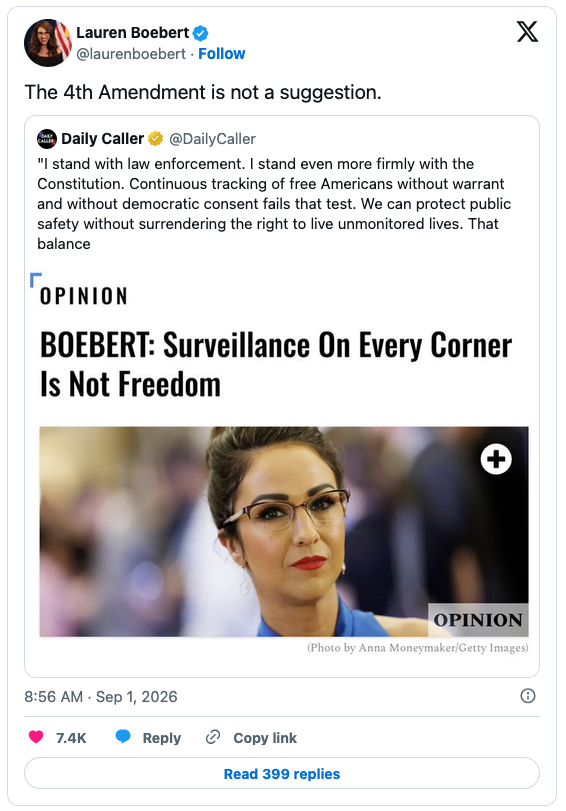
Writing for the Daily Caller, Boebert explained the problem with the cameras. “Fixed license plate reader cameras are quietly turning American streets into zones of constant monitoring,” she wrote:
These systems continuously scan and record vehicle plates, logging time, location, and travel patterns. In community after community, this infrastructure has often expanded without explicit statutory authorization, clear democratic limits, or the individualized suspicion that a warrant typically requires. It is simply happening. The result is a growing database of everyday movements — where people work, worship, shop, and take their children — compiled without the consent of the governed.
Boebert also would ban federal funding for the devices, and “tighten our laws to require warrants, limit data retention, ban the commercial sale of the information, and educate the public about how their everyday liberties are being put at risk.”
The Boebert-Massie Surveillance Accountability Act will mandate judicial warrants for “all government-initiated searches and surveillance,” including facial-recognition scanning in public. That prohibition covers schools and churches.
Also restricted will be using license plate readers “to create persistent location databases of citizens without a court order.”
The bill will forbid federal agencies from purchasing data to skirt the requirement for a warrant. It would also block federal agents from pressuring local cops to share warrantless surveillance data.
Wrote Boebert on X:
The 4th Amendment is not a suggestion.