By Literary Hub | Created at 2026-10-05 12:47:18 | Updated at 2026-10-05 16:01:42
6 hours ago
By Literary Hub | Created at 2026-10-05 12:47:18 | Updated at 2026-10-05 16:01:42
6 hours ago
I recently visited a house on Manhattan’s Upper East Side. Despite its hospitable interiors, I wasn’t invited inside. I wandered around in the dark, peering through the windows like a voyeur. I couldn’t believe what I saw. I dreamed of napping in one of the plush beds with the gilded headboards and silk sheets. I gawked at the elevator, never having been in a home with its own private lift. The art collection, hung salon-style in a large entry hall with striped floors, stunned me: cubist paintings, works by Gaston Lachaise and Marguerite Zorach, Marcel Duchamp’s famed Nude Descending a Staircase!
Article continues after advertisement
I made my way to the other side of the house, finding a room with silver walls and red lacquer furniture. A mahjong set had been abandoned mid-game on the table, and a bookshelf overflowed in the corner. I longed to be allowed in, to settle into one of the red chairs and read a book. On the shelves, alongside works by Sterne, Swift, and Defoe, I spotted a light blue book called Love Days by Henrie Waste. Oh, how I wished to read it!
If trespassing had been physically possible, maybe I would have slipped inside. But how can you break into a house so small that its furniture fits in your pockets? Built in 1916, the dollhouse was designed and continuously redecorated until 1935 by Carrie Stettheimer (1869-1944). In 1945, the house entered the collection of the Museum of the City of New York, where I saw it displayed inside a glass box on a cold winter afternoon. Carrie performed a “Honey, I Shrunk the Salon” miracle: encapsulating her family’s world of art and privilege in dollhouse miniature. The dollhouse memorializes the salon hosted by Carrie and her younger sisters, painter Florine and writer Ettie, and visited by all the great avant-garde artists and thinkers of the late nineteenth and early twentieth centuries.
Her startling novel guides us through the Stettheimer sisters’ fabulous world and the interior spaces of a troubled woman’s mind.
The dollhouse is most often discussed in the context of Florine’s (1871-1944) paintings: colorful and surreal canvases of gargantuan flowers, New York City landmarks, and her elegant sisters, dressed up in drop-waist evening dresses or romping through the countryside in pants. The house and its tiny art collection materializes Florine’s status as an avant-garde doyenne, but it also contains a rare (and very small) copy of Love Days, one of two books published by Ettie under the pseudonym “Henrie Waste.” Ettie (1875-1955), the youngest and most audacious of the Stetties, as the sisters were known, has garnered less attention for her artistic output than her sisters but was no less productive.
A hundred years after the publication of Love Days, Ettie’s writing career has all but disappeared. Instead of reading her words, we see her book miniaturized in Carrie’s dollhouse or catch glimpses of her holding a quill or book in Florine’s paintings. This new edition of Love Days, enlarged to human scale by Mandylion Press, recenters Ettie as an author of her own experience. Her startling novel guides us through the Stettheimer sisters’ fabulous world and the interior spaces of a troubled woman’s mind.
Ettie’s alter ego Henrie Waste was born in 1917 with the publication of Philosophy: An Autobiographical Fragment, a young woman’s account of pursuing a Ph.D. in Germany at the turn of the century. Henrie’s next and final novel, Love Days, was released in 1923 by Alfred A. Knopf. The use of pseudonyms by female writers born in the nineteenth century is typically understood as a feminist loophole around the patriarchal suppression of women’s writing.
A 1923 New Republic review of Love Days in which Henrie Waste is referred to with female pronouns suggests that Ettie’s nom de plume was less an act of gender transgression than of emancipation from her identity as one of the Stetties. The name “Henrie” was plucked from the half of Henrietta’s name not already in use by her lifelong sobriquet. While her family and friends called her Ettie, she chose the last name “Waste.” The surname is at odds with a novel like Love Days, wherein nothing is wasted—Ettie’s own life providing fodder for plot and character.
Ettie was born in Rochester, New York on July 31, 1875, the youngest of five children born to Joseph and Rosetta Walter Stettheimer. Joseph worked in his German Jewish family’s clothing and banking businesses, until he abandoned his family in the late 1870s, never to be seen or heard from again. Rosetta moved with her children first to her native New York City and then to Germany, raising them between Stuttgart and Berlin. Extended stays in Europe helped shield Rosetta from the scandal caused by her husband’s disappearance. In the 1890s, the eldest children, Stella and Walter, each married and moved to California, reducing the family unit to four single women, who lived together until Rosetta’s death in 1935. Florine studied at the Art Students League of New York and Ettie graduated from Barnard College in 1896. She received a master’s in psychology two years later, and in 1908, earned a Ph.D. in philosophy from the University of Freiburg. When World War I threatened the family’s Continental lifestyle, Rosetta and the Stetties permanently relocated to New York, maintaining residences at 102 West 76th Street and in the Alwyn Court building at 180 West 58th Street.
Love Days retraces the outlines of Ettie’s life through the story of Susanna Moore. While a traditional bildungsroman follows its heroine from cradle to grave, Love Days follows Susanna from college to the sanitorium, each chapter encompassing one day of Susanna’s life as she transforms from a dreamy teenager to a somber woman. Susanna attends a women’s college in Manhattan, where she excels as a scholar of ancient Greek but can hardly tell her schoolmates apart, confusing who commutes from New Rochelle and who from Nyack. While her peers put their “Mrs.” degrees to good use, marrying and settling down, Susanna continues her studies at a university in Germany. Her widowed aunt plays chaperone as Susanna attends heady lectures and repulses her many suitors.
Tired of German men throwing themselves at her feet, she returns to New York, where she rents a bohemian studio and befriends famous artists. She bristles at the idea of marriage but falls in love with Pol Grodz, “the new celebrity” of the scene, whose art “seems [to her] utterly modern, and yet to partake of the certainty of the Renaissance and its sense of harmony.” The reality of married life disappoints. Susanna asks herself: “Did the consciousness of helping an artist to produce a masterpiece even with ensuing immortality in a Museum compensate one for a protracted honeymoon…?” Henrie Waste answers this question with a resounding “No.”
Susanna’s “love days” are brief. Her passion for Pol is a flare, burning brightly and extinguishing quickly. If the novel has a moral, it is that marriage is a mistake. She learns the lesson too late; lured by desire, she ends up in a conjugal prison. The Stetties avoided such crises, flirting without signing away their New Woman freedoms. Gossips have linked Ettie, the most outgoing sister, to much younger men like Marcel Duchamp and Elie Nadelman. Duchamp (1887-1968) appears in Love Days “readymade” as Pierre Delaire, an eccentric Frenchman who surprises her at the studio after returning from Paris. “I didn’t play chess all the time,” he promises, “I began some canvases.” He explains that his new paintings have “an ulterior intention which removes them from Cubism.” If Delaire is friend-zoned in Love Days, who is Pol Grodz? Perhaps he is a pastiche of all the talented and temperamental men who visited the Stettheimer salon. Or maybe he represents the painter who produced dozens of portraits of Ettie, with whom she shared a fiery decades-long relationship. Who else but Florine?
Ettie may never have married, but she knew the dynamic between painter and subject intimately. Her sister painted her countless times in her lifetime. Susanna and Pol’s marriage sours when he spends their honeymoon obsessively sketching his new wife. He admonishes Susanna for posing “like a model before her painter—not like a wife before her husband, her lover.” Ettie portrays the relationship between artist and model as a power struggle. Susanna only succeeds as a wife when she contorts herself into his ideal image, causing him to exclaim, “you are a Grodz!” After her death, Ettie executed Florine’s estate, depositing her paintings in major collections and organizing exhibitions. In doing so, she sealed her own fate as “a Stettheimer!”, less a person so much as a recurring motif. The sister with the heavy brow and dark bangs, often with a book in her hands, can be spotted on the walls of many museums, but rarely do we get to hear from her directly.
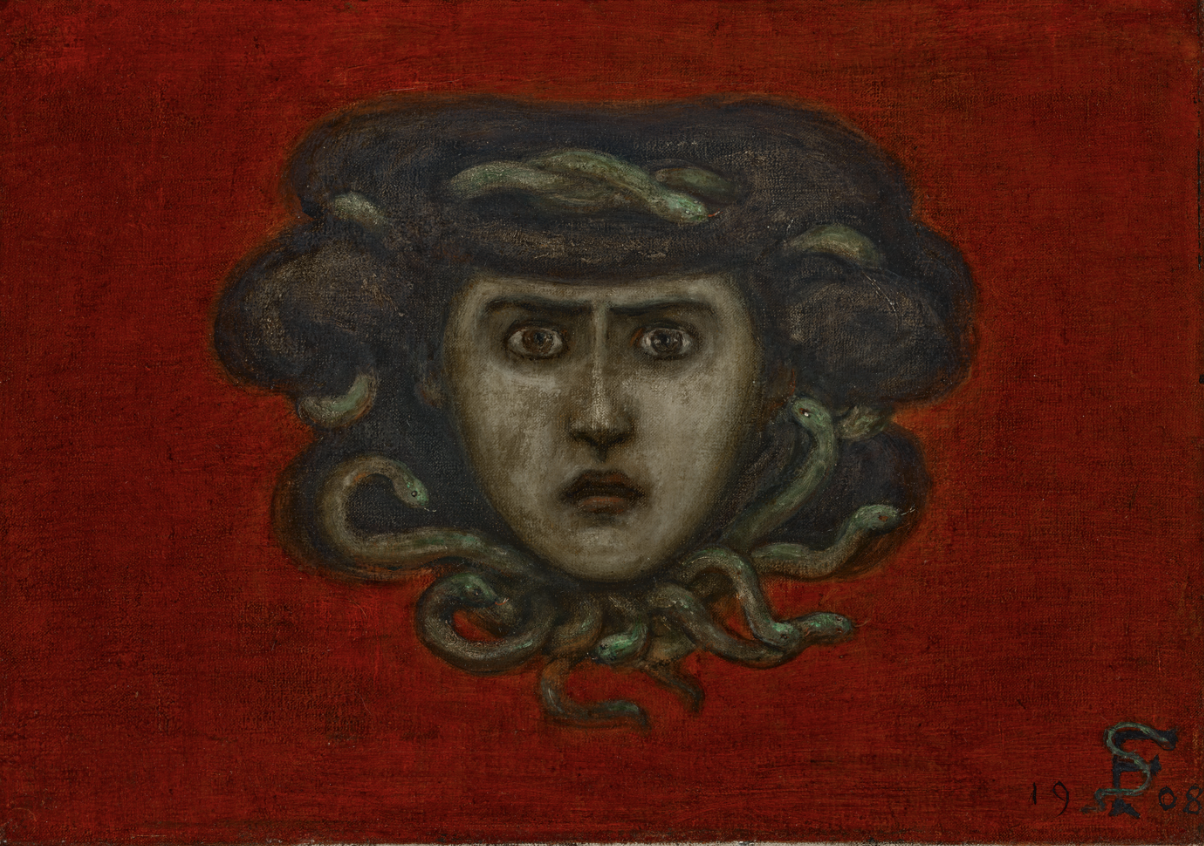
One of Florine’s portraits of Ettie provides insight into the character of Susanna Moore. Ettie’s face is transposed onto the head of Medusa. As in real life, her bangs hover close to her eyebrows, but in this portrait, green snakes slither through her hair. Her face is contorted into a look of wide-eyed horror. The portrait dates to 1908, the same year that she received her Ph.D. from the University of Freiburg. At the peak of her intellectual powers, she is depicted as a Greek mythological figure who turns men to stone. What strikes me about the painting is how Medusa herself appears to be made of stone. A floating head painted in shades of greenish gray against a blood-red background, Ettie is both Medusa and her victim. Love Days gets inside the head of the disembodied, Medusa-like woman who uses her work to escape the perils of her own subjectivity. Susanna’s relationship with her body and sex is tortured: staring at her reflection in the mirror, she wonders what she looks like, and in intimate moments, she shuts down completely.
Walking through prewar Berlin, taking in its historic architecture, Susanna daydreams of her native New York, an ever-changing city where buildings are torn down and rebuilt in the blink of an eye. “When the Plaza Hotel was antiquated it would inevitably give birth to another, newer Plaza Hotel, and die usefully.” In a stunning admission of her own disembodiment, Susanna longs to practice “this Plaza method of reproduction,” both to “give birth to a new Susanna,” but also, presumably, to avoid sex.
Later, on their miserable honeymoon, Susanna pretends to be asleep as Pol manipulates her body, drawing her closer to him in bed, whispering “I die of thirst and hunger for you.” As he violates her, Susanna lies motionless and holds herself rigid, a “skill derived from experience in impersonating dolls and dead bodies.” These moments eerily resonate with the Stettheimer dollhouse. Susanna seeks an architectural solution to the problem of human reproduction—instead of a body, she wishes to be a building. When forced to participate in human sexual contact, she turns herself into a doll.
Love Days gets inside the head of the disembodied, Medusa-like woman who uses her work to escape the perils of her own subjectivity.
From the first lines of Love Days, we are made aware of Susanna’s penchant for dissociation: she has breakfast but doesn’t remember what she’s eaten; she doesn’t ride the streetcar to college, she finds herself on it. The novel is elongated by ellipses…as if our heroine momentarily loses not words…but consciousness. She is only truly happy when she’s working, but happy does not mean whole. Work is her escape from real life. When an anonymous German classmate declares his love for her, she hides from him and her own feelings in obscure ancient texts.
After luncheon she got to work, and she soon managed to detach herself from her troubles by plunging deep into her research, an investigation of certain Greek verse forms. Working, she was no longer either happy or unhappy; she was personally submerged; she existed only as mind, as instrument. As an individual she had become as non-existent—for herself at least—as one becomes in dreamless sleep.
Unfortunately, I am familiar with Susanna’s urge to evade complex emotions through working. It is easier to exist “as mind, as instrument” than to admit to being a living, breathing person with passions and needs. It is important to remember that “plunging deep [into] research” is a privilege only recently awarded to women. Stettheimer belonged to the first generation of women granted access to the academy. Susanna worries that she can’t keep up with Pol and his avant-garde friends without acknowledging that having a college degree was radical for a woman. Stettheimer processes all this newness through Susanna’s internal dissonance and the novel’s elliptical quality.
Ettie certainly considered herself a pioneer. In 1951, she published Memorial Volume: Of and By Ettie Stettheimer, a collection of her two novels, some short stories, her Ph.D. dissertation about William James, as well as a letter he wrote praising her work. In a New York Times review that year, critic Elizabeth Janeway warned that “Miss Stettheimer is not to be laughed off.” According to Janeway, “with the Fitzgerald revival, the Twenties have suddenly become historical,” creating such an over-emphasis on the flapper years that the preceding decades threatened to disappear from the collective memory. Amid this historiographic crisis, Janeway praised Love Days for its insights into the “real years of anguish and growth” that came before the roaring Twenties.
Susanna Moore is terribly important to us, more so than any of Hemingway’s gallant girls. She is greedier, not only unsatisfied as are Lady Brett and Gatsby’s Daisy, but insatiable, for she wants so much more than life can give….She is the creation of that male age so incongruously named for Victoria—she is what emerged at the end of Victorianism when the curtain of male supremacy was finally lifted.
It is tempting to characterize the high-achieving women of the late nineteenth and early twentieth centuries as victors. But Susanna’s story does not end when she graduates from college, nor does Avis Dobell’s after she trains as a painter in Elizabeth Stuart Phelps’ The Story of Avis (1877), which Mandylion is reissuing alongside Love Days because of their shared interest in ambitious women. The novels of Stettheimer and Phelps are notable for how they portray the slow pace of change. New opportunities come with new challenges—a woman can only exist as mind or instrument for so long. If she desires to pair her success with some modicum of emotional, spiritual, or physical fulfillment, then she will suffer the consequences. While The Story of Avis is decidedly a nineteenth-century novel, Love Days belongs to the time in between. Susanna Moore “is the creation of that male age so incongruously named for Victoria,” but she has the same bobbed haircut as Brett Ashley and Daisy Buchanan, female characters liberated (at least sexually) by the shifting mores of the twentieth century.
Despite being published nearly fifty years later, Love Days tolls the same alarm bells as The Story of Avis. Susanna may be our first Mandylion heroine to make a phone call, drive an automobile, or ride an elevator, but like Avis Dobell before her, she loses her independence and creative potential when she opens her heart to love. The stubborn both/and quality of Love Days—its blend of avant-garde experimentation and Victorian conservatism—challenges our tidy chronologies and puts the “long” in Mandylion’s preferred “long nineteenth century.” The pleasure and pain of reading old books is realizing that the past is relatable. With great change comes great stagnancy. I graduated from Barnard College a hundred and twenty years after Ettie Stettheimer, a member of one of the women’s college’s earliest graduating classes. In that intervening century, women gained the vote and man went to the moon, but the appeal of entering an alternate universe where men pose no threat to the dreams of ambitious women remained constant.
______________________________
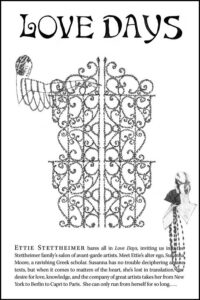
From Love Days by Ettie Stettheimer. Introduction by Mabel Capability Taylor. Copyright © Mandylion Press, 2026 and Mabel Capability Taylor.