By The Straits Times | Created at 2026-07-24 21:30:05 | Updated at 2026-07-24 22:57:19
1 hour ago
By The Straits Times | Created at 2026-07-24 21:30:05 | Updated at 2026-07-24 22:57:19
1 hour ago
SUWON – Most people know Sungkyunkwan University (SKKU) as Korea’s oldest university, founded in the 14th century.
These days, however, it is also informally known as the “Samsung university”, after its primary patron and largest corporate backer, the Samsung Group.
At the university’s Natural Sciences Campus in Suwon, about 30km south of Seoul, the connection to South Korea’s largest conglomerate is especially visible.
Under a strategic partnership dating back to 1996, several of the university’s specialised departments, including semiconductor systems engineering, intelligent software and battery engineering, are jointly run with Samsung.
Such an arrangement creates a talent pipeline fed by scholarships, internships and employment-linked programmes that lead directly to positions within its group of companies, such as Samsung Electronics, Samsung Display and Samsung SDI.
About 30 per cent of the university’s engineering graduates go on to work for Samsung Electronics or other Samsung affiliates
Sungkyunkwan University spokesperson
The hunt for the brightest young minds extends beyond the country’s borders. More than 550 international students were enrolled in undergraduate and postgraduate engineering programmes at SKKU in 2025, including about 240 from China and 130 from South-east Asian countries such as Malaysia, Vietnam and Indonesia.
SKKU’s close ties with Samsung were a key draw for Vietnamese undergraduate Nguyen Nhat Minh, 20, who chose to study computer science and engineering at SKKU mainly because of its industry links.
The conglomerate is Vietnam’s largest foreign investor, with cumulative investments exceeding US$23 billion (S$29.7 billion), and is one of its biggest employers of high-tech talent.
In May, Samsung announced plans to build a new US$1.5 billion semiconductor testing facility about 60km north of Hanoi, with operations expected to begin in November 2027.
“My parents first had that vision for me after seeing what Samsung was doing in Vietnam,” said Minh, who attended Hanoi’s FPT High School, a technology-focused school operated by FPT, one of Vietnam’s largest technology companies. “Over time, it became my vision too.”
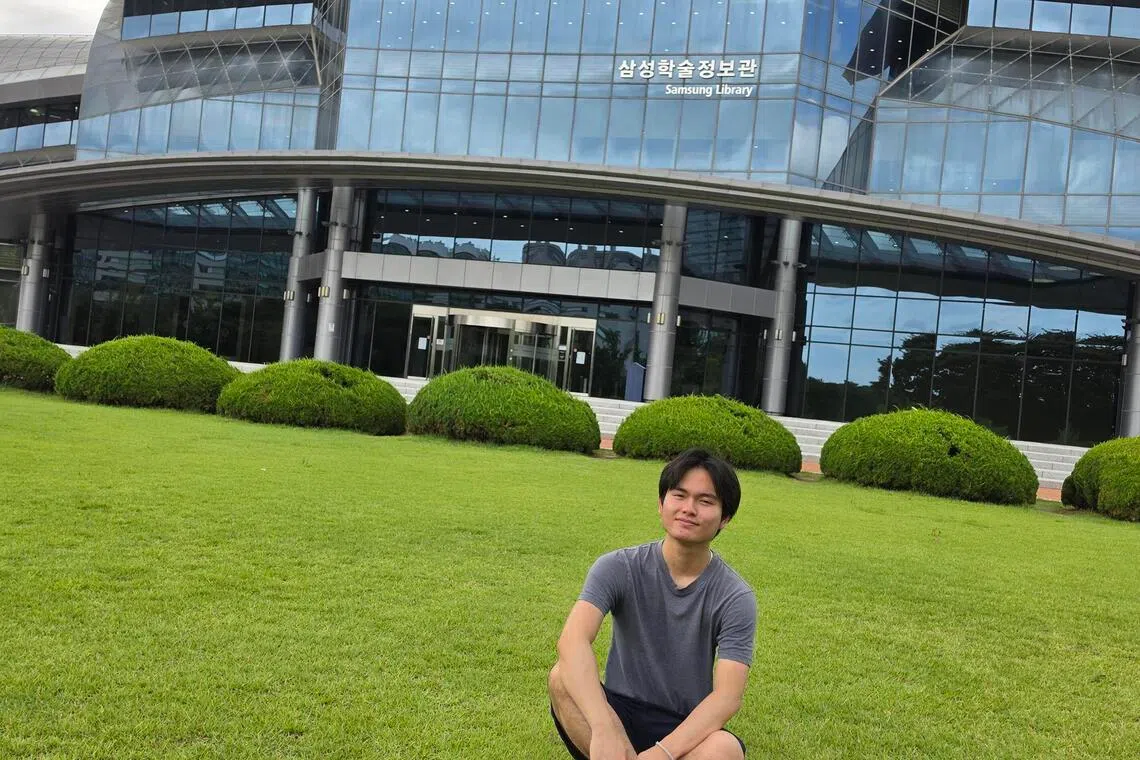
Computer science and engineering student Nguyen Nhat Minh in front of the Samsung Library, which he said is a very popular study spot. He added that Samsung distributes free food to students during every exam season.
ST PHOTO: WENDY TEO
The move to widen the talent search is part of a broader push by South Korea to plug a domestic labour shortage, especially in the artificial intelligence and semiconductor industries.
An additional 100,000 semiconductor workers will be needed by 2040 as South Korea expands the Yongin semiconductor mega-cluster and develops a new chip cluster in Gwangju.
Other companies are also looking to academia to train their future talent. Conglomerates such as SK Hynix, Hyundai Motor Group and LG Electronics also have partnerships with leading universities such as Yonsei, Sogang, Hanyang and Korea University to establish specialised degree programmes combining industry-focused training with a pathway to eventual employment.
In 2023, the Education Ministry also launched the Study Korea 300K Project, aiming to increase the number of international students from about 208,000 in 2023 to 300,000 by 2027. That target was reached in late 2025.
The initiative explicitly links higher education to South Korea’s long-term workforce needs, primarily by recruiting more students into science and engineering disciplines. It also expands English-medium degree programmes and simplifies visa and employment rules for foreign graduates.
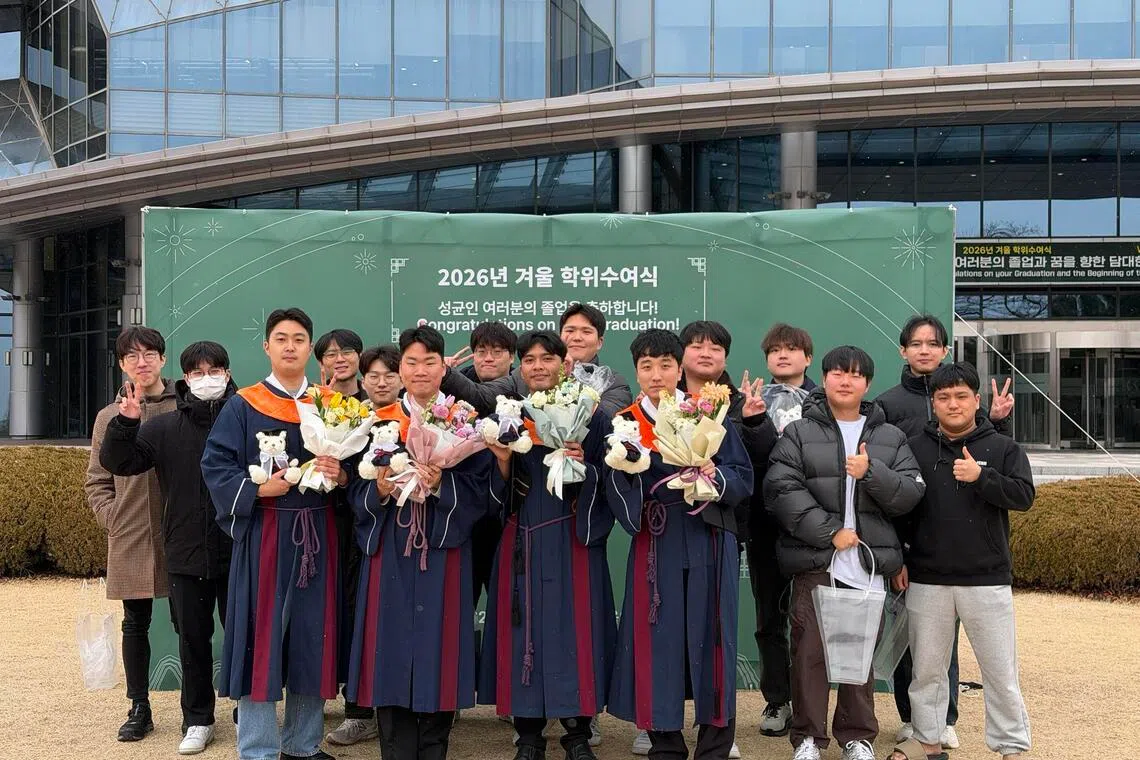
Indonesian Raihan Muhammad Syahran (front row, third from left) graduated from SKKU in February and now works in South Korea.
PHOTO: COURTESY OF RAIHAN MUHAMMAD SYAHRAN
Complementing the initiative is the new Korea-Science and Technology Advanced Human Resources (K-STAR) visa programme, which offers international graduate students and researchers a streamlined pathway to long-term residency. It shortens the eligibility period for permanent residency from six to three years and provides an accelerated route to naturalisation for those with outstanding research achievements.
Through the K-STAR programme, the South Korean authorities aim to attract more than 400 highly skilled foreign science and technology professionals each year, up from around 100 currently.
Education Ministry data shows that more than 11,500 South-east Asian students were enrolled in engineering programmes in South Korea in 2025.
Of these, Vietnamese students accounted for the largest group at 74.5 per cent, followed by Myanmar (9.6 per cent), Malaysia (4.8 per cent) and Indonesia (1.3 per cent).
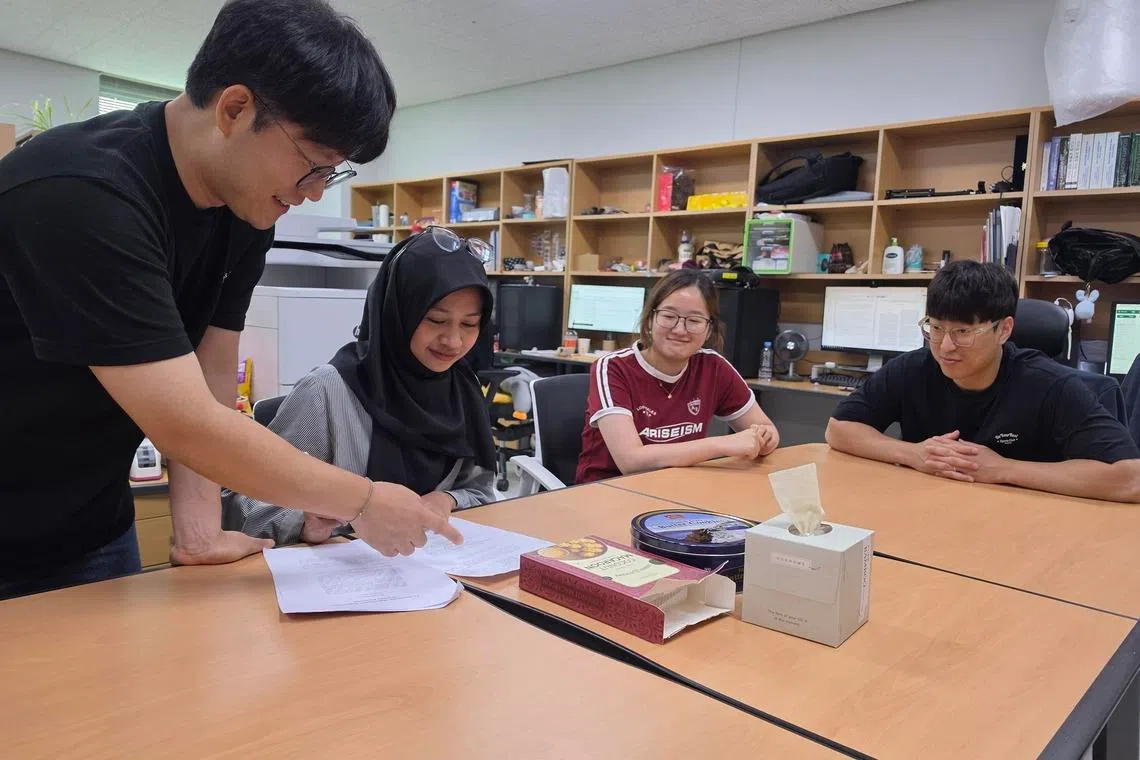
Indonesian Maharani Bahar (second from left), who is pursuing a master’s degree in computer science at SKKU, interacting with her Korean lab mates.
ST PHOTO: WENDY TEO
Despite not knowing enough Korean to hold a conversation when he first arrived two years ago, Minh said language is not a barrier, as his lessons are conducted in English and most of his schoolmates speak the language well.
Minh, who will spend four months at Singapore’s Nanyang Technological University on an exchange programme beginning in August, said the plan is to finish his master’s degree in South Korea and then pursue a doctorate in Singapore.
“Singapore’s international academic reputation is outstanding, and it will open up opportunities and exposure to larger international corporations. Education in South Korea is more specifically tailored for the South Korean industry, so I’m hoping that further studies in Singapore will broaden my horizons,” he said.
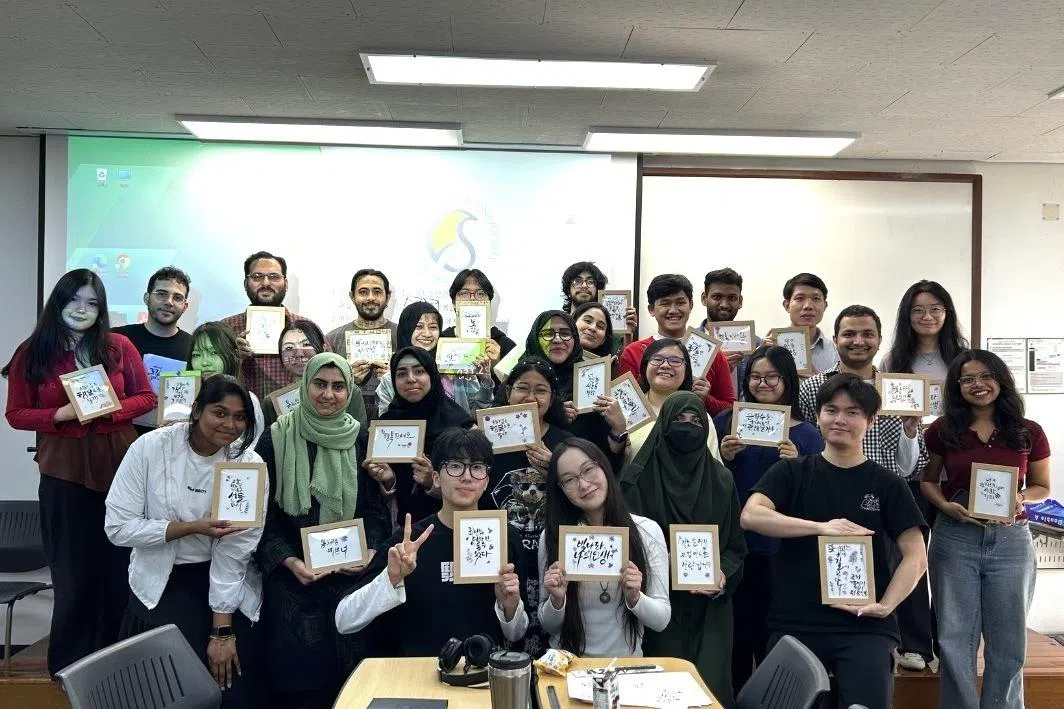
Vietnamese student Nguyen Nhat Minh (first row, far right) joined a Korean calligraphy class in May 2025, organised by SKKU’s Office of International Student Services.
PHOTO: COURTESY OF NGUYEN NHAT MINH
Indonesian Raihan Muhammad Syahran, 24, graduated with a master’s degree from SKKU in February and now works as an AI engineer in Seoul. He plans to work there for at least five years.
He had originally planned to study in Germany, but chose SKKU instead for its bond-free scholarship and the lack of a Korean-language requirement to enrol.
“Here, I can study in English, without any requirement for Korean-language proficiency,” he told The Straits Times.
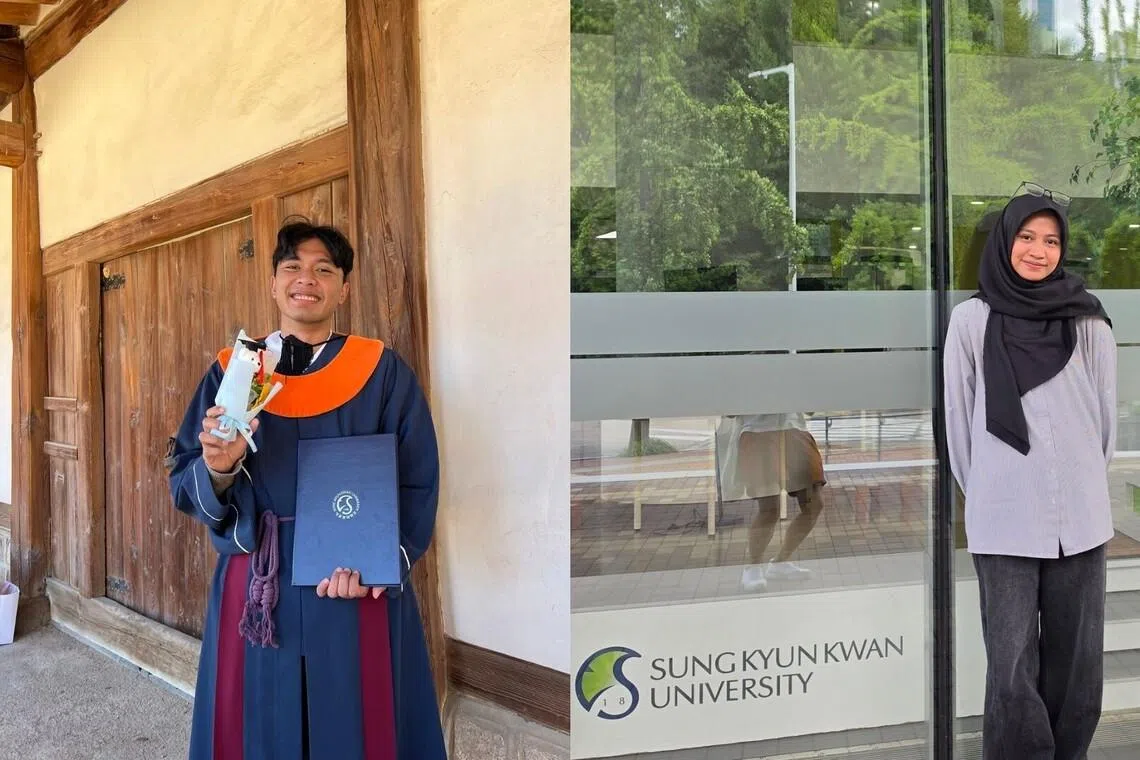
Indonesian Raihan Muhammad Syahran (left) graduated with a master’s degree in electrical and computer engineering from SKKU in February, while fellow Indonesian Maharani just enrolled in the university’s computer science master’s programme.
PHOTOS: COURTESY OF RAIHAN MUHAMMAD SYAHRAN, WENDY TEO
Like Raihan, fellow Indonesian student Maharani Bahar found it relatively easy to settle into life in South Korea.
The 25-year-old arrived in February on an Indonesian government scholarship to pursue a master’s degree in computer science, with a special interest in cybersecurity.
She has no regrets about choosing South Korea over more popular destinations among Indonesian graduate students, such as Australia and the United Kingdom.
“I feel more comfortable living in an Asian country,” she said. “But beyond that, I believe South Korea is one of the strongest places to study technology.”
This story is part of our Asian Insider feature on East Asia’s tech talent chase. Read more about the situation in Japan.