By The Straits Times | Created at 2026-08-13 13:32:05 | Updated at 2026-08-13 14:17:58
47 minutes ago
By The Straits Times | Created at 2026-08-13 13:32:05 | Updated at 2026-08-13 14:17:58
47 minutes ago
TAIPEI – As the air raid sirens sounded above, a message flashed on my mobile phone screen.
“Due to simulated air attacks on communications infrastructure, mobile network access will be affected,” it said, reminding residents to switch to fixed-line broadband internet access or indoor Wi-Fi.
The Instagram reel I was watching stopped loading; a text conversation I was having with a friend on WhatsApp ended abruptly.
For the first time during Taiwan’s annual Han Kuang war games, the government deliberately slowed mobile Internet speeds to simulate communication disruption in the event of a natural disaster or an invasion by China, which claims sovereignty over the island.
The goal? To test the public’s psychological and logistical readiness under a potential information blockade.
For 30 minutes on Aug 13 in Taipei and other parts of northern Taiwan, many tech-dependent residents and I were forced to experience the discomfort of being temporarily knocked offline.
Public 4G and 5G download speeds plunged to 1 per cent of normal capacity, meaning that bandwidth-heavy services such as streaming, gaming and large file transfers stopped working. However, phone calls and SMS text messaging still functioned.
A similar exercise was held days earlier in central Taiwan on Aug 10.
The new mobile internet speed throttling drill was tagged onto the usual air raid and civil defence drill conducted annually, when residents are legally required to stay off the streets and seek shelter indoors and underground for a set amount of time.
During the drill, I was at Taipei Main Station, the capital’s central transport hub where hundreds of thousands of commuters and tourists transit daily.
Around 10 minutes before the drill was scheduled to start, intercom announcements playing on loop throughout the building reminded people to begin moving to the basement levels.
As I followed the crowd downstairs, however, there was no sign that an air raid drill was about to begin.
Shops and eateries in the underground mall remained open and teenagers on their summer break continued playing arcade games. Others huddled inside karaoke boxes, belting out the latest Mandopop hits.
I was not too surprised.
Having covered these drills for the past three years, I have noticed that many people tend not to take them seriously. Air raid drills are typically set around lunchtime, and I have spotted office workers sipping on bubble tea and chatting gregariously indoors while waiting for the all-clear signal to go out.
Perhaps, having lived under the threat of a Chinese attack for so long, some Taiwanese treat civil defence routines simply as a minor inconvenience.
“My friend and I were asked to leave the cafe upstairs, but we’ll just go and find another cafe to park ourselves in the basement,” housewife Wang Ching-hua, 54, told me. “We have to follow instructions or we’ll get fined.”
The new mobile Internet-slowing exercise did not appear to have much of an impact either. People leaned against the wall watching videos already saved on their phones while others sat on the floor to wait out the 30-minute block.
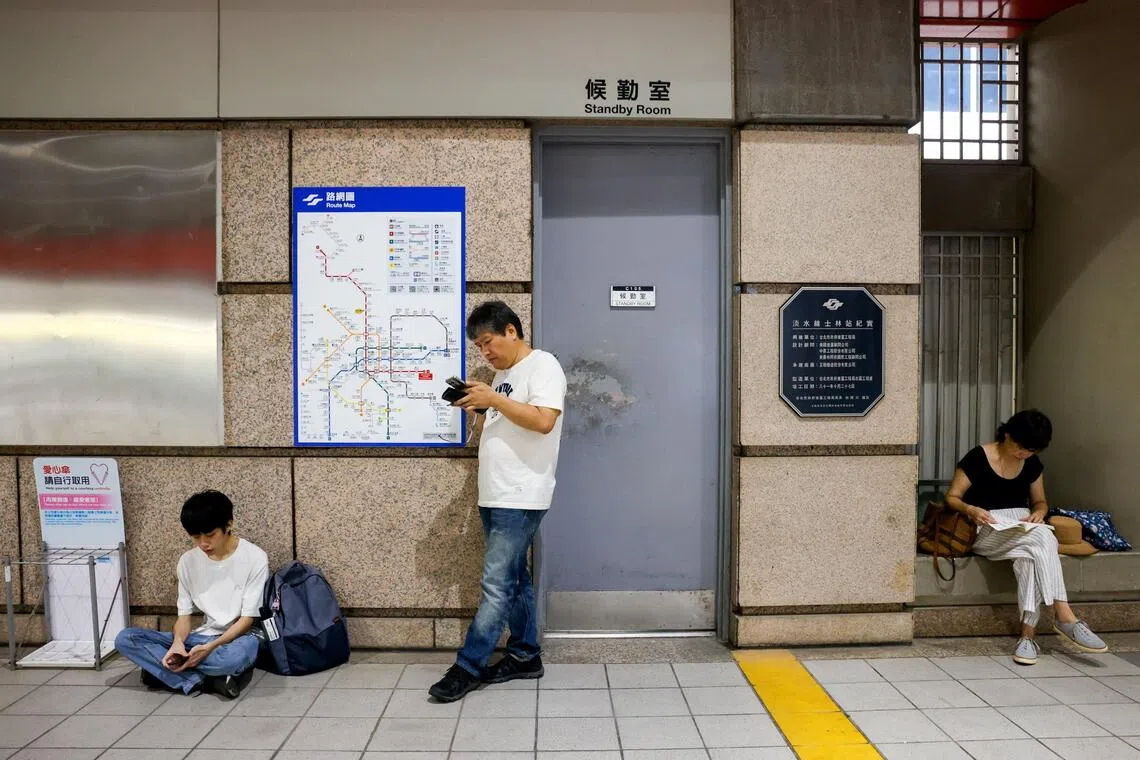
People taking shelter at a metro station in Taipei during Taiwan’s annual Han Kuang war games on Aug 13.
PHOTO: REUTERS
But the people’s apparent lack of urgency over their connectivity being blocked is concerning because Taiwan’s network vulnerabilities are very real.
In the event of a cross-strait conflict, defence analysts have long identified cyberattacks and communications blackouts as likely opening tactics of the Chinese to paralyse infrastructure and isolate Taiwan from global support.
This would mirror battlefield environments at the start of the Ukraine war in 2022, when Russia executed a cyberattack targeting a satellite Internet network which disrupted Ukrainian military command and control. The attack also caused civilian Internet outages across Ukraine and Central Europe.
And the reality is that it would not require a full-on invasion for Taiwan’s digital infrastructure to fall apart.
Taiwan is reliant on 14 international submarine cables for the vast majority of its global data traffic, and these thin cords are highly susceptible to physical sabotage and grey zone threats from nearby vessels.
Past incidents have already shown that civilian communications can be crippled if any of these cables are severed.
In February 2023, Taiwan’s outlying Matsu islands were knocked offline for several weeks when the only two undersea cables connecting the archipelago to the outside world were severed.
While there is no evidence that the undersea cables were cut intentionally, Taiwan suspected that the cables were damaged by two Chinese vessels, one by a fishing vessel and the second by a cargo ship just six days later.
For more than a month, Matsu residents were forced to camp outside the local telecommunications office with their laptops and mobile phones to get online via a back-up network. Even then, connectivity was slow and limited as it relied on older microwave radio transmission technology.
Taiwan also faces a staggering volume of cyberattacks, experiencing a daily average of 2.63 million intrusion attempts in 2025, according to data from the island’s National Security Bureau. Critical infrastructure is often targeted, from energy grids to hospitals and high-tech industrial parks.
That the government stress tests the public’s reaction to a digital blackout is therefore necessary; the bigger question now is how to make the test more effective.
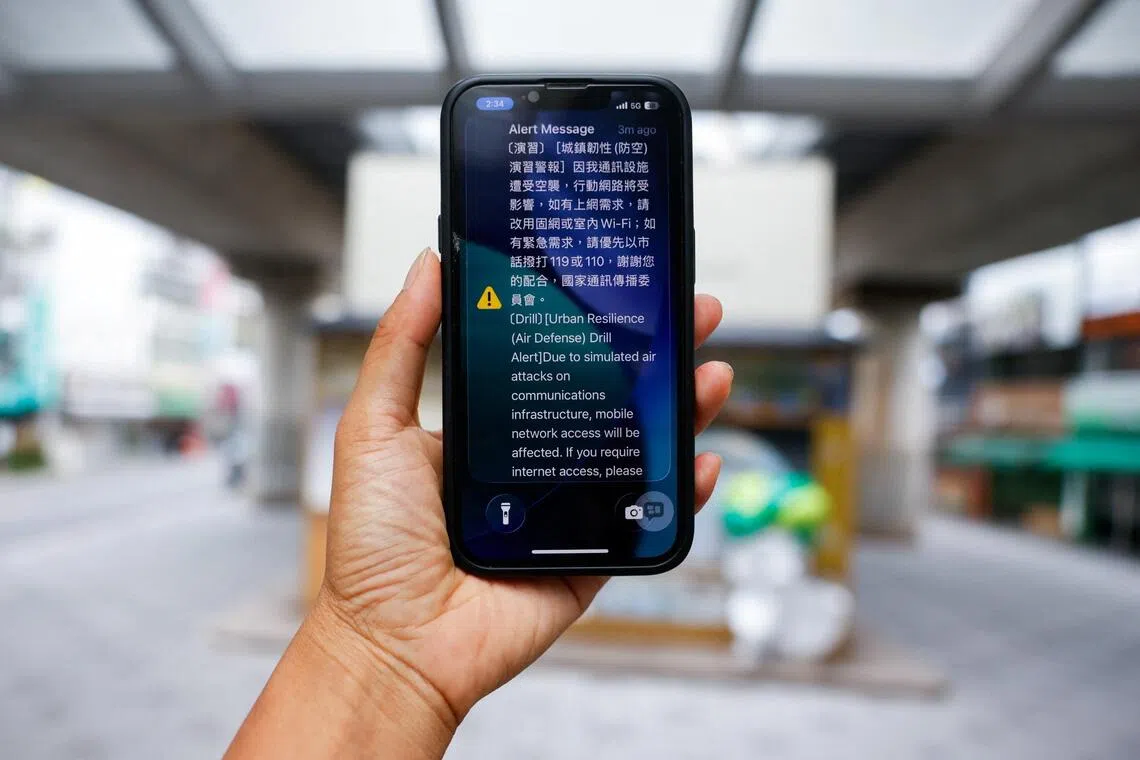
The new mobile internet speed throttling drill was tagged onto the usual air raid and civil defence drill conducted annually.
PHOTO: REUTERS
The drill by design is far from perfect.
A predetermined 30-minute test cannot realistically mimic a sustained, unannounced cyberattack. Fixed-line broadband and Wi-Fi services were also left untouched, when a true kinetic blockade would likely knock out communications entirely.
Meanwhile, the southern and eastern parts of Taiwan were excluded from participation in the Internet-slowing exercise altogether.
The authorities said that the decision for the east followed a review of local network capabilities and the potential fallout, without providing additional details.
But eastern Taiwan is highly critical for military tactical preservation, serving as a fallback zone for jet dispersals and naval deployments. And southern Taiwan hosts critical semiconductor fabrication facilities and major naval ports.
Failing to test how civilian populations and emergency logistics function under network degradation in both of these areas weakens overall urban resilience.
Perhaps, for a start, shops and restaurants should not be allowed to remain open during the drill, even if they are situated underground. A slightly extended Internet outage window of, say, an hour, would also not be as easily waited out.
The fact that the public was advised to simply switch to landlines or Wi-Fi services was not enough to compel people to seek true emergency communication alternatives either, such as downloading offline maps or taking screenshots of critical information ahead of time.
Still, the debut test is a step in the right direction of Taiwan’s shift towards a whole-of-society defence model. For years, Taiwan’s military and civilian drills have been criticised for being overly reliant on traditional military manoeuvres.
A near digital blackout reflects the realities of modern electronic warfare and brings the highly abstract threat of a conflict directly into the daily lives of its people.