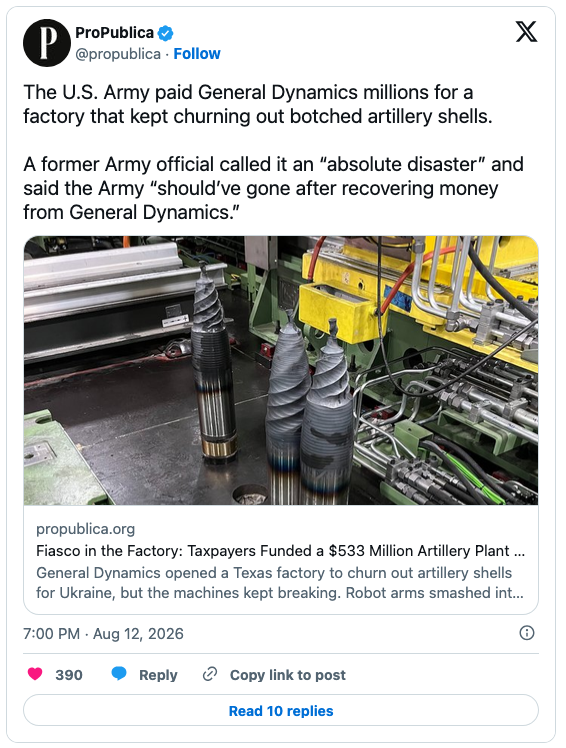
A major U.S. defense contractor received more than $500 million from U.S. taxpayers for an artillery-shell plant that produced not “a single usable shell.”
Investigative-reporting website ProPublica revealed that General Dynamics received that boatload of money to produce shells at a plant in Mesquite, Texas. It hired a Turkish subcontractor that provided malfunctioning equipment that did nothing but break down.
Not so shockingly, the catastrophic failure is linked to the war in Ukraine, where many if not most of the shells were destined to go. So U.S. taxpayers were fleeced for yet another foreign war in which the United States has no interest.
Cutting-edge Robots?
ProPublica’s story opens with fires at the plant in 2024 that ignited on “cutting edge robots” that were “churning out urgently needed artillery shells for Ukraine.”
“The robots, giant metal arms with clamps for hands, would end up drenched in oil, which would then — no surprise — combust as they moved steel blocks heated to 1,800 degrees into and out of a machine that periodically erupted columns of fire,” the website explained:
One blaze that summer melted a robot’s cables, putting it out of commission for a week.
Only weeks earlier, defense officials and executives had touted the factory’s innovative new machinery, imported from Turkey, at a gala opening ceremony. But employees were already used to spectacular mishaps, fiery and otherwise. “After the second, third, fourth time, it just became almost normal,” one former worker said. “It got to the point where I was not surprised by anything that happened there.”
Instead of producing shells in an efficient and streamlined fashion, the pricey machines kept failing in bizarre ways. The robot arms would swing out of control, smashing into carefully calibrated equipment, and sometimes they would unexpectedly drop hunks of steel 5 feet down to the floor. The factory’s signature device, meant to precisely stretch the steel for the artillery shells, instead often cracked it beyond repair. Then there were the giant press machines, which required regular pounding with a sledgehammer to function properly but still botched the shaping of nearly every shell. “We really didn’t have any standardized practice,” said Quantel White, a former employee. “It was just a bunch of guys taking turns going at the machine with a sledgehammer every night.” To workers, even the factory buildings themselves came to feel doomed, with acrid smoke hanging in 100-degree heat over foundations seemingly sinking into the earth.
So much for “cutting edge” technology from the Turks.
The Army shut down two of the plant’s three production lines last year. But “by then, General Dynamics had blown eight deadlines.”
The factory didn’t produce “a single usable shell,” the website divulged.
Price tag: $533 million. General Dynamics paid not “a penny back” and, instead of being publicly humiliated, “has been showered with new contracts,” ProPublica continued.
The Army told the website General Dynamics will repay the loss by giving discounts on other orders.
“As for General Dynamics, it has given no public explanation whatsoever,” ProPublica reported:
The company has said that it “met or exceeded requirements,” according to the inspector general report. General Dynamics declined an interview request from ProPublica. Company spokesperson Jeff Davis said ProPublica’s reporting “fundamentally mischaracterizes the circumstances and falsely impugns our record of employee safety and truthfulness with our customer.” He continued: “An article based on this foundation would be a materially false and misleading hit piece.” Davis did not respond to ProPublica’s request that he specify the alleged errors.
Ukraine Connection
The not-so-subtle subtext of the ProPublica revelation is that the United States created a useless factory with useless equipment not to rebuild its military muscle, but instead to support former President Joe Biden’s quixotic Russophobic military campaign. At all costs, American taxpayers had to fund Ukraine.
“Russia’s invasion of Ukraine in February 2022 felt like an emergency to the Biden administration,” the report continues:
For General Dynamics, it was an opportunity. And Firat Gezen was ready with a pitch.
Gezen just happens to be Turkish. And his experience in the weapons industry was financial only. But he’s also a sharp trader. “In 2020, after the Army sought to diversify its artillery supplier base by contracting with a small Pennsylvania company, Gezen swooped in and bought that company,” the website explained:
That allowed General Dynamics to maintain its stranglehold over the production of metal bodies for the standard American artillery shell, referred to by its caliber: 155 mm. “Firat throws his arm around you and talks to you nicely,” one former Army official said. “But he’s got, like, five things that he’s the sole provider of, and it’s exclusive. He’s got you locked up forever.”
That put General Dynamics in an ideal position. Russia and Ukraine were firing thousands of shells back and forth each day. The United States was a key supplier to Ukraine, but decades of disinvestment had left the U.S. artillery industry emaciated. In March 2022, Congress passed the first in a series of bills allocating billions of dollars for Ukraine-related causes, including boosting artillery production. The next month, President Joe Biden pledged to send shells to Ukraine, and he wanted to move fast. But first someone had to make them.
So American artillery manufacturing was “emaciated,” and the way to repair that problem was building shells for a foreign power. With only one plant, in Scranton, Pennsylvania, making 155 mm artillery shells, Gezen persuaded Pentagon officials to fund “a state-of-the-art production line that used a promising new technique.” The job would go to a company called Repkon.
“Repkon had never received a Pentagon contract, and certainly not for its signature metalworking process called ‘flow-forming,’” the website reported:
Whereas the Scranton method mainly involves molding ultrahot steel in giant forging presses, Repkon added a step in which a fast-spinning machine squeezes and rolls out the metal like clay on a potter’s wheel. The advantage, Gezen told defense officials, is that the same equipment could produce shells of various calibers. Most important, Repkon had a production line already available, meaning General Dynamics could start making shells faster than if it had to procure traditional equipment piece by piece.
Warning signs abounded. Army officials learned that the production line that Repkon wanted to sell had been designed to produce an older, simpler model of 155 mm shells, which was made with different steel. It wasn’t clear that the Turkish equipment could even work with the steel used to make the newer 155 mm model, as the equipment had never actually produced it, according to four former General Dynamics and Army officials. Repkon said other countries were using the machines to produce the older model. But the Army and General Dynamics could not inspect those active production lines, Repkon told them, citing customer privacy.
The Army could have balked at all of this and insisted on learning more about the capacity of the Repkon machines to perform the desired work. But learning more would’ve taken time, and time seemed in short supply. “There was incredible pressure to go fast,” a former Army official said. Everybody moved forward.
Because Ukraine — not the U.S. Army or Marines — needed artillery shells.
Nothing Produced
In May 2024, then-Army Secretary Christine Wormuth appeared at the Mesquite plant’s opening. The problem: The plant was a Potemkin village.
“Artillery shells displayed around the plant that day had been shipped in from elsewhere,” employees told the website. One worker picked up a plastic facsimile.
“The facility was supposed to start cranking out shells soon, but machines were barely functioning,” the website divulged:
Soon problems seemed to explode out of every corner, according to interviews with 12 former factory workers. For one thing, the flaming robot arms also kept smashing into things. They slammed into computer numerical control machines, breaking their windows and bending their doors. They knocked over shells. They bashed into safety fences. Workers talked about the arms going “rogue” and began calling one of them “Johnny 5” after a sentient military robot from a 1980s movie.
Even simple equipment failed with slapstick regularity, six workers said. Conveyor belts broke down. Automated carts got lost. Safety gates meant to shut down machines when workers approached did not shut down machines when workers approached. A pipe exploded, spraying water up to the ceiling. Parts on Repkon machines deformed, leading a worker to discover that they were made with Chinese steel, possibly in violation of federal regulations. (The Army said it has no evidence of such violations.)
Smoke hung in the air; it rolled off the press machines when robots sprayed them with lubricant. Workers could feel the smoke in their lungs. When they blew their noses after shifts, their mucus was black.
The plant was as hot as the Sahara Desert, the website revealed, and one worker said it was “actually hell.”
Day after day, machines broke. And because the the plant’s shell production was virtually zero, workers did nothing:
“We sat around twiddling our thumbs, trying to find work, trying to figure out what was going on,” said Natashia Passmore, a former production technician in the plant. “It was a waste of government money, and it was a waste of our time.”
The Problem With the Turks
The failures at the plant led to tension between General Dynamics workers and Repkon’s Turkish employees, the website reported.
“Repkon refused to share passwords needed to control important equipment, according to five former General Dynamics employees,” ProPublica continued:
Sometimes workers would be startled by the sight of a machine moving by itself and realize it was being controlled by someone in Turkey. Spooked, General Dynamics workers tore out hardware to cut off remote access to the machines, two former workers said.
Rumors swirled among the Americans that the Turks were purposefully sabotaging machinery — or perhaps even engaged in some convoluted form of espionage. … General Dynamics assigned someone to shadow the Repkon workers in the factory, two former staffers said. (The Army said it has no evidence of sabotage or spying.)
Even the buildings themselves — a trio of vast, anonymous boxes tucked into the crook of two freeways — were plagued with problems. Walls cracked, and daylight became visible around window frames. Doors began dragging on concrete floors. When it rained, water would flood in — “like a tsunami,” one former worker said. The foundations appeared to be shifting or sinking, six former employees said. It was as if the whole dysfunctional factory — its fires and smoke, its idle workers and haywire machines — was being slowly sucked down into the earth.
But, again, Ukraine needed the artillery shells the plant was supposed to manufacture.
About two years ago, a military reservist told this writer that his artillery unit was training with cement shells because the Biden administration had expended so much ordnance on its futile proxy war against Russia.
And now, President Donald Trump is burning through U.S. ordnance at an alarming rate to fight a losing war against Iran.