By CryptoSlate | Created at 2026-10-05 12:45:27 | Updated at 2026-10-05 14:25:51
4 hours ago
By CryptoSlate | Created at 2026-10-05 12:45:27 | Updated at 2026-10-05 14:25:51
4 hours ago
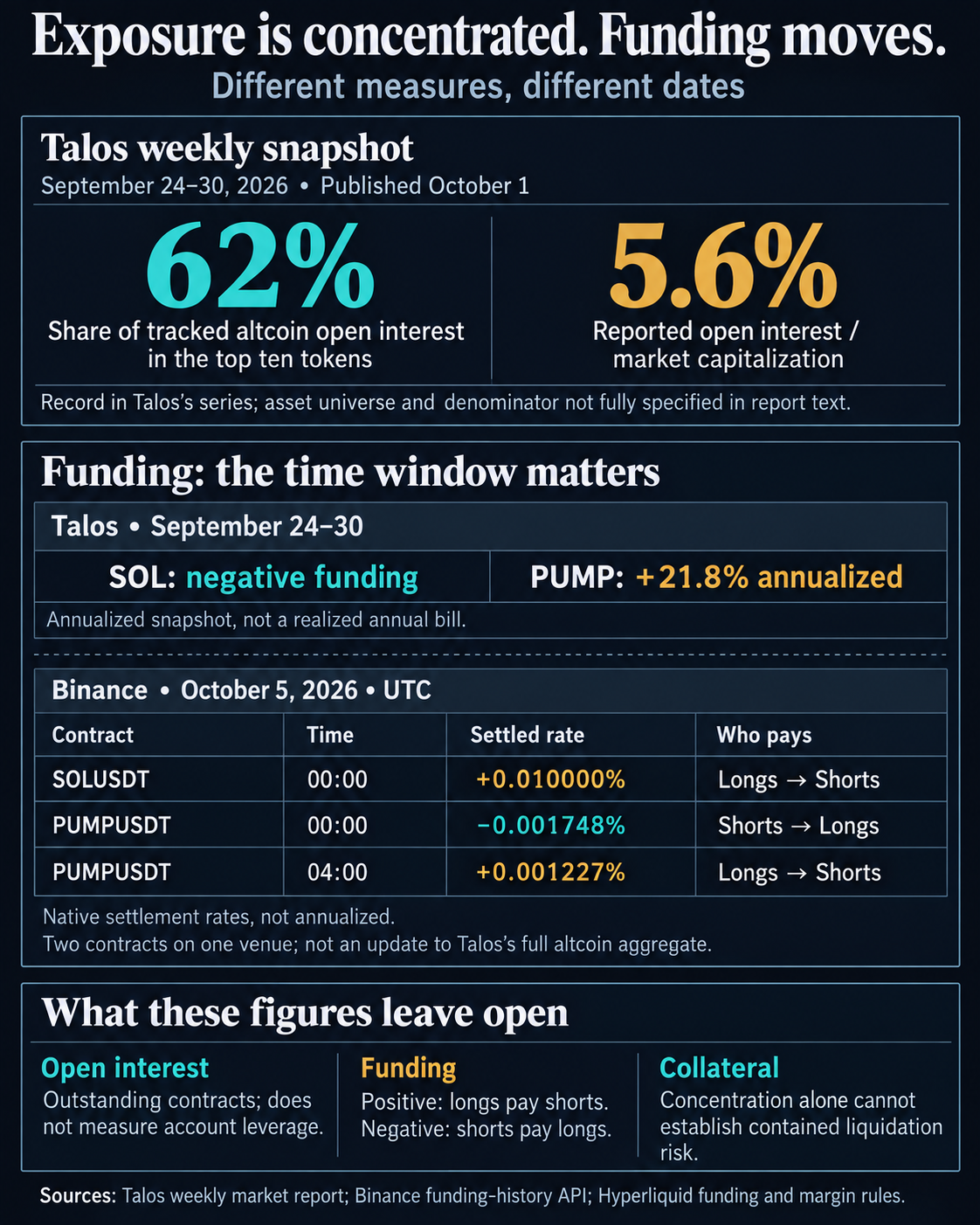
Ten tokens accounted for 62% of outstanding altcoin futures exposure, known as open interest, in Talos’s weekly market report covering September 24–30, 2026. That concentrated exposure came with different financing burdens: the report put SOL funding below zero while PUMP funding reached +21.8% annualized.
Published October 1, the market report also put altcoin open interest relative to market capitalization at 5.6%, a record in Talos’s series. For investors entering the October trading week, those numbers identify a concentrated derivatives footprint, while later Binance settlements show how quickly the cost of holding a particular contract can change.
Funding pressure can change within hours
Perpetual futures use funding payments to help keep the contract price aligned with the underlying market. As Hyperliquid’s funding mechanics explain, positive rates transfer money from long holders to short holders. Negative rates reverse that direction. A trader’s financing burden therefore depends on the contract, side and funding interval, even when two tokens both have substantial open interest.
The October 5 refresh covers two Binance contracts, rather than a matching update to Talos’s altcoin aggregate. Their settled payment records, retrieved shortly after 04:20 UTC, show positive SOL funding and a PUMP rate that changed sign within four hours.
| SOLUSDT | 00:00 | +0.010000% | Longs pay shorts |
| PUMPUSDT | 00:00 | -0.001748% | Shorts pay longs |
| PUMPUSDT | 04:00 | +0.001227% | Longs pay shorts |
Sources: Binance’s SOL settlements and PUMP settlements. Rates are native settlement percentages, not annualized rates.
SOL’s preceding observed payment, at 16:00 UTC on October 4, was also +0.010000%, eight hours before the midnight payment. PUMP’s two observed payments were four hours apart.
PUMP’s midnight payment charged shorts; its 04:00 payment charged longs. The change illustrates a financing burden that can reverse while the underlying contract remains the same. SOL’s positive midnight payment also differs from the negative funding described in the earlier Talos snapshot.
Annualization puts periodic rates on a common comparison basis, rather than locking in a year’s costs. Coin Metrics’ per-market documentation distinguishes the period a rate applies to from the input window used to calculate it. Hyperliquid settles hourly while dividing an eight-hour formula into hourly payments.
Coin Metrics’ aggregate methodology weights normalized market rates by dollar open interest and scales longer aggregate periods linearly. Its daily series is a boundary sample rather than a daily average. Those definitions describe available metrics; they do not identify the precise series or averaging window behind Talos’s +21.8% PUMP figure.
What the concentration figures measure
Talos named SOL, XRP, HYPE and ZEC among the largest markets in its top-ten group. The 62% share identifies where exposure sat within its tracked altcoin bucket. Establishing whether those tokens carried unusually large derivatives positions for their size would require comparing their exposure share with their share of market value, using the same assets and timestamp.
The report’s text leaves the historical starting date and precise ETH treatment unspecified. These limits keep the record tied to Talos’s series and prevent extending the 62% share into a claim of disproportionate crowding.
The 5.6% ratio answers a separate question: how large outstanding exposure was relative to the value of the covered tokens. Coin Metrics’ capitalization definitions distinguish the value of current issued supply, estimated circulating supply and free-float supply. Those measures can assign different values to the same token, especially when supply sits in escrow or with strategic holders. The report’s text does not identify which convention supplies its denominator, so the 5.6% should remain a Talos-reported ratio rather than a universal measure of altcoin leverage.
Under the standard open-interest definition, every outstanding contract has a buyer and a seller, with one side counted. Open interest therefore describes unresolved contractual exposure.
Dollar values add another distinction. Binance’s market-data fields separate outstanding quantities from their value. A higher dollar figure can reflect changes in prices, quantities or both. For a single linear contract with a matched price basis and unchanged quantity and supply definition, a price move can cancel out in the ratio. Across a basket, relative prices and constituents still matter.
The refreshed exposure observations are similarly specific. Binance reported approximately $1.045 billion of SOLUSDT open-interest value at 04:20 UTC on October 5. Its PUMPUSDT observation was approximately $142.876 million at 04:15 UTC.
Concentrated positions can share collateral
Talos interpreted its exposure concentration as limiting risk to relatively few tokens. Its September 29 sector analysis also characterized the rally as higher quality.
Hyperliquid’s margin rules illustrate why the distinction matters. Cross margin shares collateral across eligible positions; isolated margin confines collateral to a position. With shared collateral, losses in one holding can affect the resources supporting another. The scope of that sharing depends on the account mode and markets involved.
Its liquidation rules trigger action when account equity falls below maintenance requirements. The venue initially attempts to close positions through the order book, with a backstop available under specified conditions. Funding payments and losses on other cross-margin positions can affect an account’s actual liquidation conditions.
An exposure share cannot reveal those account balances, liquidation distances or available book depth. It consequently cannot establish either that a cascade is inevitable or that risk remains contained within the tokens with the largest open interest.
CryptoSlate’s earlier coverage of ETF concentration and altcoin spot turnover examined other dimensions of the rotation. Fund flows describe allocations, turnover describes trading activity, open interest describes outstanding contracts, and funding describes periodic financing conditions.
For investors assessing this market, the next useful evidence is a matched comparison of exposure and token value, a sequence of settled funding payments, and the collateral and liquidity conditions behind the positions. The reported 62% concentration identifies a starting point for that assessment. The October 5 settlements show how quickly the financing burden at that starting point can move.