By Gatestone Institute | Created at 2026-09-13 09:00:13 | Updated at 2026-09-13 09:49:50
49 minutes ago
By Gatestone Institute | Created at 2026-09-13 09:00:13 | Updated at 2026-09-13 09:49:50
49 minutes ago
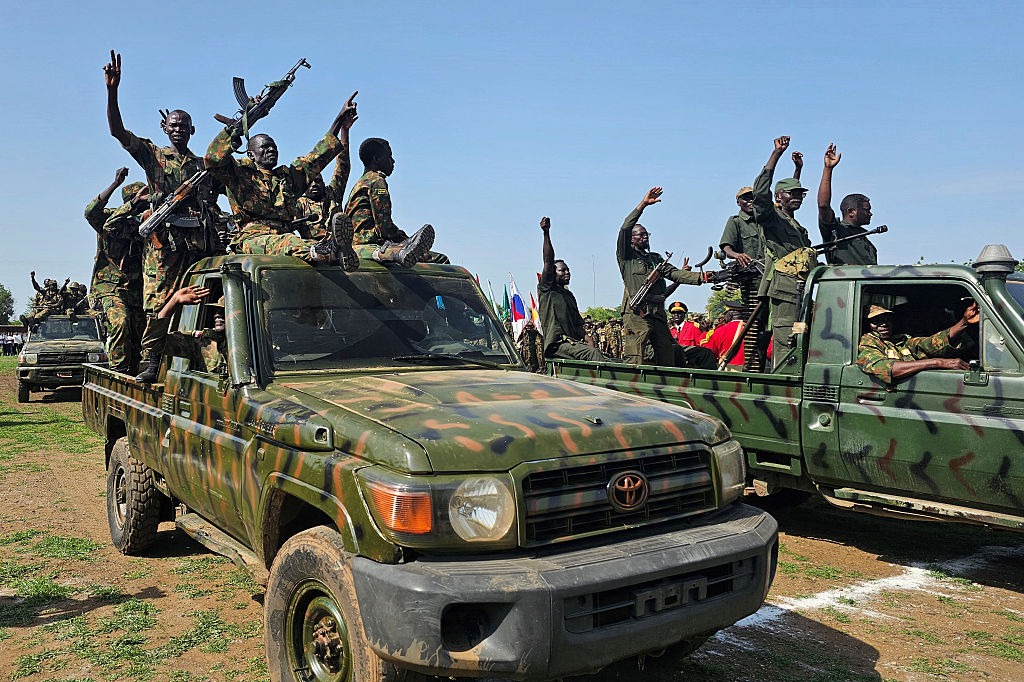 A UN fact-finding mission concluded in February 2026 that the mass executions, gang rapes and engineered starvation in Sudan bore the hallmarks of genocide, and that genocidal intent was the only reasonable inference the evidence allowed. The finding produced -- communiqués! No American campus has been covered with Sudanese encampments. No international campaign demands that corporations prove their innocence regarding Khartoum. Pictured: Sudanese Armed Forces soldiers take part in a parade on August 17, 2026, in the city of Gedaref in eastern Sudan. (Photo by AFP via Getty Images)
The human rights industry's favorite kind of victim is the politically useful one: the victim whose suffering can be attached to an adversary — a designated "villain" — preferably one that Western activists already know how to hate, pressure and organize against.
That is why Palestinian victims, when Israel can be cast as an alleged perpetrator of wrongs, generate an extraordinary machinery of outrage, while Sudanese victims of genocide, Afghan women under the Taliban, Iranian protesters murdered by their own regime, or persecuted Christians in Nigeria largely do not.
The hierarchy is not determined by the severity of the suffering; it is determined by the political usefulness of the victim and, even more importantly, by the identity of the "villain" supposedly committing these wrongs.
There are victims who acquire a constituency. Their faces appear on banners, their names are read aloud at demonstrations, actors on red carpets wear their symbols, students occupy university buildings on their behalf, and institutions discover an urgent moral obligation to issue statements. Then there are victims who die mostly alone, counted briefly by the organizations paid to count them and noticed by no one else.
Sudan belongs to the second set. The war that erupted in April 2023 between the Sudanese army and the Rapid Support Forces has produced what the UN refugee agency calls the largest displacement and humanitarian crisis in the world, with close to thirteen million people driven from their homes. Already a year ago, in late October 2025, after an eighteen-month siege, the RSF entered El Fasher and killed its inhabitants with such thoroughness that researchers at Yale identified the bloodstains in satellite imagery. A United Nations fact-finding mission concluded in February 2026 that the mass executions, gang rapes and engineered starvation of the Zaghawa and Fur communities bore the hallmarks of genocide, and that genocidal intent was the only reasonable inference the evidence allowed.
The finding produced -- communiqués! No American campus has been covered with Sudanese encampments. No international campaign demands that corporations prove their innocence regarding Khartoum, or the transfers of weapons to Sudanese warlords assessed by American intelligence. Darfur now carries the word genocide, applied by the United Nations itself -- and no constituency.
The comparison with Gaza is not a competition between corpses. Palestinian civilians deserve the sympathy owed civilians anywhere. What deserves examination is the propaganda factory of war. Within months of October 7, 2023, encampments, building occupations and mass arrests had spread from Columbia to Yale to New York University and onward across Europe. In September 2025, a pledge to refuse all work with Israeli festivals, cinemas and production companies gathered more than 5,000 signatures from film professionals, including some of the industry's biggest names.
Afghanistan tests the proposition further. Five years after the Taliban returned to Kabul, UNESCO recently reported that 2.4 million Afghan girls are shut out of secondary education. Afghanistan remains the only country that formally forbids girls and women to study beyond primary school. More than seventy decrees have narrowed their lives, and since September 2025 Afghan women have been barred even from entering United Nations premises, or are able to leave their home more than once or twice a month.
Western feminism spent decades insisting that women's rights are universal. Afghanistan is the purest available test of the claim: an entire female population removed by decree from education, employment and public life, and even a public presence -- a condition UN experts call gender apartheid. No permanent encampment stands outside Harvard demanding freedom for Afghan women, no divestment movement has become fashionable, no symbol has reached a red carpet. UN Women warns that the repression is being normalized and reports a fifty percent funding gap for its Afghan work this year. The women remain where they were; the audience has left.
Iran removed whatever doubt was left. Protests that began at the end of December 2025 spread to every province, and on January 8-9, 2026, the security forces answered with rifles and shotguns fired from rooftops and the back of trucks. Amnesty International describes mass unlawful killings as on an unprecedented scale. More than 52,000 men, women and children were massacred this year alone, accompanied by a total internet blackout and tens of thousands of arrests. The UN Special Rapporteur on Iran put the toll above five thousand.
The regime already held the record. Amnesty International documented 2,159 executions in Iran in 2025, more than double the previous year, and roughly four-fifths of executions recorded worldwide, the highest national figure since 1981. At least 48 women were among the condemned, the largest number in two decades. The West's response to Iran's January massacre took the form of diaspora rallies and a condemnation signed by 800 film professionals. The industry that produced five thousand signatures against Israeli film festivals produced eight hundred against a government that had just shot thousands of its own citizens in forty-eight hours, and its own trade press said so.
Iranian students returned to campuses in Tehran, Mashhad and Isfahan in February holding photographs of classmates killed in January, many students are still being arrested and expelled for it. The American students who occupied buildings for Gaza risked nothing worse than a disciplinary hearing, and offered the Iranian protesters nothing.
In November 2025, gunmen took 303 children and 12 teachers from St. Mary's Catholic school in Papiri, Nigeria, an abduction larger than the 276 girls seized at Chibok, Nigeria, in 2014, when a hashtag circled the world and an American first lady was photographed actually holding a placard! The Papiri children came home a month later after ransom talks, having drawn no campaign at all. The U.S. Commission on International Religious Freedom, which has spent seventeen years asking Washington to treat Nigeria as a country of particular concern, counts nearly 53,000 civilians killed there in targeted violence since 2009. Persecuted Christians present a marketing problem: Christianity registers in the Western imagination as a historical power rather than present vulnerability.
Racism and scale also do not explain the pattern. Palestinians are neither Western nor close to the campuses where their cause became dominant, and the demonstrators advocate nothing that would truly help the Palestinians, such as freedom from torture and arbitrary arrest by corrupt leaders, freedom of speech and of the press, and an education that will prepare them for a productive and prosperous life.
Western outrage has acquired a political economy: a successful cause needs more than victims. The favorite victim is not the one who suffers most, but the one whose suffering can be put to political use. A successful cause needs a usable "villain," ideally one already circulating in the narrative. Israel serves that purpose almost perfectly. It is Western-aligned, democratic, backed by Washington and permanently accessible to journalists. Its politicians answer questions, its courts rule against its government, and all of it can be pressured.
Nothing comparable can be organized against the Taliban. Columbia has no Taliban investment committee to picket, the Revolutionary Guards run no cultural exchange program to boycott, and Sudan's warlords are perfectly indifferent to a student senate in California. Dictatorships make poor targets for performative activism because dictators are immune to performance. Attacking Israel connects an activist to an apparatus of campus groups, NGOs and networks assembled over decades, with the slogans pre-written and the vocabulary standardized. A 19-year-old needs to know nothing about the Middle East to take part. He needs a placard. Sudan requires homework, and knowing about the regime in Iran regime would require him to concede that the enemies of American power are frequently worse than what they oppose.
An industry that never stops talking about "intersectionality" has built a hierarchy of compassion, in which victims and what was done to the victim count for less than who did it and what political story can be assembled around it. None of this diminishes Palestinian suffering, which was inflicted on real people. It leaves everyone else outside the door.
Consistency is the one thing the machinery fails to supply. A movement that really meant what it says about universal rights would mobilize for captives whose slaveholders, such as Qatar, enjoy vast assets. It would protest child trafficking and organ harvesting, and defend Afghan women and Iranian dissidents. Palestinian civilians would be defended as civilians rather than as evidence. Such a movement would be difficult to manipulate, impossible to monetize and useless to every exploiting faction, which explains well enough why nobody has built one.
Pierre Rehov, who holds a law degree from Paris-Assas, is a French reporter, novelist and documentary filmmaker. He is the author of six novels, including "Beyond Red Lines", "The Third Testament" and "Red Eden", translated from French. His latest essay on the aftermath of the October 7 massacre " 7 octobre - La riposte " became a bestseller in France. As a filmmaker, he has produced and directed 17 documentaries, many photographed at high risk in Middle Eastern war zones, and focusing on terrorism, media bias, and the persecution of Christians. His latest documentary, "Pogrom(s)" highlights the context of ancient Jew hatred within Muslim civilization as the main force behind the October 7 massacre.