By Literary Hub | Created at 2026-09-29 10:53:08 | Updated at 2026-09-29 12:28:56
3 hours ago
By Literary Hub | Created at 2026-09-29 10:53:08 | Updated at 2026-09-29 12:28:56
3 hours ago
Matthew J. Prigge on Writing His Book With the Help of a Librarian and a Stack of Boxes in the Basement
I got into librarianship kind of like how a barfly gets into tending bar: you sit in the place for hours on end, day after day, appreciating the hell out of the person on the other side of the counter until—with no better options—you think, I could probably do that for a living.
Article continues after advertisement
I’d published a few books before I even considered becoming a librarian, but I’d long had an admiration for the job. When I was working on my masters thesis in history, I spent weeks at the downtown library in Milwaukee, going over everything they had on the city’s old movie censor board. One day, when I was sure I’d worked through most of the library’s holdings, one of the librarians tapped me on the shoulder and motioned to a cart stacked with dozens of boxes of papers and notecards—a film-by-film accounting of every picture that the censor board had reviewed over the course of four decades. It was a more detailed accounting of the censor board’s work than I could have ever imagined existed. I hadn’t even talked to this particular librarian before, but she’d heard I was working on movie stuff. “I thought you might be interested in this,” she said. “I don’t think it’s ever been processed. It was in the basement. I kept them from throwing it out about ten years ago.”
The ideal researcher-librarian relationship is a mutually confounding one.
It was a minor intervention on her part. Probably less of a grand stance for preservation than a tepid, “Let’s hang on it just in case.” She found an out-of-the-way place for the stuff and there it sat for a decade before she overheard a few words about my project and decided to get a cart. The day or two I thought I had left working at the library turned into another six weeks and my modest little thesis became a full-length book. Just like a bartender, a good librarian makes your life more exciting while also making it more difficult.
But if a writer is just waiting for the librarian to complicate things for them, the librarian similarly longs for the patron who is going to show up and create hours of extra work. Most of a librarian’s duties are low impact. Working in a public library, you’re helping people sign into emails, showing them how to work the printer, and putting holds on best-sellers. Academia? Here’s where you can find this book, here’s how you get to this article, are you sure you’re signed into the VPN? (They’re never signed into the VPN.) So, when someone comes to you with a story they’re just dying to tell… with a research question tied into a knot the size of a hand grenade… you really appreciate the hours you’ll get to spend trying to find what they’re hoping exists. The ideal researcher-librarian relationship is a mutually confounding one.
In 2023, I started a new job as a faculty librarian at Marquette University in Milwaukee. I started over summer break, so there was plenty of time for me to settle into the role and learn about the various databases and digital collections to which the library had access. I opened a digitized collection of the LGBTQ periodicals and stared at the empty search bar and the blinking cursor. I had a light bulb moment, thinking back to one of my many lost-abandoned book projects. What the hell was his name, I thought.
I tell them never to be shy around the librarians. One of them just might know about a stack of boxes in the basement.
Years earlier, I’d had idea for book about the true story behind the 1975 film Dog Day Afternoon, in which Al Pacino plays a gay man who robs a Brooklyn bank to pay for his lover’s gender-affirming surgery. It was one of favorite films of all time and told a gritty story of love and violence and mid-summer madness that I just burned to explore further. I’d even come up with a title for the barely conceived project: Dog’s Day. And it pretty much ended there: an idea and a two-word title. I pulled up the Wikipedia page for Dog Day Afternoon, copy-pasted “John Wojtowicz” (the name of the real-life bank robber) into the search bar, hit enter, and made my life a little more complicated.
That first search turned up a few dozen articles. Those articles led to more articles, many more articles. Those articles had bylines. A few of those reporters had papers that they’d donated to various archives and libraries. Those papers had letters, clippings, and notes all providing a depth of insight into John Wojtowicz, his crimes, and his fascinating team of lovers, enemies, and accomplices. One archival visit led to others while librarians all along the way – thrilled to hear about my paper chase – added to my research stack. The book – I kept the title, by the way – comes out this month.
When I was done with Dog’s Day, I started on another project. Sixish months of research later, I realized the idea didn’t have the legs I hoped it would and I had to cut bait. That’s how it works sometimes. Some books die in the archives and that’s ok. Better there than in the hands of some bored reader. As an academic librarian, I consult with students regularly about their research – the stories they hope to tell, the question they want to answer. Most are just trying to get through the semester, but a few truly have passion for this work. So, I work through the problems they give me and create as much work for them as I can. I tell them that dead ends are not wasted time and that they will always be at the mercy of their sources. And I tell them never to be shy around the librarians. One of them just might know about a stack of boxes in the basement.
__________________________________
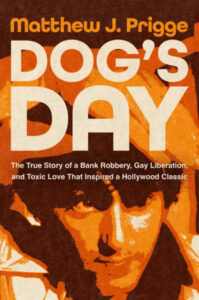
Dog’s Day by Matthew J. Prigge is available from Counterpoint.