By Literary Hub | Created at 2026-09-28 09:43:09 | Updated at 2026-09-28 10:10:13
1 hour ago
By Literary Hub | Created at 2026-09-28 09:43:09 | Updated at 2026-09-28 10:10:13
1 hour ago
Although we can see many connections between our own lives and those of 17th-century English villagers—disputes among neighbors, domestic disharmony, wealth disparity—the times were very different indeed from our own. Look around you now and strip away the trappings of the present. No electricity, no phones, no bright screens flashing information, no cackling TV in the corner of the room.
Article continues after advertisement
Quiet, isn’t it? No planes, trains, cars; no distant noise of rush hour. No plastic, no fridge, no supermarket. No water you’d consider clean, no antibiotics, no anesthetics. Keep going until you stand in a world that’s hard, but not impossible, to imagine. Deep black nights, candlelit. Evenings filled with gossip, mending clothes and tools. Waking in the dark to a day of physical labor. Want some cheese? Make it. Want some candles, socks, a snare, a salve? Make them too. Organic food, skies full of birds, farmland webbed with hedgerows. Hunger, plague, influenza: waves of death that scoured the villages every few years, tearing away a third of your neighbors, the children next door, the love of your life. Compulsory worship with frightening dogma, which could lead you equally plausibly to heaven or hell. Tight, familial church communities, huddled in isolated villages and small towns; people held in place; a striking lack of privacy and liberty. Sin, suspicion, fear.
Yet the word “witch” described an unreality: a person in league with the devil, using magic and evil spirits to hurt their neighbors, turning away from God to worship Satan.
Poorer folk and women were especially firmly regulated by religion in this 17th-century world—people like Alice Cooke of Hempnall. That will matter in the story of the witch hunt. Without religion and its laws, there would have been no such thing as a “witch,” and these two social groups—the poor and the female—were disproportionately targeted by accusations of witchcraft.
Yet the word “witch” described an unreality: a person in league with the devil, using magic and evil spirits to hurt their neighbors, turning away from God to worship Satan. The creation of that unreal enemy depended on a complex belief structure regulating church congregations, especially their least conforming and most vulnerable members. The self-assured neighbors of these people would often target them at their lowest ebb to try to force compliance, frequently involving the confession of sin. Unmarried mothers were questioned about their “fornication” and the paternity of their babies during their labor, their pain believed to prompt honesty. That was in part to force the fathers to pay child maintenance, thus saving taxpayers’ money, but also supposedly to save the souls of both parents.
It sounds bad enough in the abstract, doesn’t it? But it’s even worse when you realize that this was the reality for specific women: people like Susan Thrower of Kettleborough in Suffolk. In 1644, Susan was questioned during labor by her midwife, who then informed magistrates that Susan had named Cuthbert Dale as her child’s father, in her “extremity of pain.” The court ordered him to pay up and ordained that if he defaulted, he would be fined twenty pounds (about £2,300 in today’s money) or imprisoned. Meanwhile, Susan was sent to the house of correction for a year with her baby, a prison-like facility where unmarried mothers were “punished and set on work,” as the magistrates smugly recorded. This, the perfectly decent people of Kettleborough reasoned, was a natural and godly rebuke for Susan and Cuthbert’s sin.
Poorer women were extremely vulnerable if they were judged to have sinned like this. They could be jailed, denied church charity and excluded from the congregation to which they’d belonged. Worst off were those displaced from the parish of their birth, driven out by conflict or condemnation. They would be hounded from any other parish, because they might claim “relief”—welfare payments funded by parish taxes. Pregnant women and mothers were especially unwelcome. Sometimes they abandoned their children, as was the case with the baby “found in the street” in Great Yarmouth, Norfolk, in 1639 and christened Charity before her death.
Some poor families trudged from one village to another, falling victim to violence, hunger and cold. “Samuel Wharton, son of Robert Wharton (a beggarman),” “Mary Wharton, daughter of Robert (a beggarman)” and “Robert Wharton (a beggarman)” were all buried in Manningtree in Essex on 3, 8 and September 28, 1624. “A traveling child of thirteen years of age was found dead in a drift of snow,” recorded Lawford’s parish clerk, also in Essex, in February 1658. In Newcastle upon Tyne in February 1650, “a poor boy” died outside the fine houses by the Tyne bridge, likely of cold and hunger. In this world, it was easy to become an outcast, begging, falling out with neighbors who refused to help—a clash that was often a precondition for an accusation of witchcraft.
The impulse to hate, rather than love, thy neighbor—especially one who practiced a different version of the same faith—was also depressingly strong.
These unfortunate souls were supposed to stay in their birthplace, hoping church charity would sustain them. That fixity supposedly gave them a controllable identity under an all-seeing God, one that luckier folk imagined made society “safe.” But that was always an illusion. And during the civil wars between King and Parliament that raged across Britain in the 1640s, such ideal stasis was impossible to preserve. After war broke out over religious and political differences in 1642, people had to flee when their villages became war zones, while other places were filled with desperate refugees. People left their parishes to fight in the wars, or to run away from the wars; many fled because of religious or political change, or disruption to trade or food supply, or simply relocated to take up new opportunities.
The wars caused massive destruction of religious and civic buildings, mills and mines, housing, crops, herds and transport infrastructure, damaging prosperity and forcing some people to move or starve. Castles and stately homes were blown up, towns put under siege and their walls razed, churches stripped. Besieged towns such as Newcastle upon Tyne, Gloucester and Colchester were ravaged from both inside and out; houses, chapels, almshouses and barns around the towns were pulled down or burned by defenders to provide a clear field of fire, while the towns themselves were also bombarded by attackers. Some people lost everything, without compensation, and became homeless, throwing themselves on the charity of any parish where they ended up. The resulting climate of instability and fear meant church communities were constantly on guard against strangers without and enemies within.
This perception of threat, intertwined with a harsh interpretation of religious morality, dominated 17th-century life, with the optimistic, protective and compassionate aspects of Christianity often overpowered by fear and a desire to judge. The impulse to hate, rather than love, thy neighbor—especially one who practiced a different version of the same faith—was also depressingly strong.
The British civil wars were, in part, fought because people wanted to create their own religious paths, but unfortunately that freedom did not generally lead to a kinder Christianity. While some newly prominent groups (such as those who later became known as Quakers) emphasized love, fellowship and justice, some members of other sects (like the Presbyterians) created new fears, new sins, new tests and new punishments. This new mood – a narrower, harsher definition of religious truth – had been brewing since the Reformation movement took hold in Britain around a hundred years earlier. It was a mood that had been brewing since the Reformation movement took hold in Britain around a hundred years earlier.
The Reformation saw Protestantism become the favored religion across England and Wales, replacing the Catholicism that had preceded it. King Henry VIII (reigned 1509–1547) declared himself head of the Church of England and Wales in 1534 and the Church of Ireland in 1536, and he and his successors gradually moved these churches away from Catholicism. The Church of Scotland, meanwhile, turned Protestant in the 1560s. Many English, Welsh and Scottish people and most Irish people remained Catholic and thus opposed to the official religion, but the state churches were marching steadily away from them and toward fundamentalist revolution.
Yet, for some British people, this march toward godly reform was not fast or ambitious enough. These fundamentalists saw even the new Protestant establishment as too ritualistic and wealthy, reminiscent (they thought) of the Catholicism that had shaped national religion until the mid-16th century. So they formed their own breakaway sects, separating from the state church. The most disruptive innovators, and the originators of some of the harshest repressions, including the witch hunts, were the extreme Protestant sectarians often labeled “puritans” by their enemies (they themselves preferred the names “reformers” or “the godly”).
And, of course, such self-righteousness and entitled aggression created the perfect atmosphere in which to hunt witches: the ultimate, devil-loving heretics.
This overarching label encompassed Anabaptists, Baptists, Brownists, Levelers, Antinomians, Presbyterians, Ranters and many of the highly individual prophets and seers of 1640s Britain. Beyond wanting reform of existing religious options, these various sects differed greatly from each other. And members of these new churches were mostly not the black-dressed, hypocritical, sour-faced, monocultural figures favored by popular narrative, but often included colorful figures who were sometimes surprisingly modern in their desires. Some allowed women preachers and deaconesses, some worshipped in fields or barns instead of church buildings, which they saw as tainted by traditional design and doctrine. Some even stood up against witch hunting. But others promoted it.
Unfortunately, each of these fundamentalist groups believed they had a monopoly on truth. It was all too easy to see competitor churches and anomalous people as heretical, even demonic. What if even the slightest error in doctrine or practice allowed the devil to mislead and damn well-meaning Christians? And what if, having been shown the error of their ways, the unorthodox individuals refused to change? Then it became permissible to attack them, firstly with harsh words but then resorting to physical repression. At the sectarian level, Baptists ridiculed Quakers, Presbyterians oppressed Anabaptists. And at the personal level, many people suffered painfully for their beliefs.
In September 1644, Suffolk housewife Thomasine Stott was arrested for refusing to go to her state church. She admitted she was an Anabaptist, who had recently been re-baptized as an adult. She thought this adult rite better represented her informed commitment to her faith: Christ had not commanded his followers to baptize children, so baptism ought to be a later choice. For this argument Thomasine was jailed—stuffed into a damp, stinking, deadly stone cell crawling with rats and lice—to force her to change her beliefs.
You won’t need to know about all these sects to follow the story of the witch hunt, so don’t worry. But the overall picture of religious infighting in 1640s Britain is essential to understanding how some people, especially poorer folk and especially women, found themselves on the wrong side of powerful, pious opponents. And, of course, such self-righteousness and entitled aggression created the perfect atmosphere in which to hunt witches: the ultimate, devil-loving heretics. It seems no accident that the largest single witch trial of the 1640s, involving about 140 suspects, was held in Bury St. Edmunds, in Suffolk—where, overlooking the courtroom, hulks an enormous ruin: the former Catholic abbey. When it was closed down in 1539, its treasures, books and relics were seized and its lands and buildings sold off, some to local nobles and gentry, some to the town authorities of Bury. The building itself was then torn apart by builders scavenging stone, lead, glass and timber.
By the time of the witch trial, the sacred building stood stripped of its roofing and outer masonry—a fleshless skeleton; its giant west window glassless, miming a stone scream. The glee with which the abbey was dismantled reflected centuries of tension between the town authorities and the monks. Once Protestants took over in national government, the town seemed to have won—but it was a hollow victory, because it ripped apart the social structures and economy that had held Bury and much of its county, Suffolk, together.
Then, in 1608, a fire began in a malthouse in Bury to the east of the ruined abbey complex. It burned for three days, destroying almost half the town. Warehouses full of fish, salt, sugar and spices, stores of corn and hay, as well as horses and cattle that could not be rescued, were burned. All that was left of over two hundred homes, public buildings and shops were “heaps of stones and pieces of timber.”
Previously wealthy families were reduced to begging; the cost of rebuilding was estimated at a hundred thousand pounds (about £22 million today). The scars would have been evident for decades—the backdrop to the events of the 1640s. And in the 17th century, such events were explained as God’s punishment. A printed news pamphlet labeled the blaze “an imposition of calamity laid upon [the townspeople] by the hand and power of God for their secret sins and offenses.” Such “strange events” were “prognostications of worse to come,” it continued, unless Suffolk’s citizenry sought “to win grace and favor at God’s hands by amendment of our lives.”
When the civil wars began and witches were thought to be stalking the land, it was easy for people to assume that killing these enemies, these witches, would redeem their community—it offered a comforting semblance of power and control in an uncertain, religiously unstable situation.
__________________________________
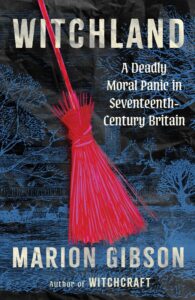
Excerpted from Witchland: A Deadly Moral Panic in Seventeenth-Century Britain. Copyright © 2026, Marion Gibson. Reproduced by permission of Scribner, an imprint of Simon & Schuster. All rights reserved.