By Literary Hub | Created at 2026-09-28 09:43:08 | Updated at 2026-09-28 10:10:24
59 minutes ago
By Literary Hub | Created at 2026-09-28 09:43:08 | Updated at 2026-09-28 10:10:24
59 minutes ago
A Table for Fortune is about September 11th. As it grew, tracing the roots of that crime in one direction and its poisoned harvest in another, the book bifurcated. The first part is, or means to be, a novel of ideas. The second turned out to be a novel of feelings. I tried to make both halves cohere, until I realized that they could not, should not—except that they must.
Article continues after advertisement
Reader, my hope is that the densely cerebral darkness of the first part (whose memo-based narration of one CIA analyst’s semi-plausible deskbound half-century can be justified only by the patterns thus revealed) will be relieved by (1) sparkles of archival fascination and (2) S E C R E T loomings of geopolitical substructure possibly exposed, along with (3) a few fun doings of this selfsame spook and his sister-in-law Lorene. As for the second part, I worked in enough daylight, even if sometimes of a rainy sort, to carry you through several sentences and maybe even into an under-subsection. (Needless to say, the seventh floor prefers to treat both parts as one product.)
I promise that A Table for Fortune is as true as I could make it. The subject was hateful but I could not escape it. Once I was lucky enough to make friends with Juan Tomas, a poet from Equatorial Guinea, who addressed a colloquium as follows: “It is the duty of the poet to speak out not because he is a poet but because he is a member of the community.” It follows that I must speak out not because I can speak but because I am an American.
(Who indeed am I to judge American foreign policy from 1966 through 2022?—Nobody, excepting an American.)
I tried to represent the flow of decisionmaking over that interval as accurately as my unCLASSIFIED misinterpretations permitted; and if some of my judgments were acid, that was merely because ACIDITY SELLS. How did we get to September eleventh, and into how many feculent sloughs did we crawl from there? My personal answer (this book) has to do with lessons not learned, with expediencies of power, of course, and most certainly with consciences disabled on all sides, but also with chance, whose effects in combination with ordinary human fallibility, particularly during crises, can be malevolent—as when the U. S. government got panicked by the atrocities of Islamic terrorists into committing torture and launching an unjust war for which it saw the possibilities. As I said, I did my best to be accurate, but let me thank Fortune that this is a work of fiction, so that my mistakes can pass themselves off as imagination! Besides, the causes and effects of ever so many specific events remain in controversy. For instance, did the Soviets invade Afghanistan out of (a) fear of Muslim insurgency, (b) Iran-cognizant Realpolitik or (c) lust for a port on the Persian Gulf? Then come still more S E C R E T matters: What mortal can chart the ever-altering relationship between the Red Army Fraktion and the Stasi, or between Donald Rumsfeld and Saddam Hussein?
I felt obligated to at least try to figure out where we came from and where we seemed to be going. Why not maunder and meander on about it, at almost necessary length?
In its CIA sections this book resembles a 1940s science-fiction novel about Venus. In other words, I did my best to extrapolate from what little I knew, necessarily erring in most of my Earthbound suppositions as to the surface temperature, climate, fauna and flora of Langley—which pathetic guesses I will with high probability never be able to VERIFY or INVALIDATE. (Were the “blue” elevators ever blue, and what color are they now? What exactly was the East Germany Desk called in 1968 and which subsequent names has it borne?) My gratitude to the CIA-affiliated people who helped me see a few kilometers deeper into Venus’s never-clearing mist is spelled out in the acknowledgments. And here let me say that despite loathing torture, assassinations, invasions based on dishonest premises, longterm S E C R E T surveillance of harmless citizens, betrayals of allies and dependents and an all too general lack of accountability, I am not against the CIA or the “intelligence community” as such. We play dirty; so do our competitors and adversaries. I wish that the CIA and FBI had prevented September eleventh. I am grateful they tried. What especially troubles me about the American case is overreach by the Executive branch, particularly when it occurs in the darkness. Whoever seeks to blame the CIA exclusively for covert actions ought to read the suppressed (but fortunately leaked) Pike Report, in which one can see a domineering White House coercing a protesting CIA into another long, needless bloodbath. As for the “War on Terror,” well, my opinions need not hide themselves.
*
Certain Venusian latitudes are so darkly occluded that when trying to understand Bush Two’s stubborn negligence just before September eleventh, or his idiotically evil pranks of “enhanced interrogation,” or for that matter Obama’s S E C R E T drone strikes, never mind the fun little ways in which Trump aka MOGUL made America great again, all I can perceive are acts and effects. Miscellaneous whys and hows I promise to guess as carefully as possible, as when I dream up medium-probable motives for the fictional character named Cheney.
*
Reader, do you find War and Peace too long? What about that hundred-page essay at the end about the insignificance of heroes in relation to the historical current they ride? I have been told that Tolstoy “needed an editor.” If you think the same, then you will not like this book.
Recently several of my fellow judges on a literary panel declined to read submissions that were more than two hundred pages long. Maybe it “was always like that.”
As for me, I decided that remembering the crimes of Cheney’s America was my duty (although Cheney with high probability would have preferred less odious applications of my subnormal intelligence). I felt obligated to at least try to figure out where we came from and where we seemed to be going. Why not maunder and meander on about it, at almost necessary length? You see, torturers and counter-torturers, victims, ideologues and perjurers, not to mention ignorant people who are good, good people who cut moral corners and suchlike known unknowns, should all get their due. So to show respect I inserted a trifle, and maybe even accidentally expanded here and there. After grubbing up extra facts, opinions, interpretations, I then naturally had to pattycake, oh, just a few more hundred pages of livid wordflesh onto my characters’ alphanumeric skeletons, because otherwise what kind of Venusians would they be?
My editor at Viking, who had indulged me for decades, grew ever less enthusiastic the more of this book he read. He never could see the relevance of the Angola parts. He furthermore reminded me (as he had been doing ever since 1986) that the cost of paper was rising. Worse yet, he informed me, the various fonts I had been deploying for years while constructing my visual grammar for A Table for Fortune (typewriterish for spook reports, italic for newscast, etcetera) could no longer be permitted to the likes of me. I replied that Viking could go on paying me twenty-odd cents an hour, for I had never cared about my so-called “income”; but due to some pathetic, entitled delusion (I continued), I also did not care (I truly didn’t!) about the cost of paper and fonts! He was silent about that, meaning that I would with medium-high confidence lose that battle. Meanwhile I promised to reread the manuscript with an open mind, to see if it could be shortened, if only by five hundred pages, or better yet two thousand. Didn’t I mean as well as Kissinger himself? So I cut and hacked and amputated and abbreviated; I really really did, but in the course of these excisions, A Table for Fortune somehow grew, oh, I forget exactly how many hundred manuscript pages longer. So I was justly fired. I still consider my former editor a friend, as I hope he does me. He did try to save me from myself. You see, I could have made a living and expanded my readership. Well, I had to fight against both of those dangers. And in the great words of Bush Two: MISSION ACCOMPLISHED!
Truth to tell, Viking and I both (and, reader, maybe even you) would have wished A Table for Fortune to be a sporty little end table with a candy dish on it—instead of the massive triumph of banquet-furniture that it most lamentably is (cobwebs and bloody chalices GUARANTEED—watch out for the poison-tipped silverware!). And if you find this prospect as drearily, obsessively overbuilt and even overstuffed as did my former editor, let me reassure you as I did him: “Don’t worry; I promise that my real hero will be born by possibly around page eight hundred!” Set up in frugal type by a hypothetical printer, Matthew (who of course is no more real than his father) may with medium-high probability save paper by coming to light even sooner than that—unless I drop in another megadigression tomorrow (the terrorists made me do it!).
*
My CIA protagonist DAVE began his life as a very few lines in the September eleventh report. You see, somebody with his codename once did something REDACTED. In case he ever reads A Table for Fortune, I would like to say that although my character must bear small resemblance to him, I have become (unlike Matthew) very fond of DAVE. Should I ever work in an intelligence agency (for after my success at Viking I am in medium-high demand, at least among cockroaches), I, too, would aim at expressing the truth as I saw it, not as the Executive demanded that it looked.—Here the seventh floor expresses medium confidence that I, too, could be manipulated into turning out a dishonest product through (a) my own tendency to please others, and (b) my preexisting loyalties (for instance, to “America” as I interpret her). On the other hand, I might be saved by my own pigheadedness, as already happened when I refused to let Viking mutilate this book into coherence and readability. DAVE as I imagine him was also ethical according to his lights, and furthermore dared to persist against his superiors both at the office and downtown; after all, he once had been Crazy Elliott the combat helicopter pilot. Since I would never knowingly meet the real-life DAVE (who may for all I know be scratching his bald spot right now while chuckling over these idiocies), I fashioned him according to my own inclination: (1) vastly more intelligent than I, (2) far more collegial (at least until the Berlin Wall fell), (3) definitely a better relative and neighbor, for he tolerated abuse, mediocrity and even small talk, while unceasingly accomplishing practical kindnesses; (4) mechanically skilled, as were my father and both grandfathers, at what I do suboptimally, and of course (5) ultra-wonderful at keeping S E C R E T S. How, I wondered, might a DAVElike individual experience the sudden end of the Cold War, our failure to prevent September eleventh and the crimes we committed in our War on Terror, thereby GUARANTEEING (I sincerely believe this) more terrorism against us?* And how would he adjust to working up insights which he could never impart to his family?
Of course his trick memory, hyper-long career and borrowings of Pravda from the colleague codenamed CYCLOPS are frankly ridiculous, especially since the latter (don’t tell Venusian Cheney) bore two functional eyes. Mea culpa. His colleagues’ sometimes parodic office personalities, however, do derive from my intermittent study of human hives, in one or two of which I have been forced to swarm, if never all the way to the seventh floor’s honeycomb; and on a like subject, let me now swear that all of the best insanities uttered by patriots in this novel were actually bestowed upon me verbatim by real-life Amcits.
When constructing his office life as a CIA analyst, I supposed that when DAVE first began working up East Germany AKA the German “Democratic” Republic, his assigned mentor-boss was a kindred intelligent sort, who taught, loved, pushed, trusted and sometimes protected him, enlivening his mindflights over a teeming observational field (call it the Night Land) and nourishing his understanding of the big picture. Once he switched to analyzing Iraq, I saddled him with a doctrinaire and domineering boss, and abandoned him to an observational field of misdirection and hopelessness. Again, I know nothing about the real people who did this work. Nor will I ever learn (not my department!) which if any CIA team leaders willingly or passively facilitated the slander about Saddam Hussein’s connection to September eleventh. Was our second invasion of Iraq another Angola-like adventure, with the Executive dragging the CIA into error? Or did true believers, such as my invented COULSON, facilitate hostilities with criminal zeal? All a novelist can do when representing Bush Two’s accomplices is to embody plausible ideologies in specific fictional characters. None of my invented time-servers, kill chain feeders and petty tyrants are meant to impugn the employees of Iraq Issue or any other particular department.
*
Now what about DAVE’s son Matthew? I made him even stupider than I, and cheerfuller, physically hardier, nobler in his sincere search for America and as brave, ethical and mechanically gifted as his father. In the first draft he was capable of carrying on a political argument with DAVE, but the more I spied on his doings, the worse that accorded with his destiny, because Matthew, you see, had limitations.
I myself also aspire to be brave. I can whistle past any number of graveyards—but how would I feel if I outlived my savings? Like DAVE, I came down with colon cancer, and paid for my survival with a third of my intestinal tract (a hyper-fun weight loss method recommended by REDACTED). At the beginning of 2025 the disease returned in an incurable form. My first reaction was relief, for I pity those who must live on in the big picture we are making. And should anybody wish to punish me for this book’s not very sycophantic views, I need not suffer long. Like Cassandra, I go on predicting the worst and not being believed. We have set a table for Fortune, so I anticipate evil, always hoping to be wrong. Meanwhile I get to act brave, but may never need to be so, unless my opioid pills run out.
*
I used to have a daughter named Lisa. She was the love of my life. When I obtained part of my FBI file (700 pages long, 500 of which are REDACTED), I was at first amused by the preposterously hostile distortions of my motives, actions, accomplishments and hopes. The FBI had been investigating me for terrorism. After they caught the Unabomber, I became an anthrax suspect because, well, because I had been a Unabomber suspect. Once I stopped laughing, it occurred to me that since the file was so viciously unfair, and they had already detained me twice, my freedom might be at risk. What if I went to prison and never came back? Lisa was then a child. I told her: “Please remember that even if they take your Daddy away, Daddy never did anything wrong.” I wanted her to know this not for me but for herself.
(To this day my incoming mail is delayed, stolen, torn open. Sometimes a box of foreign translations will arrive with the spine of every last book slit open. My Japanese translator gave up writing me years ago because I never answered her. I never answered because her letters never came.)
In 2022, Lisa completed her bulimic and alcoholic self-destruction by means of a brain bleed. She was twenty-three. At the memorial service her pious aunt assured me: “Bill, don’t worry; she’s in a better place.”—“She sure is,” said I. “She’s in a box on the piano.”—So I need not worry about myself or Lisa. It really is kind of fun, the way Fortune takes care of us. (I mean, don’tcha think?) And on that note, I believe I will chew up another opioid.
Lisa was far smarter than Matthew, indeed wickedly articulate, but less effective at manual labor, for which she cared nothing, although she used to be athletic. Unlike him, she was apolitical, and therefore lacked his sense of necessary and righteous purpose. He became homeless for quite a long time. She was homeless only briefly. Once Matthew got away from his parents, he found happiness, along with addiction and death. Lisa suffered so much that I can hardly endure to remember her last years. I suppose it is brave of me to be grateful that I outlived her, instead of failing her even more, by dying first.
As mentioned, Matthew’s rupture with his father over Abu Ghraib I originally envisaged as an intellectual debate. This began to seem unnecessary, because one either feels and believes that torture is wrong, or else one is damaged. Matthew did not need to be smart to be in the right. Nor did he need to achieve results. So why not write his pathology into his ideology? With the big picture so far beyond his comprehension, he must have begun his quest out of rancor, self-loathing and painful bewilderment—never mind that he was innately loving, which made him compassionate, and that he aspired to learn about America, in order to better love her. That was how I thought to make him live. But in each draft of A Table for Fortune I tinted Matthew’s family tragedy ever more horribly with Lisa’s desperate blood, and just for fun sprinkled in some of her parents’ anguish—for this will be a fun book all the way.
Should anybody wish to punish me for this book’s not very sycophantic views, I need not suffer long. Like Cassandra, I go on predicting the worst and not being believed.
(I would not have mentioned family matters here at all, but for the fact no private grief is private anymore. I am not DAVE, and Matthew’s mother is not Lisa’s. Matthew is not Lisa, although I have clothed some of his wretchedness in her sorrows. He would have disgusted her, loved her and pronounced her really really nice. I wish she could have shambled as cheerfully as he into the poisonous Venusian fog of homelessness. And while I am busy wishing, why not desire no September eleventh, no Iraq War and a decent, honest President?)
*
Most places mentioned (Angola being an exception; I wish I could have gone there) take their descriptions from notes I made on the spot. (For example, my skepticism about Saddam Hussein’s supposed weapons of mass destruction was formed for excellent reason on my first visit to Iraq, in 1998, which I have related in my essay Rising Up and Rising Down. Descriptions of Baghdad come from unused passages in my notebooks for that project.) Many interviews, etcetera, including the ones in supposed CIA reports, are likewise my work, as detailed in the “Sources” section, which tries to indicate not only where I got my facts and speculations but also how and why I diverged from the historical record. The reports themselves are with medium-high probability more snarky than the CIA would allow, although only the seventh floor can say for sure.
While some of the vilest ISIS acts in Volume 4 were worked up based on specific atrocity videos (for instance, the live burning of the captured Jordanian pilot Lieutenant Muath al-Kaseasbeh in 2015 truly happened, and I have described as accurately as possible what I saw in that disgusting footage), most of the CIA’s targeted killings in that “caliphate” are invented, being still CLASSIFIED. That 2010 “drone strike in Yemen, which was supposed to take out an al-Qaeda nest but instead terminated the Deputy Governor of Marib Province” really happened (see the source-notes). The S E C R E T liquidations by the U. S. of anonymous Muslims, and these operations’ apparently frequent “collateral damage,” I have tried to represent through looking at photographs of local people in these areas, and imagining (based on what I have seen in morgues, war zones & c) how they would look after being detonated, burned, pulverized, etc. For the sake of his reputation, anyone whose likeness appears in this book gets VETTED and pronounced innocent by DAVE.
Even marred by my own narrative “embellishments,” discussions of Iraqi-East German relations remain (I hope) realistic-ish—which as poor DAVE had to learn differs from being on point. Equal care (and incompetence) went into my descriptions of the GDR’s S E C R E T police (the Ministerium für Staatssicherheit der DDR, aka MfS or “Stasi”), whose prosodies** and opinions on the CIA, Angola and other topics I did my best to represent. Two formerly Stasi-affiliated fellows (who like their CIA-related counterparts receive thanks in the Acknowledgments) were kind and open with me; thanks to them I was lucky enough to see some of the Cold War from their point of view. Because their nation failed, rendering S E C R E T documents unexpectedly available to foreign civilian researchers such as myself, I might in certain particulars have attained a better “feel” for the Stasi’s thinking than for the CIA’s—but certainly reached some perceptual clarity about the CIA or the illusion thereof. Most Stasi documents in this book are reality-derived—such as the fascinating material on Otto Skorzeny—although I shortened, embellished, etcetera.
(I wish you could have been with me in that white-walled reading room, which was warm and dead silent, with the top of the H2 Hotel visible through the blind-subdivided window pane, and the blonde Rubenesque librarian, in bluejeans, socks, sandals and a shortsleeved blouse, slowly skimming page after page of the documents in a manila folder; respirations of traffic, two-tone whine of an ambulance; then another case worker came in wheeling a dolly of documents, including for instance yet another brittle folder, brownish-orange with age, multiply torn at its bottom edge, and to its front cover a necktie-shaped paperclip holding a white slip made out to my archive tigress Killinger, Eva, address REDACTED by WTV, Tgb-Nummer 000229/19Z.)
Since no Stasi material on my sub-hero Dr. Gerald Bull (or, for that matter, on DAVE) was available, why not fabricate it? The extent of GDR activities in Angola is likewise Venus-misted to individuals with my kind of SECURITY clearance, but I know that GDR cadres did run the docks at Luanda, and also trained Angolan paratroopers and S E C R E T police. The occasional bloody clashes which I have imagined between FAPLA’s Stasi partners and their enemies (SADF and UNITA) are the most plausible guesses I could make given the dearth of source documents (from what I understand, many foreign policy records have been vacuumed up by the CIA). GDR activities in Afghanistan are therefore also poorly documented in the Stasi archive, so I have been compelled to invent my own anti-socialist innuendoes. Real people such as East German Ambassador Kurt Krüger and VERIFIED GDR deeds in Afghanistan are cited in the source notes.
My descriptions of homelessness, riding the rails, hitchhiking, moonshine manufacture, desert living, lurking in flood tunnels, camping on Delta islands and day labor are taken somewhat from my occasional experiences and a great deal more from listening to practitioners who have done those things for survival. Getting to be friends with some of them has brightened my life, and also darkened it when I see what they can suffer. Supposed CIA interviews with Iraqi Kurds and ISIS refugees were done by me in Iraq, in California (thanks to my angel Alana Levinson-Labrosse) and Austria (with the help of my dear friend Georg Bauer, who was one of this book’s patient early readers). In all three places I have changed people’s names for their protection.
To help the reader, names of enemy organizations, weapons und sofort have been boldfaced into contradistinction to our own or allied counterparts: a Soviet T-34 tank versus an American B-52 bomber, Stasi HV A as opposed to the CIA, the “terrorist” Kurdish organization the PKK but not the “pro-American” Kurdish PUK. Frequently appearing obvious cases such as the USSR have been left in roman. Location numbers and letters as in “NW N Street” or “the I-5 freeway” are bolded to make them more DAVE-ish.
For verisimilitude this book preserves the German letter ß, which sounds awfully close to “ss.” Thus, “Straße” [pronounced shtrasseh] equals “Strasse,” “street.” An umlaut (¨) over a vowel should be read as an immediately following “e.” Hence “Thälmann” [tehl munn] is the same as our transliterated “Thaelmann.” Meanwhile, in our language, “POTUS” may always be (S E C R E Tly) pronounced Cheney.
___________________________________________
*For instance, I believe with high confidence that the drone technology we have carelessly, greedily spread will soon be visited upon us. Artificial “intelligence” will make mass murder even more wonderful.
**Stasi style, I must warn you, is almost stunningly opaque. And this warning comes after I have completed the laborious service of cutting and cutting again, only to find any hypothetical lattice of meaning still draped with creeping abstrusities! But to reduce an “operational operation” to an easy read would be pandering — in other words, a simply divine idea. Please console yourself that your efforts to understand Stasispeak will give you a glimpse into an alien historical reality. (And may I sell you a discreetly microfilmed copy of racier enemy S E C R E T S? Just send fifty thousand Deutschemarks to the nearest dead drop.)
______________________________
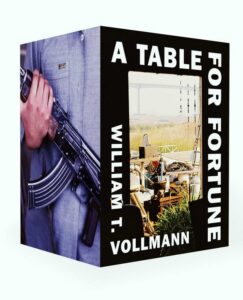
From the author’s note to A Table For Fortune by William T. Vollmann. Copyright © 2026. Available from Arcade Publishing, an imprint of Skyhorse Publishing.