By The Straits Times | Created at 2026-10-05 14:57:01 | Updated at 2026-10-05 15:31:05
1 hour ago
By The Straits Times | Created at 2026-10-05 14:57:01 | Updated at 2026-10-05 15:31:05
1 hour ago
TOKYO – Japanese Prime Minister Sanae Takaichi turned to classical Chinese literature to bookend her 30-minute policy speech on Oct 5 that opened a 69-day legislative session.
“Those with determination will eventually succeed,” she averred, quoting a famous maxim from the fifth-century historical text Book Of The Later Han.
Optics matter in diplomacy and, while it was not immediately clear if her choice of words was intended as a tentative olive branch to Beijing, Takaichi described China in her speech as “an important neighbour with which we share a long history of engagement”.
While she largely spoke about the economy – as is typical for a Diet speech – the use of the proverb underscores the scale of the policy challenges that she faces as Japan emerges from decades-long economic stagnation, with the benefits yet to be felt by most ordinary households.
On the diplomatic front, Takaichi will need to demonstrate not only determination, but also the acumen to steer Japan through choppy geopolitical waters.
Sino-Japanese ties have cooled dramatically since late 2025, when Takaichi broke diplomatic norms of strategic ambiguity to explicitly suggest military intervention if a Chinese invasion of Taiwan – the self-ruling democracy Beijing claims as its territory – creates a “survival-threatening situation” for Japan.
Takaichi, who is expected to visit China in November for the Asia-Pacific Economic Cooperation summit, emphasised dialogue on Oct 5, vowing to pursue a “mutually beneficial relationship based on common strategic interests” with China.
At the same time, she drew a firm line: “We will continue to assert Japan’s position on various issues in the East and South China Sea, Chinese military activities around Japan, coercive measures, safety of Japanese citizens in China and human rights concerns, and we will strongly demand responsible action.”
Yet beneath her classical citations, Takaichi’s primary objective was clear: reasserting Japan as an industrial and technological power while fortifying its national and economic security.
She took the unusual step of deviating from her prepared text at the outset to condemn the “heinous” robbery-murder of a 39-year-old woman in Okinawa, which sparked public outcry and led to the arrest of a 20-year-old US Marine on Oct 4.
Tokyo has lodged a strong protest with Washington, demanding full cooperation in the investigation.
On foreign policy, she pointed to a post-war international order under severe strain and reiterated Japan’s support for international judicial bodies, including the International Criminal Court (ICC).
“We will continue to champion the rule of law and play a more active role in the peaceful resolution of conflicts, including mediation,” she said, while affirming the US-Japan security alliance as the bedrock of national defence.
It will be a tightrope walk that will test her administration, balancing the rule-of-law emphasis with partners, including in the Global South, with deepening security integration with its US ally that has shown scant regard for bodies like the ICC.
Meanwhile, facing fierce competition from China, South Korea and Taiwan across critical industrial sectors from automobiles to artificial intelligence and semiconductors, Takaichi in her speech underlined deep-seated anxieties that Japan is becoming less relevant as it is leapfrogged by its neighbours.
Japan once ranked fourth on the World Intellectual Property Organization’s annual Global Innovation Index in 2007. However, the latest 2026 rankings released on Sept 29 placed Japan 12th out of 139 economies, trailing South Korea (fourth), Singapore (fifth) and China (10th).
“Nations are competing through massive, long-term industrial policies, and rivalry for advanced technology, talent, and investment is intensifying as never before,” she warned.
“If Japan alone hesitates, we risk seeing businesses, jobs and investment flow overseas, potentially causing our economy to slide back into stagnation,” Takaichi said.
“That is precisely why Japan must rise to the challenge. No matter how drastically the times shift, Japan can forge a new path forward,” she added.
Takaichi continues to enjoy high approval ratings nearly a year after taking office on Oct 21, 2025.
Defying the usual trend where Japanese Cabinets lose momentum over time, support ticked up 0.5 points to 63 per cent in a monthly Japan News Network poll conducted on Oct 3 and 4.
Recognising that her primary domestic headwinds are economic, with households squeezed by persistent inflation, she framed her agenda around “protecting livelihoods through economic strength to carve out a future filled with hope”.
She stressed her strategy of “responsible, proactive fiscal policy”, telling market investors “not to worry” about funding to plug an estimated 10 trillion yen (S$81 billion) revenue hole created by her signature policy: a two-year cut to the food consumption tax from 8 per cent to 1 per cent starting April 2027.
She did not specify where the money would come from, but argued that strategic public spending would in the long term catalyse domestic investment, lift real wages, elevate consumer sentiment and drive business profits in a virtuous circle that naturally yields higher tax revenues.
During her address, Takaichi used the word “challenge” (cho-sen) seven times to project her unflinching resolve.
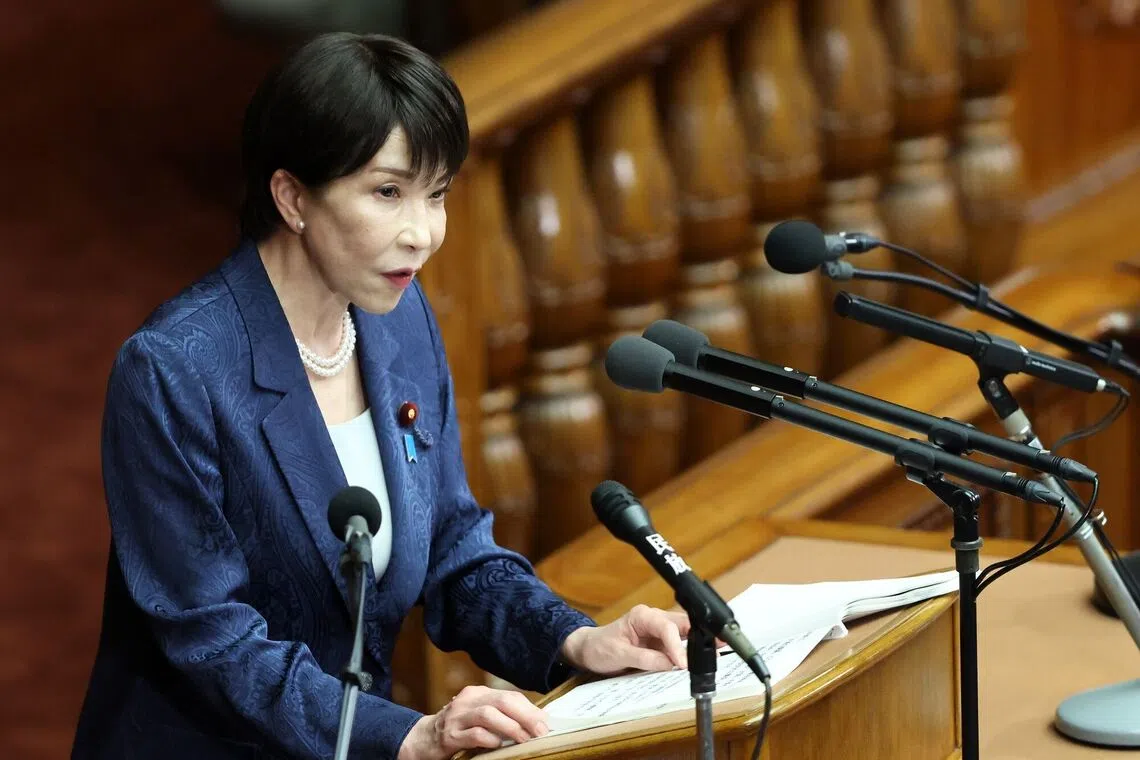
Japanese Prime Minister Sanae Takaichi turned to classical Chinese literature to bookend her 30-minute policy speech on Oct 5.
PHOTO: BLOOMBERG
Her delivery drew enthusiastic applause from the Diet’s lower chamber, where the ruling Liberal Democratic Party and its coalition partner, the Japan Innovation Party, command overwhelming numbers.
Looking ahead, Takaichi announced plans to formulate a Japan Growth Strategy Implementation Plan by year-end, along with revisions to Japan’s three key security documents, including the National Security Strategy.
Also by year-end, her government will formulate a Comprehensive Population Strategy to confront depopulation, which she described as a “national crisis unfolding quietly”.
Given simmering anti-immigration sentiment, Takaichi signalled that foreigners will be a last-resort measure to address workforce deficits in areas such as healthcare, logistics and transit.
“We must reverse the declining birthrate while building a new national structure adapted to a shrinking population,” she said, promising to “fundamentally examine the approach toward accepting foreign nationals”.
Instead of increasing immigration, she pointed to “AX” (artificial intelligence transformation) as the primary shield for essential public services.
The Parliament session, running until Dec 12, promises sharp debate.
The Cabinet plans to submit 21 Bills, including on the food tax cut and tighter regulations on foreign land acquisitions near security sites.
Opposition lawmakers will press Takaichi over her recent Cabinet appointments, notably Agriculture Minister Kazuo Yana and Education Minister Yoshihiro Seki, both previously disciplined over the LDP’s damaging political slush fund scandal.
Yana separately on Oct 5 formally apologised and withdrew his remarks made in May suggesting that road budgets were slashed for two municipalities whose mayors failed to back him in February’s general election.
Diet policy speeches are routinely filled with feel-good rhetoric – Takaichi’s predecessor Shigeru Ishiba promised to make Japan “happy” again. But translating grandiose visions into lasting policy outcomes remains the ultimate challenge.
Takaichi’s work ethic is undisputed: She has openly admitted to sleeping as little as zero to three hours a night.
Yet in a political climate where the public mood and economic realities can shift abruptly, there is no substitute for results, and the jury is out on whether Takaichi’s unyielding determination will, in the end, succeed.