By Literary Hub | Created at 2026-08-11 11:41:55 | Updated at 2026-08-11 12:26:15
3 hours ago
By Literary Hub | Created at 2026-08-11 11:41:55 | Updated at 2026-08-11 12:26:15
3 hours ago
Every so often—sometimes in October, when the annual Best American Short Stories anthology is published, or on the infrequent occasions when an iconic short story writer like George Saunders, Alice Munro, or Lydia Davis wins a major award—an article appears asking a perennial question. As The Guardian put it in 2018: “What is a short story? Why should we read them?”
Article continues after advertisement
I find these articles amusing and also sad. They repeat a kind of ritual, not unlike the rituals you’ll find in some of the most famous short stories, like Shirley Jackson’s “The Lottery” and Kafka’s “A Hunger Artist.” A troubling object, or troubling person (or, in this case, a troubling genre) is put on display where we can see it and consider what to do with it. What is the problem with this thing? Why does it not fit? It arouses strange feelings in us—pity, guilt, instinctual dislike, fidgety disapproval. Wouldn’t it be easier just to get rid of it, dismiss it, smother it?
One theory I have about the supposed public dislike of short stories is that people associate them with middle school English—you’re already dealing with warm cafeteria milk, training bras, a bit of lettuce caught in your braces, and then the teacher hands you a smudged copy of “The Lottery” or “The Gift of the Magi” or “The Telltale Heart” and tells you to answer five questions about it by Monday. Nobody likes homework. Nobody associates it with pleasure.
The short story’s subversive power is inversely correlated to its popularity, even to its academic credibility.
Short stories, like middle schoolers, are an awkward size. They don’t fit easily in today’s media landscape. Unlike personal essays and even poetry, they’ve have never found a home on the Internet, despite many valiant attempts—short story websites, podcasts, email newsletters, none of which have found much of an audience. There was a brief flash of hope when Kristen Roupenian’s “Cat Person” went viral in 2017, but that was nearly a decade ago, and, like many things in our day and age, what could have been a trend was merely a moment.
It doesn’t seem fair, does it? Since you can read a short story in one sitting—that’s how Poe defined the short story in his essay “The Philosophy of Composition”—shouldn’t that make people more eager to consume them, like Modern Love columns or Gossip Girl rewatch podcasts?
In truth, short stories demand intense concentration, sometimes even a suspension of the normal rules of language, for a short period of time. It’s hard to read one of them after another. It’s hard to read them on your phone. They’re not—I think of this as a key problem—relaxing. Of course, there are short stories that operate in all different levels of emotional intensity, but it’s easy to understand why readers don’t want to over-commit their attention. No one likes short films either, although if you happen to live near an art house theater that plays them, you’ll be astonished at how good they are.
If you look around at the way ordinary people actually consume narrative content these days, counter-intuitively, they like things relatively long. TV shows more than standalone feature films. Franchises, like Dune or Spiderman. Fantasy series that run into thousands of pages. Quantity, sheer mass, always seems to win out over intensity.
Strangely this also applies to scholars of fiction, the very people you’d think would take stories the most seriously. Outside of creative writing programs, very few literature professors teach classes on the short story, or write books about them. They study novels—and only novels, as if shorter forms of fiction don’t exist. Years ago I tried to convince W.W. Norton—publisher of literary anthologies and textbooks on every conceivable subject—to publish the first-ever anthology of short story theory and criticism and was told, “There’s no audience for a book like that.”
This, to me, signals the most important thing about short stories: even people who ought to know better are ashamed to be associated with them. The short story’s subversive power is inversely correlated to its popularity, even to its academic credibility.
If you think about great short story writers from the genre’s short history, this begins to make sense. They’re famous now, but while they were alive, writers like Poe, Kafka, Jorge Luis Borges, Heinrich von Kleist, Isaac Babel, Jane Bowles, Lu Xun, didn’t win any popularity contests, to put it mildly. In some cases it’s a miracle their work survived at all. Two of the greatest short story writers in my own personal pantheon, Bruno Schulz and Henry Dumas, were murdered by hostile governments in the prime of life—Schulz by a Nazi commander in 1942, Dumas by the NYPD in 1968—and were only rescued posthumously from total anonymity.
Short story writers, in other words, are exactly what artists are supposed to be: Clear-eyed, realistic, fiercely independent, and at peace with their place at the margins of a culture that only occasionally, unpredictably, looks their way.
It’s for this reason that I always tell my students they should embrace the short story’s obscurity, not for its own sake, but because it’s a platform on which you can build almost anything. You could publish the nation’s nuclear codes in a short story and it might take months for anyone to notice. You could—as I did last year—tell the story of how Henry Kissinger was secretly assassinated.
Short stories should be like that: wild, irresponsible, arrogant, defiant. When I asked some friends in the fiction business why they persist in writing short stories instead of (or in addition to) novels, Nicholas Montemarano summed up my thoughts more or less word for word: “There’s something freeing about writing in genres that the culture at large doesn’t value much,” he wrote. “To write as if no one will ever see what you’ve written.”
Rion Amilcar Scott echoed the same antagonistic streak: “I want to keep making the stubborn, perhaps erroneous, argument that a single story can be as powerful as a novel,” he said, echoing Borges’ famous (and perhaps apocryphal) line that the short story makes novels irrelevant. Manuel Muñoz, who won a MacArthur “Genius” Award in 2023 for his short stories set in the Mexican-American communities of California’s Central Valley, told me, “Given who/where/what I write about, I was always realistic and clear-eyed about critical attention, publication, and readership size. It matters more to me to do what engages my mind and my heart in full. And that’s always been the story.”
But perhaps (as she often does) Carmen Maria Machado said it best: “They’re my natural form,” she wrote. “I think in short stories.”
Short story writers, in other words, are exactly what artists are supposed to be: Clear-eyed, realistic, fiercely independent, and at peace with their place at the margins of a culture that only occasionally, unpredictably, looks their way. Come find us, they say. Don’t expect us to come looking for you. Seriously: you have no idea what you’re missing.
______________________________
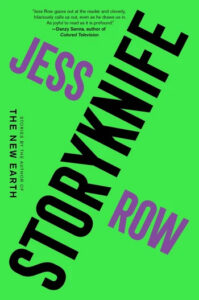
Storyknife by Jess Row is available from Ecco, an imprint of HarperCollins Publishers.