By Gatestone Institute | Created at 2026-06-21 09:30:08 | Updated at 2026-06-21 12:18:14
2 hours ago
By Gatestone Institute | Created at 2026-06-21 09:30:08 | Updated at 2026-06-21 12:18:14
2 hours ago
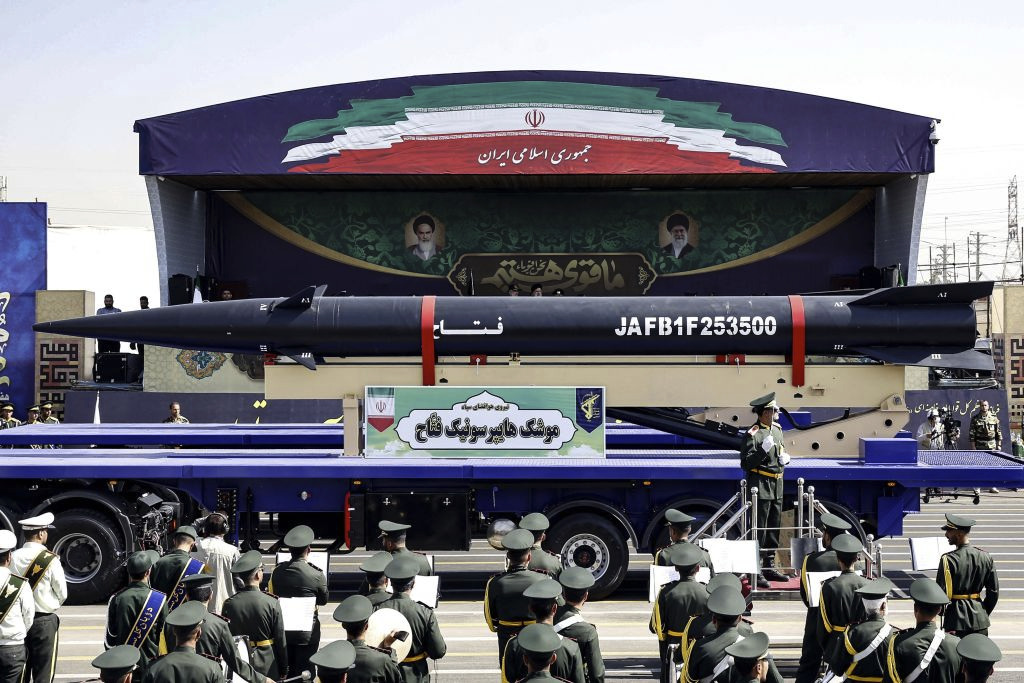 What does the agreement, if honored by Iran, deliver? It leaves enriched uranium inside Iran, concedes a right to enrichment that was recently a red line, permits the Iranian ballistic-missile program Trump now defends supposedly because other countries have missiles too, and pours reconstruction money into an economy whose ruling institution is the brutal Islamic Revolutionary Guard Corps. Pictured: A Fattah ballistic missile is displayed during the annual military parade in Tehran, on September 22, 2023. (Photo by AFP via Getty Images)
After a war launched in February to end the Iranian nuclear threat, the United States has agreed to a 60-day ceasefire, the reopening of the Strait of Hormuz, the lifting of its naval blockade, the unfreezing of Iranian assets, and an immense $300 billion reconstruction fund for the very regime the U.S. Air Force spent weeks degrading. The triumph turns out to be a recipe for everything Iran wanted and could not win on the battlefield.
The 14-point text is unambiguous on the point the White House is most eager to fog. It commits the United States, "with regional partners," to develop a "plan with at least USD 300 billion for the reconstruction and economic development of the Islamic Republic of Iran" -- $3 billion of which has, according to the unsurpassed journalist, Lee Smith, already been sent to Iran through by way of the United Arab Emirates. The president has called reports of that figure "fake news" and insisted nobody is putting up "ten cents." The clause nevertheless sits prominently in the document he signed.
To disclaim the funding by arranging for someone else to pay for it is a familiar maneuver. US Vice President J.D. Vance confirmed the transfer on CBS News and described a Gulf coalition that would finance Iran's recovery if Tehran behaved. Trump then turned and blamed Vance for the wording, saying that the statement "could have been a little more accurate." A vice president publicly scolded for telling the truth about his administration's own deal hardly projects strength or that the president is being straight with his public.
Vance answered not by reassuring the ally most threatened by the agreement, Israel, but by attacking it. In remarks aimed at Israel's government, he lashed out at members of Prime Minister Benjamin Netanyahu's cabinet as ungrateful, declared that Israel had only one leader in the world who was a friend -- which is far from true -- and claimed the Israel's weapons were paid for by American taxpayers, while omitting that much of the intelligence shared with America comes from Israel, as does much of the military know-how.
His condescension carried the rest of what one needs to know about him. This is the same Vance who told Ukrainian President Volodymyr Zelensky, "You are wrong" during a televised meeting at the White House, when Zelensky gently suggested that Ukraine needs stronger US support in battling the devastating invasion by Russia, an understatement if there ever was one. Russia continues to violate the 1994 Budapest Memorandum, in which it had guaranteed not to invade Ukraine if it gave up all its nuclear weapons – as it sadly did.
Here is the second-highest official in the United States telling Israel, which has just fought alongside America, to be quiet, be grateful, and that its survival is a favor it has not sufficiently repaid. American leaders have disagreed with Jerusalem for as long as the alliance has existed. Lecturing Israel about gratitude while handing its enemy $300 billion, and an agreement that all but guarantees its enemies the means to continue trying to destroy it, is a tack that is newer and nastier.
The arrogant tone might be tolerable if it were only distasteful. It rests, regrettably, on a falsehood about who won the war. The US campaign against Iran, dubbed Operation Epic Fury, was sold to the public as a feat of American airpower – which was real, spectacular and welcome. The targeting that made those strikes so precise did not come from satellites alone. It came from years of intelligence collected by Israel from inside Iran, which let the bombs find their marks. The men now telling Israel to be grateful are standing on the shoulders of the intelligence Israel handed them, without which the US could have gotten bogged down. That is the problem with the boast: Washington is presenting as its own a result it could not have accomplished by itself, and basing its diplomacy on the assumption that it could have done.
Only one question really matters: what does the agreement, if honored by Iran, deliver? It leaves enriched uranium inside Iran, concedes a right to enrichment that was recently a red line, permits the Iranian ballistic-missile program Trump now defends supposedly because other countries have missiles too, and pours reconstruction money into an economy whose ruling institution is the brutal Islamic Revolutionary Guard Corps (IRGC).
The scale is another factor that resists comprehension. The promised $300 billion fund is large enough to rebuild not only the economy of Iran but the apparatus of terrorist proxies controlled by it. Gulf analysts quoted in the Israeli media warn that the funds would free resources for Iran's proxy militias in Iraq, Syria, Lebanon, and Yemen. A regime that emerged from the war with the IRGC strengthened and its pragmatists dead is now to be financed back to dominance.
Probably no one actually believes that the agreement was ever meant to function as written. Washington has done this before. The three-phase plan for Gaza, announced with great solemnity, did accomplish the return of the remaining Israeli hostages in its opening stage, but then stalled, never advancing to the later phases meant to remake the territory. Phase one became the entire play. An interim framework can easily be a device for extracting one concrete concession -- opening the shipping lanes in the Strait of Hormuz -- while the other clauses quietly expire.
There is a more generous reading: If Trump signed in order to appear to give Iran everything, draw it to the table, and get the oil flowing before the midterms, all while knowing the structure would never hold, then the concessions are bait rather than surrender. The problem is that it seems from the memorandum of understanding (MOU) that most of the benefits to Iran are given up front, so the weak bargaining position that remains for the US can easily be dragged out by Iran past Trump's term in office.
Israel has stated plainly that it does not consider itself bound by the MOU so long as Hezbollah fires on its forces; it has kept striking Hezbollah strongholds in Lebanon.
Trump has repeated that if the deal collapses he will return to force – but who will do that after he is no longer president? If anyone imagines that a coalition of anyone will actually enforce anything after the first shot is fired by the IRGC, they are probably on some high-grade cannabis. We have already seen how that arrangement worked out in south Lebanon. It did not. That is why Israel is having to fight for its survival again there now.
Each Israeli reprisal can trigger an Iranian walkout, and each walkout hands Washington a legal pretext to resume the war it paused. If Trump, however, is reluctant to use force against Iran again now, why should anyone think that he would be more inclined to use it later? The weakness of it is that it depends on enemies who have spent 47 years learning to read American intentions better than Washington appears able to.
The optimistic reading is not the consensus even in Washington, and the unease inside the administration shows it. Secretary of State Marco Rubio, an Iran hawk of long standing and the official who ran the negotiations until the final week, vanished from public view the minute the deal was signed, then surfacing only as a glum figure behind the president at a press conference. A secretary of state who believes in this agreement would be trying to sell it. On Capitol Hill the reproaches were open: Senator Ted Cruz warned against handing billions to a regime that wants Americans dead. Senator Roger Wicker said the MOU negotiated away the victories of the war. The evangelical base that delivered Trump's coalition, and that regards the defense of Israel as scriptural obligation rather than policy preference, watched the administration, in the same week, scold Jerusalem and finance Iran.
Through all of this, one fantasy deserves to be retired. Regime change in Tehran has been wished for in every Western capital for nearly 50 years, but it was not the stated aim of this war -- apart from falsely promising the Iranians, who have been trying for years to remove their brutal regime, that "HELP IS ON ITS WAY." Instead, they seem to have decided to leave that dirty work to unarmed civilians with no weapons.
A regime falls when an organized force is ready to take power and when soldiers are willing to change sides -- and neither condition is yet in place in Iran. The Iranian opposition had been slaughtered, fractured and surveilled, and is leaderless, and the regime has spent decades locking every door. The United States will not deploy ground troops on Iranian soil. Without a united opposition to inherit power and without an army to seize Tehran, talk of liberation is a consolation, not a strategy. The war degraded the regime; it did not remove it -- and nothing in this agreement will. In fact, the MOU promises to enrich the IRGC again so that it can tighten its hold on the Iranian people even more viciously.
So the memorandum sits there, looking like the clumsiest concession an American administration has made to a sworn enemy in a generation, possibly exceeded only by having surrendered to the Taliban in Afghanistan. The danger is that this reading is the one being made in Beijing and Moscow: one where a superpower that bombs a country for weeks, then grants it $300 billion dollars and the right to nuclear weapons.
The US looks less like a chess player setting a trap than like a tired hegemon buying its way out of a war before an election. If China and Russia conclude that American threats expire on a domestic political calendar, the lesson will be applied again in Iran, as well as the Taiwan Strait and along the borders of Ukraine. Vance insulted an ally to defend the deal. Rubio disappeared. Trump denied what his own signature had endorsed. All three have staked their credibility on choosing not to finish what they had so brilliantly begun.
The regime in Tehran, which has waited out many American presidents and means to wait out another, is betting they are bluffing about everything except the check.
Pierre Rehov, who holds a law degree from Paris-Assas, is a French reporter, novelist and documentary filmmaker. He is the author of six novels, including "Beyond Red Lines", "The Third Testament" and "Red Eden", translated from French. His latest essay on the aftermath of the October 7 massacre " 7 octobre - La riposte " became a bestseller in France. As a filmmaker, he has produced and directed 17 documentaries, many photographed at high risk in Middle Eastern war zones, and focusing on terrorism, media bias, and the persecution of Christians. His latest documentary, "Pogrom(s)" highlights the context of ancient Jew hatred within Muslim civilization as the main force behind the October 7 massacre.