By The Straits Times | Created at 2026-09-29 21:06:54 | Updated at 2026-09-29 22:04:17
1 hour ago
By The Straits Times | Created at 2026-09-29 21:06:54 | Updated at 2026-09-29 22:04:17
1 hour ago
KUALA LUMPUR – A single fish caught in a central Malaysian reservoir has done what few freshwater catches ever do: sparked widespread alarm.
The fish, which strongly resembles a red-bellied piranha, was netted at Klau Dam in Pahang, roughly 100 kilometres north-east of Kuala Lumpur. Images of the Aug 26 catch went viral, prompting worries about attacks on children, calls for tighter controls on exotic fish and concern that a dangerous predator could spread through local waterways.
A second reported catch on Sept 18 in the same area slightly upstream has heightened anxiety. However, the first catch was discarded by the angler and it isn’t clear what happened to the second fish, leaving authorities without a physical specimen for definitive identification – only photos and video to work with.
Piranhas have long been staples of horror films, from the creature features of the 1970s to their campy sequels. Now, in Pahang, a real-life mystery has locals wondering whether the Hollywood nightmare has come to life.
The fish’s razor-sharp teeth quickly became the focus online, with fears centering on attacks on children and the possibility of the species spreading through local waterways.
“This poses danger to children swimming in the river. Such species could quickly multiply,” wrote a local social media user using the handle Pak Yuih.
Another commentator, Redxuan Alias, warned of the upcoming monsoon season: “If the water level rises, there is a possibility that these fish could spread downstream along the river. It won’t be long before the fish can breed throughout the Klau, Krau and Pahang rivers.”
But fisheries authorities have yet to confirm that either catch was a piranha – or that the species is present in local waterways. Scientists say the immediate risk to people is likely less important than the ecological risk: whether an introduced predator could survive, reproduce and spread through Malaysia’s waterways.
“The main concern would be the ecological impact rather than direct danger to people,” said Intan Faraha A. Ghani, a senior lecturer at Universiti Selangor Malaysia.
She said the netted fish resemble the red-bellied piranha, Pygocentrus nattereri, a species that rarely lives up to its Hollywood reputation. “Even in movies, sharks are portrayed as frightening. In reality, sharks tend to avoid humans. Unless they are injured or feel threatened. Like piranha, humans are not in their food chain,” the fish expert told The Straits Times.
Malaysia’s warm, tropical freshwater conditions could potentially allow a red-bellied piranha to survive, Intan said. But survival alone does not mean a population would be established.
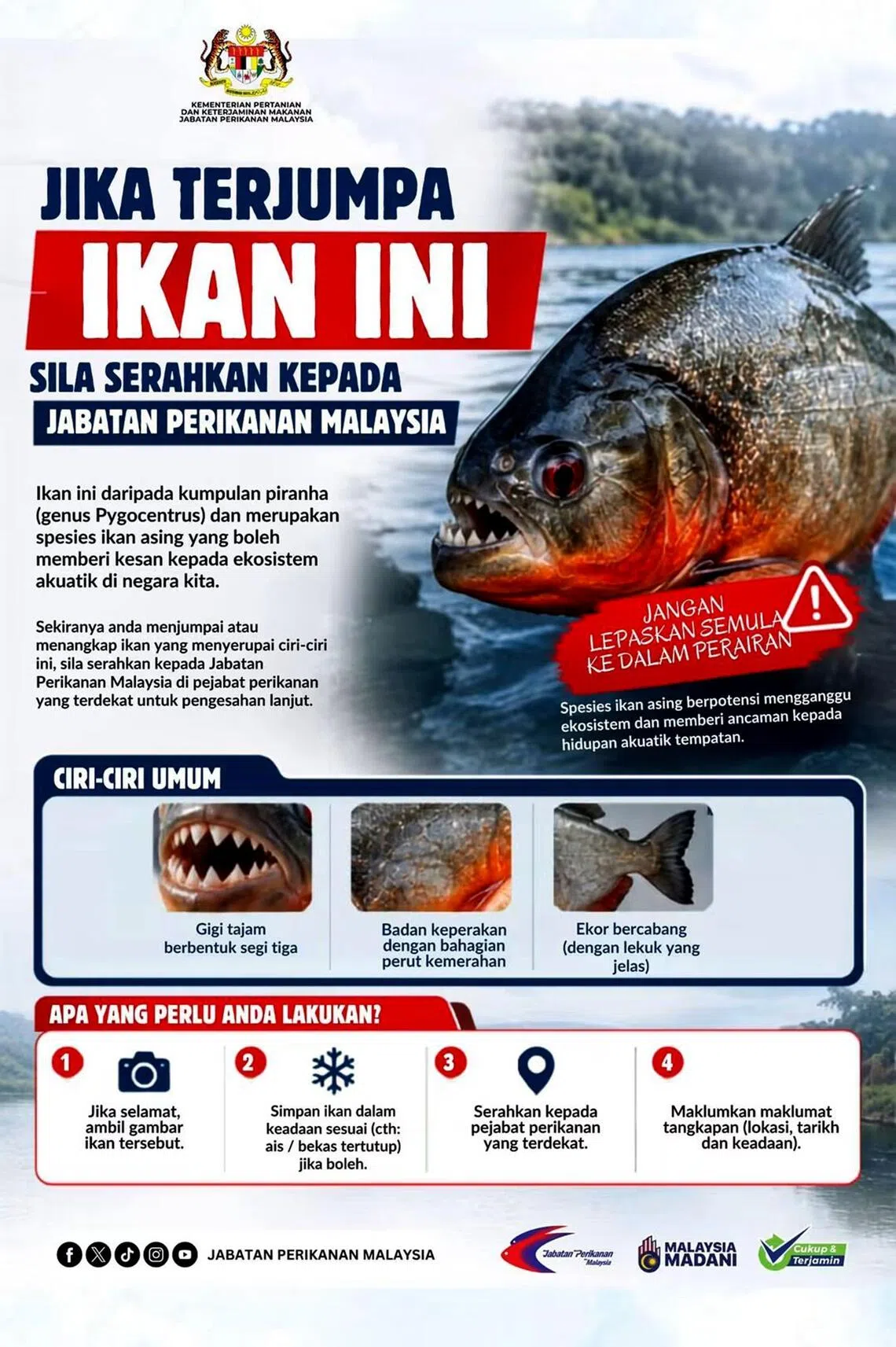
A poster by the Department of Fisheries Malaysia on the piranha - in Malay - describing its features and advising what anglers must do if they catch the fish, on its social media account on Sept 18.
PHOTO: DEPARTMENT OF FISHERY MALAYSIA
“Evidence such as juveniles, eggs, mature pairs, or repeated catches of varying sizes over time would be required to prove the fish is actively reproducing,” she noted.
She warned, however, that if piranhas became established, they could put pressure on native fish populations. They could also compete with native predators for food, disrupt aquatic food webs, damage spawning habitats and potentially introduce foreign parasites or pathogens.
The search for proof
The Department of Fisheries Malaysia (DOF) has sent photographs and video of the fish caught at Klau Dam on Aug 26 to the Fisheries Research Institute in Negeri Sembilan for assessment.
Preliminary findings suggest the fish’s physical characteristics align with the Pygocentrus genus, which includes the red-bellied piranha. But without a physical specimen, the department cannot make a definitive identification.
DOF director general Adnan Hussain told reporters on Sept 22 that given the absence of a physical specimen, officials will work with Aquaria KLCC to analyse environmental DNA, or eDNA, from water samples, comparing genetic traces left in the dam area against the KL oceanarium’s live piranha collection.
The department has asked local anglers around Klau Dam to retain and hand over any similar fish. For now, officials say there is no concrete evidence of a piranha population, unusual fish die-offs or attacks on humans.
A wider concern
The official response has drawn criticism from freshwater conservation groups, who argue the episode highlights systematic weaknesses in Malaysia’s management of invasive species.
Jejak Air Tawar, a local group that monitors native and invasive freshwater species, argued that authorities should conduct proactive, sustained field searches rather than relying passively on reports from local anglers.
Kennedy Michael, founder of the Alliance of River Three, a river-restoration initiative, similarly questioned whether the country’s river basins are adequately monitored.
“Those of us in the conservation community have voiced these concerns for over a decade,” he said. He urged stricter enforcement of existing wildlife laws, stronger legislation, and new regulations on exotic pet imports.
Michael said the ecological consequences of an introduced species may not become apparent until it becomes established and begins reproducing.
“A river is not an open-air aquaculture pond. It is an ecosystem. Once a species gets into a connected river system, you rarely get a second chance,” he told ST.
Malaysia already has populations of several established invasive species, including the suckermouth sailfin catfish (”pleco”), peacock bass, African catfish and tilapia.
The threat to protected waters
The wider concern is what an established invasive fish population could mean for native species in Pahang’s connected river systems, including waterways that feed into areas around Taman Negara, experts say.
“Taman Negara is a valuable natural ecosystem, and preventing invasive predators from becoming established is much better than trying to repair the ecological damage later,” said Nur Azalina Suzianti Feisal, who studies invasive species at the Management & Science University in Selangor.
The Fisheries Department plans to continue monitoring Klau Dam and has begun talks with e-commerce platforms to curb the illegal sale of prohibited exotic species. Inspections of ornamental fish traders nationwide are also ongoing. Piranha is a prohibited species in Malaysia, with illegal possession and sale punishable by a fine of up to RM100,000 (S$31,312).
For residents near Klau, anxiety remains high, with social media warnings about swimming continuing to circulate.
Until another specimen is caught and properly analysed, the piranha mystery of Klau Dam remains unresolved.
Sign up for our weekly Asian Insider Malaysia Edition newsletter to make sense of the big stories in Malaysia