 By Miltary.com | Created at 2026-10-05 17:20:52 | Updated at 2026-10-05 18:10:45
53 minutes ago
By Miltary.com | Created at 2026-10-05 17:20:52 | Updated at 2026-10-05 18:10:45
53 minutes ago
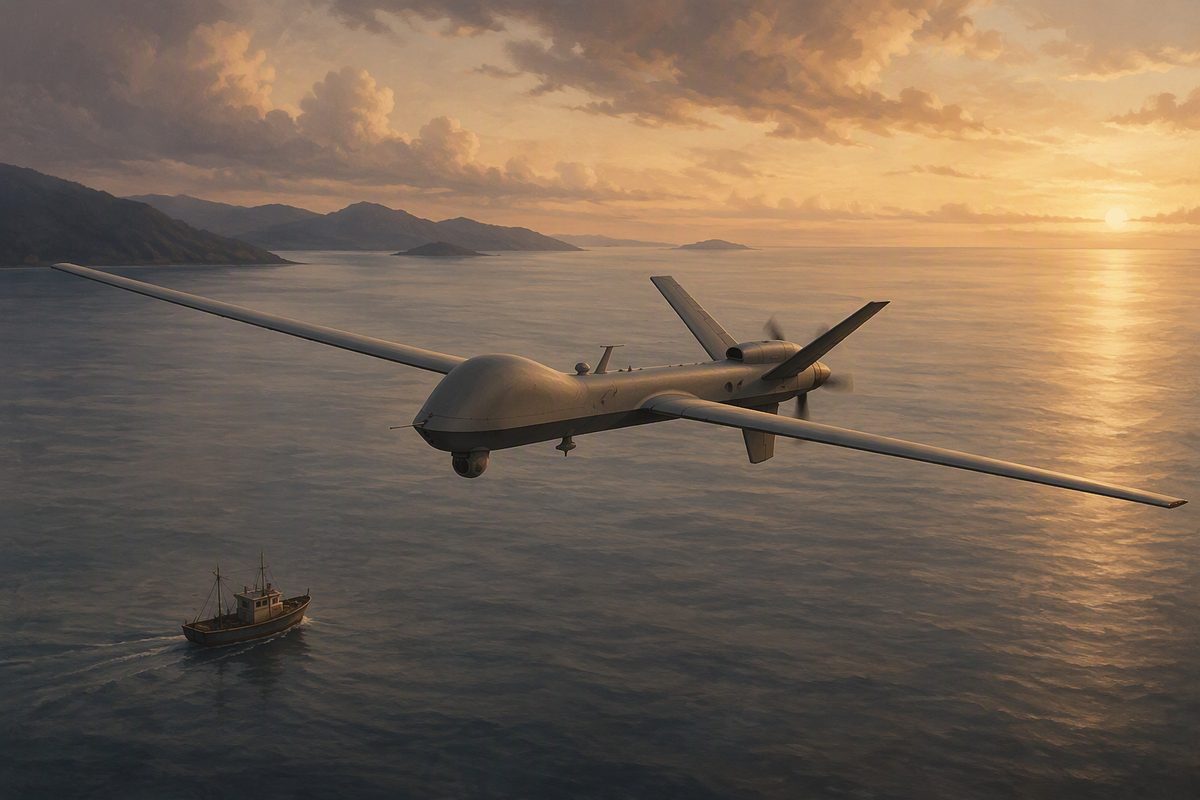
First, you hear the high-pitched whine of drones overhead. Next comes the boom of explosions.
“And then in the following days, the sea brings in a jerrycan, pieces of a boat, drugs, people too,” says Alberto, a local businessman living in the remote Colombian peninsula of La Guajira.
This grim sequence of events has become familiar for those based along this arid strip of desert, whose shores are lapped by a part of the Caribbean that has been the site of 21 U.S strikes on speedboats over the past year.
The U.S. military campaign against the alleged “narco-terrorists” manning these vessels, known as Operation Southern Spear, has faded from headline news since the first attack was launched just over a year ago on Sept. 2.
Yet it continues to destroy small boats in the Caribbean and eastern Pacific — with at least 238 dead in a total of 70 strikes so far — in the face of heavy criticism from legal experts and rights groups, who call it an ineffective program of what are essentially extrajudicial murders.
President Donald Trump’s administration has defended the campaign as justified and lawful, with the president claiming in March that it had helped eliminate nearly all drug trafficking into the U.S. by sea.
Locals on the ground, however, tell a different story. Journalists from OCCRP, the Organized Crime and Corruption Reporting Project, and 360-grados.co traveled to La Guajira, which sits at the northernmost point of South America, to learn more about how the strikes have affected the cocaine trade in this historic smuggling hub.
The residents, officials and trafficking experts who spoke — mostly on condition of anonymity for security reasons — said the strikes had failed to curb boat departures from this impoverished region, where a complex ecosystem of criminal groups control the cocaine trade, and smuggling remains one of the few reliable ways to earn a living.
When the drug-running boatmen — known here as lancheros or choferes, chauffeurs — are arrested or die, the traffickers who coordinate the business simply “get new ones,” said a longtime state official who travels frequently around La Guajira.
“Only the families of the dead feel it,” she said. “The rest do not.”
The official said she has seen no let-up in the flow of speedboats from the peninsula over the past year — an observation echoed by many others.
“A friend went out last night,” one young, fast-talking lanchero dressed in a polo shirt said casually during an interview in La Guajira’s capital Riohacha.
A shipment needs at least half a ton of cocaine to be profitable, he explained to reporters, and it typically takes at least two weeks to prepare the vessel, motors, fuel, and money needed to pay the owners of the beaches from where the boats embark.
One popular departure point is Puerto López, a far-flung settlement on the eastern coast of La Guajira peninsula, near the border with Venezuela. There, reporters found isolated sandy beaches strewn with burnt pieces of a boat, blue gasoline drums, and other flotsam and jetsam washed in by translucent teal waters.
According to one local man, the owners of the cocaine shipments — who typically contract the boatmen as drug-runners — will send people to recover the load the day after an airstrike, offering up to 3 million Colombian pesos, the equivalent of $947, per brick of cocaine found among the wreckage.
A smuggling hotspot
The beaches, coves and caves of Alta Guajira’s 300-kilometer coast have long been used as transit points for smuggling. In the 1950s, coffee went out to nearby Caribbean islands, while gasoline still comes in from nearby Venezuela when it’s inexpensive there.
“Absolutely everything moves through this area,” said Lerber Dimas Vásquez, a Colombian anthropologist at the University of Magdalena who works on issues related to organized crime. “This is one of the closest points to the Caribbean islands, so essentially, what we have is a highly important corridor. And a very poorly guarded one. It has been used for years for smuggling.”
Today, the biggest money-maker is cocaine. Several hundred kilometers to the south lies Catatumbo, a forested mountain range along the border with Venezuela that is Colombia’s second-largest cocaine-producing region.
Dimas Vásquez said drugs are moved from there to La Guajira via large trucks, which are easily concealed amid a steady flow of vehicles transporting coal mined in Catatumbo.
From La Guajira, small boats ferrying the drug have continued to “go back and forth to the Dominican Republic. Also to Curaçao, to Aruba. It continues the same. That never ends. Perhaps they charge more for traveling,” one local administrative official told OCCRP.
According to Alberto, the local businessman who has himself previously served prison time for drug trafficking, the boats are staffed by a diverse mix of men, including some from the local indigenous Wayúu community as well as Puerto Ricans, Antilleans, Dominicans, and Venezuelans.
“They embark with up to 3,000 kilos, four motors of 350 [horsepower], 25 tanks of gasoline. You spend an hour to go to Venezuela, three to Curaçao, and less than 17 to the Dominican Republic,” he said.
On Sept. 9, a boat that departed from La Guajira was struck at sea, according to locals.
U.S. authorities reported that “three narco-terrorists” were killed in a strike that day.
The U.S. press releases never mention the names or nationalities of the men killed in the attacks, while authorities in countries from where they depart, including Colombia, Venezuela, and Ecuador, have also provided little information.
That has left the work of identifying these men to local communities and journalists, such as a consortium led by the investigative outlet CLIP that was able to collect the names, or at least some information, about 19 men killed between Sept. 2 and May 5.
In an update on Operation Southern Spear one year in, U.S. officials were less bullish than their president, but said the campaign had driven a 60 percent reduction in illicit maritime activity in the Eastern Caribbean region that includes La Guajira. They also touted a 65 percent reduction in the Western Caribbean and a nearly 50 percent reduction in key areas of the Eastern Pacific.
When reached for comment, the U.S. Southern Command declined to discuss how they identify targets, but said that “every narco-terrorist neutralized” as part of the campaign “was an affiliated member of a Designated Terrorist Organization, actively transporting illicit material along known trafficking routes in international waters.”
The Trump administration does not disclose how it measures success, but Catalina Niño, a project coordinator at the local branch of the German pro-democracy non-profit Friedrich Ebert Stiftung, noted that “there is nothing to indicate that the strategy is achieving its supposed objective.
“There is no evidence that the strategy works, not even in terms of physical proof, because destroying the boats leaves no evidence behind. There are no individuals to prosecute, and there is no verifiable evidence that there were drugs on those boats in the first place,” she said. “It is impossible to obtain evidence in this regard.”
A July report issued by the Washington Office on Latin America, a rights advocacy group, noted that available evidence suggested the military campaign was having little to no impact on the supply of cocaine reaching the U.S.
Reached for comment, White House spokesperson Anna Kelly said that “all of these decisive strikes have been against designated narcoterrorists bringing deadly poison to our shores, and the President will continue to use every element of American power to stop drugs from flooding into our country and to bring those responsible to justice.”
Colombia’s presidency did not respond to requests to comment. The country’s deputy Ombudsman, Paula Aponte, said in a statement that her office has sought further information from other state agencies on the Colombian nationals believed to have died in the attacks, but with little success.
Searching for a body
Down one dusty dirt road in Riohacha sits a single-story brick home where a grief-stricken Wayúu family has been waiting for a boatman to return since May. The family, who lives without running water, has traveled across the peninsula to look for his corpse. They also constantly scan social media, where graphic videos of casualties from decimated boats circulate.
“He hasn’t appeared. They have asked about him even in the Dominican Republic,” said a distraught woman who answered the door to the family’s home and identified herself as a neighbor.
The woman explained that without a body, the man’s mother refuses to accept his death.
But many believe the moment his life ended was captured in the video accompanying a United States Southern Command press release announcing a May 4 missile strike on a vessel “operated by Designated Terrorist Organizations” in the Caribbean Sea.
“Two male narco-terrorists were killed during this action,” the press release declared.
After that announcement, word quickly spread in La Guajira that the men might be from the Wayúu community that has inhabited this desert for hundreds of years.
A group set out to sea to search for their community members and found the remains of a vessel and a headless body held up by its life jacket. They left the corpse to drift away in the Gulf of Venezuela. According to Wayúu custom, only women are allowed to touch their dead.
Shortly after, memorial photos of two local men began to circulate on social media: Adrián Lubo and Ronald Arregocés, two friends from Riohacha.
Both were under the age of 40 and were widely known as boatmen who occasionally worked for drug traffickers. A person close to one of them who spoke on condition of anonymity said Lubo had earned local renown as a competent speedboat driver who had successfully delivered — or in local parlance, “crowned” — several cocaine shipments to neighboring Caribbean islands.
In La Guajira, the prosecutor’s office told OCCRP that it had not opened any criminal investigations against Lubo and Arregocés, and that neither of them is known to appear in any criminal organizational chart.
The men’s relatives sought help from a respected mediator to seek compensation from the owner of the drug shipment.
“But apparently he has not fulfilled it to them,” the neighbor of one of the families said.
Guerrillas and gangs
While U.S. attacks fail to stop the smuggling of cocaine from this remote territory, state authorities are also little match for the armed groups and gangs that control much of the area.
Near La Guajira’s border with Venezuela, the only police station for miles is a one-story, half-finished building in Castilletes, a few hundred meters from the frontier. When reporters visited the mud-stained outpost, eight shirtless police officers in shorts and flip-flops were posted there without any cars or motorcycles parked nearby, while two donkeys wandered past outside.
Officers are sent to this remote station on rotations of two or three months, with fresh water and food delivered weekly by trucks that make a five-hour journey across dusty desert roads.
Locals and security experts say the ELN guerilla group — an insurgent force in at least 180 municipalities that controls many rural border crossings and drug transit points — is a far more powerful presence, patrolling the region in SUVs equipped with satellite internet, and carrying assault rifles, pistols, bulletproof vests, tactical boots and uniforms.
While reporting in the region, reporters were stopped by a group of masked and armed men in combat gear who said they were from the ELN and asked the driver to alert them next time he entered the area.
“Basically, they charge anyone who has to move drugs through there,” said Colombian anthropologist Dimas Vásquez. “What they do is sell security — that is, ensuring the drugs aren’t lost — and they provide a safe platform so shipments can leave from there either by boat or by small plane.”
The local administrative official reporter spoke to said the ELN controls both sides of the Colombia- Venezuela border and demands money for everything that transits through the area, not just drugs.
“One has to pay because they dominate the corridor and coordinate the logistics, the transport, sometimes the security,” the official said.
According to Dimas Vásquez, some leaders of local indigenous clans who once held more sway over the cocaine trade now work at the behest of armed groups in the region, which in addition to the ELN include the Gaitanist Self-Defense Forces of Colombia, the Conquering Self Defense Forces of the Sierra Nevada and Tren de Aragua.
“Esto es un arroz con mango” — This is rice with mango — a local merchant said to describe the situation, using a common Spanish expression to describe a mess.
A few hundred meters from Castilletes’ lonely police outpost lies an improvised tomb in the sand, where the body of a large man was buried after he was found on the beach with a life vest and shrapnel encrusted in his flesh.
The unknown man — and perhaps the family of a lanchero — are still waiting for authorities to exhume him or provide any report on who he is, where he came from, and the circumstances of his death, according to the local administrative official. Given the security situation in the region, a military escort would be needed for anyone to reach the body, the official added.
In the meantime, locals conducted a traditional spiritual ceremony to “harmonize” the many’s body before burying him, the official said.
“He was blessed so he is not a restless soul.”
©2026 Miami Herald. Visit miamiherald.com. Distributed by Tribune Content Agency, LLC.