 By The Epoch Times | Created at 2026-08-22 15:06:28 | Updated at 2026-09-25 07:52:25
1 month ago
By The Epoch Times | Created at 2026-08-22 15:06:28 | Updated at 2026-09-25 07:52:25
1 month ago
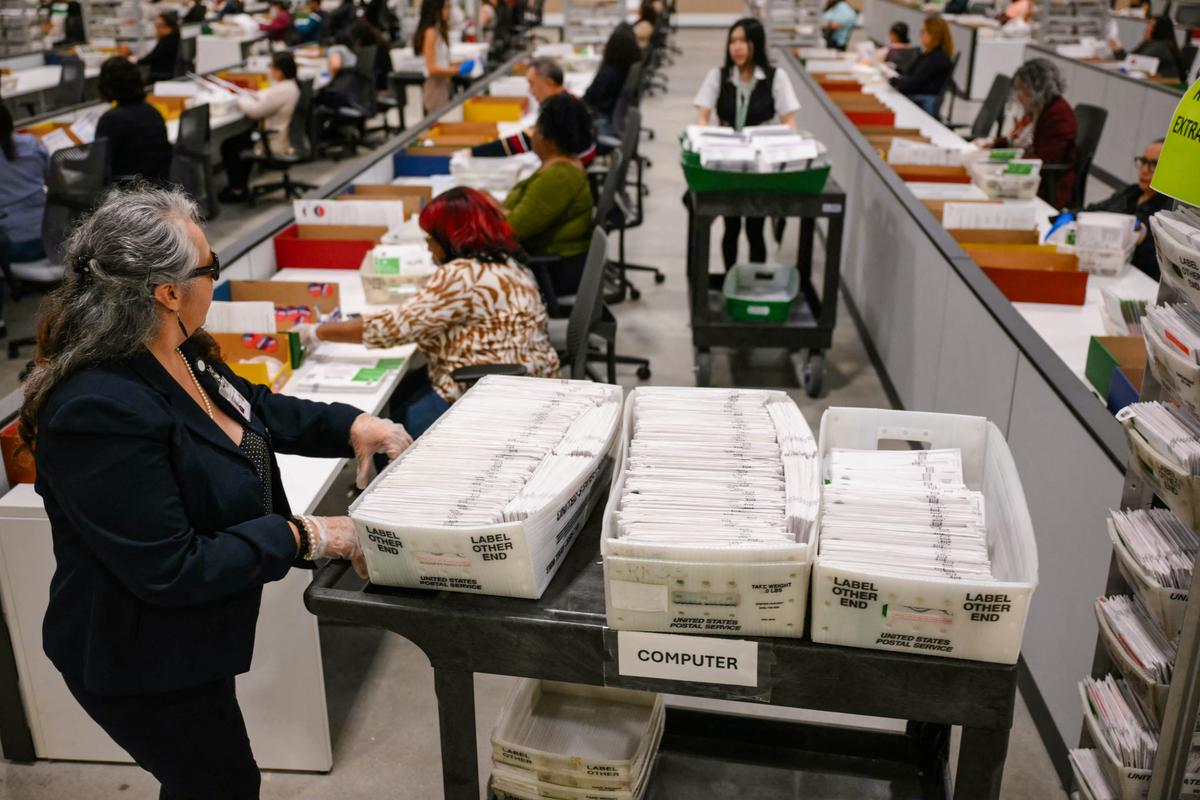
An election worker moves mail-in ballots to be organized for tabulation at the Los Angeles County Ballot Processing Center during California's state primary election in the City of Industry, Calif., on June 2, 2026. Patrick T. Fallon/AFP via Getty Images
The U.S. Postal Service (USPS) published a final rule on Aug. 21 that would impose additional measures on mail-in voting, though its implementation remains subject to court orders.
In a 95-page document published in the Federal Register, USPS said it will not implement the new rule unless the government obtains relief from two injunctions issued on June 25 and Aug. 11 that block USPS from carrying out President Donald Trump’s executive order seeking to tighten mail-in voting rules.
The final rule, if implemented, would require states to provide lists of voters who receive mail-in ballots. USPS will not collect voters’ party affiliation or inspect the contents of ballots under the rule.
It states that postal service workers are not authorized to open mail sealed against inspection, and that USPS will maintain data from the exterior of mailpieces, including address and barcode information.
The rule also requires states to ensure federal ballot mail envelopes meet certain preparation requirements and provide data on outbound and return ballot mailings.
The Postal Service also emphasized that the rule will not involve reviewing individual voters’ eligibility or auditing state voter rolls. The document is set to be formally published in the Federal Register on Aug. 26.
“If the government obtains timely relief from the injunctions, implementation immediately thereafter will provide election officials as much time as possible before the next election to comply with the rule’s preparation standards for Federal Ballot Mail envelopes, and to prepare to submit data to the Federal Ballot Mail Portal, before the mail-in and absentee ballots subject to this rule are mailed (which generally occurs in September or thereafter, as determined by state law),” the rule stated.
The rule follows Trump’s March 31 executive order aimed at enhancing election integrity. The order directed the Department of Homeland Security to compile lists of verified U.S. citizens eligible to vote in each state using citizenship, naturalization, and other federal records.
Judge Indira Talwani of the U.S. District Court for the District of Massachusetts ruled on June 25 that the executive order exceeded presidential powers and violated constitutional principles.
The judge emphasized that election procedures have traditionally been managed by state and local governments since the nation’s founding.
Talwani also found that the president lacked the authority to create state-by-state voter rolls and that USPS does not have legal authorization to establish binding rules governing mail-in voting.
On Aug. 11, the judge expanded the injunction to prevent USPS from implementing standards for mail-in and absentee ballots nationwide ahead of the November elections.
Jackson Richman contributed to this report.