By The Rio Times | Created at 2026-10-09 01:26:51 | Updated at 2026-10-10 04:47:21
1 day ago
By The Rio Times | Created at 2026-10-09 01:26:51 | Updated at 2026-10-10 04:47:21
1 day ago

Key Facts
- Vale’s New York shares fell 1.40% to US$13.42 making the Brazilian miner the weakest name on our proxy board as iron ore demand worries resurfaced.
- China’s steel industry is the drag only about 7% of Chinese steelmakers were profitable at the end of September, forcing blast furnaces to curb output.
- Daily hot-metal output hit a six-month low falling to 2.34 million tonnes, a direct gauge of how much iron ore Chinese blast furnaces are consuming.
- Holiday stockpiles swelled 9.3% inventories of five major carbon-steel products reached 4.2 million tonnes during the October 1-7 National Day break.
- CSN Mineração bucked the trend the smaller Brazilian mining share rose 0.61% to R$4.97 (about US$0.99) on Brazil’s exchange, while Rio Tinto gained 0.19% to US$93.34.
Today’s Focus
Iron ore’s slide is really a China steel story. Only about 7% of Chinese steelmakers were profitable at the end of September, and mills responded by cutting blast-furnace output; daily hot-metal production, the closest proxy for iron ore consumption, fell to a six-month low of 2.34 million tonnes.
The timing made it worse. During the October 1-7 National Day holiday, inventories of five major carbon-steel products jumped 9.3% to 4.2 million tonnes, leaving warehouses fuller just as seasonal construction demand normally picks up.
For Brazil, the pain is concentrated in Vale, the world’s second-largest iron ore exporter. Its New York shares fell to US$13.42, while smaller domestic peer CSN Mineração actually rose to R$4.97 (about US$0.99) in São Paulo.
What matters today. The iron ore market is being squeezed by falling Chinese blast-furnace demand, leaving Vale exposed to further downside unless Chinese steel margins recover.
01 The session in one read
Iron ore proxies slipped on Thursday, October 8, 2026, as evidence piled up that Chinese steelmakers are pulling back. Vale, Brazil’s giant and the world’s number-two exporter, saw its New York-listed shares fall 1.40% to US$13.42.
The tone was set in China, not in mining pits. Only about 7% of Chinese steelmakers were in profit at the end of September, and daily hot-metal output dropped to a six-month low of 2.34 million tonnes, cutting the immediate need for imported ore. CSN Mineração, the smaller Brazilian comparison in São Paulo, rose 0.61% to R$4.97 (about US$0.99), showing the pain was not evenly spread.
Assessment — Demand, not supply, now decides HIGH
The balance of evidence points to further softness until Chinese steel margins recover. With only a sliver of mills profitable, the industry association has called for output cuts, while holiday stockpiles mean no immediate restocking impulse. The variable to watch is China’s daily hot-metal output: if it stabilises above the current six-month low, iron ore could find a floor; if it keeps falling, Vale’s New York shares are the clearest short-term casualty.
Follow this story
Get an email when there’s news on Markets
Free. One email a day at most, and only when there is news. This also signs you up to our weekday newsletter, The LatAm Brief. Nothing arrives until you click the confirmation link, and you can stop either with one click. Privacy policy.
02 The board
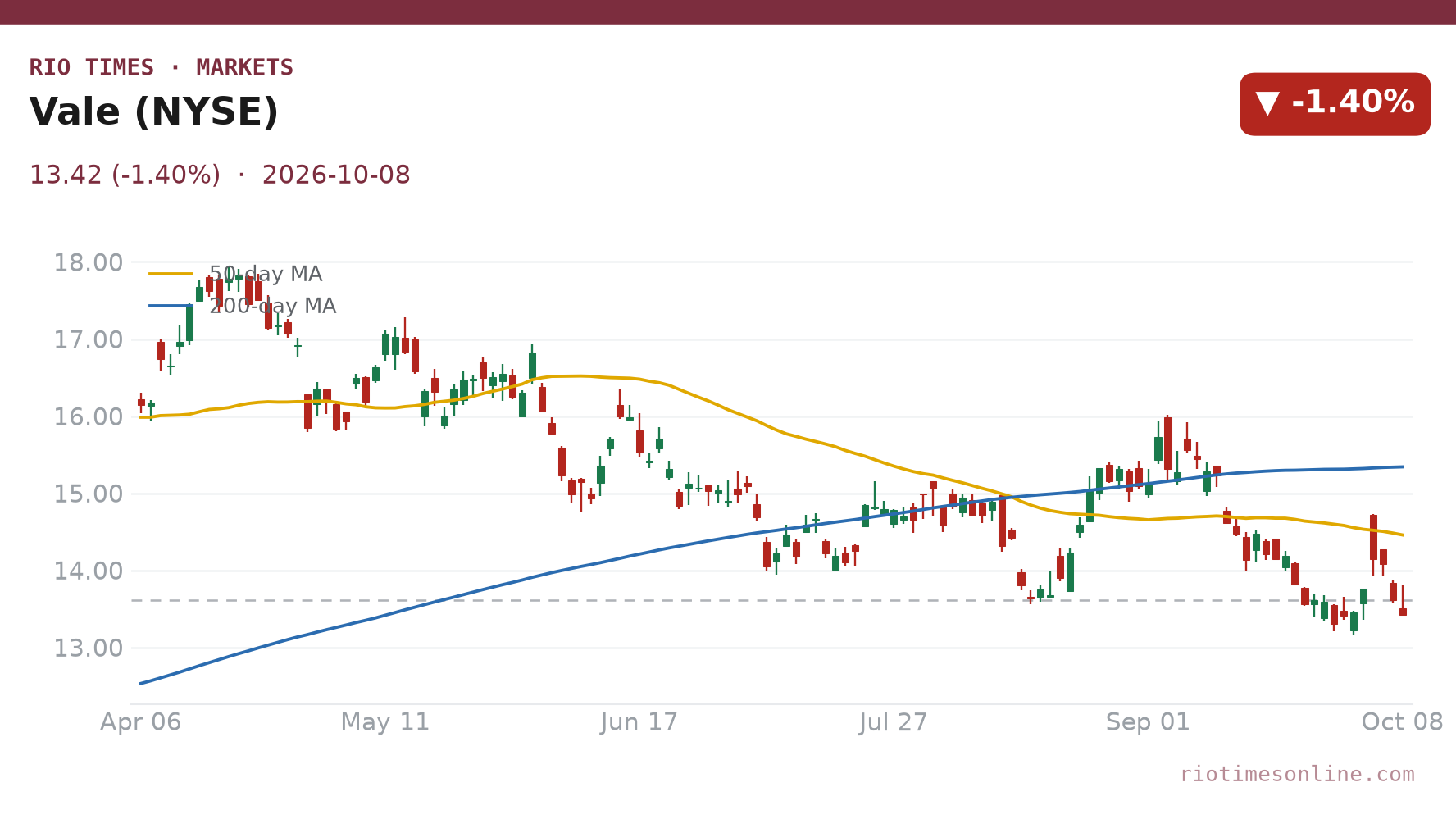
The proxy board tells a split story. Vale’s New York-listed shares led the decline at US$13.42, down 1.40% on the session, while Anglo-Australian miner Rio Tinto edged up 0.19% to US$93.34, perhaps cushioned by its aluminium and copper exposure.
In São Paulo, CSN Mineração gained 0.61% to R$4.97 (about US$0.99), a reminder that domestic Brazilian factors, including the real and local steel demand, can offset the global iron ore trend for smaller names. None of these is the raw commodity price; they are the shares and funds investors actually trade as stand-ins for the steelmaking ingredient.
| Iron ore (Vale) | US$13.42 | -1.40% |
| CSN Mineração | R$4.97 | +0.61% |
| Rio Tinto | US$93.34 | +0.19% |
Source: RT close, 2026-10-08. Where a commodity has no spot feed, an exchange-traded tracker or leading producer is shown as a labelled proxy.
Live Market IntelligenceThe live market boardInside: market breadth, the sector heatmap, currencies & rates, the Latin America scoreboard and the full instrument board.Rio Times · Live Market Intelligence
Latin America — Cross-Market Board
Regional
Oct 8, 2026 · 21:54
Ibovespa · benchmark
206,220.24 +0.94%
L 167,142day rangeH 168,310
+21.85% over 12 months
Market breadth · 5 names
60% advancing
3 ▲ advancing2 declining ▼
Currencies, rates & key inputs
Latin America scoreboard
IndexLastTodayStrength
IbovespaBrazil 206,220.24 +0.94%
S&P/BMV IPCMexico 64,851.89 +0.31%
S&P IPSAChile 11,024.22 +0.22%
S&P MERVALArgentina 2,832,472 +0.30%
MSCI COLCAPColombia 2,525.90 -0.36%
BVL S&P PerúPeru 60,766.81 -1.71%
Full instrument board
| IBOV | 206,220.24 | +0.94% | +21.85% | 204,302.33 | 168,310 | 167,142 | — |
| IPSA | 11,024.22 | +0.22% | — | 10,999.64 | 11,210 | 10,984 | 1,513,213,483 |
| IPC MEX | 64,851.89 | +0.31% | +12.17% | 64,653.33 | 66,121 | 65,405 | 108,886,187 |
| MERVAL | 2,832,472 | +0.30% | +30.51% | 3,022,485 | 3,042,365 | 2,991,150 | — |
| COLCAP | 2,525.90 | -0.36% | — | 9.04 | 9.05 | 9.02 | 4,133 |
| BVL PERÚ | 60,766.81 | -1.71% | — | — | — | — | — |
| USD/BRL | 5.16 | +0.01% | -5.13% | 5.16 | 5.18 | 5.14 | — |
| EUR/BRL | 5.95 | +1.01% | -5.83% | 5.89 | 5.98 | 5.94 | — |
| USD/MXN | 17.06 | -0.24% | -8.58% | 17.10 | 17.08 | 17.01 | — |
| USD/CLP | 913.98 | +0.04% | -5.67% | 913.65 | 915.11 | 906.68 | — |
| USD/COP | 3,140 | +0.03% | -22.04% | 3,139 | 3,141 | 3,105 | — |
| USD/PEN | 3.36 | -0.66% | -4.82% | 3.38 | 3.38 | 3.35 | — |
| USD/ARS | 1,493 | +0.10% | +12.96% | 1,491 | 1,494 | 1,480 | — |
| USD/UYU | 40.27 | +1.24% | +1.80% | 39.77 | 40.27 | 40.23 | — |
| USD/PYG | 5,939 | +1.68% | -19.54% | 5,841 | 5,939 | 5,925 | — |
| USD/BOB | 11.64 | -0.76% | +72.04% | 11.73 | 11.72 | 11.64 | — |
| USD/DOP | 58.34 | +1.25% | -3.44% | 57.62 | 58.34 | 58.04 | — |
| USD/CRC | 445.92 | +0.89% | -9.71% | 441.97 | 448.50 | 445.92 | — |
Largest moves today
BVL PERÚ 60,766.81 -1.71%
USD/PYG 5,939 +1.68%
USD/DOP 58.34 +1.25%
USD/UYU 40.27 +1.24%
EUR/BRL 5.95 +1.01%
IBOV 206,220.24 +0.94%
USD/CRC 445.92 +0.89%
USD/BOB 11.64 -0.76%
The session read
The Ibovespa rose 0.94%, with breadth positive — 3 of 5 names higher. IPC MEX led, while BVL PERÚ lagged.
V
◆ Live Company Intelligence
Vale
NYSE: VALEVALE3Basic MaterialsOther Industrial Metals & Mining65,805 employees
$57.92B
Market cap
Analyst target $16.60
Wall Street view
3.6Moderate Buy/ 5
10 Buy14 Hold1 Sell
Avg. price target $16.60 · +8% vs 200-day
Valuation & profitability
Market cap$57.92B
Revenue (TTM)$218.07B
P / E ratio27.2
Profit margin4.8%
Return on equity4.1%
Price & risk
52-wk low
$9.8852-wk high
$17.44
Beta (volatility)0.70
200-day average$15.33
Revenue trend · 6y
20202025
Latest $38.23B
Ownership
Institutions20.7%
Shares outstanding4.26B
Top holderCapital World Investors
Institutional holders5+ funds
Dividend
Yield38.9%
Payout ratio2.0%
Fwd. annual$0.84
What Vale does. Vale S.A., together with its subsidiaries, produces iron ore and nickel in Brazil, Asia, the Middle East, North Africa, Europe, the Americas, and Oceania. The company operates in two segments, Iron Ore Solutions and Vale Base Metals. It extracts, produces, and distributes iron ore, iron ore pellets, briquettes, nickel, copper, other ferrous…
03 What moved it
The core driver is Chinese steel economics. With about seven in every hundred Chinese steelmakers profitable at the end of September, the Iron and Steel Association urged producers to cut output and reduce inventories, a call that directly shrinks iron ore demand. Hot-metal production, the blast-furnace gauge of ore consumption, fell to a six-month low of 2.34 million tonnes.
The National Day holiday made it worse. During the October 1-7 break, when mills often keep running but construction sites slow, inventories of five major carbon-steel products swelled 9.3% to 4.2 million tonnes. Mills now face the double burden of weak margins and full warehouses.
04 The Latin American read
Brazil’s link to this market is Vale. As the world’s second-largest exporter, its New York shares are the most liquid proxy for global investors betting on iron ore, and on Thursday they fell to US$13.42. Vale’s move also reflected a firmer US dollar and higher long-dated US Treasury yields, which tend to weigh on commodity-linked equities.
CSN Mineração, the smaller and more domestic-facing play, rose 0.61% to R$4.97 (about US$0.99). That divergence suggests Brazilian investors were less panicked than New York traders, perhaps seeing CSN’s product mix or local pricing as less directly exposed to the Chinese marginal buyer.
05 The names to watch
Vale is the cleanest Brazilian proxy: its volume, its export book and its earnings move closely with the seaborne iron ore price that our spot feed does not carry. When Chinese steel margins crack, Vale is typically the first Latin American name to feel it, and Thursday’s US$13.42 close shows that tension.
CSN Mineração offers a smaller listed comparison. Its R$4.97 (about US$0.99) close is a useful check on whether iron ore weakness is hitting Brazil broadly or whether idiosyncratic factors, from logistics to local steel, are at work. Rio Tinto, at US$93.34, shows how diversified miners can absorb an iron ore downdraft better than pure plays.
06 The outlook
The near-term path hinges on Chinese steel margins. The industry body’s call for lower output and inventories, combined with full holiday stockpiles, argues for a cautious few weeks. Keep watching daily hot-metal output; if it returns above the current 2.34-million-tonne six-month low, buyers may step back into ore. If it falls further, Vale’s New York shares at US$13.42 look vulnerable to another leg down.
07 What to watch
- China hot-metal output: the closest gauge of blast-furnace ore consumption; a stabilisation above 2.34 million tonnes would signal demand support.
- Chinese steel inventories: the 4.2 million tonnes of carbon-steel products built up over the holiday must be worked down before mills restock ore.
- Vale New York share price: the most liquid global proxy for iron ore; watch whether US$13.42 acts as a floor or breaks lower.
Frequently Asked Questions
Why did iron ore fall on Thursday?
Chinese steelmakers are unprofitable and cutting output; with only about 7% of mills in profit, hot-metal production dropped to a six-month low, curbing ore demand.
What does Vale have to do with iron ore?
Vale is Brazil’s giant and the world’s second-largest iron ore exporter, so its New York shares are a widely traded proxy for the commodity’s price, which has no spot feed here.
Why did CSN Mineração rise while Vale fell?
CSN Mineração gained 0.61% to R$4.97 (about US$0.99) as a smaller, more domestic play; Vale fell 1.40% to US$13.42 on weaker iron ore, a firmer dollar and higher US yields.
What should I watch next?
China’s daily hot-metal output and steel inventory drawdown; if either improves, iron ore and Vale could stabilise. If not, further pressure is likely.
Market data: RT
This article was produced by The Rio Times’ automated newsroom system. How we use AI · Report an error · Editorial responsibility: Matthias Camenzind, Editor-in-Chief
LatAm Markets: Live Signals → — real-time movers, turnover leaders and FX across Latin America.