Virginia’s far-left Democratic Governor Abigail Spanberger plans to pave her state with almost 300,000 acres of solar panels to feed the voracious energy appetite of data centers.
The idea is contained in the energy plan she released last week.
The problem: As WJLA reported, the plan will consume an area the size of two counties and one city.
Virginia Gov. Abigail Spanberger is proposing 277,000 acres of solar panels to produce home grown “clean” energy.
That’s the size of Fairfax County, Arlington County, and the City of Alexandria combined.
Ninety percent of the solar panels would be placed on farmland and… pic.twitter.com/g7jYpofqJ1
The Plan
Buried deep in the eye-glazing 157-page report is language that should terrify those concerned about the environment.
“According to reports from Virginia Farm Bureau and the Virginia Department of Forestry, Virginia has 7.3 million acres of farmland and as of 2018 Virginia had 16 million acres of forestland,” page 100 says:
Historical solar deployment has been on a mix of forest and farmland, with 50% of utility scale solar to date being developed on forested land and 40% on farmland.
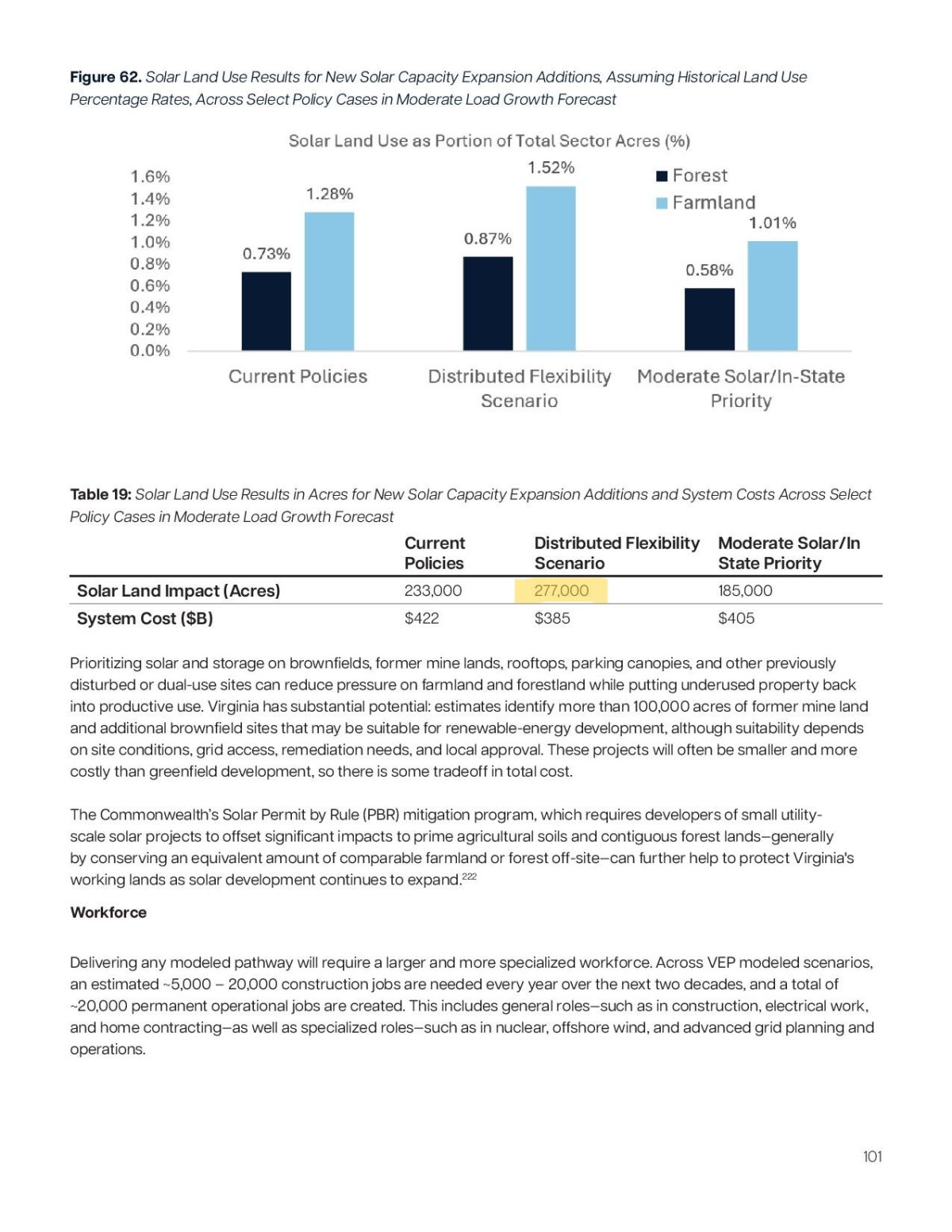
Page 101 elaborates on the scheme to cover almost 300,000 acres with hideous solar panels.
That comes under the table “Solar Land Use Results in Acres for New Solar Capacity Expansion Additions and System Costs Across Select Policy Cases in Moderate Load Growth Forecast.”
A “distributed flexibility scenario” measures the “solar land impact” in acres.
The plan envisions gobbling up 277,000 acres at a cost of $385 billion.
“Prioritizing solar and storage on brownfields, former mine lands, rooftops, parking canopies, and other previously disturbed or dual-use sites can reduce pressure on farmland and forestland while putting underused property back into productive use,” the plan says:
Virginia has substantial potential: estimates identify more than 100,000 acres of former mine land and additional brownfield sites that may be suitable for renewable-energy development, although suitability depends on site conditions, grid access, remediation needs, and local approval. These projects will often be smaller and more costly than greenfield development, so there is some tradeoff in total cost.
So even if the plan uses all 100,000 acres of the former mines and brownfield sites, 177,000 acres will still be required to place solar panels. Brownfield sites are on possibly contaminated land that is no longer used.
Reaction
WJLA rightly noted just how much land 277,000 acres is: “Fairfax County, Arlington County, and the City of Alexandria combined.” Virginia has just 30,000 acres of panels now, meaning Spanberger, a CIA Democrat, is quite the ambitious wannabe energy tycoon.
State Senator Glen Sturtevant (R) told the station that Spanberger’s daffy proposal isn’t an energy plan. “It’s really more of a data center growth plan that’s wrapped up in environmentally friendly packaging,” he said:
She wants to essentially carpet Virginia with another 300,000 acres of solar panels. The governor wants to increase what we already have by 10 times to be able to power these data centers. So it’s concerning for folks like me who have been calling for a data center moratorium in Virginia. We’ve got hundreds of data centers already. We’re the leading data center location, if not in the entire country, in the entire world, and the governor appears to not be putting the brakes on that development at all. …
Everyone understands as a matter of common sense that the solar panels aren’t effective when the sun isn’t out, and the windmills aren’t effective when the wind isn’t blowing.
The dismal economics of solar power preclude its being a cheaper, risk-free energy source, as Michael Shellenberger, who helped expose the Twitter Files, wrote for Forbes. In 2018, Shellenberger wrote that solar power produced more toxic waste than nuclear. He returned to the subject in 2021, noting that his conclusion invited a farrago of denunciation.
But the facts vindicated Shellenberger. “When reporters eventually looked into the issue they came to the same conclusions I had,” he wrote:
In 2019, The New York Times published a long article about toxic old solar panels and batteries causing “harm to people who scavenge recyclable materials by hand” in poor African communities. In 2020, Discover magazine confirmed that “it is often cheaper to discard them in landfills or send them to developing countries. As solar panels sit in dumps, the toxic metals they contain can leach out into the environment and possibly pose a public health hazard if they get into the groundwater supply.”
Then came the Harvard Business Review (HBR). It concluded “that the waste produced by solar panels will make electricity from solar panels four times more expensive than the world’s leading energy analysts thought,” Shellenberger wrote:
“The economics of solar,” write Atalay Atasu and Luk N. Van Wassenhove of Institut Européen d’Administration des Affaires, one of Europe’s leading business schools, and Serasu Duran of the University of Calgary, will “darken quickly as the industry sinks under the weight of its own trash.”
Federal subsidies won’t help the matter, HBR concluded. The panels will produce so much waste that by 2035, “discarded panels would outweigh new units sold by 2.56 times,” the writers concluded:
“In turn, this would catapult the LCOE (levelized cost of energy, a measure of the overall cost of an energy-producing asset over its lifetime) to four times the current projection.”
The solar industry, and even supposedly neutral energy agencies, grossly underestimated how much waste solar panels would produce.
Louisa County’s North Anna nuclear power plant produces 1.89 gigawatts of power per year and sits on 1,075 acres.
The Google AI search engine reports that producing the same 1.89 gigawatts of power would require anywhere from 9,450 to 13,230 acres of solar panels.