By The Rio Times | Created at 2026-09-18 08:22:03 | Updated at 2026-09-18 09:13:39
1 hour ago
By The Rio Times | Created at 2026-09-18 08:22:03 | Updated at 2026-09-18 09:13:39
1 hour ago
The LatAm Brief
One email, every weekday morning. What moved in Latin American markets, politics and expat life.
Yesterday’s subject line: “The Fed raised. Brazil cut, four hours later.”
Free. We send a confirmation link first — nothing arrives until you click it. Unsubscribe with one click in any edition. If you stop opening us for 30 days we stop sending by ourselves, as we assume the interest is no longer there. See our privacy policy. We never share your email.
Key Facts
- London zinc settled at US$3,888.70 a tonne, up 2.04%, after falling in each of the two previous sessions.
- Nexa Resources closed at US$12.92, a gain of 6.95%, recovering from a 4.28% fall the day before.
- Buenaventura rose 4.96% to US$34.71, with the Peruvian producer tracking both zinc and precious metals higher.
- Treatment charges paid to smelters have turned negative, the clearest signal that concentrate supply is tighter than smelting capacity.
- London warehouse inventories remain low by historical standards, and physical availability outside China is described as particularly tight.
- Peru is the world’s second-largest zinc producer, with Mexico and Bolivia both inside the global top ten.
Today’s Focus
Zinc rebounded on Thursday after two losing sessions. London zinc settled at US$3,888.70 a tonne, up 2.04%.
The equity response was far larger than the metal’s move. Nexa Resources rose 6.95% to US$12.92 and Buenaventura 4.96% to US$34.71.
Nexa had fallen 4.28% the day before, so part of Thursday was simple recovery. The rest was a repricing of the concentrate story.
Thursday also sat inside a strong day for mining equities generally. Copper, iron ore and precious metals names all rose alongside zinc.
That story is about ore rather than metal. Treatment charges paid to smelters for processing concentrate have turned negative.
A negative treatment charge means smelters are paying for the privilege of having something to smelt. It is the plainest possible signal of tight mine supply.
What matters today. Negative treatment charges are a mine-supply signal, not a demand signal. That is what separates this rally from an ordinary metals bounce.
One-stop reference
Company Intelligence
Every listed company in Latin America — financials, ownership and structure for 1,450+ companies across 26 exchanges, in one place.
01 The session in one read
Thursday was a rebound rather than a breakout. Zinc had fallen in each of the two preceding sessions and recovered most of that ground in one.
The size of the equity moves is what makes it interesting. A two percent move in the metal produced a seven percent move in Nexa.
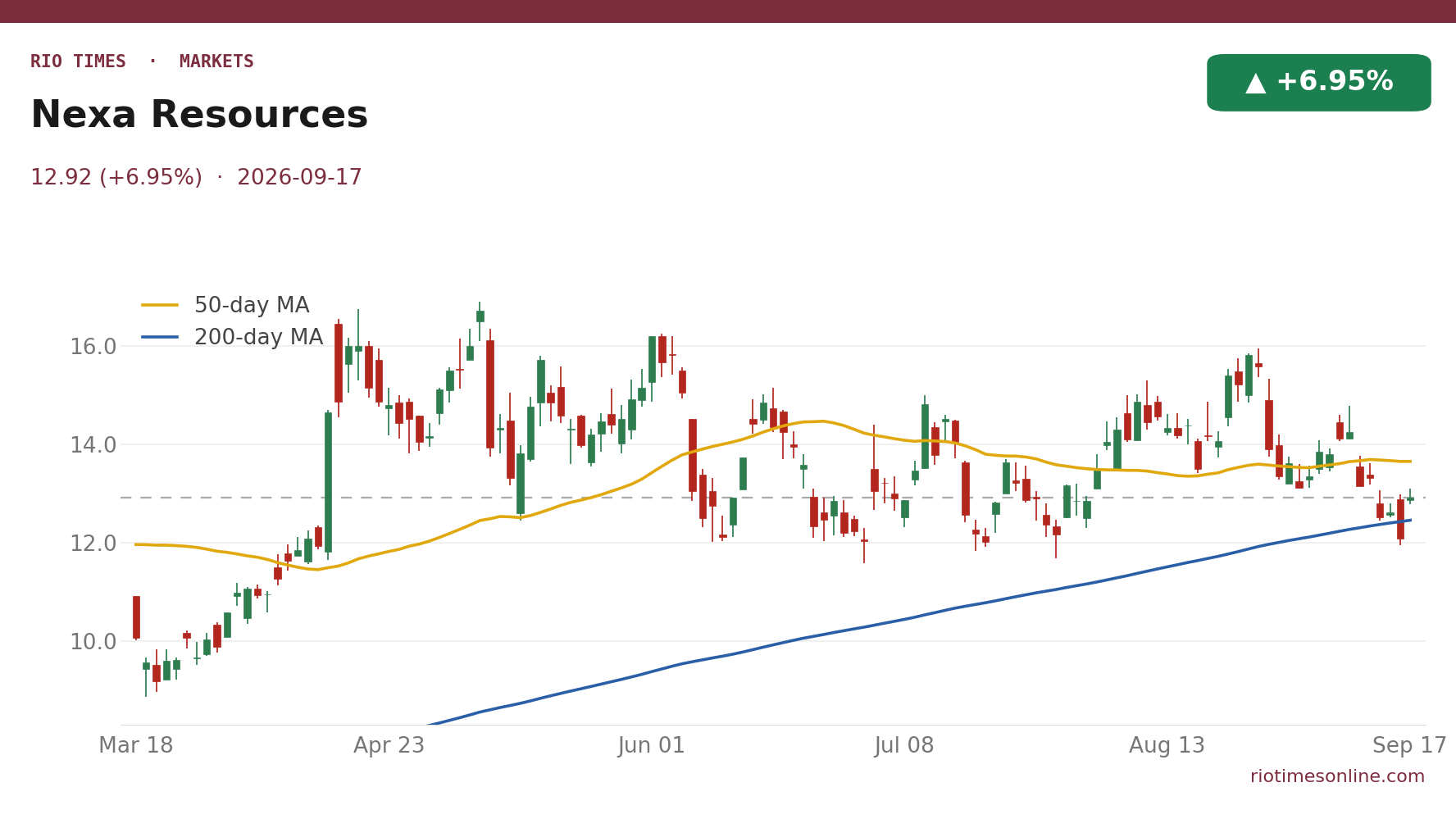
Nexa’s shares have been volatile through September without establishing a trend. Thursday’s gain took the stock back above its level at the start of the week.
That volatility is normal for a mid-cap miner with operating leverage. Small changes in the metal price move earnings by much more.
02 The board
| London zinc (per tonne) | US$3,888.70 | +2.04% | Rebound after two losing sessions |
| Nexa Resources (NEXA) | US$12.92 | +6.95% | Recovers a 4.28% fall the day before |
| Buenaventura (BVN) | US$34.71 | +4.96% | Peruvian polymetallic producer |
| Treatment charges | Negative | — | Smelters competing for scarce concentrate |
| London inventories | Low | — | Below historical norms for this point in the year |
| Silver (per ounce) | US$65.43 | +3.44% | Buenaventura also has precious metals exposure |
The two figures without numbers are the important ones. Negative treatment charges and low inventories describe a market short of raw material.
Buenaventura’s gain has two drivers rather than one. It produces silver and gold alongside base metals, and both rose sharply on Thursday.
03 What moved it
Concentrate supply is the binding constraint in zinc this year. Mine output has fallen short of smelting capacity, and disruptions have made the gap worse.
Treatment charges are the price smelters receive for turning concentrate into metal. When they turn negative, smelters are effectively bidding for ore.
London inventories are low by historical standards and physical availability outside China is described as particularly tight. That combination supports the price independently of demand.
None of that changed on Thursday. What changed was that the market stopped selling for two days and remembered the structural position.
04 The Latin American read
Peru is the world’s second-largest zinc producer after China. Mexico and Bolivia are both inside the global top ten.
That makes the region unusually exposed to a concentrate squeeze. When ore is scarce, the countries that mine it capture more of the value chain.
Nexa is the clearest listed expression of that position. It mines in both Peru and Brazil and owns the smelters that process the output.
Its operations run from Cerro Lindo, El Porvenir and Atacocha in Peru to Vazante and Aripuanã in Brazil. The smelters are Cajamarquilla in Peru and Três Marias and Juiz de Fora in Brazil.
05 The names to watch
Nexa is the pure play and moved accordingly, gaining almost seven percent. Its integrated model means it captures both the mining and the smelting margin.
Buenaventura is the diversified alternative. Zinc is one of several metals it produces, which dampens the swings in either direction.
Grupo México and Southern Copper produce zinc as a by-product of copper. Neither is a zinc trade, but both benefit at the margin.
Bolivian production is largely unlisted. It reaches investors through trade data and government revenue rather than through equity.
06 The outlook
The concentrate shortage is a supply story and supply stories take years to resolve. New mines take five to ten years from discovery to production.
That argues for a floor under the price rather than a ceiling. It does not argue for a straight line, as the two preceding sessions showed.
Demand remains the uncertainty. Zinc goes overwhelmingly into galvanised steel, which means construction, which means China.
Chinese steel futures rose on Thursday on pre-holiday restocking. That helps zinc in the short run and says little about the months after October.
The metal is a regional revenue question as much as a mining one. Peruvian and Bolivian export receipts move with the concentrate price rather than the refined one.
That distinction is easy to lose when reading a London settlement. The tightness sits upstream of the exchange, in ore that never reaches a warehouse.
07 What to watch
- Treatment charges: Negative charges are the single clearest measure of how tight concentrate supply has become.
- London inventories: Stocks are already low for the time of year, and further falls would tighten the market again.
- Nexa against the metal: A seven percent equity move on a two percent metal move shows how much operating leverage the stock carries.
- Chinese galvanised steel demand: Zinc’s end market is construction, so Chinese steel output is the demand signal to follow.
- Buenaventura’s precious metals: Silver rose 3.44% on Thursday, so part of the gain was not a zinc story at all.
Frequently Asked Questions
How much did zinc rise on 17 September 2026?
London zinc settled at US$3,888.70 a tonne, up 2.04%. It had fallen in each of the two previous sessions.
Why did Nexa Resources jump almost seven percent?
Nexa rose 6.95% to US$12.92, recovering a 4.28% fall the day before and repricing tight concentrate supply. Mid-cap miners carry high operating leverage to the metal price.
What are treatment charges and why do they matter?
They are the fee smelters receive for processing concentrate into metal. Negative charges mean smelters are effectively paying for ore, which signals a severe shortage of mine supply.
Where does Nexa Resources operate?
It mines at Cerro Lindo, El Porvenir and Atacocha in Peru and at Vazante and Aripuanã in Brazil. Its smelters are Cajamarquilla, Três Marias and Juiz de Fora.
Which Latin American countries produce zinc?
Peru is the world’s second-largest producer after China. Mexico and Bolivia are both inside the global top ten.
Why did Buenaventura rise?
It gained 4.96% to US$34.71 on a combination of zinc and precious metals. Silver rose 3.44% on the same session.
Sources: RT end-of-day series for NEXA and BVN; Trading Economics for the London zinc settlement, inventories and treatment-charge commentary; Nexa Resources corporate guidance for the asset list; Rio Times prior-session reports for the preceding falls.
This article was produced by The Rio Times’ automated newsroom system. How we use AI · Report an error
LatAm Markets: Live Signals → — real-time movers, turnover leaders and FX across Latin America.
The Rio Times · Power Map
See who really holds power in Latin America
Click to open the Power Map →