By Literary Hub | Created at 2026-09-03 09:42:41 | Updated at 2026-09-30 23:13:22
3 weeks ago
By Literary Hub | Created at 2026-09-03 09:42:41 | Updated at 2026-09-30 23:13:22
3 weeks ago
Our bevy of brilliant reviews this week includes Dwight Garner on Marlon James’s The Disappearers, Kate Tuttle on John Dos Passos’s U.S.A. trilogy, Parul Sehgal on Rachel Cusk’s The Life of M, Laura Miller on Kai Bird’s American Scoundrel, and Alexandra Harris on Colm Tóibín’s The Bridge.
Brought to you by Book Marks, Lit Hub’s home for book reviews.
*
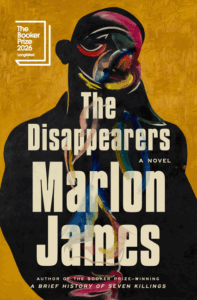
“In the souk that is contemporary publishing, much attention has gone recently to the minimalists and the tinkerers, to writers of short novels steeped in irony. It’s been a meal of small plates, reflective of short attention spans.
The Jamaican writer Marlon James’s new novel, The Disappearers, at 600-plus pages, is instead a maximalist’s banquet: It is humane, blood-flecked, disturbing and sustaining. It takes James 90 pages to say hello. It’s another 70 pages before his story settles into your guts and begins to twist them. It’s yet another 150 before you fully comprehend his loping authority and the scale of his ambitions. Booster rockets fall away. Disparate coordinates begin to converge.
Why not just say it? With this novel about gay experience and murderous homophobia in Jamaica and elsewhere during the 1980s and ’90s, James has written a masterpiece, the novel of the decade and possibly of the century thus far.
It deserves to be talked about alongside Salman Rushdie’s Midnight’s Children, for its tumult of language and its crisscrossing post-colonial themes; Toni Morrison’s Song of Solomon (James picks up on a revenge scenario from that novel); and William Faulkner’s Absalom, Absalom!—the greatest American novel, I’d argue—for many reasons but especially for the way James, like Faulkner, hammers his themes like a Vulcan, rolling over them relentlessly from new and sometimes oblique angles, advancing and enlarging his attack each time. This is another way of saying The Disappearers was one of the signal reading experiences of my adult life. It sank knives deep into my heart. I’m still in recovery from it.
…
“This novel is related in coarse, blunt and wired language: the darker vocabularies we hold back. It’s a hard book to talk about in a family newspaper. One feels like Norman Mailer coerced into using the fig-leaf term ‘fug’ in The Naked and the Dead, or the street gang member in West Side Story who shouts at Officer Krupke, ‘Krup you!’ I suppose you could call James’s language slang, which Carl Sandburg described as ‘language that rolls up its sleeves, spits on its hands and goes to work.’ But hands are not what is spat upon here.
…
“Patricia Highsmith, whose baleful influence is felt in this novel, wrote that ‘because of what they have been through, all homosexuals are blood brothers across time.’ James, a long-haul trucker of the human spirit, carves that notion into his novel’s chest. You don’t finish The Disappearers. It finishes you.”
–Dwight Garner on Marlon James’ The Disappearers (The New York Times)
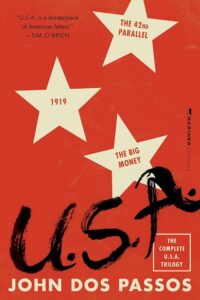
“If there were ever a work that deserved the phrase ‘more than the sum of its parts,’ it would be this series of novels—The 42nd Parallel (1930), 1919 (1932), and The Big Money (1936)—written as the nation spun into and then slogged through the Great Depression. They are set earlier, covering the birth of the 20th century to the crash of the stock market, and they are about, oh, everything.
“Ambition is a funny word to book reviewers, who tend to use it as almost an insult. It almost always appears in a sentence that goes on to list the ways an author’s reach exceeds her grasp, and many of the novels we praise the most these days are never in danger of that. Neat and tidy is hard enough to do, and there is great satisfaction in novels that paint a small picture with elegance and control. “U.S.A” is not that kind of book, not in the least.
…
“These characters, whether rich or poor, are rendered in the naturalistic style of fellow American novelists like Theodore Dreiser and Sinclair Lewis—they don’t have the tortured interiority we’ve come to associate with the literary novel, but we see them face the dilemmas of their generation, striving for economic security as American capitalism grinds up workers and proclaims its riches at the same time. Dos Passos created characters to illustrate the contradictions he saw painfully in his own life as both American insider and outsider: a speculative economy that promoted a growing wealth gap, flagrant racism, war as a tool for economic growth, the founders’ ideals twisted to punish anyone advocating for free speech (in one early scene, a young man is hauled away by the cops for reading the Declaration of Independence on a soapbox).
…
“Dos Passos wrote more politically than any other modernist, and more vividly than any other political novelist. At its best, the trilogy hums with this dual energy, acerbic and absurdist, as when he recalls being a teenager in Europe during WWI: ‘up north they were dying in the mud and the trenches but business was good in Bordeaux and the winegrowers and the shipping agents and the munitionsmakers crowded into the Chapon Fin and ate ortolans and mushrooms and truffles…’ It’s impossible to read the trilogy now without seeing the abundant parallels to our own century.”
–Kate Tuttle on John Dos Passos’ U.S.A. trilogy (The Boston Globe)

“By now, the roman à clef, as a genre, tends to provoke a set of familiar, slightly stale debates: Who owns the facts of a life? What is the relationship between artifice and reality, license and theft? What immunities does the artist possess, what does she claim? And my own question, plaintively: Must we? Yet again? Can we agree that there are no definitive answers (but we promise to settle the issue once and for all the next time this debate rolls around)?
One doesn’t want to trade in generalities, not when it comes to this case; it is Cusk one wants to talk about, the particular and thorny ire she inspires, and the spirited defense. She keeps finding herself here, struggling to defend her work and eliciting such articles. In a recent interview with The New York Times, Cusk insisted that she hadn’t expected any controversy, as blankly as Buster Keaton might mug for the camera before stepping on a rake. How, then, are we to understand her particular talent for trouble?
I once heard Cusk speak in Paris, at the sort of literary event she is famous for skewering—those parades of authorly self-commodification. She spoke haltingly, weighing her words, and then suddenly veered off, into an odd tangent. She envied those who perform menial work. Bus drivers, for example. Imagine the simplicity of those lives, I recall her saying—’to go home and be done with work for the day.’ I copied down her words, marveling at the condescension. She had lost the room and seemed to know it. She vaped discreetly and slumped a little in her chair. ‘Life hasn’t been very fun for me.’
…
“Life of M is a lost little book—undisciplined, unfocused and instantly forgettable. The New Yorker deemed it Cusk’s ‘weakest novel.’ The true faults with the book turn out to be less ethical than technical. Cusk may have jettisoned the conventional narrative lumber of character and scene, but she replaced them with a series of pieties and poses all her own that, with time, have started to feel strained, the characters who sound the same and speak in portentous tones about fate and chance, the fetishistic descriptions of interiors, the inexplicable shifts in point of view.
…
“Cusk is curiously invested in portraying herself as an outcast and controversial figure. As the critic Clair Wills noted in a review of Coventry: ‘There is so much in these essays about being disliked—by her parents, by her readers, by her ex-husband, by her friends—that this performance of being shunned itself calls out for interrogation. We could interpret her insistence on her own unpopularity as proof of her worth. The more people complain about her, the more “true” she is being.’ To such an artist, any scandal becomes proof that she has struck gold, illuminated an unarticulated conflict and paid the valiant price. Persecution becomes proof of integrity.”
–Parul Sehgal on Rachel Cusk’s Life of M (The New York Times Magazine)
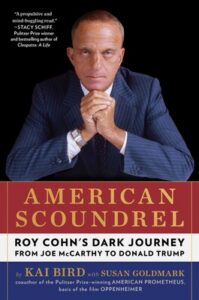
“The book—written by Bird but co-authored with his wife, Susan Goldmark, whom he credits with doing a sizable amount of the research—is a bounteous cornucopia of midcentury sleaze and uneasily addictive for just that reason. It’s got Mafia hits and frame jobs and blackmail and bribery and election tampering. It’s got forgery and insurance scams and perjury and espionage and sex trafficking and a lot of tax evasion. It makes James Ellroy novels look like Theo of Golden by comparison, and it makes for mesmerizing reading.
…
“Bird argues that Cohn set the pattern for an angry, resentful, yet hypocritical populism to rise to power in the form of Donald Trump. Cohn, like McCarthy, saw himself as an enemy of the establishment that Bird usually chronicles, what one rich demagogue quoted in American Scoundrel reviled as ‘the socially pedigreed, the culturally acceptable, the certified gentlemen and scholars of the day, dripping with college degrees.’ Never mind that Cohn, like Trump, relished his wealth and rubbing shoulders with the famous and powerful. Both recast their riche v. nouveau riche battles as a crusade on behalf of the working class, and many people, astonishingly, have fallen for it.
‘His values, his unethical behavior, and his political mindset have survived and replaced the values of the establishment he so resented,’ Bird writes of Cohn. ‘Certainly, he gave us the narcissistic politics of Donald Trump.’ As ugly and lurid as this saga is, American Scoundrel is consistently riveting, full of astonishing twists, ballsy plots, and eleventh-hour escapes from justice, like the legal version of the exploits of some Old West outlaw who is forever eluding the sheriffs by the skin of his teeth. It’s hard not to be impressed as well as horrified. Americans have long harbored a sneaking admiration for people who buck the system, who get to make their own rules instead of having rules imposed on them. It makes for a great story. Until, that is, we finally recognize that the real enemy and the ultimate loser in this scenario isn’t the system, but ourselves.”
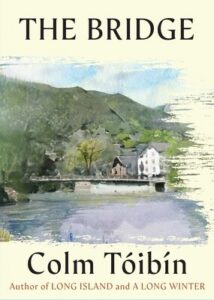
“Tóibín’s relationship with Catalonia now spans five decades. His first novel was set in Barcelona; his latest collection, The News from Dublin, includes several fine Spanish stories. He spends part of each year in the mountains near Llavorsí, and in writing about Miquel he is thinking his way into lives that have unfolded in that long known yet hardly knowable place. The germ of Miquel’s story came in a particular glimpse of local history. Tóibín was told that a ruined building was all that remained of the house where a woman once grew desperate enough to walk away from her family. It was said that the snow came; it was said to be a terrible tale. A Long Winter and The Bridge have grown from that beginning.
Tóibín responds powerfully to the qualities of exactitude and seriousness he finds in Catalan writing, in the work of Mercè Rodereda for instance, and these are very much qualities of The Bridge. We know that Miquel feels deeply, but nothing in his life has licensed or recommended the articulation of personal emotion. Tóibín practises a sustained reticence, even as fate strikes so cruelly as to give this story an absurdist edge.
Readers of Brooklyn and its follow-up Long Island will know that Tóibín has careful ways of handling a sequel: those novels are both richly complete in themselves while opening depths in each other. The Bridge, too, works alone or as part of a pair. To read A Long Winter afterwards, meeting the past that crouches in the shadows of the later story, would be as absorbing as to read chronologically. A further instalment seems possible. Any change would be welcome to lift Miquel from stultifying conditions, though it’s unlikely to offer much relief.
This is the kind of small volume temptingly piled by the checkouts at Christmas. I wouldn’t recommend it as a stocking-filler; the stocking would fall to the floor with the weight of sorrow. But this is a memorable short work in which Tóibín’s unsentimental prose is flawlessly matched to the austere worlds of people enduring, in their different ways, lives stripped back to the bone.”
–Alexandra Harris on Colm Tóibín’s The Bridge (The Guardian)