 By The War Zone | Created at 2026-06-23 19:54:19 | Updated at 2026-06-23 20:48:39
1 hour ago
By The War Zone | Created at 2026-06-23 19:54:19 | Updated at 2026-06-23 20:48:39
1 hour ago
The TWZ Newsletter
Weekly insights and analysis on the latest developments in military technology, strategy, and foreign policy.
The U.S. military has released new details about the massive Fightertown Recapitalization (FTR) program at Joint Base Elmendorf-Richardson (JBER), in Anchorage, southeastern Alaska. This is a huge effort valued at approximately $7 billion that would effectively create an entirely new fighter hub to support future Air Force operations in the strategically important Arctic and Pacific regions.
The details emerged in a special notice announcing an upcoming virtual industry day, where government officials plan to brief contractors on the scope of the program and gather feedback on construction risks, industry capabilities, and acquisition strategies before moving toward a formal procurement process.
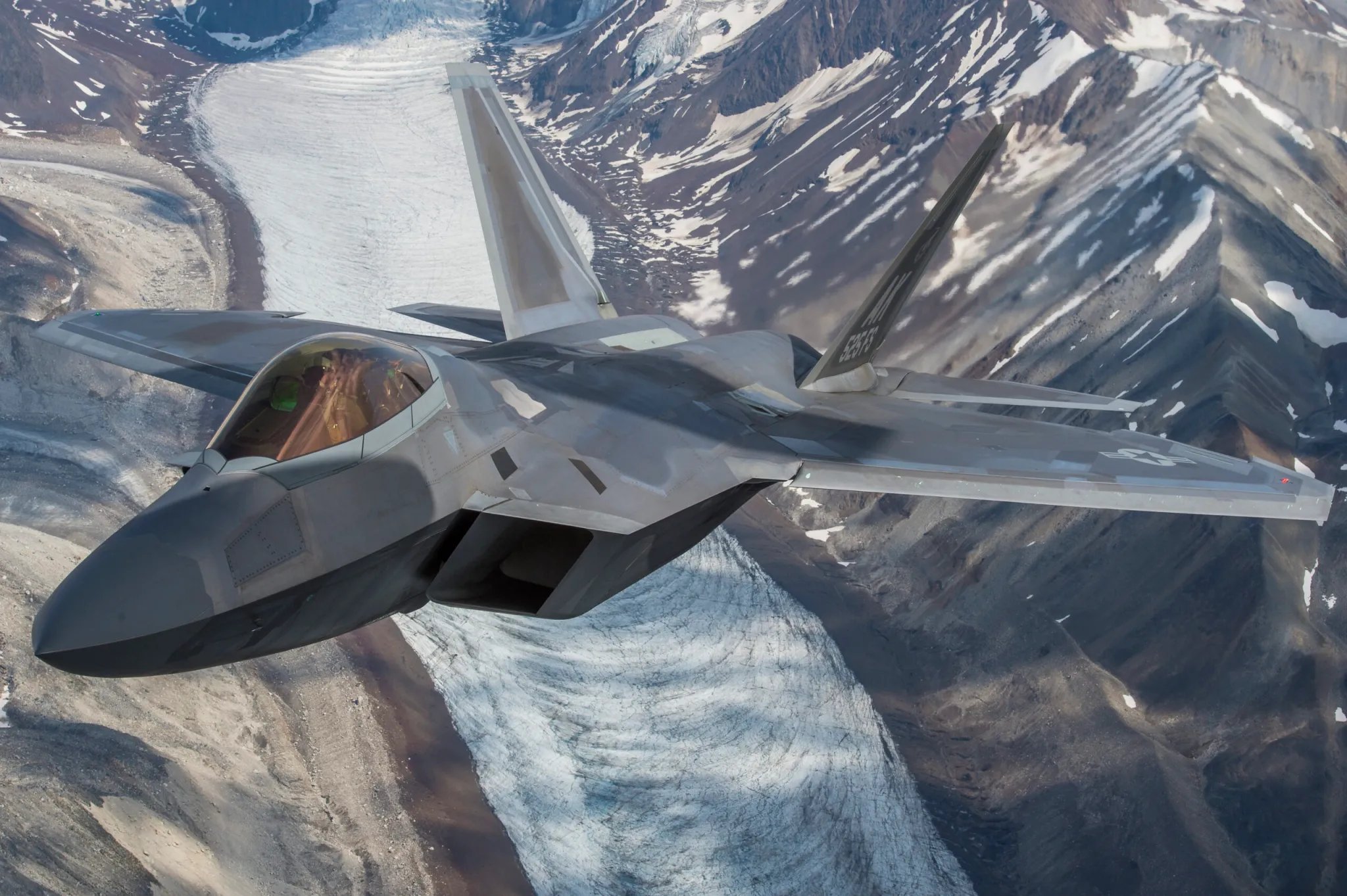 A U.S. Air Force F-22 Raptor from Joint Base Elmendorf-Richardson flies over the Joint Pacific Alaska Range Complex. U.S. Air Force photo by Staff Sgt. James Richardson
 While the notice, from the U.S. Army Corps of Engineers, is intended primarily as market research, it offers one of the clearest looks yet at the scale and ambition of the Fightertown recapitalization effort.
According to the notice, existing airfield facilities cannot support the program’s requirements, prompting the selection of a new site to expand the current airfield infrastructure. Rather than a collection of isolated projects, the government describes the effort as a “complete campus approach” intended to synchronize facility construction with aircraft procurement, personnel movements, and logistical requirements.
The envisioned campus would include aircraft hangars, squadron operations facilities, corrosion control facilities, maintenance shops, and other aviation support infrastructure. Extensive airfield improvements are also planned, including new taxiways, aprons, shoulders, and specialized aircraft operating surfaces.
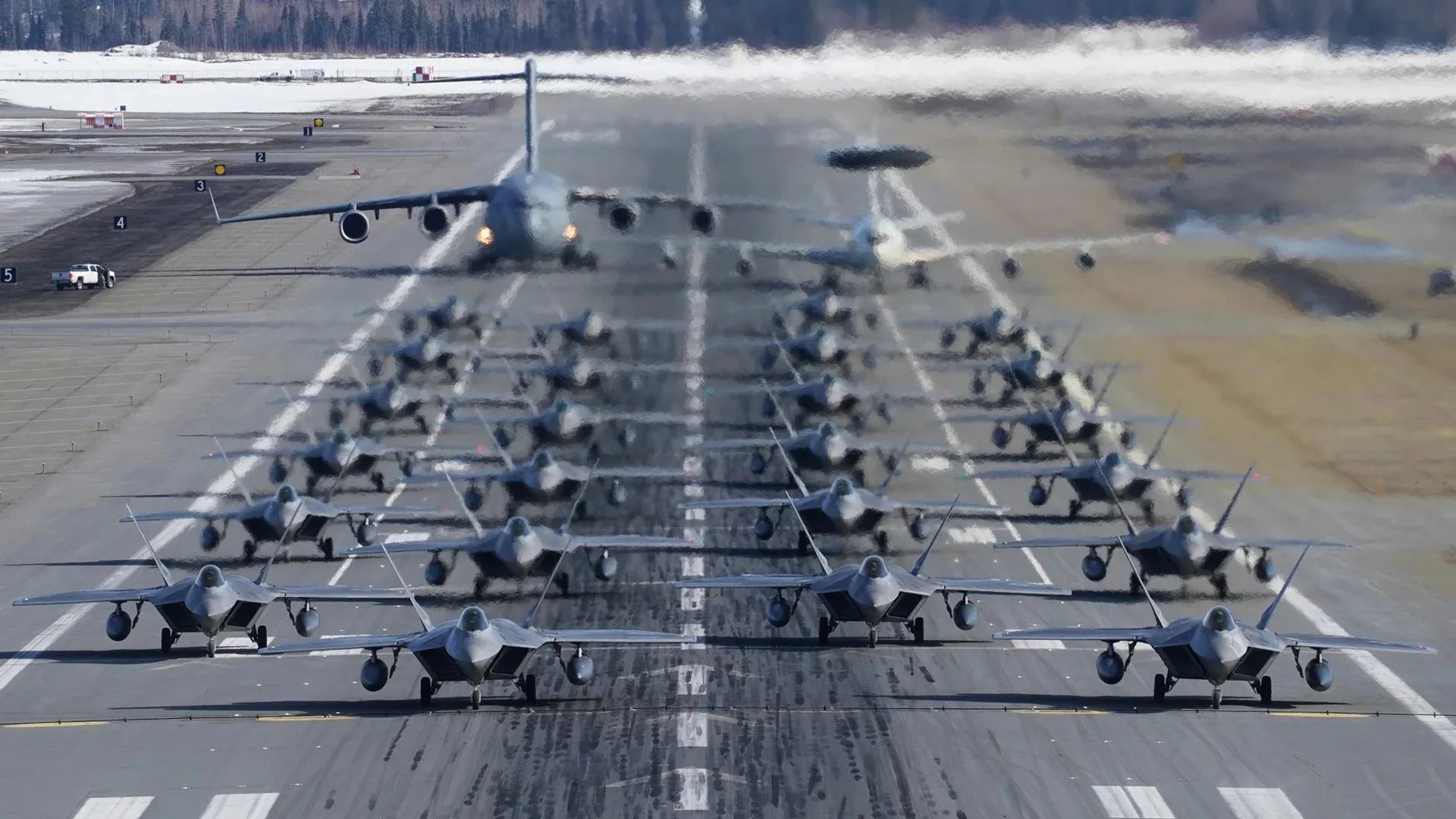 A picture of a so-called “elephant walk” readiness exercise at Joint Base Elmendorf-Richardson showing 24 of the resident 3rd Wing’s F-22s, as well as a C-17 and an E-3. U.S. Air Force
 Highly likely to be included in the recapitalization efforts will be measures to help reduce vulnerability and ensure critical operations could continue in wartime. After all, in a potential fight against China or Russia, JBER would be high on the list of priority targets in the opening phases of a large-scale conflict. As we have repeatedly outlined in the past, aircraft shelters with varying degrees of hardening are suddenly very much back on the agenda in response to growing drone and missile threats.
Beyond flight-line infrastructure, the project encompasses a substantial support ecosystem. Plans call for a munitions complex, petroleum operations facilities, warehousing and supply functions, dining facilities, visitor control infrastructure, firefighting facilities, training centers, simulators, and housing for unaccompanied airmen.
The government also notes that the campus design remains flexible and could ultimately involve modifications to, or demolition of, existing facilities as planning progresses.
Rather than relying solely on traditional military construction contracting approaches, the Army Corps of Engineers says the program intends to leverage authorities provided in the Fiscal Year 2026 National Defense Authorization Act. Those authorities could allow the use of Other Transaction Authority (OTA), Progressive Design-Build (PDB), and other alternative execution methods.
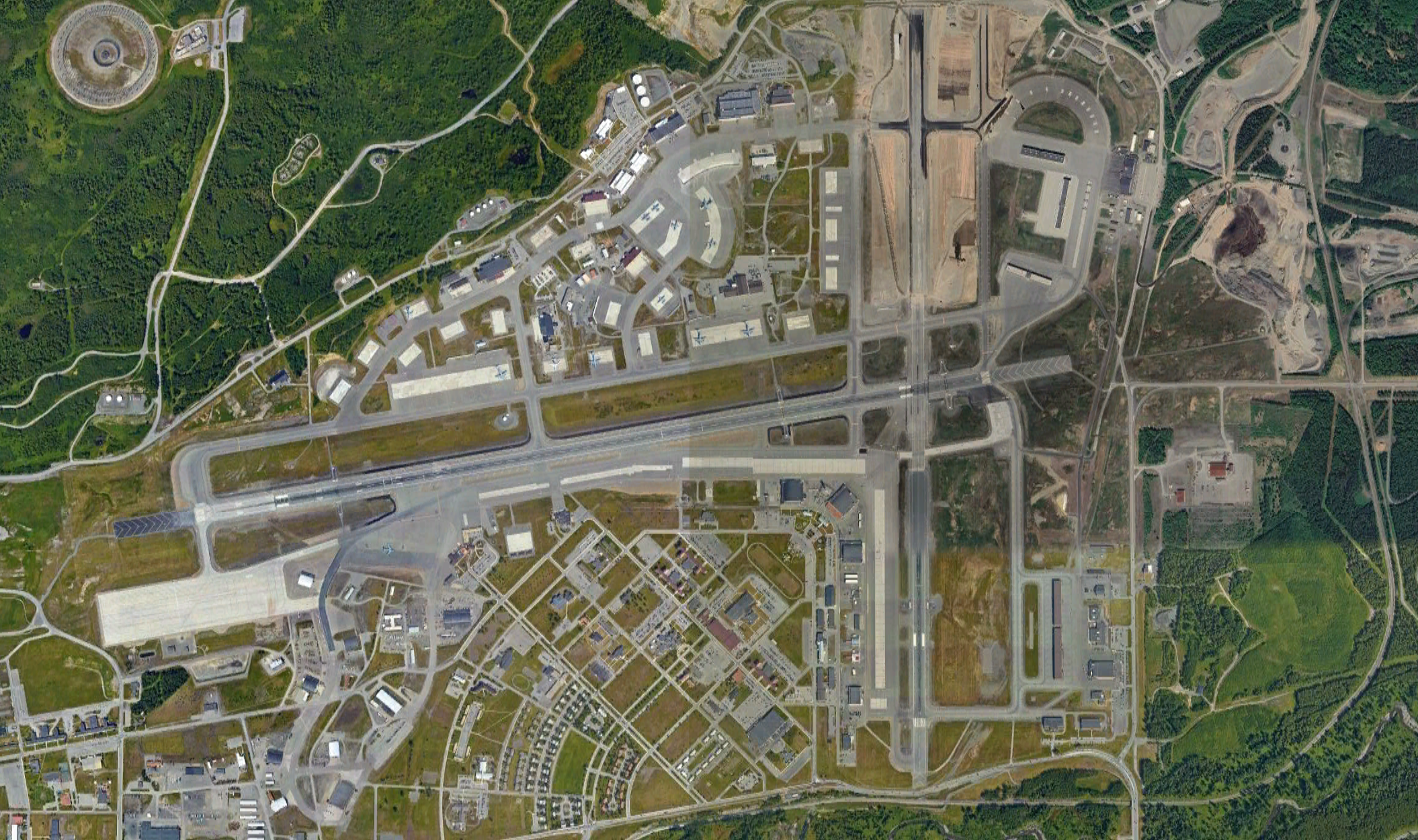 The sprawling Joint Base Elmendorf-Richardson (JBER), in Anchorage, southeastern Alaska, as seen in a satellite image from May of this year. Google Earth
 The notice explicitly states that the government intends to capitalize on private-sector innovation while avoiding what it describes as costly and time-consuming federal contracting burdens. It also emphasizes that the execution strategy will encourage industry partners to propose novel technical and construction solutions.
The scale of the investment underscores Alaska’s growing importance as a hub for U.S. airpower. JBER already serves as one of the Air Force’s premier fighter installations and occupies a critical geographic position between North America, the Arctic, a part of the world that has only grown in strategic significance in recent years, and the Indo-Pacific theater, where strategic planning is highly focused on a potential future conflict with China.
Joint Base Elmendorf-Richardson hosts the headquarters of the 11th Air Force, the service’s top command in Alaska, and its 3rd Wing, which operates a mix of F-22 Raptor stealth fighters, E-3 Sentry Airborne Warning Control System (AWACS) radar planes, C-17 Globemaster III airlifters, and C-12 light utility aircraft. It is also home to the Alaska Air National Guard’s 176th Wing, which has additional C-17s, as well as HC-130 Combat King rescue aircraft and HH-60 rescue helicopters.
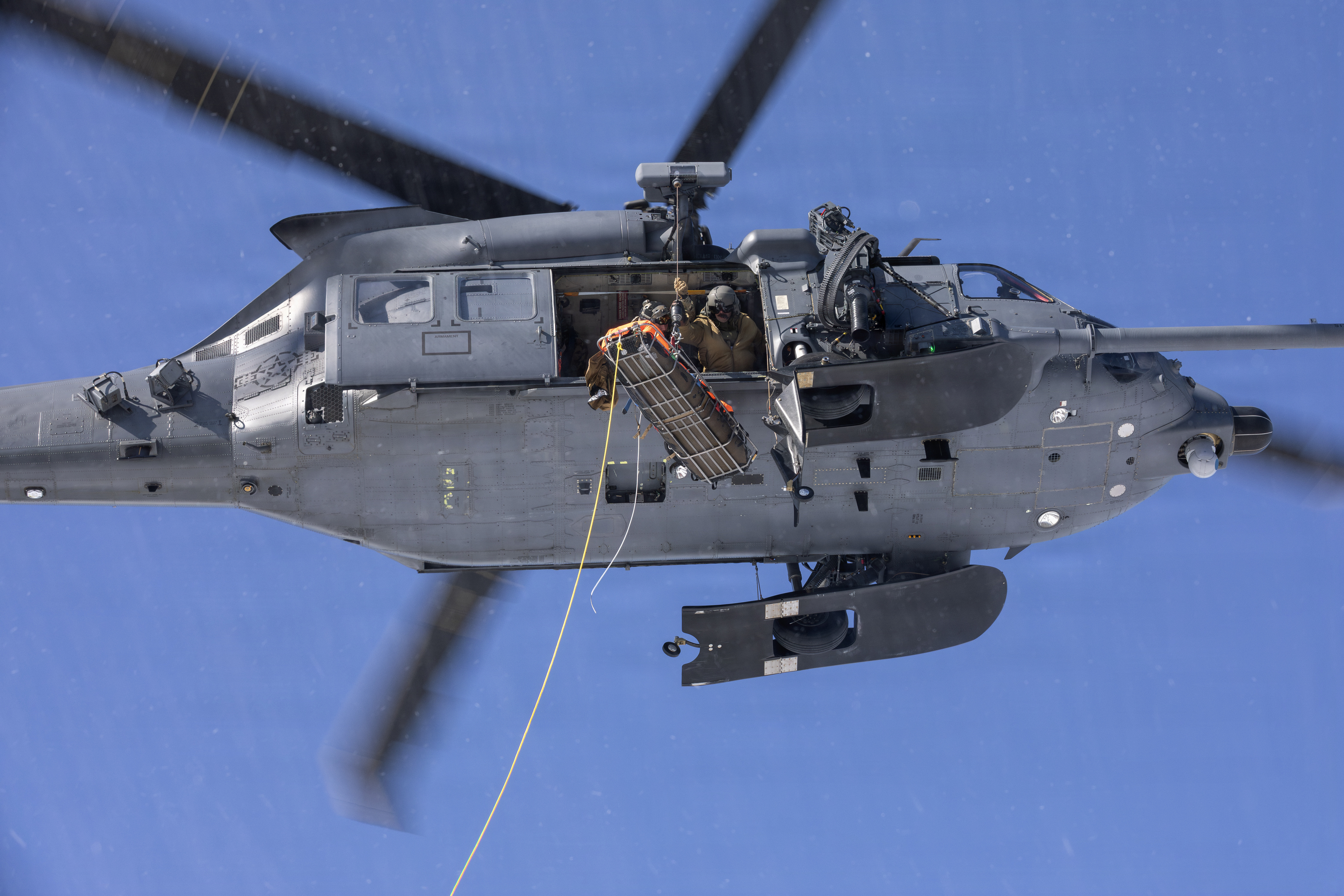 HH-60W Jolly Green II helicopter aircrew assigned to the 210th Rescue Squadron, 176th Wing, Alaska Air National Guard, hoist a simulated downed pilot during a full mission profile training exercise at Malemute Drop Zone, Joint Base Elmendorf-Richardson, Alaska, March 31, 2026. Alaska National Guard photo by Alejandro Peña
 In addition, in 2023, the Air Force announced the creation of the 55th Operations Group, Detachment 1 at the base, as a detachment of the 55th Wing at Offutt Air Force Base in Nebraska.
“The new detachment will… serve as a strategic launch and recovery point for RC-135V/W Rivet Joint operations and exercises in the region,” according to the Air Force.
The move reflected increased demand for RC-135V/W Rivet Joint spy plane sorties in the Pacific, with JBER being well-positioned for these aircraft to gather intelligence on areas of interest in the northern end of the Pacific and the increasingly strategic Arctic region.
The arrival of the Rivet Joint prompted a previous reconstruction effort at JBER. In what the Air Force described as a “mega-project,” one of the two runways there was extended to help it better support operations involving larger aircraft like these.
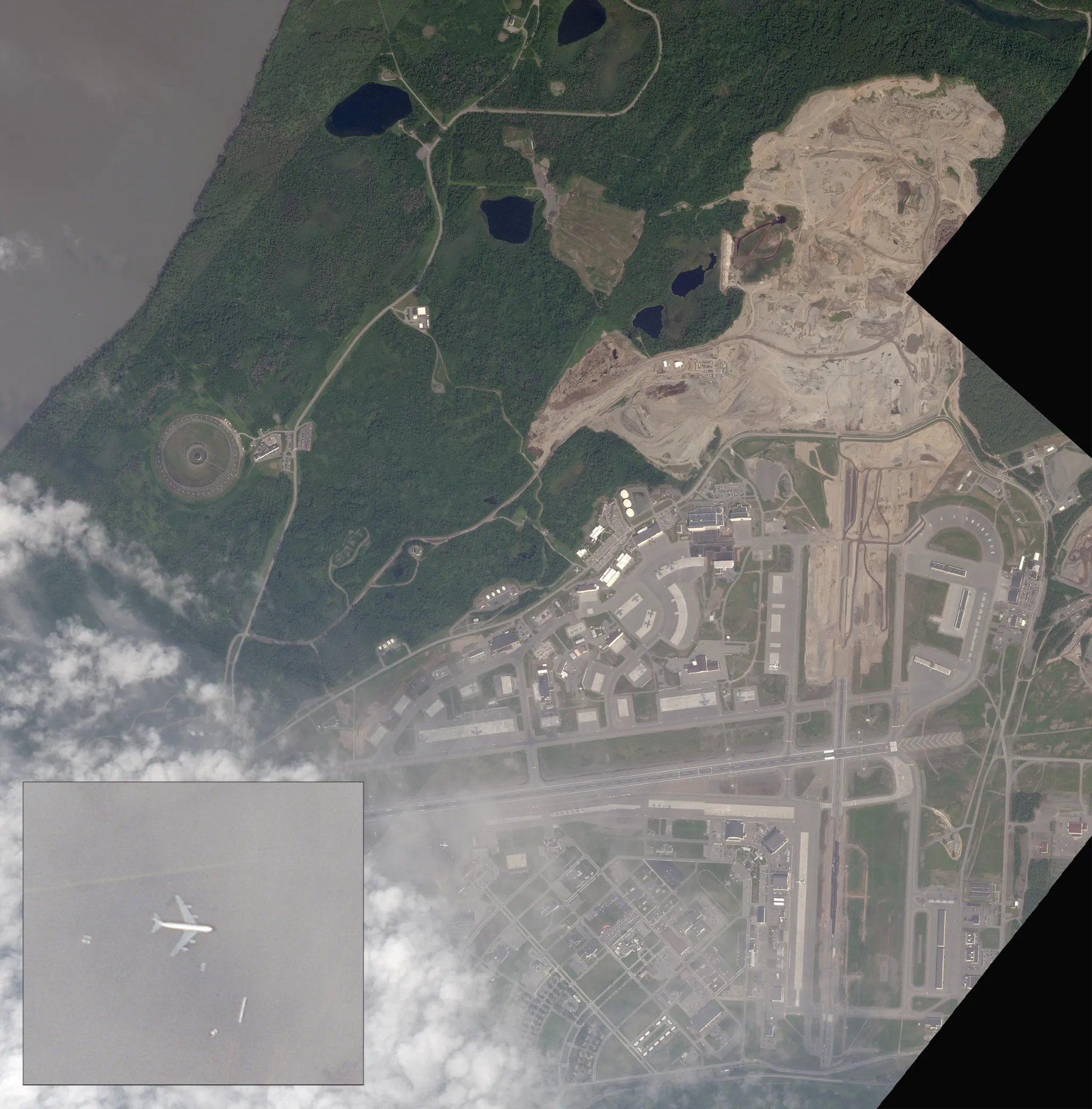 A satellite image of Elmendorf Air Force Base taken in July 2023. Evidence of the runway extension “mega-project” is plainly visible at the northeastern end of the base. You can see an RC-135 Rivet Joint sitting on the southwest ramp area as well. PHOTO © 2023 PLANET LABS INC. ALL RIGHTS RESERVED. REPRINTED BY PERMISSION
 In the future, the strategic location of JBER, as well as its current status as one of the few F-22 bases, suggests that it could well eventually host the F-47 sixth-generation stealth fighter, the first of which is expected to make its first flight sometime in 2028. The F-47 could therefore well end up as the centerpiece of the Alaskan Fightertown, in keeping with the vision for the jet serving as a critical force multiplier that can bring together other crewed and uncrewed assets. With that in mind, at least some of the Fightertown Recapitalization program may be specifically tailored to the requirements of the F-47.
Importantly, JBER also serves as the focal point for the Red Flag-Alaska and Northern Edge exercises.
The Red Flag-Alaska exercises can take place up to four times a year and mirror those flown over the Nellis Range Complex in Nevada, with some differences. Namely, the ranges in Alaska, many of which are instrumented, are enormous, and can include a more varied array of assets.
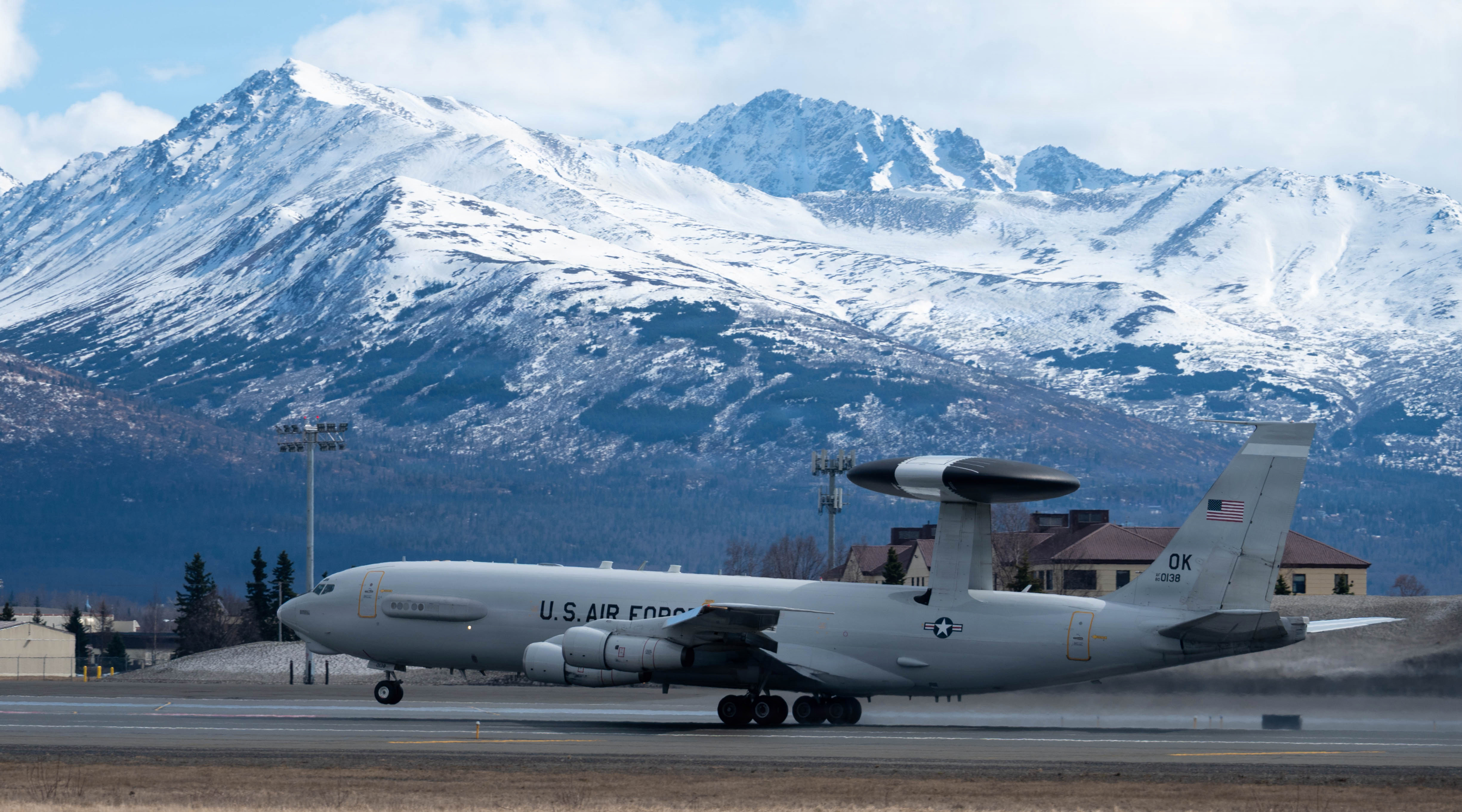 A U.S. Air Force E-3 Sentry takes off during exercise Red Flag Alaska 26-1 at Joint Base Elmendorf-Richardson, Alaska, April 29, 2026. U.S. Air Force photo by Tech. Sgt. Joseph Miller
 From JBER and other bases in the region, Red Flag-Alaska participants have access to the Joint Pacific Alaska Range Complex (JPARC). Covering an area of more than 67,000 square miles and providing 77,000 square miles of airspace above, JPARC is the “largest instrumented air, ground and electronic combat training range in the world,” according to the Air Force. It is regularly used to provide a realistic training environment for full-spectrum engagements, ranging from individual skills to large-scale joint engagements.
JPARC’s role could grow further in the coming years as the Air Force pushes large-scale exercises further and further out into the broad expanses of the Pacific. Other range complexes further down along the West Coast are seeing increasing use, as well. Even very large overland ranges, such as the sprawling Nevada Test and Training Range (NTTR) adjacent to Nellis Air Force Base, are increasingly constrained when attempting to replicate modern scenarios based on ever-growing adversary anti-access and aerial denial (A2/AD) bubbles.
Meanwhile, Northern Edge also occurs in and around Alaska every two years, with these large-scale events being used to test and evaluate new systems and capabilities from across the U.S. military.
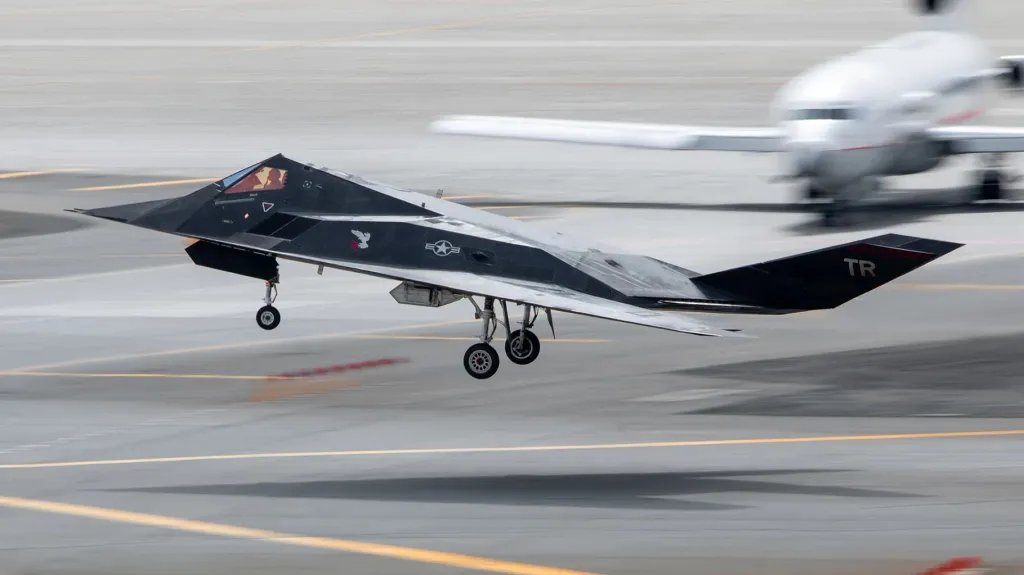 One of the Air Force’s tiny force of semi-retired F-117 Nighthawk stealth jets, now used for test and evaluation purposes, at Elmendorf during Northern Edge 2023. U.S. Air Force
 In the past, the Air Force has described Northern Edge as a demonstration of “the U.S. commitment to the region by building interoperability, advancing common interests and a commitment to our allies and partners in ensuring a free and open Indo-Pacific,” as well as showcasing U.S. ability to defend the homeland from and throughout Alaska.
As planning advances, we will learn more about what this new Alaskan Fightertown will look like. What is already clear is that the Air Force and the Pentagon are preparing for a long-term expansion and modernization effort on a scale rarely seen at an operational fighter base.
More details could emerge during the industry day scheduled for June 30, when government officials will provide a comprehensive update on the program and solicit feedback from industry partners on how to execute one of the Air Force’s biggest military infrastructure projects.
Update: 3:45 PM ET –
“We are deliberately investing in Pacific Air Force’s critical infrastructure by replacing and upgrading operations and maintenance facilities in addition to making repairs to existing buildings and funding mission-ready materiel, storage, and sustainment necessary for homeland defense and Agile Combat Employment operations,” a U.S. Air Force official has now told us in response to our queries for more information about the Fightertown plan. “We are also extending the runway and building a Joint Integrated Test and Training Center at JBER.”
“We are in the design stage now and will have a better idea of timelines once we receive an appropriation,” they added.
Contact the author: [email protected]