 By GB News (World News) | Created at 2026-10-06 01:45:57 | Updated at 2026-10-06 02:07:47
49 minutes ago
By GB News (World News) | Created at 2026-10-06 01:45:57 | Updated at 2026-10-06 02:07:47
49 minutes ago
New evidence has emerged suggesting servants in Ancient Egypt were deliberately killed to accompany their pharaohs into the next world.
Dr Roselyn Campbell, an Egyptologist and bioarchaeologist at Purdue University, analysed 46 crania recovered from the cemetery of Umm el-Qa'ab near Abydos in southern Egypt, where First Dynasty rulers were interred roughly 5,000 years ago.
Of those examined, 18 displayed signs of severe head injuries inflicted at or around the time of death, according to findings published in the journal Frontiers in Environmental Archaeology.
The results indicate that at least 39 per cent of the individuals studied were likely struck down with fatal blows, providing the most robust physical evidence to date that ritual killings accompanied royal burials during the earliest era of unified Egyptian rule.
The pioneering British Egyptologist Sir Flinders Petrie excavated the skulls in the 1920s, uncovering a vast complex of pharaonic tombs and hundreds of surrounding subsidiary graves at the Abydos site.
Many of these smaller burial plots were marked with names and official titles, identifying their occupants as court officials, seal-bearers, artisans, guards and domestic workers who had served the royal household.
Sir Flinders suspected the sheer volume of burials pointed to mass ritual killing, but the forensic tools available to him at the time were insufficient to confirm his theory.
He found no clear signs of injury on the remains.
The discovery was made at Abydos in southern Egypt

GETTY
Unable to prove his hypothesis, the British archaeologist reburied the majority of the skeletons, preserving only the skulls.
These were sent to the University of Cambridge, where they sat in the Duckworth Collections for nearly a century before Dr Campbell's fresh analysis.
Dr Campbell determined that the wounds Sir Flinders had originally dismissed as natural damage were in fact traumatic injuries sustained around the moment of death.
"The injuries on the preserved crania are generally linear fractures, which would likely cause rapid unconsciousness, internal bleeding and death," she said.
The archaeological site of Abydos has long fascinated historians
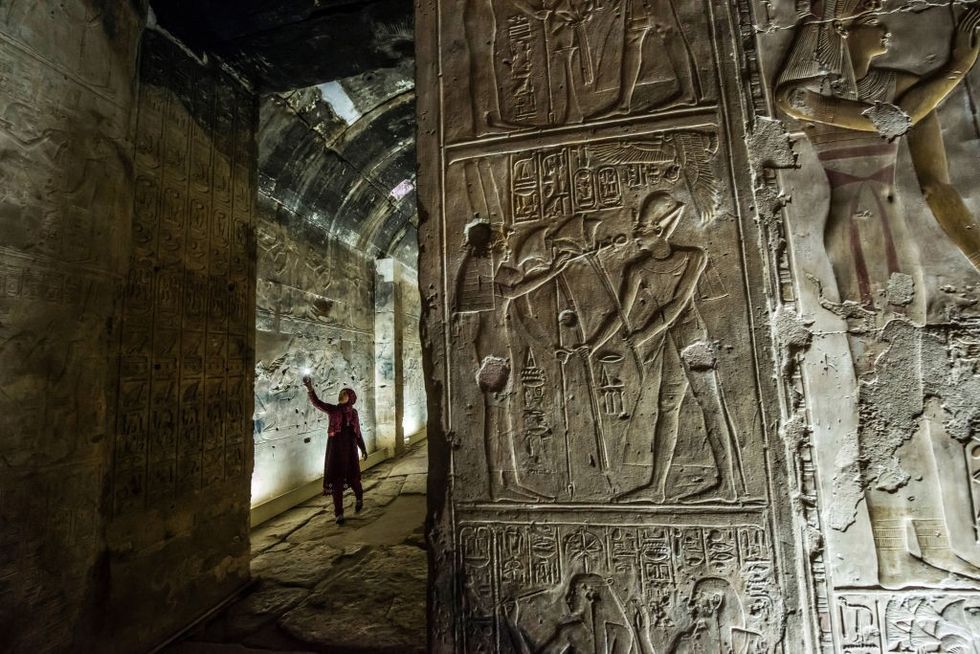
GETTY
One skull bore evidence of a chopping wound inflicted near the eye, while others showed sharp-force trauma alongside the more common fracture patterns.
The fractures did not match mace strikes, a weapon frequently depicted in ancient Egyptian art as a tool for vanquishing enemies. Instead, the injuries suggest the victims were hit with broad, flat implements, possibly fashioned from wood or antler.
Dr Campbell said: "Retainer sacrifice is a type of human sacrifice where those close to a ruler are killed when the ruler dies.
"In many cultures, retainer sacrifice is practised because of beliefs that the sacrificed individuals will continue to serve the ruler in some kind of afterlife, but retainer sacrifice can also be a visceral display of the ruler's power."
Funeral processions made up a key part of ancient Egyptian culture

GETTY
The practice of killing retainers appears to have been confined to a narrow window of Egyptian history.
While Aha, the inaugural First Dynasty pharaoh, was accompanied by only a handful of subsidiary burials, his successors had hundreds of graves surrounding their tombs and enclosures.
The custom tapered off rapidly and had seemingly vanished entirely by the start of the Second Dynasty.
Pharaohs eventually substituted human victims with small wooden and stone servant figurines known as ushabti, which were placed in tombs to carry out duties for the deceased in the afterlife.
Temple of pharaoh Seti has been the centre of the investigation

GETTY
Professor Salima Ikram of the American University in Cairo noted that "the practice was short-lived, with people being replaced by statuettes.
"Possibly some or all retainers felt that this was a boon and that they would enjoy an eternal life in the service of the god-king, though they might also have resented it, been terrified, and tried to escape this fate."