By The Rio Times | Created at 2026-10-06 07:16:53 | Updated at 2026-10-06 08:27:39
1 hour ago
By The Rio Times | Created at 2026-10-06 07:16:53 | Updated at 2026-10-06 08:27:39
1 hour ago

ECONOMY · CHILE
Key Facts
- —The country Chile, the world’s largest copper producer, is governed by conservative President José Antonio Kast. His first budget is now before Congress.
- —Why it matters Chile borrows at home and abroad, partly from international bond investors. A larger borrowing ceiling signals bigger financing needs at a time of persistent deficits.
- —Why now The 2027 budget bill was formally received by the Chamber of Deputies on Monday 5 October, starting a 60-day period for Congress to pass it.
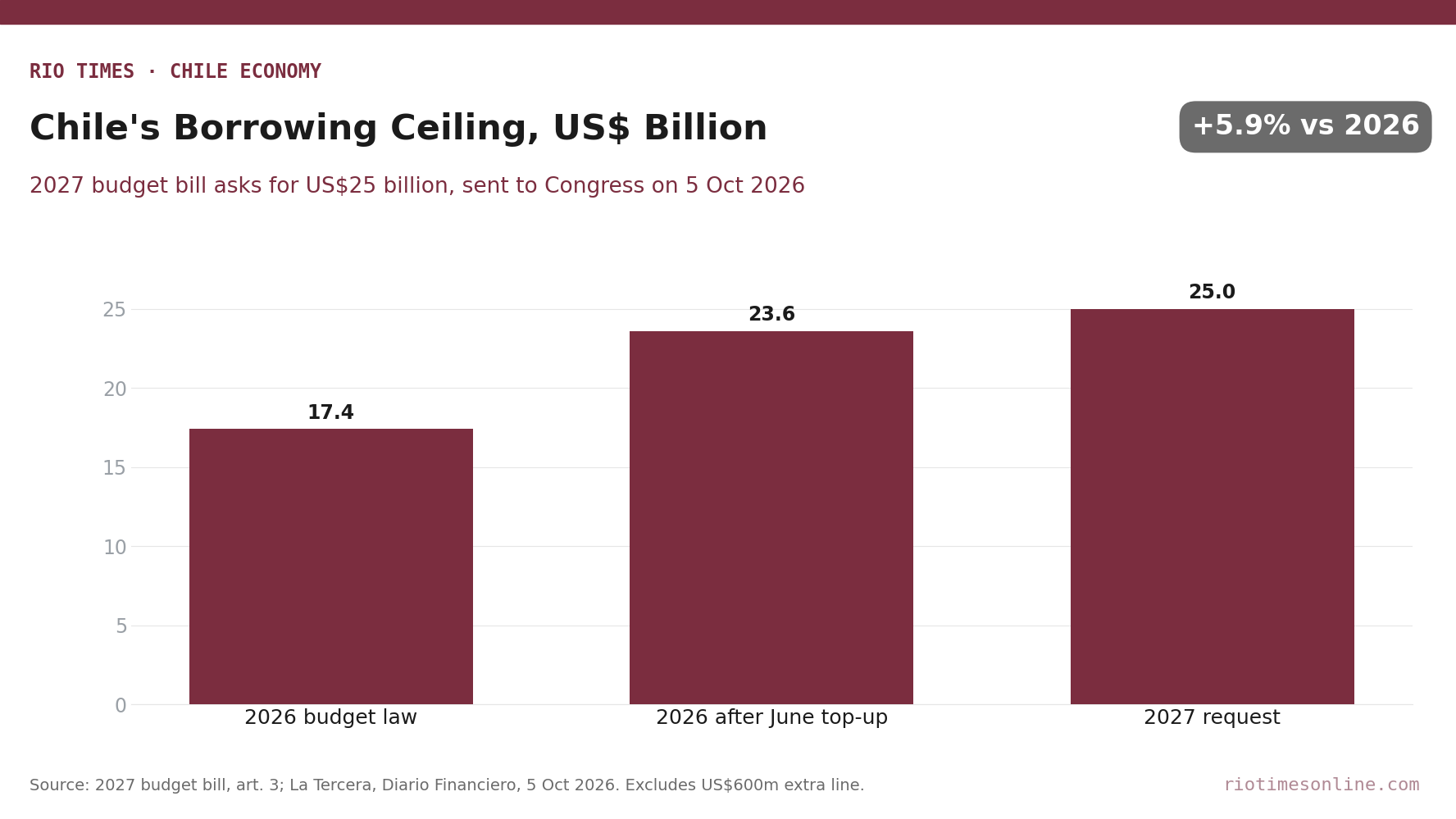
- —What happened Article 3 of the bill asks Congress to let the government borrow up to US$25 billion in 2027, plus a separate US$600 million line.
- —The numbers The 2026 budget law allowed US$17.4 billion. Congress added US$6.2 billion in June, lifting this year’s ceiling to US$23.6 billion.
- —What it means for you Holders of Chilean government bonds can expect continued new issuance in 2027. The ceiling is a maximum, not a promise to borrow it all.
- —Still open The split between local and foreign borrowing, the 2027 deficit forecast and whether Congress trims the request.
The Chile debt ceiling for 2027 would rise to US$25 billion under the budget bill the government formally sent to Congress on Monday 5 October. That is above the US$23.6 billion allowed this year, and well above the US$17.4 billion in the last budget written by the previous government. For US investors, it means a familiar sovereign borrower will need more money next year, at home and abroad.
Finance Minister Jorge Quiroz, the economist who runs fiscal policy for President José Antonio Kast, defended the figure at a press briefing in Congress. “The increase in debt comes from a relatively simple calculation,” he said, as quoted by La Tercera and Diario Financiero. “First you have to pay earlier debts, and then you have to cover the deficit plus below-the-line spending, and that is it.”
Economists quoted by La Tercera called the amount high. They also stressed that official debt details were only due on Tuesday 6 October.
What the Budget Bill Asks For
Kast, a conservative who took office in March, presented his first budget on television on Wednesday 30 September. The full bill, a 72-page document, was then formally received by the Chamber of Deputies on Monday afternoon.
The bill sets total net spending at 105.8 trillion pesos (about US$109 billion), Emol and EFE reported. That is 1.5% more than this year.
Article 3 authorises the president to take on obligations of up to US$25 billion in 2027, in Chile or abroad, in pesos or foreign currency. The text says the amount includes repayments and interest on existing public debt, CNN Chile and The Clinic reported.
A second clause allows a further US$600 million, kept separate from the main limit. Article 2 also lets the state guarantee loans and bonds of state companies and state universities, up to US$500 million, The Clinic reported.
Each borrowing must be approved by supreme decree through the Finance Ministry, naming what the money is for. Copies go to the finance committees of both chambers within 15 days.
Follow this story
Get an email when there’s news on Chile markets
Free. One email a day at most, and only when there is news. This also signs you up to our weekday newsletter, The LatAm Brief. Nothing arrives until you click the confirmation link, and you can stop either with one click. Privacy policy.
Why the Number Looks Bigger Than It Is
The Chile debt ceiling is a legal maximum for one budget year, 2027. It does not mean public debt will grow by US$25 billion, CNN Chile noted.
Much of the money would refinance bonds that fall due. Andrés Pérez, chief economist at Itaú bank in Chile, estimated 2027 maturities at about US$15 billion. The rest would cover the deficit and other financing needs.
Comparisons also depend on how the lines are counted. Most outlets compare US$25 billion with this year’s US$23.6 billion. The investigative news site CIPER counts the extra US$600 million in both years, giving US$25.6 billion against US$24.2 billion.
The June top-up matters here. On Monday 1 June, the day of his first annual address, Kast sent Congress a bill for US$6.2 billion more in 2026 borrowing. Congress approved it, Diario Financiero and Emol reported.
The bill links the plan to a structural deficit target of 1.8% of GDP for 2027. That is one point below the 2.8% target in force for this year, according to the bill’s message.
The government’s own argument is about interest. During 2026, 5.3% of the budget went on interest payments, the government said. “Every peso we pay today in interest is a peso that does not reach a health clinic, a nursery school or a police station,” Kast said.
What Economists Say About the Chile Debt Ceiling
Pérez called it “a high amount” that follows an extraordinary request this year. By Itaú’s calculations, gross financing needs would run slightly above 6% of GDP in 2027.
He added that the government probably kept some slack, in case revenue again falls short of forecasts, La Tercera reported.
Maximiliano Acevedo, an economist at the think tank Rumbo Colectivo, said the request is about US$5 billion above the figure in July’s official fiscal report. He called it the highest of any previous budget law.
Juan Ortiz, an economist at the economics observatory of Diego Portales University, struck a calmer note. He said the 5.9% rise on this year’s ceiling is consistent with a further deficit that must be financed.
Opposition lawmakers asked Quiroz to explain the increase, T13 reported. He said individual items can still change in Congress, within the overall spending limit.
What It Means for You
For bond investors in the United States, the Chile debt ceiling is a guide to supply. Chile may borrow in dollars or other foreign currencies, so some new bonds could reach international buyers.
The stabiliser is the debt level. The budget office projected in July that gross debt would end 2026 at 42.7% of GDP, below the government’s 45% anchor.
For visitors and dollar earners in Chile, the borrowing request has no direct effect. Separately, the Treasury’s dollar sales this month are covered in Chile Peso Jumps as Treasury Sells Up to US$600M a Week.
For the spending side of the same bill, see Kast Raises Chile’s 2027 Spending 1.5% in Budget.
What Is Not Known
The budget office presents its Public Finance Report to the joint budget committee on Tuesday 6 October. It should show the projected 2027 deficit and debt path.
It is not yet known how much the Treasury will raise abroad rather than at home, or in which currencies. Nor is it clear whether Congress will cut the ceiling before the 60-day deadline.
How much does Chile want to borrow in 2027?
The 2027 budget bill asks Congress for authority to borrow up to US$25 billion, plus a separate line of up to US$600 million. The amounts include repayments and interest on existing debt.
Will Chile’s debt rise by US$25 billion?
No. The figure is a ceiling, not a target, and much of it would refinance bonds falling due in 2027. Net new debt depends on the deficit.
When will Congress decide?
Congress has 60 days from the bill’s formal receipt on Monday 5 October to pass the 2027 budget, including the borrowing limit.
Sources: La Tercera, 6 October 2026; La Tercera, 5 October 2026; Diario Financiero; CNN Chile; The Clinic; Emol; CIPER; Government of Chile; Budget Office (Dipres), Public Finance Report, July 2026.
Editorial responsibility: Matthias Camenzind, Editor-in-Chief · Editorial standards · Report an error
LatAm Markets: Live Signals → — real-time movers, turnover leaders and FX across Latin America.