By The Rio Times | Created at 2026-10-03 17:18:20 | Updated at 2026-10-03 18:09:19
1 hour ago
By The Rio Times | Created at 2026-10-03 17:18:20 | Updated at 2026-10-03 18:09:19
1 hour ago

One-stop reference
Company Intelligence
Every listed company in Latin America — financials, ownership and structure for 1,450+ companies across 26 exchanges, in one place.
EDUCATION · CHILE
Key Facts
- —The country Chile, where President José Antonio Kast sent his first budget bill, for 2027, to Congress on 30 September. Lawmakers have 60 days to pass it.
- —What happened Education Minister María Paz Arzola defended ending the Yo Elijo mi PC laptop grant but said Congress will decide, 24 Horas reported on 2 October and BioBioChile on 3 October.
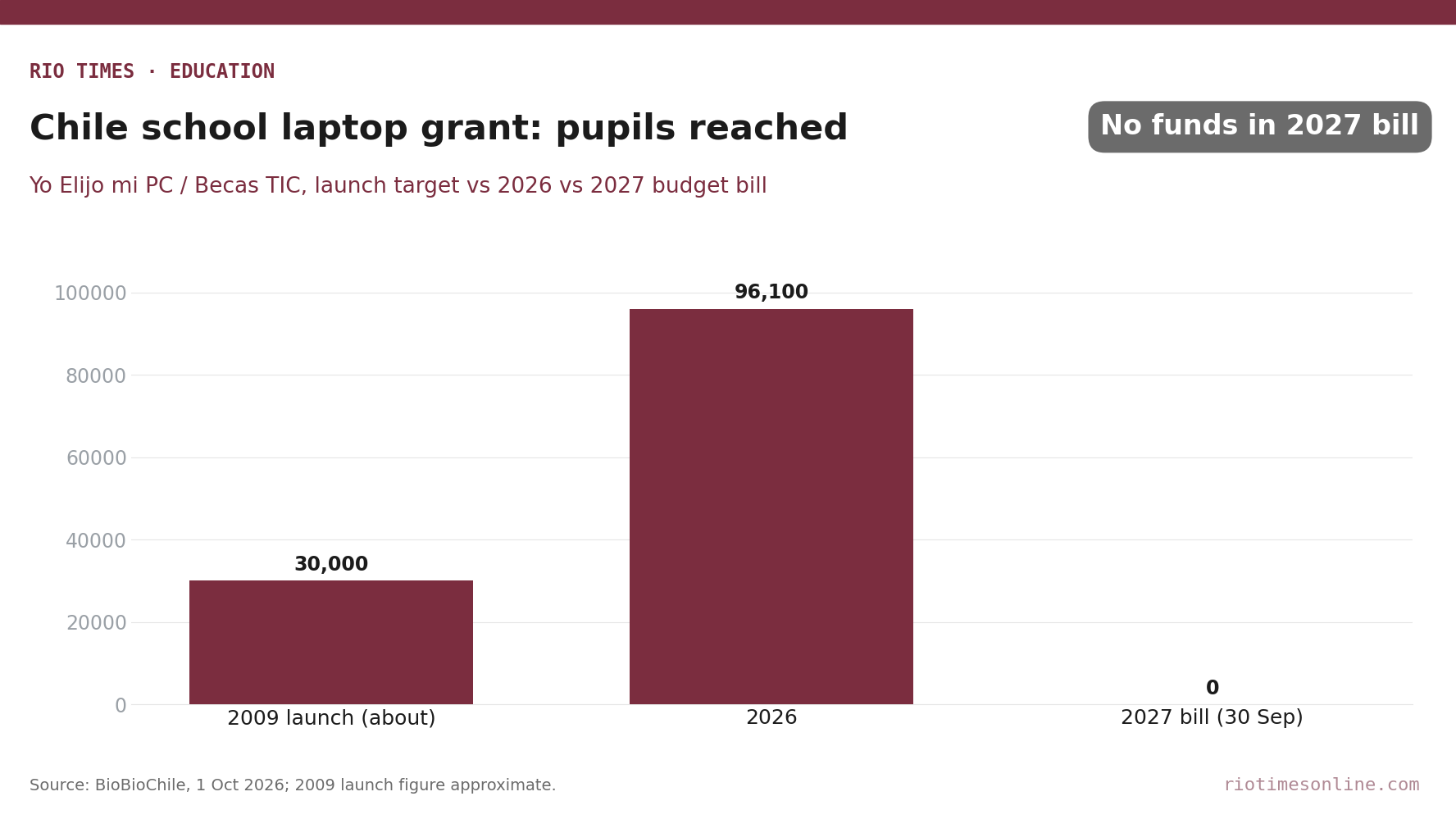
- —The numbers The grant reached 96,100 pupils in 2026 with about CLP 35 billion (about US$35.6 million), BioBioChile reported on 1 October. The 2027 bill assigns it nothing.
- —What it means for you Families of seventh-graders in public schools should not count on a state laptop in 2027. Socialist, populist and some pro-government deputies are pushing to restore it.
- —Still open Whether the government agrees to put money back. Under the constitution, Congress can cut budget spending but cannot add it on its own.
The fate of Yo Elijo mi PC, Chile’s 17-year-old school laptop grant, now rests with Congress. Education Minister María Paz Arzola defended the cut but said lawmakers would have the final word.
“We are always respectful of the discussions that take place in Congress,” she told 24 Horas in an interview published on Friday. BioBioChile reported on Saturday that she had left the programme’s future in lawmakers’ hands.
The minister keeps the cut but opens the door
The 2027 bill gives the grant no money, as reported on 3 October in Chile 2027 Budget Drops School Laptop Scheme. It reached 96,100 pupils this year with about CLP 35 billion (about US$35.6 million at 982 pesos per dollar, 2 October).
Arzola said the government is united behind the decision. The programme “is not having the impact one would expect on learning,” she told 24 Horas.
She then called the bill a proposal open to comment. “When we start the conversation, everyone will be able to put forward their arguments,” she said.
In an interview with La Tercera on Saturday, she said the grant exists only through the annual budget law. “It is not that we have anything against computers,” she said, adding that money should go where impact is proven.
The ministry’s stated priority is early-childhood education, she told the paper. Overall, Kast’s bill raises spending 1.5%, as set out in Kast Raises Chile’s 2027 Spending 1.5% in Budget.
Follow this story
Get an email when there’s news on Chile
Free. One email a day at most, and only when there is news. This also signs you up to our weekday newsletter, The LatAm Brief. Nothing arrives until you click the confirmation link, and you can stop either with one click. Privacy policy.
Votes line up against the cut
Socialist deputy Juan Santana, of the lower house education committee, said his party will reject the education chapter until the money returns. Radio Universidad de Chile and estapasando.cl both reported his position on 3 October.
Deputy Zandra Parisi of the populist Partido de la Gente (PDG) also asked the government to keep the grant. The state cannot “close the education gap by widening the digital gap,” she said.
Former presidential candidate Franco Parisi called the programme one of Chile’s most meritocratic policies, estapasando.cl reported. The site argued that PDG votes can tip a closely divided lower house.
Dissent also comes from inside the coalition. Deputies of the conservative UDI, a government ally, plan to restore the grant and find savings elsewhere, BioBioChile reported on 2 October.
Why Congress cannot simply add the money
Chile’s constitution lets Congress reduce spending in the budget bill but not raise it, except for items fixed by permanent law. The laptop grant has no such law, as Arzola noted.
Restoring it would therefore need an amendment from the government itself. If Congress fails to pass the bill within 60 days, the president’s version takes effect.
There is precedent for a deal. During last year’s debate, CLP 9.8 billion (about US$10.0 million) was restored for 2026 coverage, the Rio Times reported, citing The Clinic.
Opposition to the wider education cuts has already reached the streets, as covered in Chile Students March Against 2027 Budget Cuts. Arzola said the parliamentary debate on the grant has not yet begun.
What Is Not Yet Known
The government has not said whether it would accept a partial restoration or a redesigned grant. Finance Minister Jorge Quiroz, asked about the cut, said he did not recall the specific findings against the programme, Radio Universidad de Chile reported.
It is also unclear how the PDG bloc will vote on the full education chapter. The UDI wants the money taken from misused public-sector sick leave and from the national human rights institute (INDH), BioBioChile reported.
Sources: BioBioChile, 3 October 2026; BioBioChile, 2 October 2026; BioBioChile, 1 October 2026; 24 Horas, 2 October 2026; La Tercera, 3 October 2026; Radio Universidad de Chile, 3 October 2026; estapasando.cl, 3 October 2026; Constitution of the Republic of Chile, budget-law clause.
This article was produced by The Rio Times’ automated newsroom system. How we use AI · Report an error · Editorial responsibility: Matthias Camenzind, Editor-in-Chief
The Rio Times · Power Map
See who really holds power in Latin America
Click to open the Power Map →