By The Rio Times | Created at 2026-10-03 17:18:19 | Updated at 2026-10-03 18:09:20
1 hour ago
By The Rio Times | Created at 2026-10-03 17:18:19 | Updated at 2026-10-03 18:09:20
1 hour ago

One-stop reference
Company Intelligence
Every listed company in Latin America — financials, ownership and structure for 1,450+ companies across 26 exchanges, in one place.
DISASTER RECOVERY · COLOMBIA
Key Facts
- —The country Colombia. A magnitude 7.4 earthquake struck the west on 10 August 2026; Infobae put the toll at 335 dead and 36,327 homes destroyed on 3 October.
- —What happened The Fondo Milagro reconstruction fund, announced on 12 August, had received no money by late September, CAMBIO magazine reported on 2 October, citing Finance Ministry replies.
- —The numbers COP 624.7 billion (about US$189 million) was added to the 2026 budget on 17 September. A further COP 2.7 trillion (about US$815 million) was requested on 29 September.
- —What it means for you The money is not lost; the Finance Ministry still holds it. Rebuilding contracts through the fund cannot start until its trust contract is signed.
- —Still open The ministry has given no start date, has not named a fiduciary company, and Congress has yet to vote on the extra money.
Colombia’s Fondo Milagro, the fund created to rebuild after the 10 August earthquake, has not started operating. By late September it had received no money, according to Finance Ministry replies reported by CAMBIO magazine.
The Pereira newspaper El Diario and the news site Infobae carried the findings on Saturday, 3 October. That is 52 days after the fund was announced, and the ministry has set no date for it to begin.
What the fund was meant to do
President Abelardo de la Espriella announced the fund on 12 August, two days after the magnitude 7.4 quake centred in Chocó. It was the core of his plan (see World Rushes Aid to Colombia as Quake Toll Hits 281 and Plan Milagro Begins).
It was meant to pool national and foreign money for homes, hospitals, schools, roads and airports. Decree 1379, signed on 9 September, set it up as a ring-fenced trust that creditors cannot seize.
The model was the fund that rebuilt Armenia after the 1999 earthquake. It was designed to avoid the slow contracting rules of the national disaster-risk fund and of Fondo Adaptación, a state rebuilding agency.
Follow this story
Get an email when there’s news on Colombia
Free. One email a day at most, and only when there is news. This also signs you up to our weekday newsletter, The LatAm Brief. Nothing arrives until you click the confirmation link, and you can stop either with one click. Privacy policy.
Where the money stands
On 17 September the government added COP 624.7 billion (about US$189 million) to the 2026 budget for the emergency. CAMBIO traced it to a US$200 million World Bank contingent credit that Colombia arranged in 2025.
The ministry said none of it had been moved into the trust, so the ministry still holds it. Figures here use COP 3,312 per US dollar, the close on 2 October.
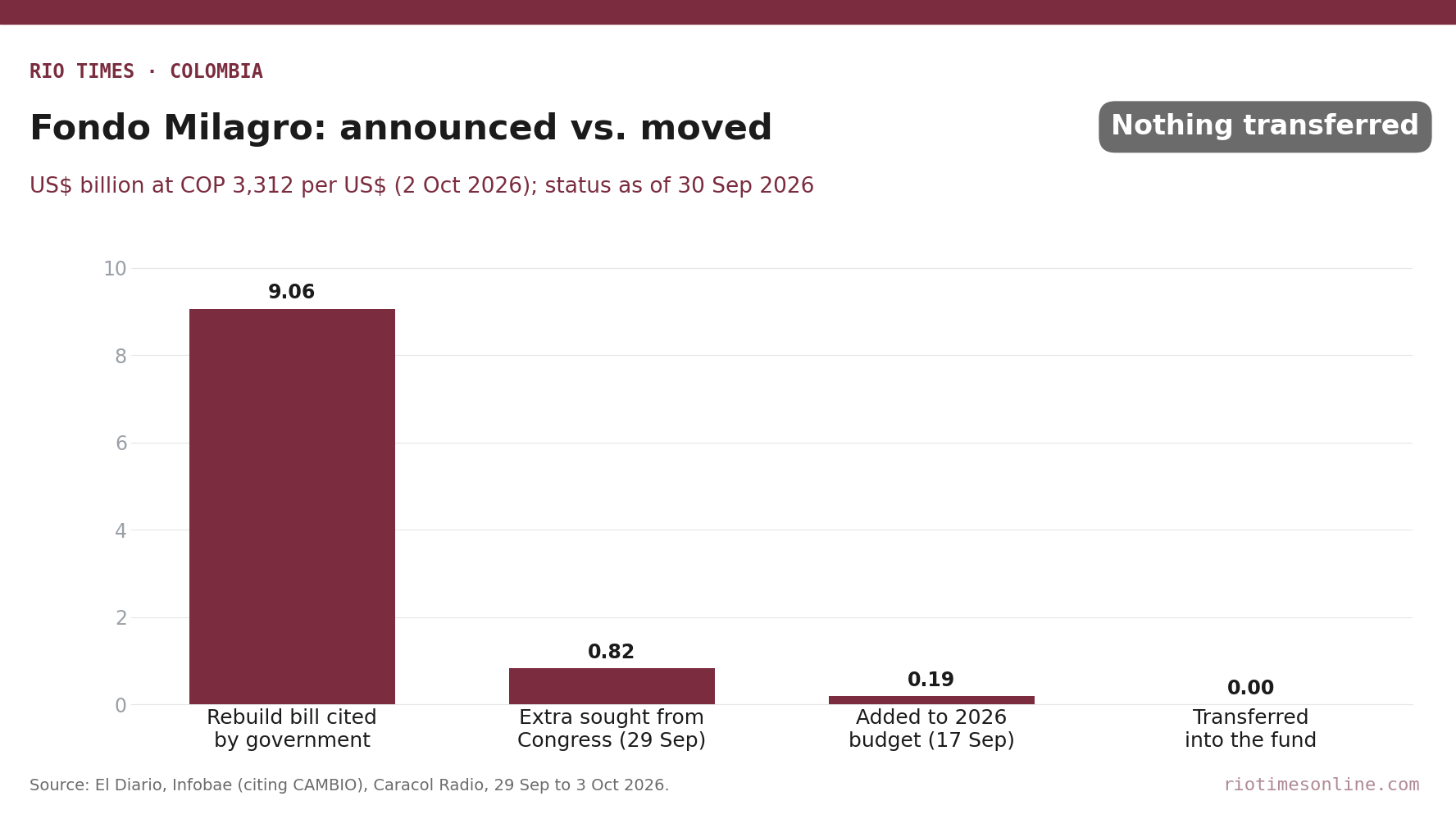
On 29 September the ministry asked Congress for another COP 2.7 trillion (about US$815 million) for Fondo Milagro, Caracol Radio reported. It expects to raise that sum by cutting penalties and interest on overdue tax and other obligations.
The government has spoken of a rebuilding operation near COP 30 trillion (about US$9.1 billion). That echoes the damage estimate covered in Colombia Puts the Earthquake Bill at Roughly US$9.6 Billion.
Why the fund is stuck
The trust contract with a fiduciary company has not been signed, the ministry told Green Alliance lawmaker Catherine Juvinao. Without it, the board cannot be seated and the manager cannot formally take office.
On 30 September the ministry said the Fondo Milagro contracting manual was still being defined, with no draft yet. The decree gives the president five board seats; the disaster agency UNGRD gets a voice but no vote.
Official answers have not matched: UNGRD told Juvinao on 11 September that businessman Jaime Andrés Uribe had been manager since 21 August. The presidency later said it held no records on the fiduciary or board minutes.
What is still moving
Other relief continues, as Colombia’s Earthquake Reconstruction Turns to 8 Percent Mortgages and Frozen Student Loans reported. Banks have offered victims 8 percent mortgages, and the state student lender froze loan collections.
The first tranche is also already in the budget rather than pending abroad. On the ministry’s own account, the unsigned trust contract is the step holding up the board and the manager.
What Is Not Yet Known
The ministry has not said when the Fondo Milagro trust will be signed or which fiduciary company will run it. Nor has it disclosed the fee or how the company will be chosen.
It is unclear how quickly Congress will vote on the extra COP 2.7 trillion (about US$815 million). The core findings rest on CAMBIO’s investigation, which other outlets have relayed rather than independently confirmed.
Sources: El Diario (Pereira), 3 October 2026; Infobae, 3 October 2026 (both citing CAMBIO); CAMBIO, 2 October 2026; El Quindiano, 3 October 2026; Caracol Radio, 29 September 2026; Portafolio, 9 September 2026.
Editorial responsibility: Matthias Camenzind, Editor-in-Chief · Editorial standards · Report an error
The Rio Times · Power Map
See who really holds power in Latin America
Click to open the Power Map →