By The Rio Times | Created at 2026-10-01 08:17:10 | Updated at 2026-10-01 10:07:37
2 hours ago
By The Rio Times | Created at 2026-10-01 08:17:10 | Updated at 2026-10-01 10:07:37
2 hours ago
The LatAm Brief
One email, every weekday morning. What moved in Latin American markets, politics and expat life.
Yesterday’s subject line: “Colombia decides rates today, near its own debt ceiling”
Free. We send a confirmation link first — nothing arrives until you click it. Unsubscribe with one click in any edition. If you stop opening us for 30 days we stop sending by ourselves, as we assume the interest is no longer there. See our privacy policy. We never share your email.
ECONOMY · COSTA RICA
Key Facts
- —The country Costa Rica, a Central American economy that earns most of its foreign currency from tourism, manufactured exports and business services sold abroad.
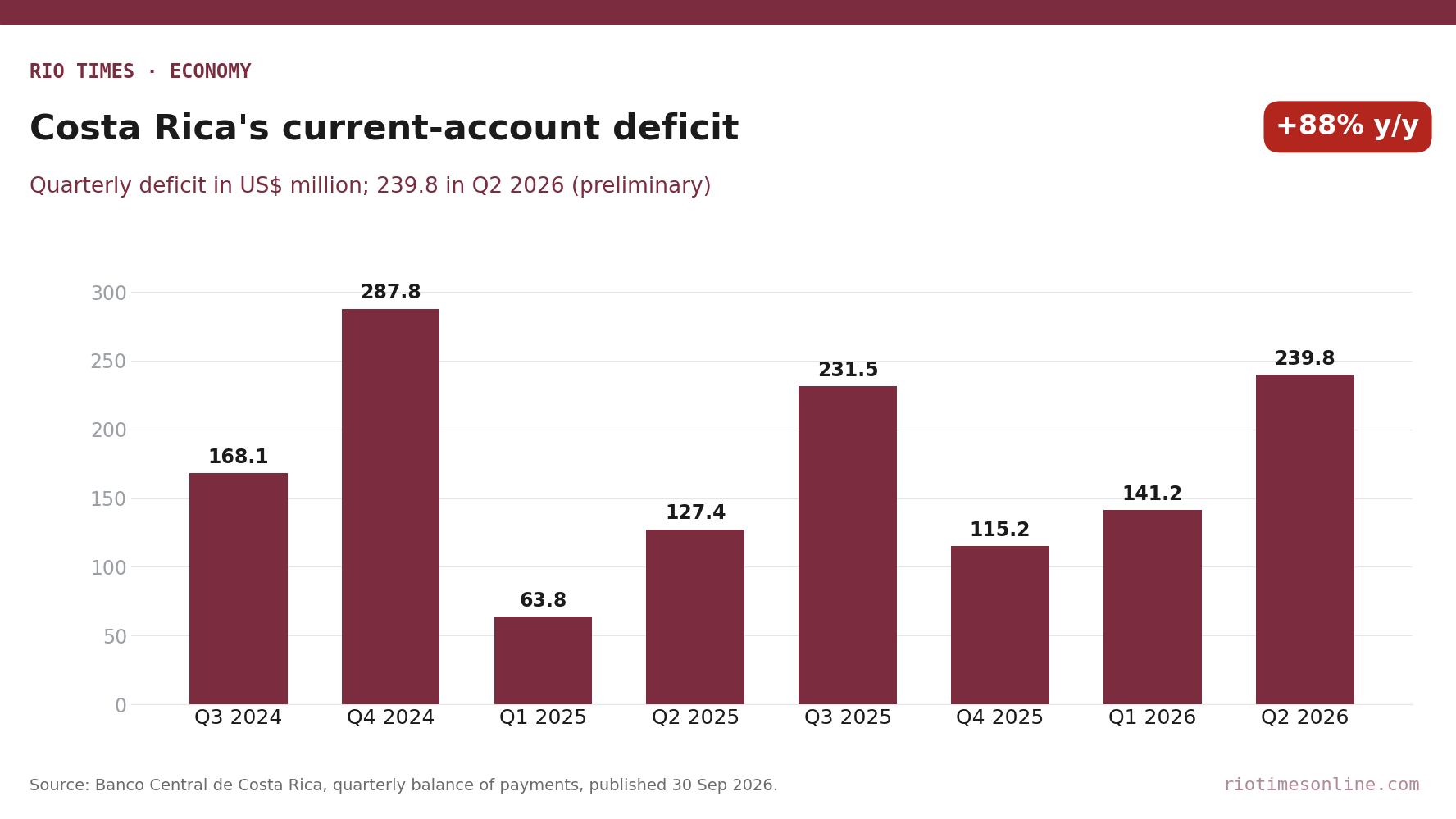
- —What happened The central bank reported on Wednesday (30 September) a current-account deficit of US$239.8 million for April–June 2026, up from US$141.2 million in January–March.
- —The numbers A year earlier the gap was US$127.4 million. Goods imports rose 12.3% year on year in the second quarter; goods exports rose 6.8% (BCCR, preliminary).
- —What it means for you The gap is small and was more than covered by investment inflows; reserve assets rose US$1.56 billion in the quarter. The colón remains near record strength.
- —Still open Whether the strong colón keeps widening the goods gap later in the year. Third-quarter figures have not been published, and all 2026 data are preliminary.
The Costa Rica current account deficit widened to US$239.8 million in the second quarter of 2026. The Central Bank of Costa Rica (BCCR) published the preliminary figure on Wednesday (30 September).
Free daily brief — no card needed
Get every Costa Rica story in one morning email
We build you a personalized brief around the topics you follow — free for 7 days. Love it? Your first month after that is US$1.
Yes, email me my free daily brief — I can unsubscribe any time.
That compares with US$141.2 million in the first quarter and US$127.4 million a year earlier. It is the widest quarterly gap since late 2024, when it reached US$287.8 million.

One-stop reference
Company Intelligence
Every listed company in Latin America — financials, ownership and structure for 1,450+ companies across 26 exchanges, in one place.
Imports grew faster than exports
The current account measures a country’s trade in goods and services plus income and transfers with the rest of the world. A deficit means more money flowed out than came in.
In the second quarter, goods imports rose 12.3% from a year earlier to US$6.86 billion. Goods exports grew more slowly, by 6.8%, to US$6.44 billion.
The goods deficit therefore jumped to US$426.0 million, from US$82.4 million in the same quarter of 2025. That swing alone is larger than the overall widening.
Services remained the counterweight, with a surplus of US$2.41 billion against US$2.14 billion a year earlier. Tourism receipts, which the bank records as travel, edged up to US$1.32 billion from US$1.29 billion.
Profits paid abroad remain the largest drain
The biggest outflow is primary income, mainly interest and profits paid to foreign owners. It came to a net US$2.41 billion in the quarter, against US$2.35 billion a year earlier.
Income paid on foreign direct investment accounted for US$2.22 billion of the outflows. Remittances received from Costa Ricans abroad rose to US$230.4 million from US$197.5 million.
Investment inflows more than cover the gap
The financial side of the balance of payments shows why the deficit is not a strain. Net foreign financing came to US$1.66 billion, led by US$1.54 billion of new direct investment into Costa Rica.
Reserve assets rose by US$1.56 billion in the quarter. In its July outlook, the BCCR expected the deficit for 2026–27 to be 0.7 percentage points of GDP wider than in 2025.
The bank said that, as in earlier years, the gap would be more than financed by long-term foreign resources. For the first half of 2026, the deficit totalled US$381.0 million, up from US$191.2 million a year earlier.
A strong colón cuts both ways
The colón reached ¢446.93 per US dollar on 16 September, its strongest level since the series began in December 2007, CRHoy reported. It traded near ¢456.6 per dollar on 1 October.
A strong currency makes imports cheaper and has helped keep prices down, as Costa Rica Inflation to End 16 Months Below Zero, Central Bank Chief Says reported. For households paid in colones, foreign goods and travel cost less.
Exporters see the other side, since their dollar revenue buys fewer colones. “The exchange rate is a source of pain across the whole system,” tourism chamber Canatur president Martí Jiménez said, El Financiero reported on 30 September.
For residents earning in dollars, the effect runs the other way, as explained in Costa Rica’s Record-Strong Colón: What It Means for Expat Budgets. The current account deficit itself remains modest next to quarterly exports of nearly US$11 billion.
What Is Not Yet Known
The BCCR marks all balance-of-payments figures from 2023 onward as preliminary, so the second-quarter numbers may still change. The bank’s table does not say how much of the import rise reflects prices rather than volumes.
It is also unclear whether the strong colón will keep widening the goods gap in the second half. Third-quarter figures have not yet been published.
Sources: Banco Central de Costa Rica, quarterly balance of payments (MBP6), preliminary, 30 September 2026; BCCR monetary policy report release, 30 July 2026; CRHoy, 16 September 2026; El Financiero, 30 September 2026. Exchange rate: open.er-api, 1 October 2026.
This article was produced by The Rio Times’ automated newsroom system. How we use AI · Report an error
LatAm Markets: Live Signals → — real-time movers, turnover leaders and FX across Latin America.
The Rio Times · Power Map
See who really holds power in Latin America
Click to open the Power Map →