By The Straits Times | Created at 2026-09-12 13:16:27 | Updated at 2026-10-05 12:00:41
3 weeks ago
By The Straits Times | Created at 2026-09-12 13:16:27 | Updated at 2026-10-05 12:00:41
3 weeks ago
KUALA LUMPUR – Amid repeated chants of “bubar” or “dissolve” from some 3,000 party delegates, UMNO president Zahid Hamidi challenged Malaysian Prime Minister Anwar Ibrahim to eject the party from the unity government and face a vote of confidence in Parliament.
His fiery remarks came at the end of one of UMNO’s most combative general assemblies in recent years, further straining the ruling alliance forged between the party and Anwar’s Pakatan Harapan (PH) bloc in 2022.
“Are you brave enough (to kick us out)?” Zahid demanded, addressing a roaring, packed hall at the World Trade Centre Kuala Lumpur on Sept 12. “If yes, then do it now. If you are brave, then dissolve Parliament now.”
Zahid, who is also Malaysia’s deputy prime minister, said his challenge was a response to calls from within PH for UMNO to be removed from the government following the party’s increasingly open criticism of Anwar’s leadership.
Holding up the agreement signed by both sides to form the government in late 2022, he reminded his coalition partners that Anwar’s administration exists only because of UMNO’s backing.
“The prime minister is the prime minister because of UMNO’s support,” Zahid declared.
His bold words capture the growing confidence of the party that believes its fortunes have finally turned – eight years after being booted out of power in 2018, following six decades of unbroken rule.
The four-day assembly that ended on Sept 12 came barely six weeks after the Barisan Nasional (BN) coalition secured a landslide victory in the Negeri Sembilan state polls, working alongside opposition Perikatan Nasional (PN) partners to completely displace Anwar’s Pakatan Harapan (PH) from its long-held dominance in the state. That momentum had been building since July, when BN swept 48 out of 56 seats in the Johor state polls, with UMNO taking 36 seats on its own.
The twin triumphs confirmed what the party had been hoping: that by consolidating the conservative Malay vote alongside once-bitter rivals like PAS, it could easily crack ruling coalition PH’s traditional strongholds.
Having spent much of the last decade relegated to a weakened coalition partner, the mood at the 2026 assembly proved that UMNO no longer views itself as a junior stakeholder, but as a kingmaker ready to dictate terms. This sudden surge of confidence marks a dramatic turnaround for the party.
Founded in 1946, the nation’s oldest political party led Malaya to independence in 1957 and shaped the nation through six decades of unbroken rule. That dominance came to a crashing halt in 2018 when public fury over the multi-billion-dollar 1Malaysia Development Berhad (1MDB) scandal surrounding then-prime minister Najib Razak handed the BN coalition its first-ever electoral defeat.
The back-to-back victories have radically shifted the power balance inside the federal coalition. No longer behaving like the bruised junior partner that Anwar rescued in 2022, a resurgent UMNO is now openly treating the unity government as a temporary marriage of convenience – one it intends to walk away from the moment the next general election is called.
At the party meeting, Zahid again voiced support for an earlier GE16 – which is not constitutionally due until February 2028 – signalling deepening tensions within Anwar’s ruling alliance.
Elections should be held “as soon as possible,” he said. “The general election is the defining moment for us to regain the mandate to lead,” he told thousands of party faithful on Sept 11. The blunt rhetoric is the clearest indicator yet that UMNO has no intention of extending its alliance with PH beyond the current parliamentary term.
Yet, rather than coasting on recent victories, Zahid also used the stage to warn delegates against complacency, urging them to reflect on the institutional arrogance that cost them power eight years ago.
“Have we repented enough?” he demanded of the crowd. “I repeat: have we repented enough? Have we grasped the needs of today? Are we ready to make a change?"
Breaking ranks with ‘guru’
Zahid’s remarks come as UMNO continues to grapple with the very types of graft allegations that triggered its 2018 downfall.
Sharing the stage with the president were two prominent figures linked to a newly revived controversy surrounding Malaysia’s pilgrimage fund, Tabung Haji. Former religious affairs minister Jamil Khir Baharom, who is currently under investigation, led the assembly’s opening prayer, while former fund chairman Abdul Azeez Abdul Rahim – recently charged with abuse of position – was asked to stand and receive a round of applause.
Zahid framed these legal troubles as political targeting orchestrated by the Prime Minister. Turning his focus toward Anwar, whom he sarcastically addressed as guru (teacher), Zahid used the affectionate term from their past mentor-protégé relationship to deliver a blunt warning.
“Guru, listen to us, guru,” Zahid said. “We do not want the courts to be abused.”
Further breaking ranks, Zahid pledged that if UMNO returns to lead the federal government, it will restore the Goods and Services Tax (GST) to replace the Sales and Service Tax (SST) favoured by the Anwar administration, explicitly rejecting a hybrid model currently being considered by the unity government.
Such open defiance from a sitting deputy prime minister underscores a profound shift: UMNO no longer views itself as the weakened partner that joined Anwar’s government in 2022, but as a force that believes it can once again dictate the terms of Malaysian politics.
New old friends
The clearest signal of this changing political tide unfolded right on the main stage, where top leaders from PAS sat in the front row as honoured guests. This striking visual presence underscored a shifting “blue wave” of conservative Malay unity, signaling a growing threat to the stability of Anwar’s ruling alliance.
Such confidence hinges on rekindled relations between UMNO and its longtime nemesis turned potential partner, Parti Islam SeMalaysia (PAS).
The unity government forged in 2022 was initially hailed for ending two years of political instability and bringing UMNO together with Anwar’s Reformasi movement after nearly a quarter-century of bitter rivalry.
But as UMNO’s electoral fortunes improve, its attention is increasingly shifting towards another old adversary. For the party, a renewed push for “Malay unity” and cooperation with PAS offers the prospect of consolidating the Malay-Muslim vote, by far the largest electoral bloc in the country.
Both sides have been easing into the idea in recent months, with UMNO representatives attending PAS annual congress in early September and PAS delegates subsequently appearing at the UMNO assembly. The two parties have also begun discussing cooperation ahead of the coming Melaka state election.
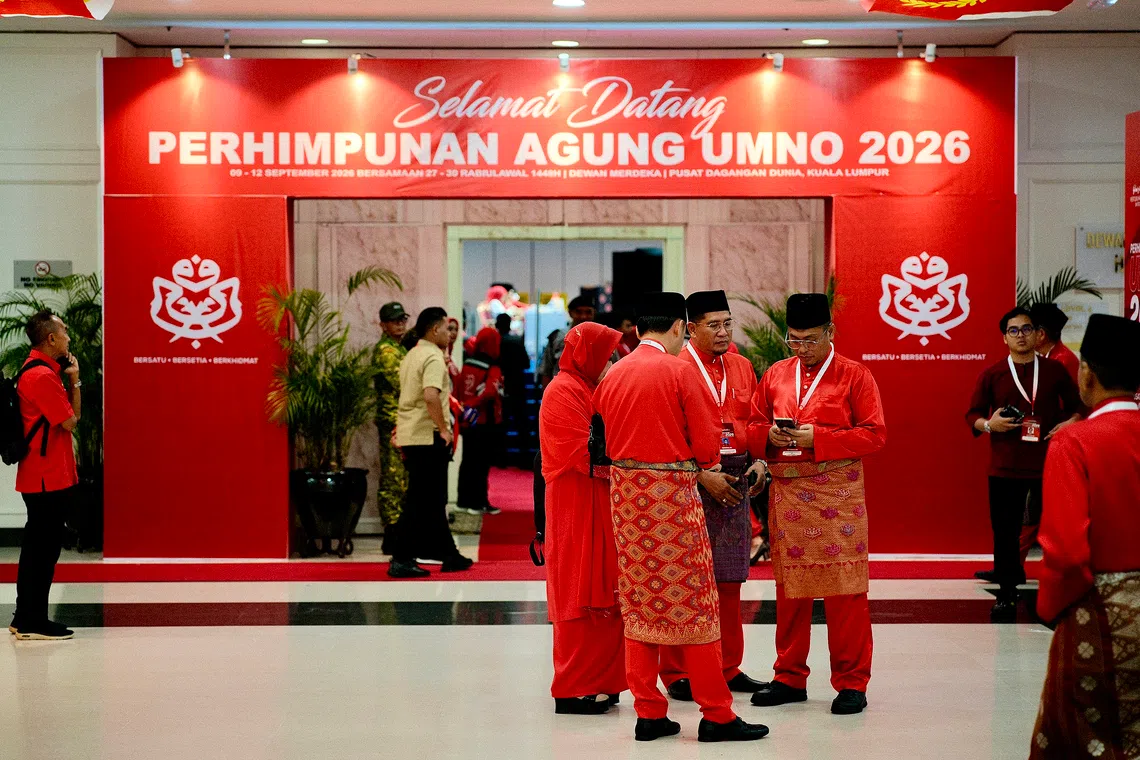
UMNO delegates at the World Trade Centre Kuala Lumpur on Sept 11 for the party's general assembly.
ST PHOTO: HADI AZMI
PAS Youth vice-chief Muhammad Hanif Jamaluddin said he supported cooperation with UMNO, adding that party members were accustomed to accepting decisions made by the leadership.
Whether UMNO will be given room to contest seats in Kelantan and Terengganu depends on ongoing, complex negotiations between UMNO and PAS regarding seat allocations ahead of the next general election, which must be held by early 2028.
The Islamist opposition party is approaching any potential realignment from a position of considerable electoral strength. PAS won 43 parliamentary seats at GE15, forming the biggest bloc by party in Parliament, and leads the state governments in Kelantan, Terengganu, Kedah and Perlis.
Hanif said such an arrangement was possible, although no discussions had yet been held on the matter.
“That is something we will discuss when the time comes. We see unity between PAS and UMNO as very important, especially to avoid overlapping or clashes,” he said.
“Whatever decision is made by the top leadership will be implemented.”
But beneath the public displays of reconciliation lies the more difficult question of who would lead such an alliance.
In his closing speech on September 12, UMNO deputy president Mohamad Hasan made clear that his party does not intend to play second fiddle in any Malay unity arrangement.
“Mutual understanding shouldn’t be one-sided where we are the only ones expected to understand and they take advantage,” Mohamad said.
He suggested testing PAS’ sincerity by demanding room for UMNO to contest in Terengganu. In the 2023 Terengganu state polls, PAS swept 27 seats and Bersatu won five under the PN banner, leaving the UMNO-led BN bloc with nothing.
“If you are sincere, let’s do this together,” he said. “We want to test their honesty and see how far it goes.”
Mohamad’s cautious stance marks a notable departure from other top party leaders, including Zahid, who appear more eager to partner with PAS. He reminded party faithful not to get carried away by recent victories, urging them to focus instead on rebuilding UMNO’s independent grassroots strength.
“We have our dignity. Don’t pawn it away.”
Sign up for our weekly Asian Insider Malaysia Edition newsletter to make sense of the big stories in Malaysia