 By The War Zone | Created at 2026-08-19 21:15:44 | Updated at 2026-08-19 21:29:21
22 minutes ago
By The War Zone | Created at 2026-08-19 21:15:44 | Updated at 2026-08-19 21:29:21
22 minutes ago
The TWZ Newsletter
Weekly insights and analysis on the latest developments in military technology, strategy, and foreign policy.
A U.S. Air Force’s new EA-37B Compass Call electronic warfare jet made an appearance near the Russia’s Kaliningrad enclave on Tuesday. The flight was part of a large presence of U.S. and NATO reconnaissance and electronic warfare aircraft and Polish ground forces arrayed near the strategic Baltic Sea salient bordering Poland and Lithuania. This took place place against the backdrop of growing concerns about increasing Russian aggression in the region – including a growing fears of a potential limited action against a NATO member and concerning Russian naval operations in the Baltic Sea. However, NATO is downplaying the aerial mission as routine and not a reaction to any particular event.
“On 18 August 2026, NATO deployed a specialized reconnaissance and electronic warfare flight package over the Baltic Sea near the Kaliningrad Oblast,” a Polish military official told TWZ on Wednesday. “This operation involved the deployment of a rare US EA-37B ‘Compass Call II’ electronic warfare aircraft, relocated from Greece to Powidz in Poland, which operated alongside an E-3 AWACS and an ARTEMIS II surveillance plane.”
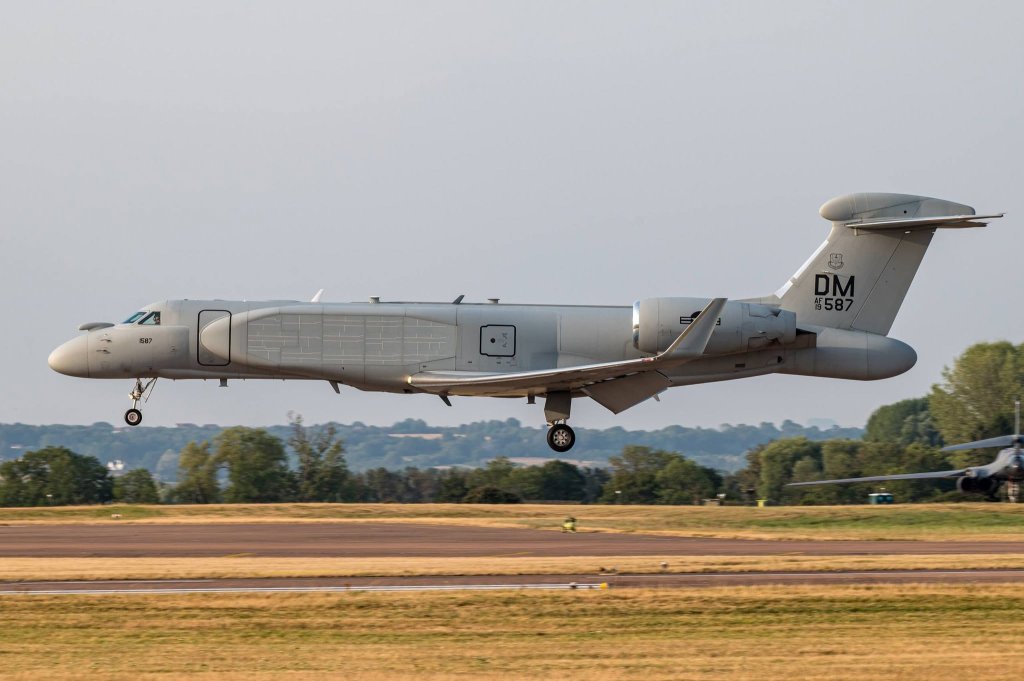 An EA-37B Compass Call electronic warfare jet arriving at RAF Fairford in the U.K. after taking part in Operation Epic Fury. (Matt Belcher)
 The Polish military official, who spoke on the condition of anonymity to discuss operational details, declined to offer further information about the role of the Polish ground forces, how many there were, or how they were equipped.
A NATO official on Wednesday clarified to us that the activity, which is ongoing, is allied in nature and controlled by the U.S., not NATO. We have reached out to U.S. Air Forces in Europe – Air Forces Africa (USAFE) for additional details.
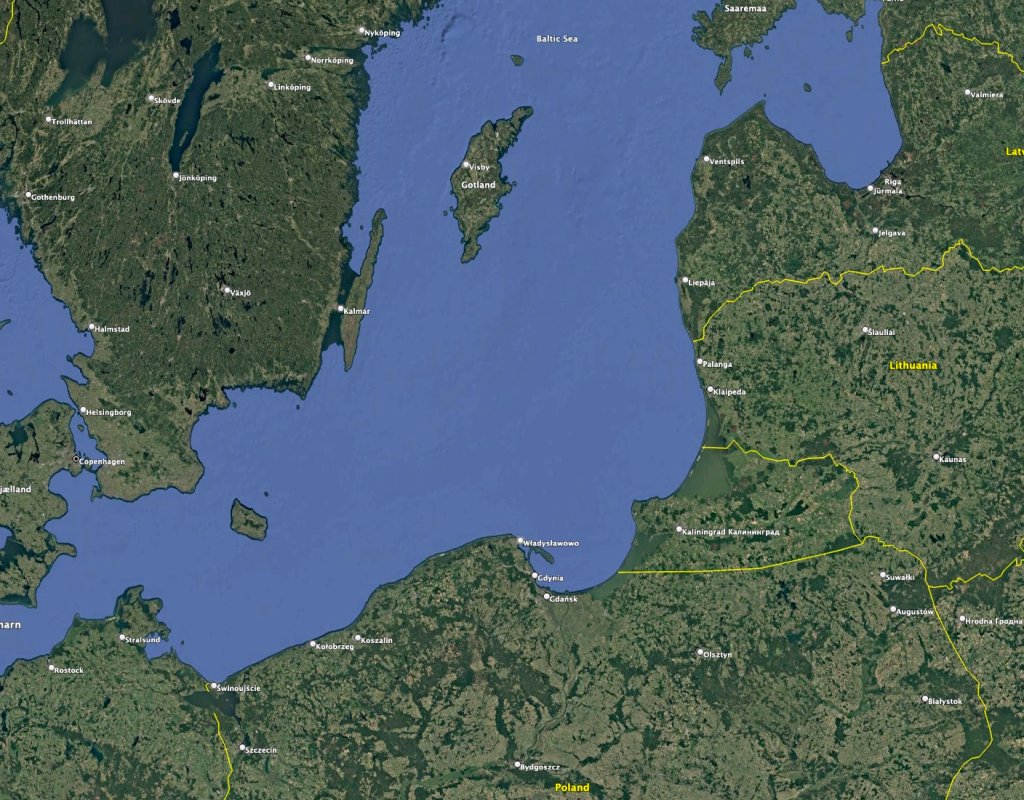 Kaliningrad. (Google Earth)
 After open-source flight trackers noticed the increased air activity near Kaliningrad on Tuesday, we reached out to NATO spokesman Col. Marty O’Donnell for comment.
“NATO is a defensive Alliance and Allies are constantly honing their defensive abilities,” he explained. “The Allied activity today in the Baltic region involving U.S. and Norwegian fighter aircraft, Polish ground forces, a NATO E-3A Airborne Warning & Control System (AWACS), and more, which is being overseen by the U.S., is one example of this approach.”
NATO aircraft operating near Kaliningrad is not a unique circumstance. The enclave – separated from Russia and ensconced between two NATO nations and the Baltic Sea – is a key Russian military outpost, hosting an array of nuclear-capable ballistic missiles, anti-ship missiles, several squadrons of tactical jets and thousands of troops.It has also been a notorious hub of disruptive Russian electronic warfare activity itself.
However, having an EA-37B operating over the area is of note. This was reportedly the first time one of these highly specialized jets appeared near the enclave. Online flight trackers showed it flying orbits in Polish airspace near Kaliningrad for nearly two hours on Tuesday.
Ostatnim widocznym elementem układanki jest "SHOCK55" czyli należący do amerykańskicy sił powietrznych EA-37B Compass Call.
Co dość istotne (i co wiecznie jest przedmiotem pomyłek…) to nie jest maszyna rozpoznania radioelektronicznego ale walki radioelektronicznej. 4/ pic.twitter.com/RIUbdw41Xf
A heavily modified Gulfstream G550 business jet, the aircraft leverages the Conformal Airborne Early Warning (CAEW) configuration developed first for the Israel Defense Forces. The jet packs powerful active electronically scanned arrays is designed to provide critical stand-off jamming support, including against enemy radars and communications systems. The EA-37B also has a secondary intelligence, surveillance, and reconnaissance (ISR) function given its ability to spot, track, and geolocate various types of emitters.
The Air Force is planning to procure 10 of these jets to replace the aging and ever smaller fleet of turboprop EC-130H Compass Call planes, of which only four remain. The 43rd Electronic Combat Squadron flew the first training sortie for the EA-37B on May 2, 2025, and flew its first combat missions during the Operation Epic Fury war against Iran.
The Compass Call is one of, if not the world’s most power airborne EW platform and blinding and deafening Russian forces in the enclave would be critical to minimizing any military impact that capabilities based there could have in a contingency.
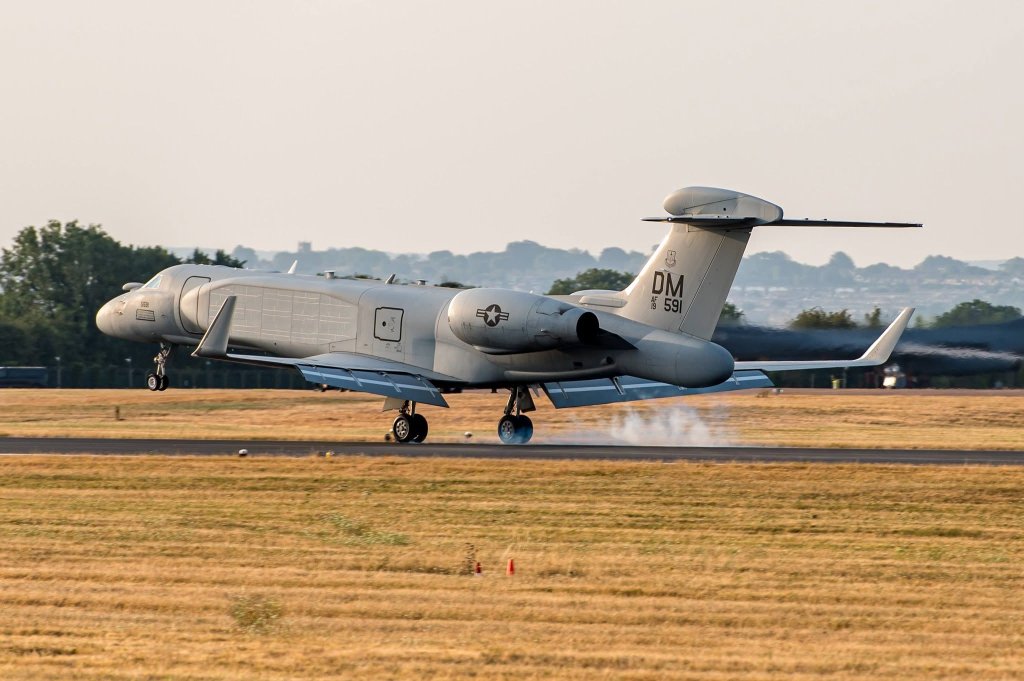 An EA-37B Compass Call electronic warfare jet landing at RAF Fairford in the U.K. after taking part in Operation Epic Fury. (Matt Belcher)
 As we noted earlier in this story, though NATO is downplaying the activity, it comes amid growing concerns about Russian actions in the region and against the backdrop of the still raging war in Ukraine.
Earlier this week, the Russian frigate Admiral Kasatonov escorted the Russian Floating Storage/Production ship Portovyy through the Baltics, according to The Telegraph. It was the second such transit of a Russian warship in the region in recent weeks and part of Moscow’s increasing efforts to protect its energy shipments in the wake of seizures of its shadow fleet vessels by European authorities, the independent Russian The Insider news outlet noted.
Last week, The Wall Street Journal reported that “Russian President Vladimir Putin could try to test NATO’s resolve with a limited assault on an allied country in the next few years, according to new U.S. intelligence reports that posit possible scenarios ranging from a cyberattack to a small-scale land incursion.”
“U.S. and European leaders increasingly see signs of Russia conducting probing attacks to test NATO’s resolve, including Russian cruise missiles that have landed in Poland and drones flown into Romania,” the publication added.
Last month, Lithuania’s president said intelligence assessments suggest that Russia is planning potential attacks on critical infrastructure in the Baltic states or Poland.
“President Gitanas Nausėda said that authorities were monitoring the risk of attacks that could disrupt the country’s energy and transport systems, including facilities supporting Lithuania’s connections with the European electricity grid,” The Hill reported.
🇱🇹🇷🇺Lithuania Warns of Possible Russian Infrastructure Attacks, Without Providing Evidence, Reuters
▪️ Lithuanian President Gitanas Nausėda stated that the country's intelligence services allegedly received information about Russia preparing possible strikes on critical… pic.twitter.com/dM9CvlruRq
Though NATO says there is no connection between the ongoing air activities and specific Russian threats or ship movements, the Polish military official suggested otherwise.
“Official NATO statements framed the maneuvers as routine defensive capability enhancements under U.S. supervision,” the official posited. “However, expert analysis suggests that this deployment is intended to deter potential Russian provocations in the Baltic region.”
It is unclear how much longer the current U.S./NATO aerial activities around Kaliningrad will take place. Regardless the use of a Compass Call along the highly strategic enclave’s borders is a clear message to Russia.
Contact the author: [email protected]